

Artificial intelligence has already changed software testing through automation, predictive analytics, and self-healing solutions. But a new generation of AI systems is taking things further.
Agentic AI systems can make decisions, take actions, adapt to changing conditions, and work toward defined goals with limited human intervention.
This changes how software needs to be tested.
Instead of validating only whether a system produces the expected output, QA teams now need to evaluate how an AI agent makes decisions, responds to changing conditions, follows constraints, and handles unexpected situations.
This article explores:
- What is Agentic AI?
- Why traditional testing methods are not enough
- The new challenges introduced by autonomous AI systems
- Key areas to focus on when testing AI agents
- How the role of QA engineers is evolving
- Skills QA professionals need for effective Agentic AI testing
ON THIS PAGE
Understanding Agentic AI
Traditional software systems generally respond to predefined inputs and instructions. Conventional AI applications can generate outputs based on the information and instructions they receive.
Agentic AI systems go a step further. They can:
- Set smaller goals to achieve a larger objective
- Plan and execute multi-step actions
- Interact with external systems
- Adapt their approach based on outcomes
- Use feedback and context to determine their next action
Instead of simply answering a question, an AI agent can:
- Browse the web
- Analyze information
- Make decisions
- Call APIs
- Retrieve data
- Complete transactions
In short, agentic systems act, not just respond.
This autonomy introduces a new layer of complexity for software testing.
Why Agentic AI Changes the Testing Landscape
Traditional test automation works well when application behavior is predictable. QA teams define test cases, expected results, and assertions, and automation executes those scenarios repeatedly.
The traditional model can be simplified as:
Input A → Expected Output B
Agentic AI introduces a different model.
An agent may make decisions based on context, memory, available tools, external data, and the outcome of previous actions.
An agentic system may therefore exhibit:
- Non-deterministic behavior
- Dynamic decision-making
- Environment-dependent outcomes
- Adaptive behavior
- Continuous changes in behavior
You are no longer testing only static functionality. You are testing how a system behaves over time and across different conditions.
This requires QA teams to move beyond simple validation and focus more on behavior, risk, safety, and reliability.
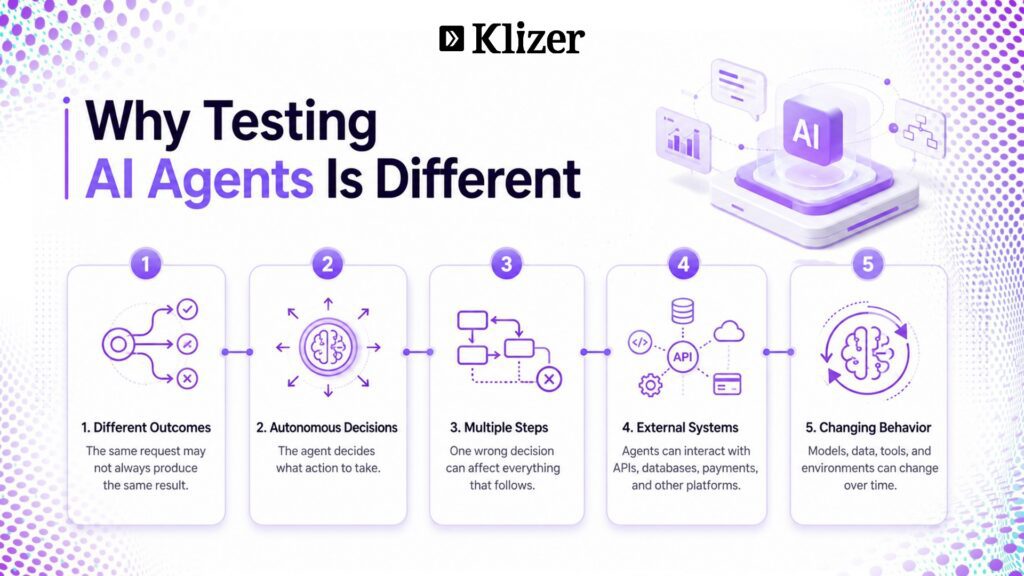
Key Challenges in Agentic AI Testing
1. Non-Deterministic Behavior
Agentic AI systems may produce different outputs or take different actions for the same initial input. The outcome can depend on factors such as:
- Context
- Memory
- Environment
- External API responses
- Available information
This challenges the traditional testing model, which often expects an exact output for a given input.
Instead of checking only for an exact result, testers should validate:
- Behavioral constraints
- Acceptable outcomes
- Goal achievement
- Consistency across scenarios
- Compliance with business rules
The question changes from “Did the system produce the expected answer?” to “Did the system behave within acceptable boundaries?”
2. Autonomous Decision-Making
Agentic AI systems can make decisions and determine their next actions without requiring a human to specify every step.
This introduces risks such as:
- Acting too quickly
- Selecting an incorrect option
- Misinterpreting ambiguous instructions
- Taking actions that technically satisfy a request but violate business rules
Testing should therefore ask:
- Does the agent make a reliable decision?
- Does the decision support the intended goal?
- Does the agent handle ambiguity appropriately?
- Is the action safe?
- Does it respect predefined constraints?
The quality of the decision becomes just as important as the successful completion of the task.
3. Multi-Step Execution Risks
Unlike a single API call or predefined automation script, an AI agent may perform a sequence of actions to complete a task.
For example:
- Understand the request
- Search for relevant information
- Retrieve data
- Evaluate available options
- Execute an action or transaction
- Verify the result
A small error at an early stage can create a significant failure later in the workflow.
For example, if an agent retrieves incorrect inventory data, it could make the wrong purchasing decision or trigger an unnecessary reorder.
QA teams therefore need to test:
- Individual steps
- Dependencies between steps
- Error handling
- Recovery mechanisms
- End-to-end outcomes
- Failures at different points in the workflow
Testing should not stop at individual actions. It must evaluate the complete chain of decisions and actions.
4. External System Interaction
Agentic AI systems often interact with external systems such as:
- APIs
- Databases
- Third-party platforms
- Payment systems
- ERP systems
- Financial systems
These interactions introduce additional risks.
Testing should consider:
- Rate limits
- Data integrity
- Authentication and authorization
- Security vulnerabilities
- API failures
- Duplicate transactions
- Transaction reversibility
- Incorrect or incomplete external data
You are no longer testing an isolated application. You are testing how the agent operates within a larger technology ecosystem.
5. Continuous Learning and Behavioral Drift
Agentic systems can operate in environments where models, prompts, data, tools, and external systems change over time.
As these components change:
- Today’s behavior may not match tomorrow’s behavior.
- Performance may become inconsistent.
- Previously safe behaviors may produce unexpected outcomes.
- New failure patterns may emerge.
This makes continuous evaluation important.
QA teams should consider:
- Continuous monitoring
- Drift detection
- Behavioral regression testing
- Performance monitoring
- Decision and action logging
Testing therefore becomes an ongoing activity rather than something performed only before a release.
How Is Agentic AI Testing Different from Traditional Testing?
Testing agentic AI is not simply about verifying buttons, links, APIs, or predefined workflows. It involves validating intent, behavior, security, alignment, and trustworthiness.
Agentic systems are often built using large language models (LLMs), tools, memory, and reasoning or orchestration components. These systems can determine what to do, which tool to use, and what action to take based on the scenario.
This creates an important difference between traditional software testing and Agentic AI testing.
| Traditional Software Testing | Agentic AI Testing |
| Defined behavior | Probabilistic and adaptive behavior |
| Fixed test cases | Scenario-based testing |
| Tool-driven execution | Goal-driven execution |
| Limited adaptability | Adaptive behavior |
| Predefined expected results | Acceptable behavioral ranges |
| UI/API validation | Behavioral and goal validation |
| Pass/Fail decisions | Risk and outcome evaluation |
| Script-based regression testing | Behavioral regression testing |
| Human-defined logic | AI-assisted decision-making |
| Functional correctness | Intent, safety, and impact |
The goal is no longer only to determine whether the software works.
It is to determine whether the agent behaves correctly, safely, and consistently within the conditions in which it operates.
Major Areas to Focus on in Agentic AI Testing
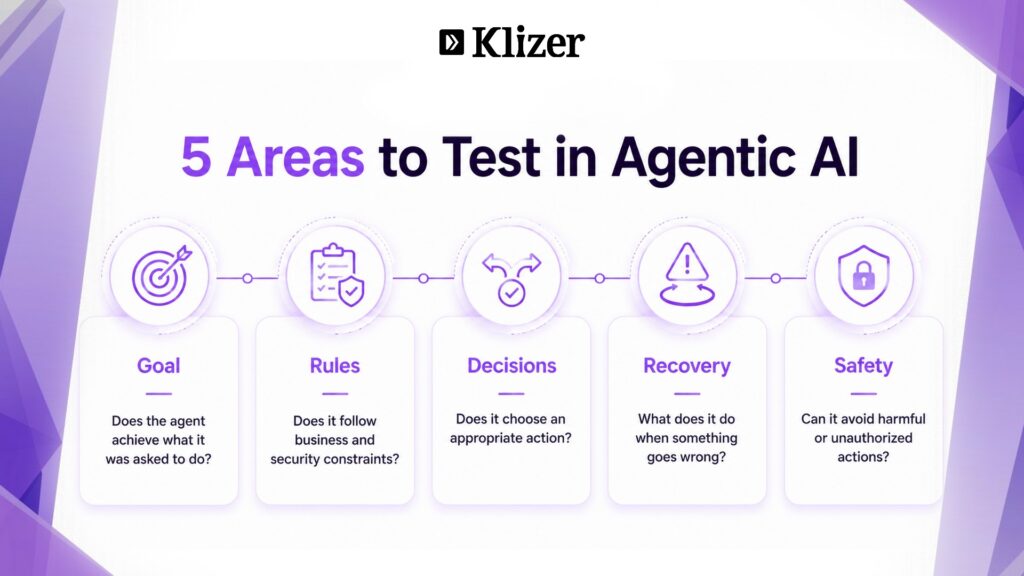
1. Goal Alignment Testing
Goal alignment testing evaluates whether an AI agent’s actions support its intended objective and follow the organization’s business rules and constraints.
For example:
Scenario: An AI agent is asked to book the cheapest available flight.
Does the agent:
- Prioritize price as instructed?
- Consider the user’s stated constraints?
- Avoid making assumptions?
- Follow applicable booking policies?
Similarly, if an agent is asked to optimize a development project, does it make decisions that support the defined project objectives without violating important constraints?
Testing should verify alignment with:
- Business objectives
- User intent
- Organizational policies
- Ethical requirements
- Compliance rules
2. Guardrail and Constraint Validation
Every agent needs clearly defined boundaries.
These boundaries may include:
- Spending limits
- Security permissions
- Data privacy restrictions
- Access controls
- Regulatory requirements
- Business rules
QA teams should intentionally test what happens when an agent encounters these boundaries.
For example:
- What happens when the spending limit is reached?
- Can the agent access restricted information?
- Can it execute an unauthorized transaction?
- How does it respond to a malicious or misleading prompt?
- Does it ask for human approval when required?
This is similar to adversarial testing for autonomous systems, where testers actively attempt to push the system outside its intended operating boundaries.
3. Scenario-Based and Simulation Testing
When deterministic testing is insufficient, realistic scenarios and simulations become increasingly important.
Testers can:
- Create realistic multi-step workflows
- Provide incomplete information
- Introduce ambiguous instructions
- Simulate API failures
- Inject errors during execution
- Change environmental conditions
- Test unexpected user behavior
The goal is to observe:
- Quality of decisions
- Efficiency of recovery
- Ability to handle failures
- Escalation mechanisms
- Compliance with constraints
- Final task outcomes
This allows QA teams to evaluate how the agent behaves when conditions are not perfect.
4. Explainability and Transparency Testing
Agentic systems need sufficient traceability to understand why actions were taken.
QA should verify:
- Are decisions and actions logged?
- Can testers determine which inputs and tools influenced an action?
- Are important actions auditable?
- Can failures be traced back to a specific step?
- Is the system able to provide an understandable rationale for its actions?
This does not necessarily mean exposing internal model reasoning. Instead, organizations should focus on observable decision factors, action logs, tool calls, and audit trails that make the system easier to evaluate and debug.
Without adequate traceability, identifying the cause of an unexpected autonomous action can become extremely difficult.
5. Safety and Ethical Risk Testing
Autonomous systems can introduce risks beyond traditional software defects.
These may include:
- Bias in decision-making
- Security risks
- Financial risks
- Privacy risks
- Operational risks
- Reputational risks
QA teams should incorporate:
- Bias and fairness testing
- Edge-case exploration
- Adversarial testing
- Ethical boundary testing
- Privacy and security testing
- Human-approval scenarios
This shifts quality assurance from simply detecting defects to actively managing risk.
A Practical Example of Agentic AI in eCommerce
Imagine an AI agent responsible for managing several ecommerce activities:
- Monitoring inventory
- Adjusting prices based on demand and seasonal conditions
- Launching promotions
- Reordering products when inventory falls below a threshold
This may improve operational efficiency, but it also introduces significant risks.
For example:
- An incorrect price reduction could reduce revenue.
- Misinterpreted demand could result in excessive inventory.
- A promotion could violate pricing or discount policies.
- An incorrect reorder could create unnecessary stock.
Testing such a system requires more than checking whether the agent completes each task.
QA teams should consider:
- Simulating demand spikes
- Testing seasonal changes
- Evaluating financial impact
- Testing business-rule restrictions
- Simulating inaccurate or incomplete inventory data
- Testing failure recovery
- Validating approval and escalation mechanisms
- Verifying fail-safe behavior
You are not just testing screens or workflows. You are testing business decisions.
The Evolving Role of QA in Agentic AI Systems
As organizations adopt AI-driven systems, the role of QA is evolving.
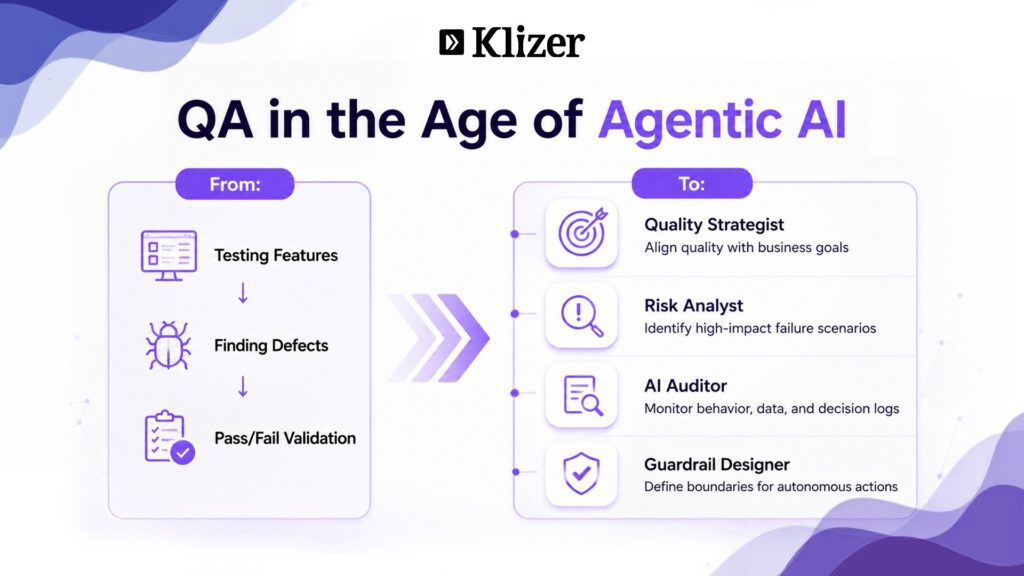
QA professionals are increasingly taking on responsibilities such as:
Quality Strategists
Quality strategists align testing objectives with business goals. They identify what matters most to customers and the business and establish quality standards for AI-driven systems.
Risk Analysts
Risk analysts evaluate the potential financial, operational, security, and strategic risks associated with autonomous systems.
They help organizations identify high-impact failure scenarios and determine how those risks should be mitigated.
AI Auditors
AI auditors review decision logs, system behavior, data quality, and model performance. They help identify issues such as behavioral drift, inconsistent decisions, and potential bias.
Guardrail Designers
Guardrail designers work with development and product teams to define the boundaries within which AI agents can operate.
This can include:
- Permission controls
- Spending limits
- Approval workflows
- Data access restrictions
- Escalation rules
The role of QA becomes more strategic as AI systems gain greater autonomy.
Skills QA Engineers Need for Agentic AI Testing
To remain effective in an AI-driven testing environment, QA professionals need to expand their skill sets.
AI/ML Basics
Understand how technologies such as LLMs work at a high level, how models use data, and why AI systems can produce different outputs.
Prompt Engineering Basics
Understand how prompts can define context, instructions, examples, constraints, and expected behavior.
Risk-Based Testing Strategies
Learn how to prioritize testing based on the potential impact and likelihood of failure.
Data Validation Techniques
Develop the ability to evaluate data quality and identify potential bias or inconsistencies that could influence agent decisions.
Monitoring and Observability
Understand how to use logs, metrics, traces, and behavioral signals to monitor AI agents over time.
Ethical AI
Understand principles related to fairness, transparency, privacy, accountability, and responsible AI development.
Automation skills remain important, but critical thinking becomes even more important.
Is Automation Enough for Agentic AI?
No. Automation remains an important part of the testing process, but it cannot be the only approach for agentic AI systems.
Conventional test automation works particularly well for deterministic systems, where the input, workflow, and expected output are clearly defined.
Agentic AI introduces a different paradigm.
These systems can make decisions based on context, available information, memory, tools, and changing conditions.
Therefore, testing cannot focus only on verifying outputs. It must also evaluate behavior, intent, safety, and impact.
Automation Can:
- Run simulations
- Execute large numbers of scenarios
- Monitor system behavior
- Detect anomalies
- Perform regression testing
- Collect and analyze test data
However, human judgment is still required to determine whether an autonomous decision is appropriate in a real-world context.
Define Safety Boundaries
Humans need to determine what the system is allowed to do and what it must never do.
These boundaries can include business rules, ethical considerations, security policies, and regulatory requirements.
Interpret Behavior
Automation can identify what an agent did. It may not be sufficient to determine whether the decision was appropriate for the business context.
QA professionals need to evaluate the quality and impact of those decisions.
Assess Real-World Risk
QA teams need to consider what could happen if an agent makes the wrong decision.
A technically successful workflow can still create a serious business problem.
Approve Releases
QA teams remain responsible for evaluating whether the system is ready for production based on defined quality, safety, security, and risk criteria.
Agentic AI does not reduce the need for QA. Agentic AI raises the QA bar.
The Future of Agentic AI Testing
As organizations adopt more autonomous AI systems, testing will need to keep pace with how these systems operate.
We can expect greater focus on:
- New frameworks for evaluating AI agents
- Continuous behavioral monitoring
- AI safety and validation standards
- Explainability and auditability requirements
- AI governance within CI/CD pipelines
- Automated simulation and adversarial testing
- Continuous evaluation of agent behavior
The focus of testing will gradually move from feature validation toward autonomy validation.
Final Thoughts
Agentic AI is changing what we expect from software, and QA needs to change with it.
Testing is no longer just about checking if something works. It is also about making sure AI agents make the right decisions, follow the rules, and act safely.
Agentic AI does not reduce the need for QA. It raises the QA bar.
Building an AI-powered ecommerce experience? Get in touch with Klizer to discuss your requirements and explore our Advanced AI for ecommerce and ecommerce QA Testing Services.