
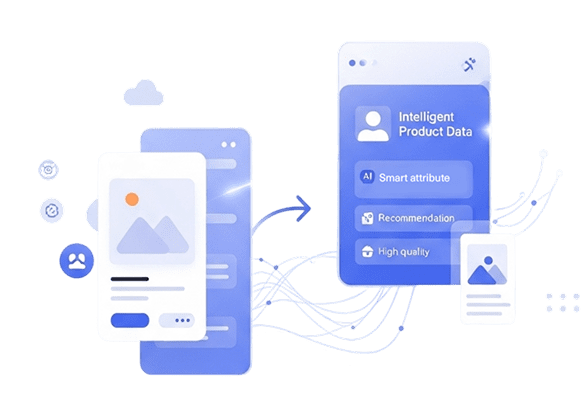
AI eCommerce Product Data Enrichment Services
Managing thousands of SKUs often involves incomplete supplier data, inconsistent attributes, and missing specifications.
Klizer’s AI automatically extracts product information from PDFs, supplier catalogs, and web sources, then enriches and structures it for PIM systems, marketplace listings, and product pages.
Our Expertise
What is AI Product Data Enhancement &
Enrichment?
Incomplete product information is one of the most common reasons ecommerce teams struggle with product onboarding. Supplier catalogs often arrive as PDFs, spreadsheets, or unstructured documents. Important details such as dimensions, materials, compatibility, or specifications may be buried inside those files.
AI ecommerce product data enrichment automates this process. Instead of manually copying data from documents, AI extracts product attributes, structures the information, and fills missing catalog fields so listings are complete, searchable, and consistent. This allows merchandising and catalog teams to focus on launching products faster instead of fixing product data.
60%
less manual data
entry
3x
faster product
onboarding
94%
average catalog accuracy
at go-live
25%
reduction in returns from
product mismatch
70%
drop in per-SKU
processing time
2x
more products live
per sprint
Why Your Business Needs AI-Driven Product Data Enrichment?
Higher Data Accuracy
Product specifications pulled from supplier documents are automatically validated and standardized, helping ensure fields like dimensions, materials, and compatibility remain consistent across the catalog.
Faster Product Onboarding
Data gaps are closed at the point of ingestion, so products move from supplier document to live listing without your team manually chasing missing fields.
Improved Merchandising Performance
Complete titles, accurate attributes, and structured specifications improve how products are indexed by search engines and ranked within marketplace and on-site search results.
Reduced Returns and Customer Complaints
When dimensions, compatibility, and descriptions accurately reflect the product, customers make better purchase decisions, and your return rate reflects that.
How We Work
Our Implementation Process
Discovery & Audit
We start by reviewing your current catalog, data sources, and existing PIM setup. This helps us understand where the gaps are and map the right enrichment approach for your specific product mix and workflows.
Data Source Integration
We connect to your supplier PDFs, product datasheets, web sources, and existing feeds. This is where raw product information gets pulled in automatically, without your team having to touch a file.
Enrichment & Standardization
Our AI processes the extracted data, enriching descriptions, filling missing specifications, standardizing attributes, and structuring everything for your backend and catalog schema.
PIM & Platform Sync
Enriched product data is pushed directly into your PIM and ecommerce platform. Listings stay accurate and up to date across every channel, without manual exports or re-uploads.
Monitoring & Ongoing Support
We don’t disappear after go-live. As your catalog grows and supplier data changes, we monitor enrichment quality and apply improvements to keep pace with your business.
Ready to Stop Fixing Product Data Manually?
See how Klizer helps ecommerce and catalog teams improve data accuracy, speed up product onboarding, and keep listings consistent across every channel, without the manual effort.
Why Choose Klizer?
20+ Years of eCommerce Experience
Klizer brings 20+ years of ecommerce experience, with deep expertise in catalog complexity, PIM challenges, and marketplace requirements.
Built for Complex Catalogs
Our team is experienced with high SKU counts, complex pricing structures, compliance-sensitive attribute requirements, and multi-channel formatting.
Fits Into Your Existing Stack
We extend existing ERP, PIM, CRM, and legacy systems. Enrichment is delivered in a format that works with what you already have without disrupting your current setup.
Built-in Enterprise Security
Every implementation follows industry-standard security practices: encrypted data handling, secure storage, and compliance with GDPR and applicable regulatory standards.
Long-term Post-launch Support
We stay on after launch, monitoring output quality, flagging issues before they accumulate, and adjusting as your catalog evolves.
Success Stories
Discover the Journeys We Have Impacted


Sokolin was founded in 1934 and has received one of New York's first liquor licenses after Prohibition. Now in its 92nd year, the business is run by David Sokolin's grandson...
Client Experiences, in Their Words

We have been a partner for Klizer for five years now, and the experience has been terrific. They have been an excellent partner to help us grow and sustain our business.
Ryan Van Hoozer
VP of Operations,
Marysville Marine Distributors
Klizer’s communication skills were above and beyond what I have
experienced with vendors. The relationship was such a great fit that we brought on Klizer employees in-house to work with us directly.
Dan Schuessler
Digital Project Manager,
Riddell
Klizer delivered a high-functioning website that perfectly coordinates with our company branding while enhancing our ecommerce capabilities for our customers
Jennifer Krach
Vice President Sales, Marketing, &
Customer Service, C-Line
Insights from Our Experts



FAQs About Product Data
Enhancement & Enrichment
Most attribute errors don’t get caught until a product goes live, such as a wrong dimension, a missing compatibility note, or a title that doesn’t match the spec sheet. By then, it’s already affecting search rankings, customer decisions, and potentially returns. Automated validation catches those inconsistencies at ingestion, before they reach your listings.
Most ecommerce teams deal with a version of the same problem: supplier data arrives in PDFs, spreadsheets, or scattered web pages, and not all of it makes it cleanly into your catalog. AI product data enrichment is the process of automating that translation. Instead of a team member manually copying specs from a datasheet into a PIM field, AI reads the source document, identifies the relevant attributes, and structures that data so it’s ready to use. The result is a catalog that’s more complete, more consistent, and far less dependent on human data entry to stay that way.
The short answer is: any field that’s missing, wrong, or inconsistent. In practice, that usually means titles that are too generic to rank, descriptions that don’t match what the product actually does, and attribute fields — dimensions, materials, compatibility notes, specifications — that were never filled in because no one had time to chase them down. We map the enrichment scope to your specific catalog during discovery, so we’re targeting the gaps that actually affect your business, not a generic checklist.
We work with supplier PDFs, product datasheets, manufacturer catalog documents, and web-based sources. If your supplier sends over a 200-page PDF with specs buried in footnotes, that’s exactly the kind of document this is built for. We review your specific sources during the discovery phase to confirm compatibility and build the right extraction logic for each one.
Returns often happen because customers buy something based on incomplete or misleading information, then receive a product that doesn’t match what they expected. When dimensions are right, compatibility is clearly stated, and the description actually reflects what’s in the box, customers can make a confident decision before purchasing. That confidence translates directly into fewer post-purchase surprises and, over time, a measurably lower return rate.
Our AI models are trained on product data patterns, but they don’t operate in isolation. Every enriched dataset goes through a structured review before it’s pushed to your PIM or platform. After go-live, we monitor output quality on an ongoing basis and flag issues before they accumulate. The goal is a process that improves over time, not one that delivers clean data once and then goes silent.
Yes, and in more than one way. Complete, well-structured listings give search engines more accurate signals to index. Attribute-rich titles and descriptions improve keyword relevance without keyword stuffing. On marketplace platforms, more complete data often improves your position in on-site search results. It’s not a magic fix, but a properly structured catalog from the ground up gives your SEO efforts a much stronger foundation to build on.
Yes. We deliver enriched data in a format that integrates directly with your PIM and ecommerce platform. During the discovery phase, we assess your integration requirements and configure the output accordingly — so the data lands where it needs to go without requiring manual exports or reformatting on your end.
It does. Different marketplaces have different attribute requirements, title character limits, and category structures. We factor those requirements into the enrichment process so your listings meet the spec for every channel you sell through, rather than forcing you to adapt data manually for each platform after the fact.
It depends on three things: how large your catalog is, how complex your source documents are, and what integrations are already in place. We don’t give a generic number because a 500-SKU catalog with clean supplier feeds looks very different from a 50,000-SKU catalog pulling data from 30 different manufacturers. After the initial discovery and audit, we’ll give you a realistic timeline based on what we’ve actually found — not an estimate padded to be safe.
No, and treating it as one is one of the more common mistakes we see. Catalogs grow. Suppliers update their specs. Attribute requirements change. If the process only runs once, the data quality degrades over time and you’re back where you started. We monitor quality after launch and continue applying improvements as your catalog evolves — so the baseline doesn’t quietly slip while your team is focused on something else.
Fix What’s Holding You Back
With 20+ years behind us, we build AI-powered ecommerce experiences that help businesses scale faster and stand out online.

Enterprise eCommerce solutions for B2B Industries
1005 West 41st Street
Suite 201, Austin, TX 78756
- info@klizer.com
-
1005 West 41st Street
Suite 201, Austin, TX 78756
Industries
Our Work
About Us
© Copyright 2026 Klizer. All Rights Reserved

Enterprise eCommerce Solutions for B2B Industries

© Copyright 2026 Klizer. All Rights Reserved