
eCommerce businesses struggle to keep product information accurate, consistent, and updated across multiple platforms. Integrating your ERP (Enterprise Resource Planning) system with Akeneo PIM (Product Information Management) solves this challenge by ensuring smooth data flow, improving efficiency, and creating one reliable source of product data for the entire organization.
In this blog, explore why Akeneo PIM – ERP integration is important for modern product-driven companies.
ON THIS PAGE
Why Do You Need ERP Integration with Akeneo?
ERP systems manage back-office tasks like inventory, pricing, and purchasing, while Akeneo focuses on product experience and enrichment. When these two systems are not connected, information becomes scattered and hard to keep accurate.
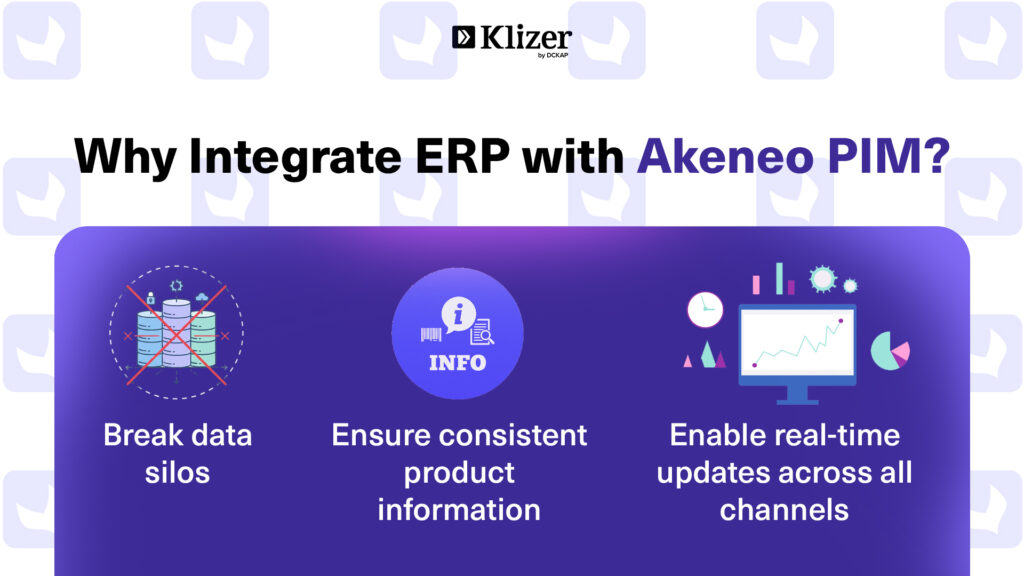
Integrating ERP with Akeneo helps you:
- Keep product and stock updates consistent across all channels
- Give marketing, sales, and operations teams real-time, reliable data
- Remove manual updates, speed up workflows, and keep your digital systems connected
Benefits of ERP Integration with Akeneo PIM

Avoid Data Redundancy
Disconnected systems often lead to repeated data entry, inconsistencies, and duplication. By integrating Akeneo PIM with your ERP, product data automatically flows between systems, eliminating redundant entries and manual errors. This ensures that teams work with clean, consistent data at all times.
Example : A flooring manufacturer updates the price of “Ceramic Tiles – White Gloss” in the ERP. Without integration, the eCommerce team manually updates the price in Akeneo, leading to mismatched prices across Amazon, Magento, and retailer portals.
With ERP → Akeneo integration, the price update automatically flows, ensuring all channels display the correct pricing instantly.
Centralized Product Information
An integrated ecosystem provides a single source of truth for all product-related data. Whether it’s SKU codes, attributes, specifications, or images — every update in ERP reflects automatically in Akeneo and vice versa. This boosts collaboration between teams and ensures everyone works with accurate, up-to-date information
Example:
A fashion retailer maintains product SKUs, cost, and supplier details in ERP, while marketing teams enrich descriptions, size guides, and lifestyle images in Akeneo.
With ERP → Akeneo Integration ensures both systems remain synchronized, preventing missing attributes during new collection launches.
Streamlined Data Flow from ERP
Core product data — such as SKU, product name, short and long descriptions, technical details, and pricing — is usually maintained in ERP. Integrating with Akeneo ensures this information is automatically transferred, enriched, and prepared for omnichannel distribution, saving valuable time and effort.
Example:
A consumer electronics brand launches 150 new SKUs (e.g., Bluetooth speakers) in its ERP.Instead of manually creating entries in Akeneo, the integration auto-creates product records in Akeneo with basic details.
The PIM team can start enrichment immediately, reducing launch time by days.
Enhanced Data Security via API Integration
Modern API-based integrations offer secure, scalable, and real-time data exchange between ERP and Akeneo PIM. This eliminates the need for risky file uploads or manual syncs, protecting sensitive business data and ensuring compliance with enterprise security standards.
Example : A global retailer previously used CSV imports to upload product data from ERP into Akeneo. Files often contained sensitive supplier or cost information, risking exposure.
With ERP → Akeneo API integration eliminates file uploads and ensures encrypted, secure syncing , meeting company cybersecurity standards.
Faster Time-to-Market
Automation between ERP and Akeneo PIM significantly reduces time spent on data synchronization. Teams can quickly push enriched product information to eCommerce platforms, marketplaces, and other digital channels — getting products online faster and ahead of competitors.
Example: A sports equipment company introduces a new cricket gear line.Earlier, manual data syncs took 2–3 weeks.With ERP–Akeneo integration, products appear in Akeneo immediately after ERP entry.
With ERP → Within hours, enriched content is pushed to Shopify, Amazon, and eCommerce stores — beating competitors to market.
Improved Data Quality and Enrichment
ERP systems store essential product data, but Akeneo PIM allows you to enrich that data with marketing details, SEO content, localized translations, and media assets. The integration bridges efficiency (ERP) and creativity (PIM), delivering a complete product story to customers.
Example : A home appliances brand stores core specs (power, capacity, dimensions) in ERP.
With ERP → Akeneo adds user manuals, videos, technical highlights, and translated descriptions.Integration ensures ERP data remains authoritative while Akeneo enhances it for digital channels.
Scalability and Flexibility
As businesses expand, managing thousands of SKUs manually becomes impossible. With a strong ERP–PIM integration, product updates, pricing changes, and inventory data scale automatically, adapting easily to business growth and market changes.
Example:
A multi-brand marketplace expands from 5,000 SKUs to 80,000 SKUs. Manual updates become impossible.
With ERP – Akeneo integration, product updates such as inventory changes and price adjustments scale automatically without hiring extra staff.
Reduced Manual Effort and Errors
Manual imports, spreadsheets, and data mapping often lead to inconsistencies and wasted time. Integration automates data exchange, reducing human intervention and the chances of mistakes — helping teams focus on strategy and growth instead of repetitive tasks.
Example : A furniture retailer frequently changes inventory levels in ERP.Previously, the team exported inventory sheets daily for Akeneo import — often uploading outdated values.
With ERP → Real-time integration, Akeneo always reflects the latest stock, preventing overselling on the website.
Better Customer Experience
Accurate, rich, and consistent product data across channels leads to better customer trust and engagement. Shoppers find correct product details, reducing returns and boosting overall satisfaction.
Example : A beauty brand had product pages missing ingredient lists or showing old images — leading to customer confusion and returns.
With ERP → After integration, every ERP update triggers a refresh in Akeneo, ensuring eCommerce pages always show correct details — resulting in fewer complaints and higher sales.
Improved Decision-Making
With unified and clean data flowing between ERP and Akeneo PIM, leadership gains clear visibility into product performance, stock levels, and channel efficiency — enabling smarter business decisions and proactive planning.
Example : A home decor brand sees frequent stockouts on best-selling rugs but wasn’t aware because data across ERP and eCommerce was inconsistent.Once integrated, accurate inventory + performance data becomes visible, allowing managers to adjust procurement, avoid out-of-stock situations, and increase revenue
Read Next- Why Is ADA Compliance Testing Important For Ecommerce Websites?
Akeneo PIM–ERP Integration Services by Klizer
Klizer specializes in delivering end-to-end Akeneo PIM–ERP integration services tailored to your business needs. With deep expertise in both Akeneo and major ERP systems, Klizer ensures seamless data synchronization, automation, and customization to fit your organization’s unique workflow.
Key highlights of Klizer’s service include:
- Expert consultation and architecture design for PIM–ERP integration.
- Custom connector development for real-time data flow.
- Secure API-based integration setup with monitoring and support.
- Ongoing maintenance, performance optimization, and scalability planning.
- Automated ERP data synchronization — daily or scheduled syncs to keep data fresh and consistent.
- Comprehensive success and error logging, ensuring transparency in every sync cycle.
- Automated email notifications for both success and failure logs, keeping teams instantly informed.
With Klizer, businesses achieve complete automation, minimal manual intervention, and maximum reliability — empowering teams to focus on growth instead of data maintenance.
Conclusion
Integrating Akeneo PIM with your ERP system is more than a technical upgrade. It is a practical business decision that helps every team, from procurement to marketing, work with the same accurate product data. This leads to faster product launches, fewer mistakes, and better experiences for your customers.
If you want to simplify your data flow and support steady growth, Akeneo PIM–ERP integration powered by Klizer is the right choice. As an enterprise ecommerce solution partner, Klizer helps businesses manage product data more efficiently and improve overall operations.