Our Expertise
What You’ll Understand After the Assessment
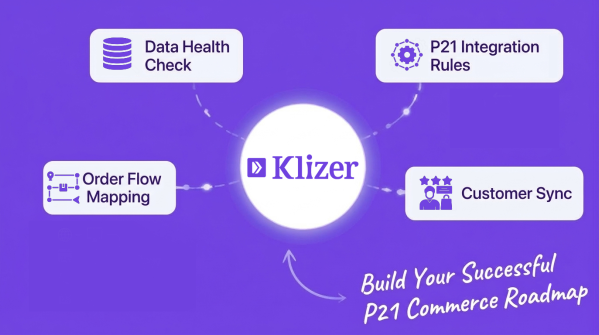
How Ready Your P21 Environment Is for Migration
Understand what your current environment contains and which areas may need attention before migration can begin.
What Needs to Move
Review the data, customizations, integrations, workflows, reports, and ecommerce dependencies that may need to be addressed as part of the migration.
Where Migration Risks May Exist
Identify areas that could create delays, unexpected rework, or disruption if they aren't addressed during planning.
What You Should Address First
Prioritize the work that needs to happen before migration based on your business requirements and system dependencies.
What Your Migration Could Look Like
Get practical next steps and an initial view of scope, timing, and investment where enough information is available.
Who Is This P21 Commerce Assessment For?
Running an older or heavily customized Epicor P21 environment
Evaluating a move to P21 Cloud
Planning a P21 upgrade or migration
Unsure whether your current customizations will work in the target environment
Managing integrations between P21, ecommerce, PIM, CRM, EDI, WMS, or other systems
Concerned about moving complex product, customer, pricing, inventory, or order data
Running ecommerce alongside P21 and need to understand migration dependencies
Trying to identify migration risks before committing to a project
Building a migration roadmap and need help understanding scope
Looking only for routine P21 support
Looking for a small one-off customization
Not considering a P21 migration, upgrade, or cloud move
Looking for a generic ERP selection exercise
Not ready to share information about your current P21 environment
What Happens After You Book the Call
We Review
Complete a short questionnaire about your P21 version, environment, customizations, integrations, ecommerce platform, and migration goals. We review the information before the call.
We Assess
Spend 30 minutes with a Klizer specialist discussing your current P21 environment, what you're planning to change, and the dependencies that could affect the migration.
You Get a Plan
Within 48 hours, receive a written summary of key considerations, potential risks, recommended next steps, and an initial scope or investment range where possible.
Why B2B Teams Trust Klizer With P21 Migration
A P21 migration affects more than the ERP. It can change how ecommerce, product data, pricing, inventory, orders, customer accounts, and other business systems work together.
Klizer brings experience across B2B commerce environments where P21 is part of a larger operational ecosystem. That means migration planning can account for the systems and workflows around P21, not just the ERP itself.
20+
Years in B2B eCommerce
300+
Stores launched and scaled
25%
Average conversion lift

Trusted Experienced Epicor Partner
P21 Migration Requirements Vary by Industry
Migration planning needs to account for the way each business actually sells, prices, manages products, and fulfills orders.
Large catalogs, account-specific pricing, and high-volume ordering can create significant data and integration dependencies.
High SKU counts
Compliance data
Bulk ordering
Fitment, multi-brand catalogs, and seasonal products can add complexity to data and ecommerce dependencies.
Fitment data
Multi-brand catalogs
Seasonal demand
Branch inventory, contractor pricing, and warehouse availability need to remain accurate throughout the transition.
Multi-warehouse
Contractor tiers
Quick reorder
Variable products and contractor accounts may require careful handling during data and workflow migration.
Variable products
Seasonal catalogs
Contractor accounts
Dealer pricing, seasonal products, and availability need to be considered when mapping the existing environment to the target setup.
Chemical compliance
Dealer pricing
Seasonal stock
Project quantities, freight requirements, and large-format products can affect ordering and integration workflows.
Project ordering
Freight pricing
Large-format products
Product and fitment data may require detailed mapping to preserve how customers find and order parts.
VIN compatibility
Fitment data
Multi-brand catalogs
Customer access, regulatory attributes, and product restrictions need to be considered alongside the core ERP migration.
Restricted access
Regulatory attributes
Account controls
Client Experiences, in Their Words

We have been a partner for Klizer for five years now, and the experience has been terrific. They have been an excellent partner to help us grow and sustain our business.
Ryan Van Hoozer
VP of Operations,
Marysville Marine Distributors
Klizer’s communication skills were above and beyond what I have
experienced with vendors. The relationship was such a great fit that we brought on Klizer employees in-house to work with us directly.
Dan Schuessler
Digital Project Manager,
Riddell
Klizer delivered a high-functioning website that perfectly coordinates with our company branding while enhancing our ecommerce capabilities for our customers
Jennifer Krach
Vice President Sales, Marketing, &
Customer Service, C-Line
Insights from Our Experts
Frequently Asked Questions
What is a P21 Migration Assessment?
A P21 Migration Assessment is a focused review of your current Epicor P21 environment and the factors that could affect a migration or move to a new P21 environment. It considers areas such as data, customizations, integrations, ecommerce dependencies, workflows, and reporting.
What does the Epicor P21 migration assessment include?
We review the information you provide about your current P21 environment, discuss your migration goals, and identify the areas that may require planning or further investigation. You receive a written summary with recommended next steps.
Can you assess our readiness for P21 Cloud?
Yes. A P21 migration readiness assessment can help identify the customizations, integrations, data, workflows, and other dependencies that should be reviewed before moving to P21 Cloud.
Do we need to replace P21?
Not necessarily. The assessment is intended to help you understand your current environment and migration options. Depending on your requirements, the appropriate path may involve upgrading, moving to P21 Cloud, modernizing integrations, or making changes around the existing ERP.
What happens to our ecommerce platform during a P21 migration?
Your ecommerce platform does not necessarily need to change. The assessment can identify how your existing ecommerce platform depends on P21 for products, pricing, inventory, customers, and orders, and what needs to be considered when those connections change.
What systems should be included in a P21 migration assessment?
Depending on your environment, this may include eCommerce, PIM, CRM, EDI, WMS, payment systems, reporting tools, custom applications, and other integrations connected to P21.
How long does a P21 migration take?
The timeline depends on your P21 version, customizations, data, integrations, business processes, and target environment. A focused migration may take weeks, while a complex environment can require several months of planning and implementation. The assessment helps establish a more relevant timeline.
What is the typical investment for a P21 migration?
There is no standard migration cost. Scope depends on the environment, data, integrations, customizations, testing, and target architecture. Where enough information is available, the written follow-up will include an initial investment range.
Who should join the assessment?
Include the people who understand your P21 environment and the business processes affected by the migration. This may include ERP, IT, ecommerce, operations, sales, or executive stakeholders.
What if we are still evaluating P21 Cloud?
That’s fine. The assessment can help you understand what your current environment contains, what needs to be addressed, and what questions should be answered before committing to a migration path.
Know What Your P21 Migration Requires Before You Move
A P21 migration affects more than the ERP. Data, customizations, integrations, ecommerce, and business workflows all need to work together after the move.
Start with a focused assessment to understand your migration dependencies, identify what needs attention, and build a practical path forward.
30 minutes. Practical recommendations. No obligation.