
Our Expertise
Why Businesses Are Moving Away from ECC
Limited customization on a Magento backbone
ECC restricts access to the Magento functionality it's built on, so teams end up paying full licensing costs for a platform they can only partially use.
A ceiling on advanced B2B
workflows
Tiered pricing, contract rates, and configured products often exceed what ECC supports natively, forcing teams to fund custom development on top of an already restrictive platform.
No path to headless or AI-driven commerce
ECC ties the front end to Magento's monolithic structure, keeping AI-personalized storefronts and headless front ends out of reach without a separate rebuild.
High cost for minor customizations
Changes that take a developer a day on open Magento require Epicor's involvement under ECC, turning small requests into disproportionately large invoices.
Long implementation timelines
Non-standard pricing rules, product configurations, or inventory setups don't fit ECC's data model cleanly, pushing go-live back by weeks or months.
What Decoupled Commerce Means for ECC Replacement
Data, rather than one platform trying to do both. Your storefront handles merchandising and checkout. Your ERP handles inventory, pricing, and fulfillment. Each stays focused on what it does best.
This works through API-first integration. Data moves between systems through APIs built around your business rules, not a fixed connector with a vendor's default mapping, so new data flows or changes to pricing and inventory don't wait on a vendor's release cycle.
Magento Open Source is the natural replacement for ECC because it's the same commerce engine, without the licensing layer limiting what you can do with it. You get the full extension ecosystem, and customization decisions stay with your team.
None of this means giving up the ERP sync you already depend on. A custom integration layer, built as a proper Epicor Magento integration, keeps product data, inventory, pricing, and orders flowing between your storefront and your ERP, whether that's P21, Eclipse, Kinetic, SAP, or NetSuite, without tying your roadmap to Epicor's release schedule.
How Klizer Replaces ECC with a Flexible Commerce Stack
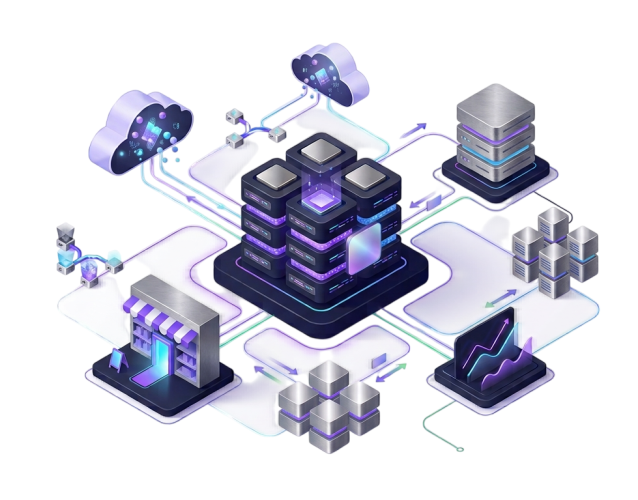
Full Magento Open Source Platform
- Complete frontend and backend control
- Access to thousands of extensions
- No vendor restrictions on customization
Custom ERP Integration (P21, Eclipse, Dynamics 365, NetSuite)
- Real-time product and inventory sync
- Customer-specific pricing
- Order flow: web to ERP to fulfillment
- Account and credit management
API-First Middleware Architecture
- REST / GraphQL APIs
- Event-driven architecture
- Middleware orchestration layer
- Future-proof and platform-agnostic
Advanced B2B UX and AI-Powered Features
- Headless commerce (React, Vue)
- AI-driven personalization and search
- Custom workflows: quotes, approvals, RFQs
- Modern B2B/B2C digital experience
Platform Fit
What Changes When You Move from ECC to Klizer
Capability
ECC
Klizer (Magento + Custom Integration)
Customization
Limited
Fully flexible
Platform Control
Restricted
Full ownership
ERP Integration
Native but rigid
Custom, scalable
Cost Flexibility
High / unpredictable
Controlled and optimized
AI / Headless Ready
Limited
Fully supported
How the Epicor Ecommerce Migration to Magento Open Source Works
Connected Commerce requirements change by industry. Each industry has different buying rules, product data, and fulfillment requirements. Your commerce systems need to reflect them.
Discovery and Architecture
We audit your current ECC setup, map existing integrations, and identify gaps between what you have and what you need.
Deliverable:
ECC audit and migration scope
Magento Implementation
We set up Magento Open Source, build the UI/UX, and configure the extensions your business requires.
Deliverable:
Configured Magento environment
ERP Integration
We develop the custom API and middleware layer, configure data sync, and test integration across product, pricing, and order flows.
Deliverable:
Tested ERP integration
Migration and Go-Live
We migrate your data, run the new setup alongside ECC in parallel, and manage the cutover once everything checks out.
Deliverable:
Live Magento environment with ERP sync intact
Optimization
We tune performance, roll out AI and headless features where relevant, and keep improving based on real usage.
Deliverable:
Ongoing optimization and support
Discover the journeys we have impacted
We've worked with manufacturing and distribution businesses across the globe, helping them solve real challenges and grow with confidence. Browse through our client success stories to see the difference we've made.
Client Experiences, in Their Words

We have been a partner for Klizer for five years now, and the experience has been terrific. They have been an excellent partner to help us grow and sustain our business.
Ryan Van Hoozer
VP of Operations,
Marysville Marine Distributors
Klizer’s communication skills were above and beyond what I have
experienced with vendors. The relationship was such a great fit that we brought on Klizer employees in-house to work with us directly.
Dan Schuessler
Digital Project Manager,
Riddell
Klizer delivered a high-functioning website that perfectly coordinates with our company branding while enhancing our ecommerce capabilities for our customers
Jennifer Krach
Vice President Sales, Marketing, &
Customer Service, C-Line
Insights from Our Experts


Frequently Asked Questions
Will I lose my ERP integration if I leave ECC?
No, but it does get rebuilt. Moving off ECC means replacing its native connector with a custom, API-based integration rather than carrying the old one over. In practice, this usually ends up supporting more than ECC did, because you’re no longer limited to what Epicor’s default mapping allows. The sync itself — product data, inventory, pricing, orders — stays intact throughout.
How long does an ECC to Magento migration take?
It depends on how complex your pricing logic is, how many inventory locations you run, and how many systems need to connect. A straightforward catalog with list pricing and one ERP instance moves faster than one with contract pricing, multi-branch inventory, or several connected systems. We don’t give a timeline upfront because it isn’t knowable yet. Discovery gives you a real number based on your actual setup, not a generic estimate.
Can Klizer integrate with Prophet 21 (P21)?
Yes. For Epicor p21 ecommerce setups specifically, P21’s pricing engine and order structure are areas we’ve built custom integrations for directly, including contract pricing, tiered breaks, and multi-branch inventory — the same requirements that usually push P21 users past what ECC’s native connector can handle.
What's the cost difference between ECC and Magento Open Source?
Is headless commerce possible after migration?
Do I need to re-enter all my product data?
Ready to Move Off ECC?
A migration assessment shows you exactly what moves, what needs custom work, and what a realistic timeline looks like for your setup.