Manufacturers and distributors manage B2B operations that standard ecommerce setups may not handle well. Customer-specific pricing, account-based catalogs, bulk ordering, payment terms, complex product data, and ERP-driven inventory must work within established workflows.
Shopify Plus for manufacturers can support these requirements, but implementation involves more than setting up a storefront. Businesses must configure the commerce experience around their specific B2B processes and backend systems.
For manufacturers and distributors, the key is connecting the Shopify Plus storefront with the systems that manage products, customers, orders, inventory, and other core processes.
ON THIS PAGE
Why Do Manufacturers and Distributors Need Complex B2B Commerce?
Manufacturers and distributors often need commerce workflows that reflect negotiated commercial terms, multiple buyer roles, technical product requirements, and connected backend systems.
Customer-Specific Pricing and Contracts
B2B buyers may receive negotiated price lists, volume discounts, contract rates, or region-specific pricing. The commerce platform must apply the correct pricing rules to each customer account.
Multiple Buyers and Approval Workflows
A business account may include procurement teams, technical users, purchasing managers, and finance teams. Each user may need different permissions, while some orders may require internal approval before submission.
Complex Product Information
Manufacturers often sell products with technical specifications, configurations, certifications, compliance documents, and other product data. Buyers may need this information to evaluate products before placing an order.
Bulk and Repeat Purchasing
Manufacturers and distributors frequently process large or recurring orders. Buyers may need quantity-based ordering, minimum order rules, quick reordering, or account-specific purchasing workflows, particularly given that 62% of B2B customers surveyed preferred to reorder online in McKinsey’s 2021 research.
How Does Shopify Plus for Manufacturers Support B2B Commerce?
Shopify Plus gives manufacturers and distributors tools to structure B2B buying around companies, customer-specific catalogs, negotiated pricing, payment terms, and buyer permissions. For manufacturers, these capabilities support account-based purchasing and self-service buying, which is increasingly relevant as 67% of B2B buyers prefer a rep-free experience, according to Gartner.
1. Manage Companies and Buyer Access
Shopify B2B lets businesses organize customers into companies and company locations. Each location can have its own contacts, catalogs, pricing, payment terms, and checkout settings. Businesses can also assign different permissions to buyers based on their roles.
2. Apply Customer-specific Catalogs and Pricing
Manufacturers and distributors can create catalogs for specific B2B customers and locations. Shopify supports quantity rules and volume pricing, while Shopify Plus adds unlimited catalogs and direct catalog assignment to companies and company locations. These capabilities help distributors manage different product assortments and negotiated prices across customer accounts.
3. Handle B2B Payment Terms
Businesses can configure payment terms for company locations, including Net 7, Net 30, Net 60, or payment due on fulfillment. Shopify Plus also supports B2B deposits and partial payments.
4. Support Complex Ordering Workflows
B2B customers can place orders through company accounts, while merchants can require orders to be submitted as drafts for review. Confirm separately how buyer-side approval chains will work.
How Can Shopify Plus Integrate with ERP and Other Business Systems?
Shopify Plus can connect with business systems through APIs, apps, middleware, and custom integrations.
1. Connect with ERP Systems
An ERP such as Epicor Prophet 21, SAP, NetSuite, or Microsoft Dynamics can manage core operational data while Shopify Plus handles the digital buying experience. Depending on the architecture, the integration can transfer product, customer, inventory, pricing, order, and fulfillment data between the systems.
2. Synchronize Product Information
Manufacturers may manage product records in an ERP or PIM, including specifications, attributes, descriptions, images, and technical documents. An integration can transfer required product data to Shopify Plus, reducing duplicate entry and keeping the storefront aligned with the designated source system.
3. Connect Customer and Account Data
Shopify Plus can integrate customer and company information with ERP and CRM systems. This can support customer record updates, account management, and the transfer of relevant B2B transactions to backend systems.
4. Connect Orders and Fulfillment
Orders placed through Shopify Plus can be sent to an ERP, OMS, or fulfillment system for processing. These systems can return relevant order status, fulfillment, shipment, and inventory updates to the storefront.
5. Use Middleware or Custom Integrations
Businesses with multiple backend systems may use middleware to transform and route data between platforms. Shopify APIs and webhooks can support custom workflows when standard apps or connectors do not meet a specific integration requirement.
6. Define System Ownership
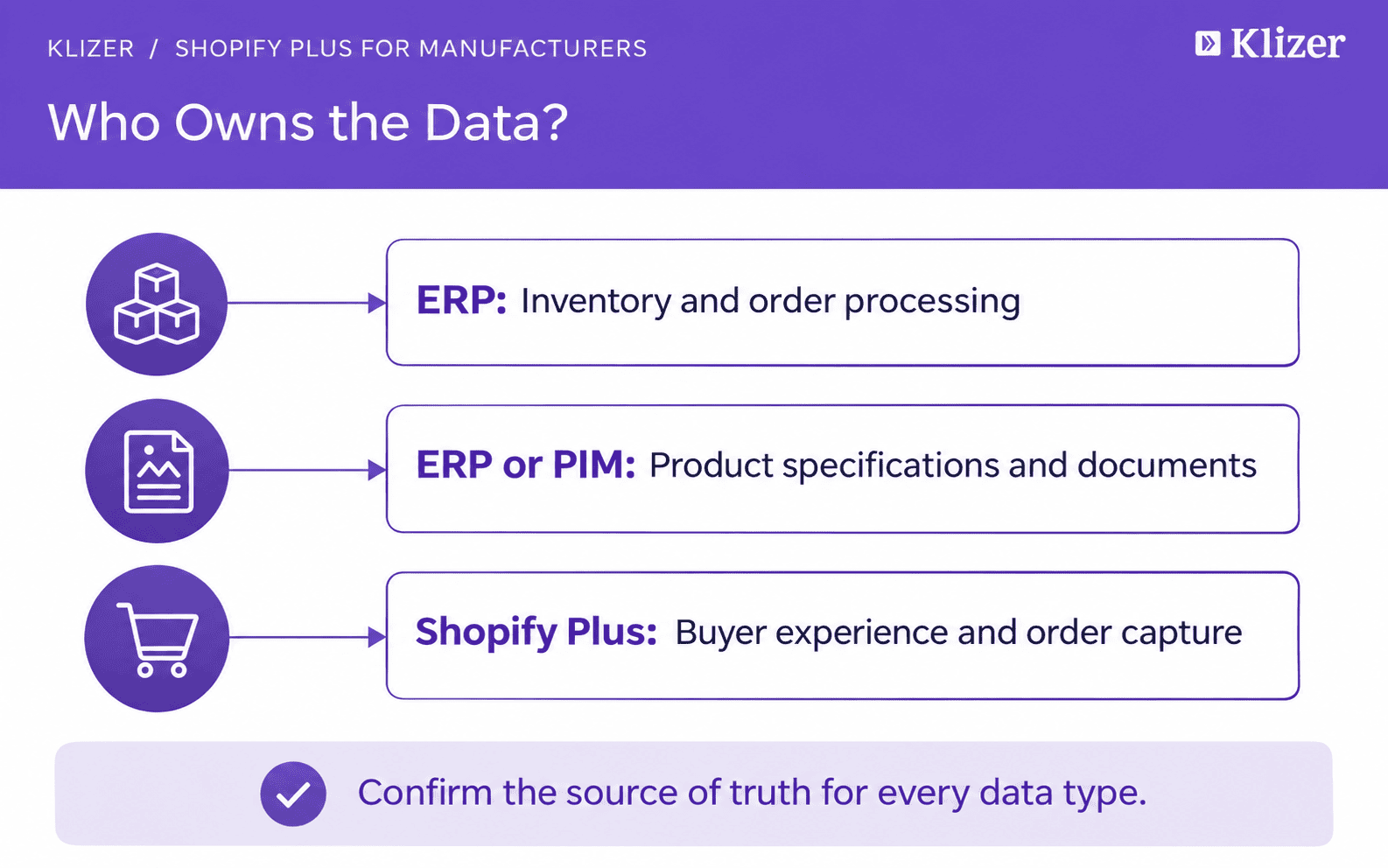
The integration should establish which system is authoritative for each data type. For example, an ERP may remain the source for inventory and order processing, while Shopify Plus manages the storefront and B2B buying experience. Clear ownership helps prevent conflicting records across connected systems.
What B2B Requirements May Need Custom Shopify Plus Development?
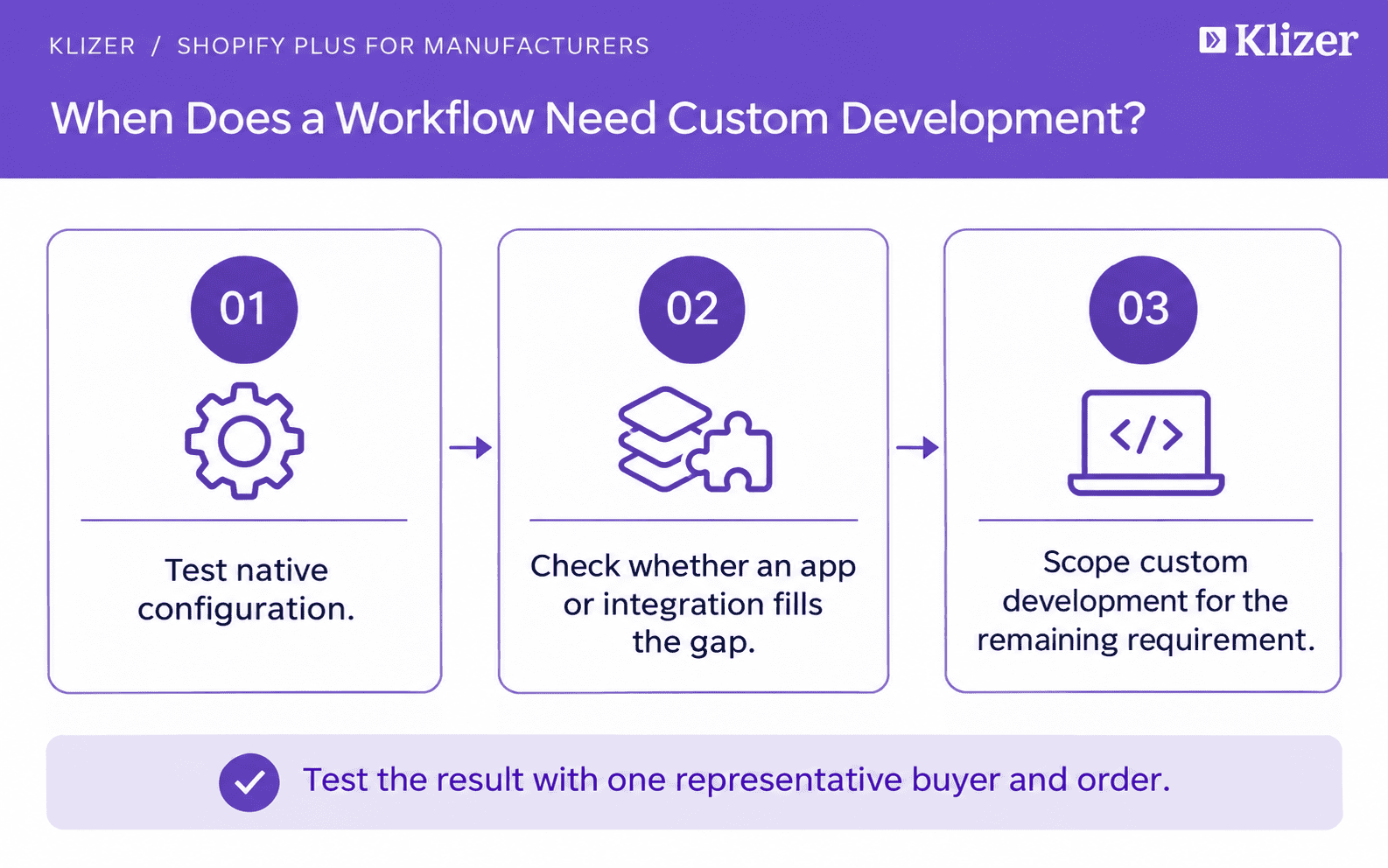
Custom Shopify Plus development may be needed when a manufacturer or distributor has B2B workflows that standard Shopify configuration cannot fully support. First check native configuration and existing apps:
| B2B Need | When to Evaluate Custom Development |
| Complex pricing | Pricing depends on contracts, products, territories, channels, or multiple business rules. |
| Product configuration | Buyers need to select specifications, components, dimensions, or other product attributes. |
| Quotes and approvals | Orders require sales review, quote revisions, negotiated pricing, or multiple approval stages. |
| Buyer workflows | Businesses need project-based orders, saved templates, custom forms, or account-specific processes. |
| Custom checkout | Checkout requires specific delivery rules, purchase-order validation, shipping logic, or transaction rules. |
| Custom apps and APIs | Native Shopify features or existing apps cannot support the required workflow, requiring custom apps, APIs, or webhooks. |
How Does Shopify Plus Fit into a Connected Commerce Strategy?
Shopify Plus fits into a Connected Commerce strategy as the digital commerce layer within a connected business architecture. For manufacturers and distributors, the approach aligns the customer experience with the data, systems, and insights that support B2B operations, an important consideration as 57% of surveyed distribution buyers ranked digital as their primary purchasing channel, compared with 33% in 2022, according to McKinsey.
Foundation
Establish the architecture, data ownership, governance, and processes that keep the commerce environment aligned.
Storefront
Use Shopify Plus as the B2B commerce channel where customers interact with the brand and place orders.
Integration
Connect the commerce layer with the systems that support the business, so commerce workflows remain aligned with operational processes.
Intelligence
Use connected commerce data for analytics, reporting, customer insights, demand analysis, and operational decision-making.
Frequently Asked Questions
Can Shopify Plus Support a Dedicated Wholesale Storefront?
Yes. Eligible businesses can use dedicated B2B expansion stores. Users and billing can be managed centrally, but each store has separate data and settings.
Can Shopify Plus Support International B2B ecommerce?
Yes, Shopify Plus can support international B2B selling with market-specific currencies, languages, domains, pricing, and product availability, depending on the configured Shopify Markets setup.
Can a Manufacturer Run B2B and DTC Commerce On Shopify Plus?
Yes, Shopify supports B2B and DTC commerce within the same platform, allowing businesses to serve business buyers and consumers through connected commerce operations.
Can Shopify Plus Support Separate B2B and DTC Business Entities?
Eligible merchants can assign Shopify Payments business entities to markets. Confirm that your legal entities, locations, and B2B and DTC market setup meet Shopify’s requirements.
Conclusion
Shopify Plus becomes more valuable when manufacturers and distributors treat B2B ecommerce as part of their broader business architecture rather than as a standalone storefront. The strategic priority is to build a commerce foundation that can adapt to complex customer requirements, operational processes, and future digital initiatives.
For industrial manufacturers and distributors, the Connected Commerce decision starts with ownership: decide where pricing, product data, and orders are managed before configuring the Shopify Plus storefront. That gives integration and reporting a reliable foundation.
Planning a Shopify Plus B2B implementation? Book a consultation with Klizer to review your pricing, ordering, and ERP requirements.