

The future of B2B ecommerce is already taking shape as distributors move toward self-service buying, AI-powered experiences, connected systems, and more flexible commerce platforms. Today, a customer may expect to find a product, check account-specific pricing, place a bulk order, and reorder it online without waiting for a sales representative.
This shift is accelerating digital transformation in distribution and increasing the need for flexible, scalable ecommerce. For example, a distributor managing thousands of SKUs can use Shopware B2B eCommerce to create personalized buying experiences while connecting its storefront with ERP, PIM, CRM, and other business systems.
Meanwhile, B2B eCommerce trends such as AI, personalization, API-driven integrations, and composable commerce are helping distributors build more intelligent and adaptable digital ecosystems.
ON THIS PAGE
Why Does the Distribution Industry Need Future-Ready B2B eCommerce?
A future-ready B2B ecommerce strategy helps distributors meet changing buyer expectations, manage complex operations, and scale digital sales. Digital has become the primary purchasing channel for 57% of B2B distribution buyers, up from 33% in 2022.
Changing Buyer Expectations
Customers want 24/7 self-service, fast product searches, real-time inventory visibility, quick ordering, and easy reordering without relying on sales representatives.
Omnichannel Buying
Buyers expect consistent experiences across ecommerce portals, mobile devices, and sales teams, with access to accurate account and order information.
Complex Pricing and Catalogs
Distributors must manage customer-specific pricing, negotiated contracts, volume discounts, and thousands of SKUs while maintaining accurate product data.
Connected Operations
Integrating B2B ecommerce with ERP, CRM, PIM, and warehouse systems keeps product, customer, order, and inventory data synchronized.
Protection from Disintermediation
As manufacturers expand direct digital sales, distributors need stronger online experiences to retain customers and differentiate beyond product availability.
What Are the B2B eCommerce Trends Shaping the Future of Distribution?
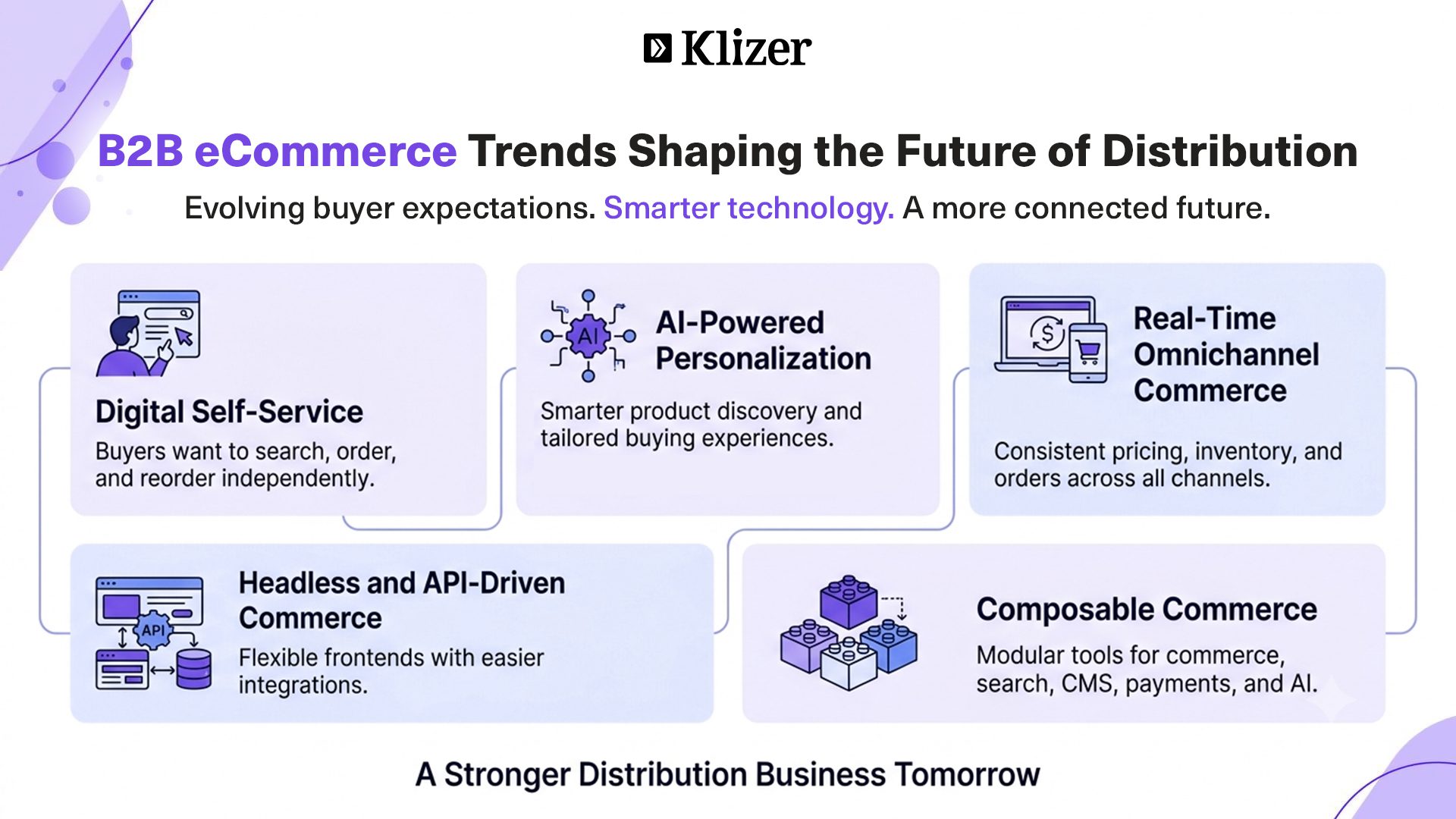
The key B2B ecommerce trends shaping the future of distribution include digital self-service, AI-powered personalization, omnichannel commerce, headless architecture, and composable commerce.
Digital Self-Service
Buyers increasingly want to search, check availability, view pricing, order, and reorder independently. Gartner found that 67% of B2B buyers prefer a rep-free experience, while 45% used AI during a recent purchase.
AI-Powered Personalization
AI in B2B commerce can analyze buying behavior to improve product discovery, recommendations, and personalized experiences.
Real-Time Omnichannel Commerce
Synchronizing inventory, pricing, customer, and order data across ecommerce, mobile, marketplaces, and sales channels creates a consistent buying journey.
Headless and API-Driven Commerce
Headless commerce separates the frontend from backend systems, enabling faster experience updates and easier integration with ERP, PIM, CRM, and other platforms.
Composable Commerce
Composable commerce allows distributors to combine modular technologies for commerce, search, PIM, CMS, payments, and AI when their business requirements justify a more flexible architecture.
Why Is Shopware a Strong Foundation for the Future of B2B eCommerce?
Shopware provides a flexible, API-first foundation for B2B ecommerce, helping distributors manage complex buying requirements, integrate enterprise systems, and scale digital experiences as customer expectations and technology evolve.
API-First Architecture
Shopware connects with ERP, CRM, PIM, WMS, and other systems, helping distributors create a connected B2B ecommerce ecosystem and support headless experiences.
B2B Components
Shopware’s B2B Components support company structures, employee roles, permissions, approvals, customer-specific pricing, quotes, and quick ordering for complex purchasing relationships.
Flexible Business Rules
Shopware’s Rule Builder lets businesses apply conditions to pricing, shipping, promotions, and other processes based on customer groups or order values.
Modular Scalability
Distributors can add capabilities as they expand into new markets, introduce products, or adopt new sales channels.
AI-Enabled Commerce
AI in B2B commerce can support product recommendations, personalization, content workflows, and task automation.
For distributors evaluating the platform from an operational perspective, Klizer’s Shopware distribution commerce guide covers the underlying B2B features, integrations, and rollout requirements in more detail.
How Is AI Transforming Shopware B2B eCommerce?
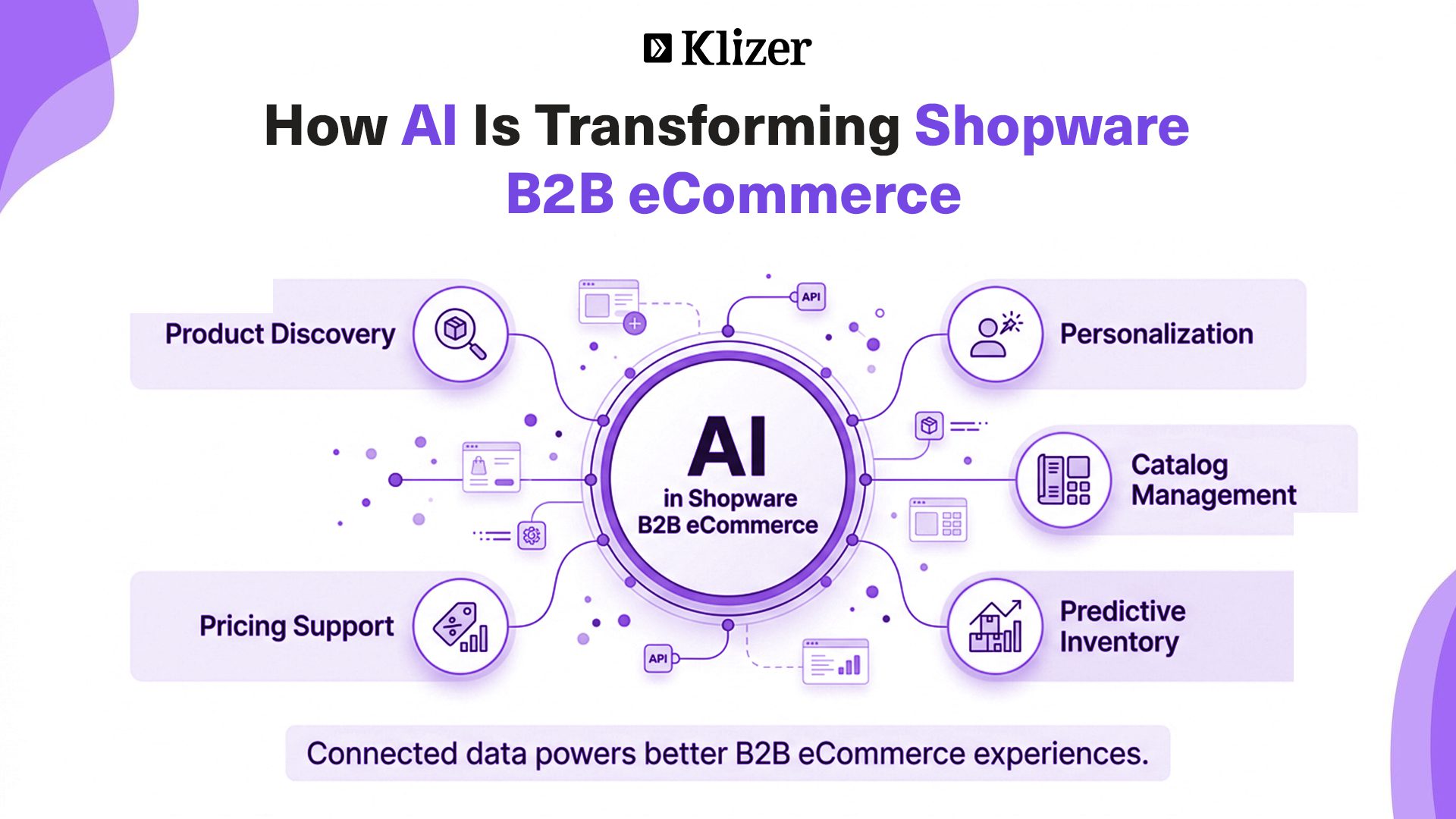
AI in B2B commerce is transforming Shopware B2B ecommerce by improving product discovery, personalization, catalog management, and operational automation. Forrester’s Buyers’ Journey Survey 2025 found that 94% of business buyers use AI during the buying process, up from 89% the previous year.
AI-Powered Product Discovery
AI can understand natural-language queries and buyer intent, helping customers find relevant products without relying on exact SKU searches. Image-based search can also help identify replacement parts from photos.
Automated Catalog Management
AI can generate and refine product descriptions, translate content, summarize reviews, and organize large catalogs, reducing manual work for distributors.
Personalized Buying Experiences
AI in B2B commerce can analyze purchase history and customer behavior to deliver relevant recommendations, complementary products, and reorder suggestions.
Pricing Assistance
AI can help surface relevant pricing and offer information, while authoritative customer-specific and contract pricing remains controlled by the ERP and commerce rules.
Predictive Inventory
AI can analyze historical demand and current purchasing signals to help distributors forecast replenishment needs and manage inventory. The accuracy of these predictions depends on reliable inventory, order, and demand data across connected systems.
Agent-Assisted Purchasing
As AI agents begin supporting product discovery and procurement, distributors need structured product data, reliable availability, customer-specific pricing, and secure APIs. Klizer’s guide to agentic commerce for B2B buyers and sellers explains how this shift changes the infrastructure required for digital B2B transactions.
How Does Composable Commerce Support a Future-Ready Distribution Business?
Composable commerce helps distributors modernize specific parts of their commerce architecture without requiring every capability to come from one system.
Modular Flexibility
Distributors can add, replace, or upgrade capabilities such as search, CMS, payments, or personalization without rebuilding the entire B2B ecommerce environment.
Connected Operations
APIs can connect Shopware with ERP, CRM, PIM, WMS, and inventory systems, creating a unified flow of product, customer, order, and inventory data.
Faster Modernization
A modular architecture allows businesses to introduce capabilities such as AI, advanced search, and personalization incrementally instead of replacing the complete commerce stack at once.
Multi-Channel Scalability
A composable architecture supports ecommerce stores, mobile experiences, marketplaces, and other channels as the business expands.
How Can Distributors Build a Future-Ready Shopware Strategy?
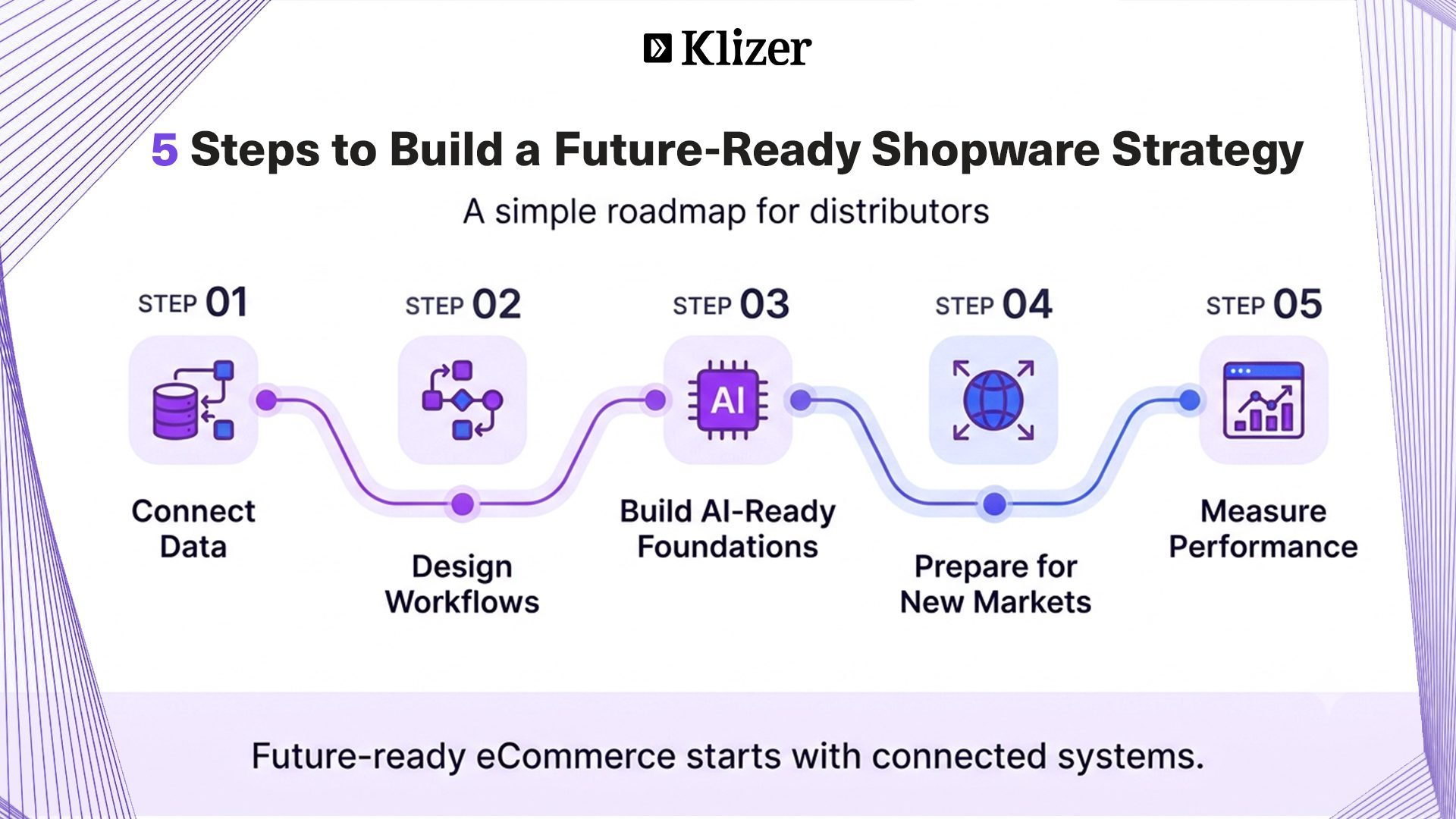
A future-ready strategy starts with reliable commerce data and architecture, not with adding every new technology available.
1. Connect Core Commerce Data
Integrate Shopware with ERP, PIM, CRM, and WMS platforms so product, customer, pricing, inventory, and order data have clearly defined systems of record.
In distributor environments built around Epicor Prophet 21, SAP, NetSuite, or Microsoft Dynamics, these data ownership and synchronization rules should be defined before adding AI, personalization, or headless experiences.
2. Design B2B Workflows Around Buyer Requirements
Use Shopware Rule Builder for customer-specific pricing and discounts.
Automate minimum order quantities, shipping rules, and checkout conditions.
Provide customer-specific catalogs, negotiated pricing, order tracking, reordering, and account management.
3. Build an AI-Ready Foundation
Preparing your data and integrations today makes it easier to adopt AI in B2B commerce as new use cases emerge.
- Apply AI to product search and recommendations.
- Personalize catalogs and buying experiences.
- Automate routine support and content workflows.
4. Prepare for New Markets and Channels
A scalable B2B ecommerce platform should support expansion without requiring a complete technology overhaul.
- Support multiple storefronts and digital channels.
- Manage regional currencies, taxes, catalogs, and payment methods.
- Adapt experiences to different markets and customer requirements.
5. Measure Adoption and Operational Performance
Future-proofing does not end with implementation.
- Track self-service adoption, conversions, and customer engagement.
- Monitor search performance and order processing efficiency.
- Evaluate new B2B ecommerce trends based on measurable business value.
Conclusion
The future of B2B ecommerce is moving toward connected, intelligent, and highly personalized buying experiences. For distributors, adopting AI in B2B commerce, composable commerce, self-service, omnichannel selling, and flexible integrations can improve customer experiences.
However, a future-ready commerce strategy depends on more than adopting AI or composable technology. The Foundation, Storefront, Integration, and Intelligence layers need to work from accurate, connected operational data.
That is how Klizer approaches Connected Commerce for manufacturers and distributors: Foundation, Storefront, Integration, and Intelligence working as one connected system.
Shopware B2B ecommerce provides the foundation to support this transformation, but technology alone does not create a future-ready distribution business. Distributors need to align their commerce architecture with their existing ERP, PIM, CRM, WMS, pricing models, customer journeys, and long-term growth plans.
Talk to Klizer about your Shopware B2B commerce strategy.
Frequently Asked Questions
1. What Is the Future of B2B eCommerce?
The future of B2B ecommerce will focus on AI-assisted buying, self-service, personalization, automation, and connected digital experiences.
2. Why Are Distributors Investing in Digital Commerce?
Distributors are investing in digital commerce to reduce manual processes, improve customer retention, expand sales channels, and serve buyers more efficiently.
3. How Can B2B Companies Compete With Marketplaces?
B2B companies can compete by offering specialized product expertise, account-specific pricing, reliable fulfillment, personalized experiences, and stronger customer service.
4. How Will AI Change B2B Sales?
AI will augment B2B sales by identifying customer opportunities, automating routine tasks, analyzing buying signals, and helping sales teams provide more relevant recommendations.
5. Is B2B eCommerce Replacing Traditional Sales Teams?
No. B2B ecommerce is more likely to automate routine purchasing while sales representatives focus on complex accounts, negotiated deals, and relationship-driven sales.