
Two things have been happening at once in B2B commerce. Headless architecture pulled the storefront away from the commerce engine, and AI got good enough to decide what goes in it. Put together, they turn the storefront into something closer to a live decision than a published catalog, rebuilt for whoever shows up.
Which raises the question of what that decision runs on. Consumer platforms answer with browsing behavior, but industrial distribution needs more than that. What a buyer should see depends on their contract terms, what they are entitled to order, and what is actually on the shelf this morning, and all of it lives in the ERP. Headless AI ecommerce works when the intelligence layer can read that data, and breaks when it cannot.
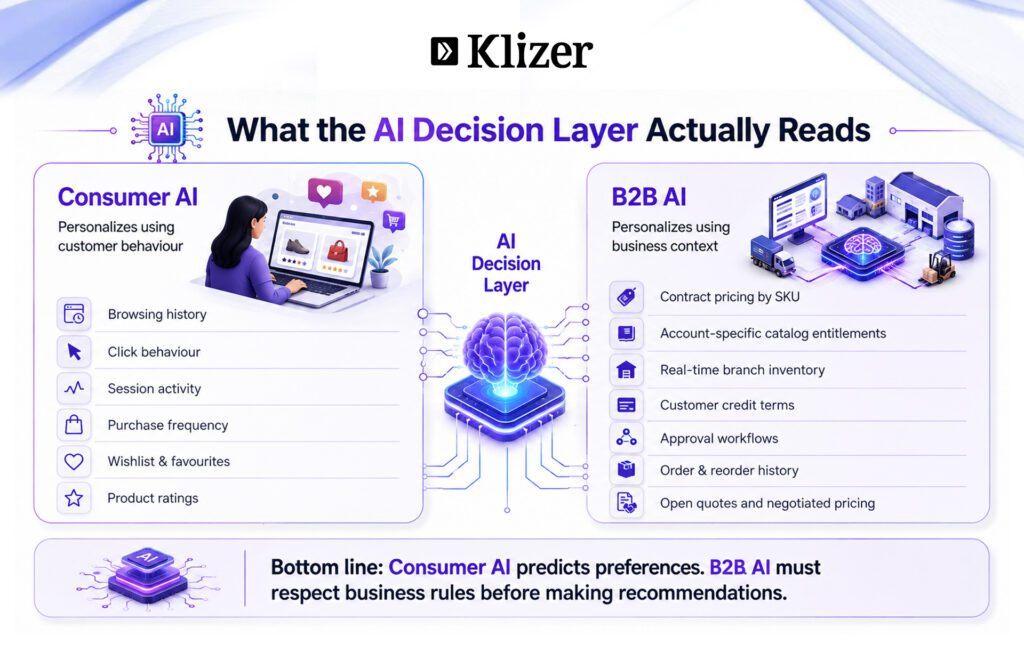
Two kinds of decisions run through that slot. Content decisions, like which banner runs or how search results are ordered, can be driven by behavioral signals alone. Commercial decisions, meaning what a buyer is allowed to purchase, at what negotiated price, and against what stock, can only be driven by the system of record.
Most ecommerce personalization tooling was built for the first category. AI ecommerce personalization in a distribution context lives almost entirely in the second.
ON THIS PAGE
What Does AI Add to a Headless Commerce Architecture?
In a decoupled setup, the frontend requests content and the backend returns it. Nothing in that exchange requires the response to be the same for every buyer, which is where the intelligence layer earns its place: it decides which products, prices, and messages get returned for this specific account on this specific request.
McKinsey’s 2026 Global B2B Pulse survey found that while more than 90% of organizations personalize content in some form, only 20% of market leaders deploy true one-to-one personalization, against 5% of everyone else.
Why Traditional Platforms Fail at B2B Personalization
Monolithic platforms render one storefront per customer group. You can create tiers, assign price lists, and hide categories, but the logic runs inside the template layer, and the template layer only knows what the platform database has been told.
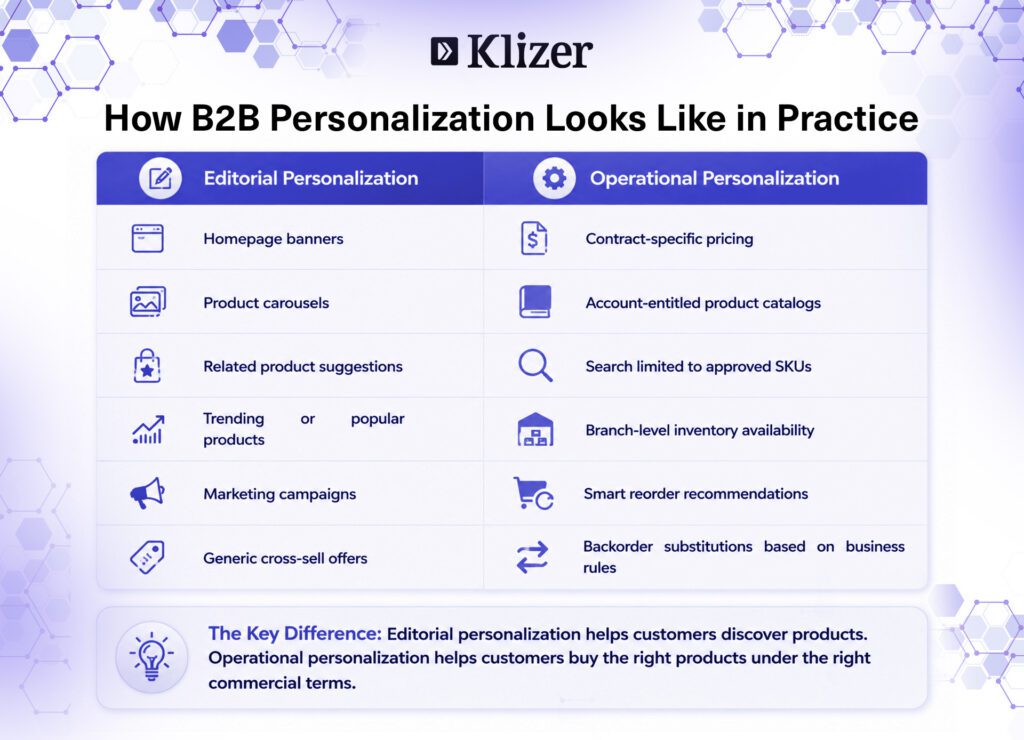
That model holds up until the personalization needs to reflect something the platform does not own:
- Contract pricing negotiated per account, per SKU, with volume breaks
- Catalog entitlements that vary by account, region, or purchasing agreement
- Real-time availability across multiple branches and warehouses
- Credit terms, holds, and approval hierarchies that gate what a buyer can order
Platforms that added APIs on top of a monolithic core can expose this data, but usually as a synced copy that lags behind the source. Headless AI ecommerce architectures fail the same way when teams treat the ERP as an overnight batch feed rather than a live dependency.
Read More: B2B eCommerce Personalization: How to Deliver Account-Based Experiences at Scale
The Technical Architecture Behind AI Personalization
A working implementation needs four layers, and skipping any of them shifts the problem downstream rather than solving it.
1. Data layer
The ERP stays the system of record for pricing, entitlements, credit, and inventory. Order history, quotes, and returns come from the same place. Behavioral data from the storefront supplements this, but it never overrides it.
2. Context layer
Signals from the ERP, the storefront, the PIM, and the CRM resolve into a single account and user context that the model can reason over. Without this, every recommendation is built on a partial view.
3. Decision layer
This is where ecommerce AI recommendations, ranking models, and search relevance run. Generative AI ecommerce applications sit here too, handling product data enrichment, search query interpretation, and conversational assistance for buyers who are describing a part rather than searching for a SKU.
4. Delivery layer
The frontend consumes the decision through the same API contract it uses for everything else, and it needs to do so inside a latency budget. AI ecommerce personalization that noticeably delays a product page has cost more than it returned.
What Personalization Actually Looks Like for a Distributor
The use cases that matter to a returning contractor or a purchasing manager are operational, not editorial. They come back to reorder, to check availability, and to get a quote approved.
Ecommerce AI recommendations in this setting are strongest when they predict replenishment from consumption patterns rather than suggesting adjacent categories. A buyer who orders the same fittings every three weeks wants the cart pre-built, not a carousel of related products.
The same logic applies further along. Search that filters to entitled SKUs before ranking them saves more time than better ranking alone, and substitution logic that surfaces an in-stock equivalent, where specs and certifications allow, when the primary part is on backorder prevents an abandoned order. Ecommerce personalization here is closer to operational efficiency than to merchandising.
The Risk of AI Recommendations Without ERP Data
The risk in B2B is not a weak recommendation. It is a confident, well-presented recommendation that is commercially wrong.
Picture a storefront that suggests a product the account is not contracted to buy, displays list price instead of the negotiated rate, and shows it as available from a branch that sold the last unit that morning. Without current commercial data, those errors are invisible to the model and immediately obvious to the buyer.
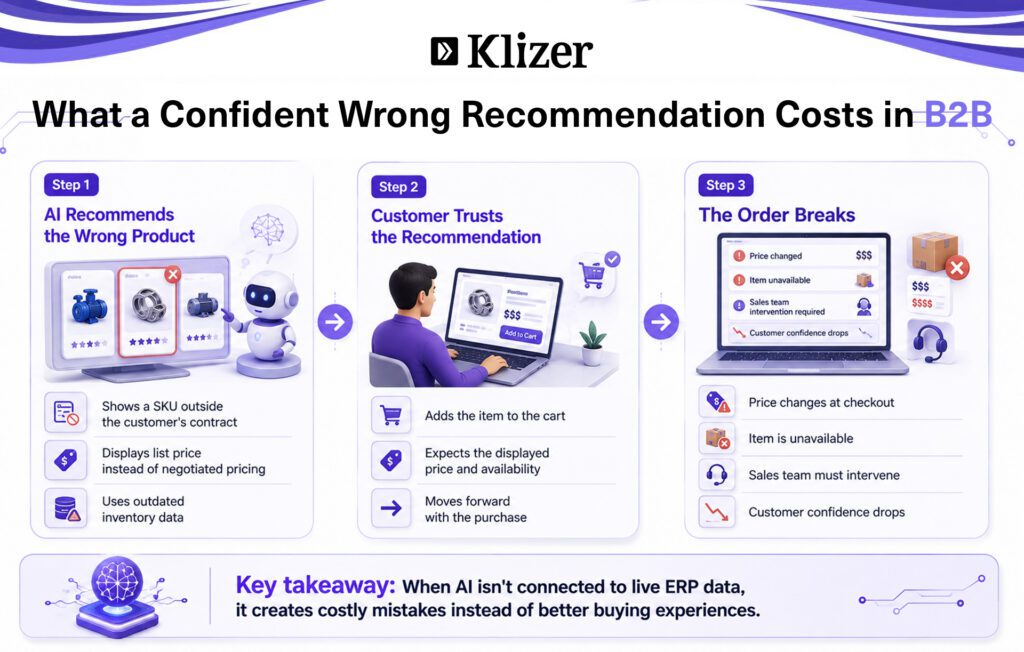
Generative AI ecommerce features sharpen the risk, because fluent natural-language output reads as authoritative even when the data behind it is stale. For a customer whose entire relationship runs on negotiated terms, that is not a usability issue, it is a credibility problem that gets escalated to a sales rep.
It has real commercial consequences. According to McKinsey’s 2026 survey, inconsistent information across teams ranked as the top reason B2B buyers switch suppliers.
AI Implementation Challenges in Headless and How to Solve Them
Most projects stall on the same set of problems, and they are less about model selection than about the systems underneath.
- Thin catalog data: Models cannot rank reliably on attributes that are missing, inconsistent, or unnormalized. Enrich product data in the PIM before expecting relevance gains from the decision layer.
- ERP read load: Personalizing every page against live ERP calls will strain the system. Solve it with a caching and event-driven sync strategy that keeps pricing and availability current without hammering the source.
- Cold-start accounts: New buyers have no history. Fall back to segment-level and contract-level defaults rather than showing a generic catalog.
- Governance: Log what was recommended, at what price, to which account. When a buyer disputes what the storefront showed them, you need the record.
Final Thoughts
Headless commerce and AI personalization only work together when the storefront and the ERP run as one system. The storefront is where personalization becomes visible: the recommendation, the price, the availability. The ERP is where price, eligibility, and availability are established, and treating that as a sync job between two separate projects is why so many storefronts end up guessing.
Klizer builds this as four layers instead of four vendors: the ERP foundation, the headless commerce development, the integration layer that keeps them in sync, and the AI that makes the decisions. Built specifically for manufacturers and distributors.
If your storefront can render fast but your AI ecommerce personalization is still guessing at price and stock, the gap is in how your systems talk to each other.
Book a free consultation with the Klizer team to see where that gap sits in your stack, and what closing it would take.