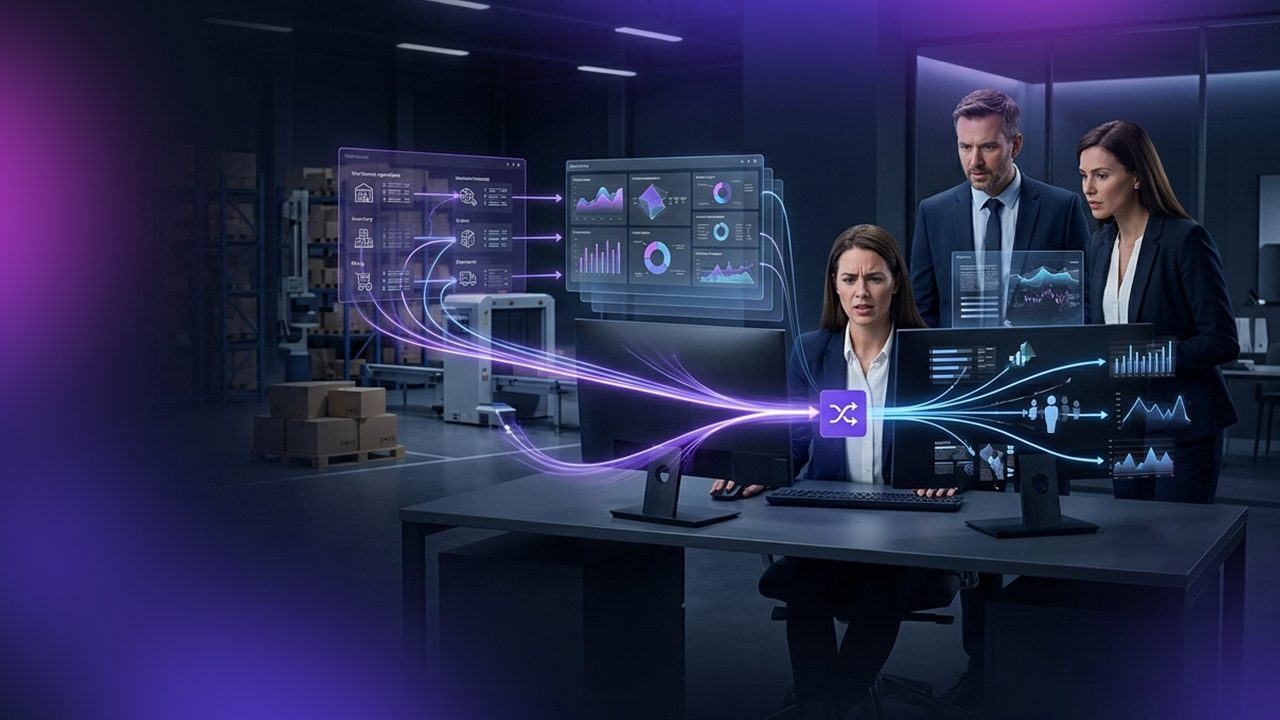

Ask any B2B buyer what they want from a storefront and the list gets long fast: speed, pricing that reflects their contract, a mobile experience that doesn’t fall apart, ERP data that’s actually current. Monolithic platforms were never built for that list. They can stretch to cover some of it, but at scale, the seams show.
Headless commerce solves this by separating the frontend presentation layer from the backend commerce engine. With Shopware, developers can build highly scalable and flexible B2B commerce solutions using APIs, modern frontend frameworks, and composable architectures.
In a headless architecture, Shopware acts as the powerful commerce backend while frontend applications are developed independently using technologies such as React, Vue.js, Next.js, Nuxt.js, or native mobile frameworks. This gives development teams greater flexibility, faster deployment cycles, and better scalability for enterprise B2B operations.
ON THIS PAGE
Why Headless Commerce Matters for B2B
Here’s the part most vendors won’t tell you upfront: headless is not the right call for every B2B business. If your catalogue is small, your buyers are happy, and your ERP integration already works, ripping out a monolith to go headless is a solution chasing a problem. Where it earns its keep is complexity, multiple buyer types, contract pricing that changes per customer, and three storefronts that all need the same data. That’s when the monolith starts fighting you, and headless stops being an architecture buzzword and starts saving you real time.
Typical B2B requirements include:
- Large, segmented product catalogues
- Customer-specific and contract-based pricing
- ERP, PIM, and CRM integrations
- Multi-store and multi-language support
- Advanced approval workflows and purchase order management
- Bulk ordering capabilities
- High-performance, low-latency APIs
- Dealer and partner portals
- Personalised storefronts per customer segment
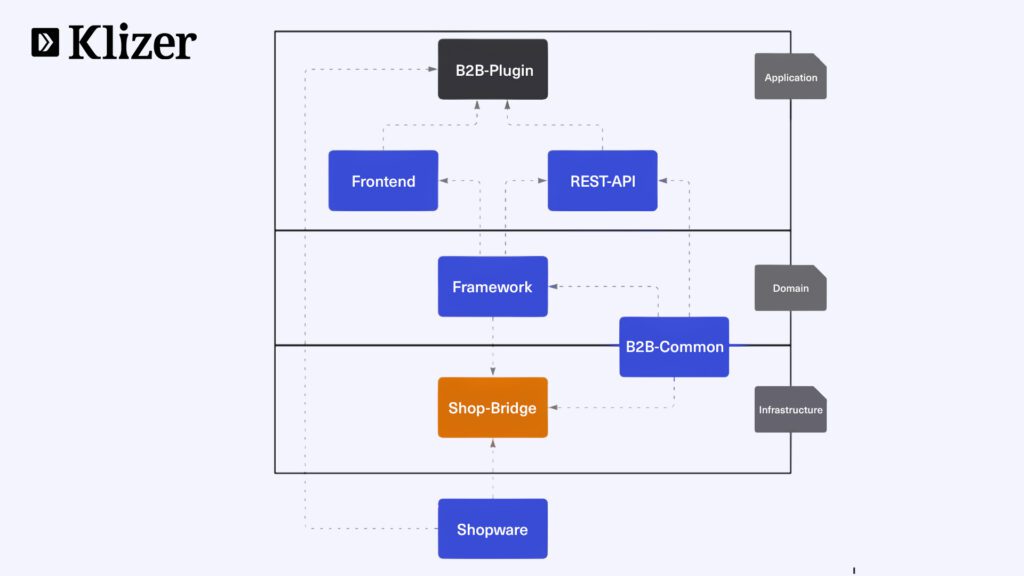
Most B2B businesses still run legacy ERP or WMS systems that cannot easily integrate with modern commerce platforms. Headless solves this through API gateways and middleware that bridge data between old and new systems, letting businesses modernise customer experiences without disrupting backend stability.
A headless architecture allows developers to build all of these features independently, without being restricted by frontend limitations or tightly coupled deployment pipelines.
Traditional Commerce vs Headless Commerce
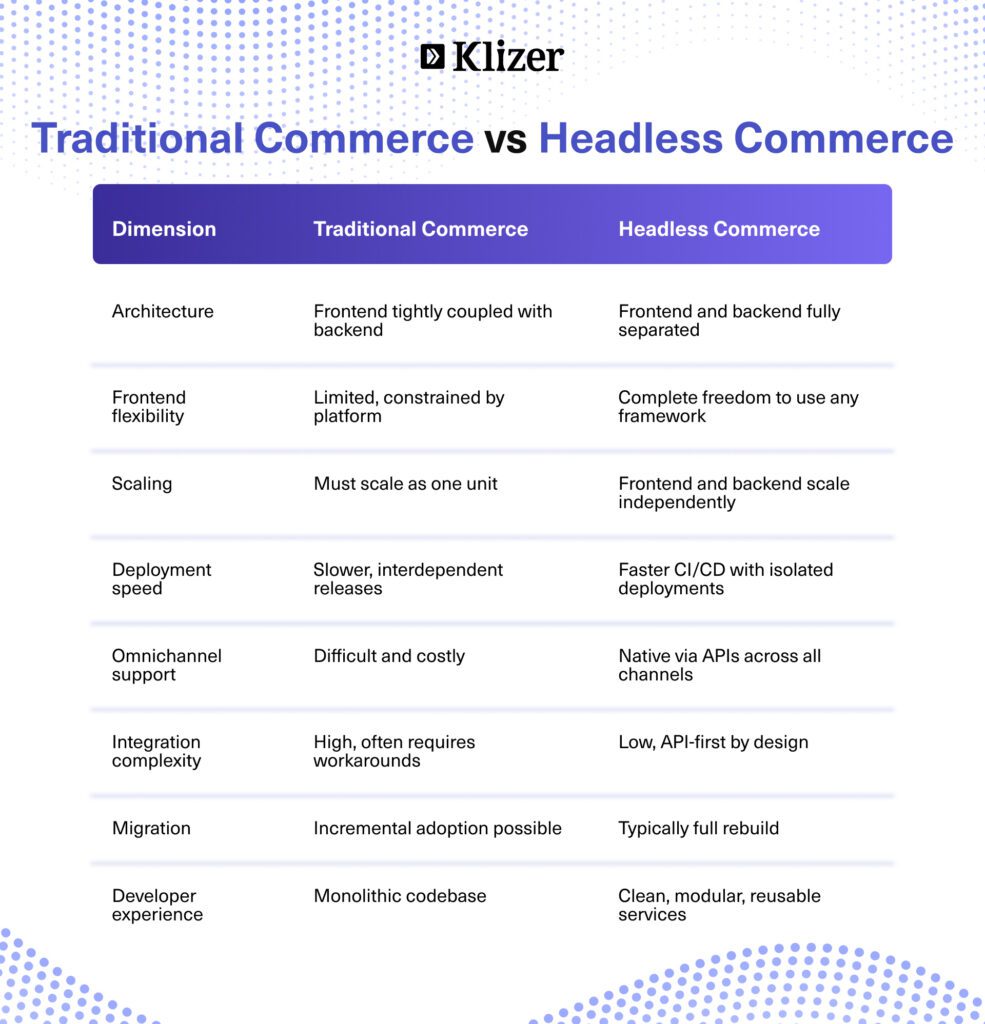
| Dimension | Traditional Commerce | Headless Commerce |
| Architecture | Frontend tightly coupled with backend | Frontend and backend fully separated |
| Frontend flexibility | Limited, constrained by platform | Complete freedom to use any framework |
| Scaling | Must scale as one unit | Frontend and backend scale independently |
| Deployment speed | Slower, interdependent releases | Faster CI/CD with isolated deployments |
| Omnichannel support | Difficult and costly | Native via APIs across all channels |
| Integration complexity | High, often requires workarounds | Low, API-first by design |
| Developer experience | Monolithic codebase | Clean, modular, reusable services |
Key Benefits of Headless Shopware for B2B
1. Independent Scalability
Frontend and backend scale on their own terms. A traffic spike on the storefront? The backend never feels it. Product imports and ERP syncs run in parallel, out of sight. And a dealer portal, a mobile app, and a self-service store can all pull from the same APIs at once, three frontends, one backend, no contention.
2. Faster Frontend Performance
With headless, developers can implement server-side rendering (SSR), static site generation (SSG), edge caching, lazy loading, and API response caching. None of this is automatic, though; going headless doesn’t make a site fast. It gives you the tools to make it fast. We’ve seen teams ship a headless frontend that performs worse than the monolith it replaced, simply because nobody owned a caching strategy. The performance is real, but it’s earned, not granted.
3. Better Developer Experience
Development teams gain independent deployments, faster frontend iteration, cleaner architecture, technology flexibility, and reusable API services. Teams can work in parallel without blocking backend releases, which significantly reduces time-to-market for new features.
4. Omnichannel and Multi-Storefront Support
The architecture enables sophisticated omnichannel scenarios that would be impossible with traditional platforms. A customer can start their journey on one channel, move to another for detailed product information, check inventory, and finally purchase elsewhere, with their cart, preferences, and history remaining synchronised throughout, all powered by the same headless backend.
5. Composable and Future-Proof Architecture
The MACH Alliance principles (Microservices, API-first, Cloud-native, Headless) provide the foundation for composable commerce. Shopware’s API-first design aligns directly with MACH principles, making it a strong foundation for composable B2B platforms.
Looking for an expert Shopware development team? Browse through our services here.
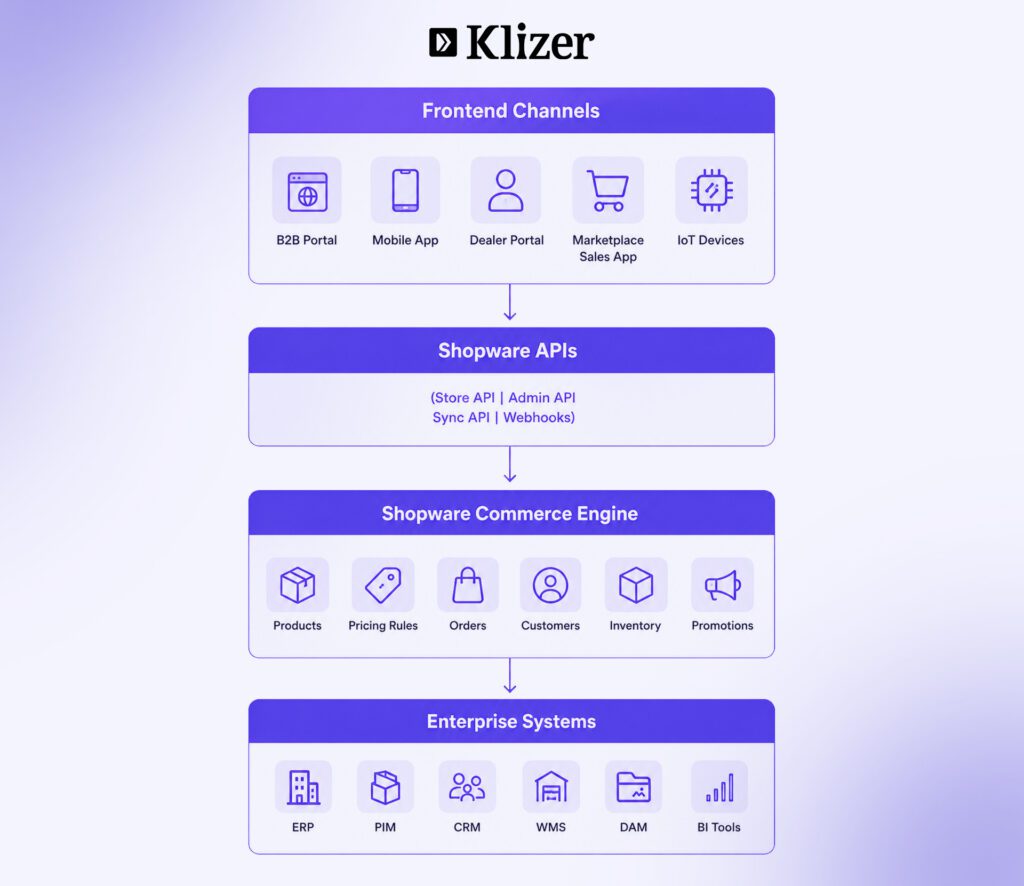
Shopware’s API-First Architecture for B2B
Shopware provides a comprehensive set of APIs that power any frontend application:
- Store API for customer-facing storefronts
- Admin API for back-office and ERP integrations
- Sync API for bulk data operations
- Webhooks for event-driven integrations
Shopware supports both traditional and headless architectures, allowing existing installations to be gradually transitioned to headless. Not all eCommerce systems provide a true headless structure, as some only offer API interfaces without fully decoupling the backend. Systems with an API-first approach like Shopware enable complete separation of frontend and backend, giving businesses extensive flexibility in designing their sales channels.
Example: Fetching Products via Store API
javascript
const response = await fetch(
‘https://your-shopware-site.com/store-api/product’,
{
method: ‘POST’,
headers: {
‘Content-Type’: ‘application/json’,
‘sw-access-key’: ‘YOUR_ACCESS_KEY’
}
}
);
const products = await response.json();
console.log(products);
This allows any frontend application, whether a React SPA, a Next.js SSR app, or a mobile application, to retrieve and display product data dynamically without any coupling to the Shopware frontend layer.
Best Practices for Scalable B2B Headless Architecture with Shopware
- Use event-driven architecture for ERP and PIM synchronisation
- Implement layered caching at the API, CDN, and application level
- Deploy frontends independently via CI/CD pipelines
- Use microservices for high-complexity functions like pricing and inventory
- Monitor API performance and set up alerting for latency thresholds
- Optimise database indexing for large B2B product catalogues
- Use asynchronous processing for bulk orders and data imports
- Maintain comprehensive API documentation for internal and partner teams
- Plan for gradual migration rather than a big-bang replatform
Check our headless commerce development services.
Frequently Asked Questions
What is headless commerce in Shopware?
Headless commerce in Shopware refers to an architecture where the frontend presentation layer is fully decoupled from the Shopware backend. The frontend, built in frameworks like React, Vue.js, or Next.js, communicates with Shopware exclusively through APIs such as the Store API and Admin API. This allows teams to build and deploy frontend experiences independently without touching backend logic.
Is Shopware good for B2B headless commerce?
Yes. Shopware is purpose-built to support both B2B and B2C use cases in a headless setup. It offers native B2B features, including customer-specific pricing, quote management, approval workflows, and multi-storefront support, all accessible via its API-first architecture. Shopware has also been recognised as a Leader in the IDC MarketScape for Headless Digital Commerce.
What is the difference between headless commerce and composable commerce?
Headless commerce separates the frontend from the backend via APIs. Composable commerce extends this further by breaking down the entire backend into independently deployable microservices covering areas like checkout, search, and pricing. Headless is often the first step toward a composable architecture.
What frontend frameworks work with Shopware headless?
Shopware headless is framework-agnostic. Common choices include React, Next.js, Vue.js, Nuxt.js, and Angular. Shopware also offers Storefront as a reference implementation, and the community maintains integrations with composable frontend frameworks like Alokai (formerly Vue Storefront).
How does headless Shopware integrate with ERP systems?
Shopware’s Admin API and Sync API are designed for high-volume data operations. ERP systems such as SAP, Microsoft Dynamics, and custom solutions can synchronise orders, inventory, customer data, and pricing rules via these APIs or through middleware layers and webhooks for real-time event-driven updates.
Is headless commerce suitable for mid-market B2B businesses or only enterprises?
Headless commerce is viable for mid-market businesses, particularly those with complex product catalogues, multiple buyer personas, or plans for international expansion. However, it does carry higher initial development and infrastructure complexity compared to traditional monolithic setups. Shopware’s support for gradual, progressive migration to headless reduces this barrier significantly.
What performance improvements can B2B businesses expect from headless Shopware?
Businesses that implement headless commerce typically see faster page load times through SSR and edge caching, improved Core Web Vitals scores, and better SEO performance. Studies report up to a 20% reduction in load times and measurable uplift in conversion rates following headless migration.
Does going headless with Shopware require a full platform migration?
No. Shopware supports a hybrid and progressive approach. Businesses can migrate individual storefronts, channels, or customer segments to headless while keeping other parts of their setup on the traditional Shopware frontend. This reduces risk and allows teams to validate performance before full transition.
Conclusion
Headless commerce with Shopware provides a modern, scalable, and future-ready foundation for enterprise B2B eCommerce. By separating the frontend from the backend, development teams gain flexibility, faster performance, independent scalability, and easier integration with ERP, PIM, and CRM systems.
For developers, this architecture opens the opportunity to build high-performance B2B solutions using modern frontend technologies while leveraging Shopware’s proven commerce engine on the backend.
The organisations that get the most out of headless aren’t the ones chasing it as a trend. They’re the ones who hit a real wall with their old setup and picked the architecture that solved it. If that’s you, Headless Shopware is worth the investment. If it isn’t yet, it’s worth knowing where the wall is.
For more help regarding your store and how you can break from monolithic architecture to headless, book a consultation here!