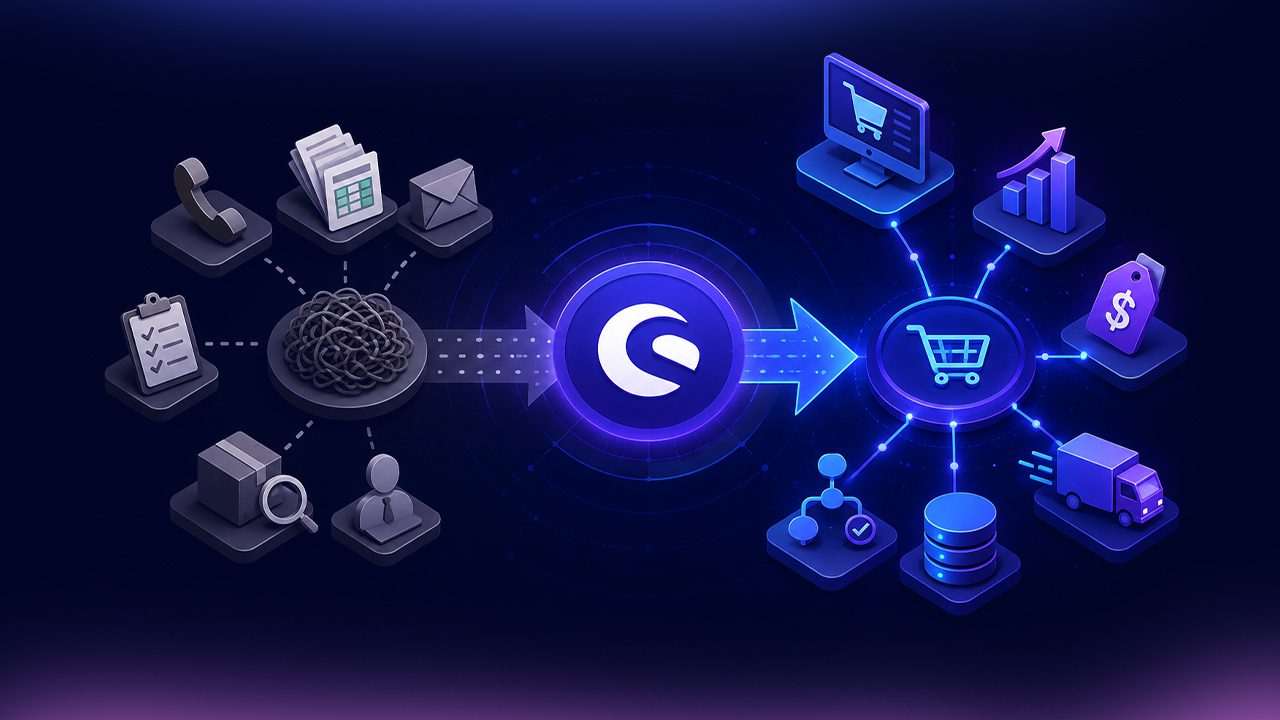

In 2026, brands are moving to headless commerce for one reason: the storefront stopped being the only place customers buy.
Distributors now sell through websites, punchout catalogs, EDI feeds, sales reps, and marketplaces, but many legacy platforms were built for a single channel. Headless commerce separates the storefront from the commerce engine so that one system can feed all of them.
The shift is driven by the growing cost of fragmented systems. Every new channel added to a monolithic platform creates duplicate catalogs, pricing logic, and sync processes that increase complexity. Your best customer may not have opened your website in eight months, but their orders still arrive weekly through a punchout integration nobody has looked at since it went live, and that integration is now quietly deciding what price they see.
Headless is the architectural response to this fragmentation. It is neither a design trend nor a front-end refresh. It is a decision about where your commerce logic lives, enabling it to support every channel without being rebuilt each time.
ON THIS PAGE
What is Headless Commerce?
The model separates the presentation layer from the commerce engine that runs behind it. The storefront your customers see becomes an independent application, and the systems handling catalog, pricing, inventory, and order processing sit behind an API layer that any front end can call.
In a traditional monolithic platform, those two halves are welded together. The theme, the templates, and the checkout logic all live inside the same codebase as the business rules, which is why changing the look of a product page can quietly break the way a price is calculated.
Headless ecommerce removes that coupling, so the commerce engine no longer cares whether the request came from a website, a mobile app, a customer’s procurement system, or a rep working from a tablet on a plant floor. It answers the call and returns the data.
What Are the Benefits of Headless Commerce for B2B Sellers?
The monolith stopped being able to serve the number of channels a B2B business now runs. A distributor selling through multiple channels is running five front ends against one back end, and a platform that assumes a single storefront will fight that arrangement at every turn.
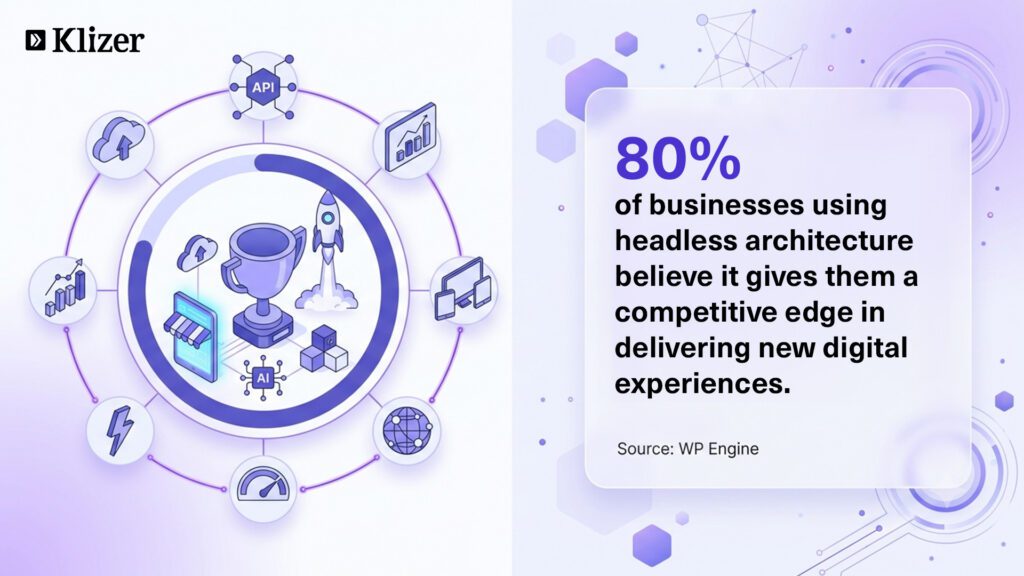
The market has already moved on this. 73% of businesses are already running headless architecture. Among businesses that have not adopted it yet, 98% said they plan to evaluate headless solutions within the next 12 months. 80% of enterprise adopters report positive ROI within 12 months of going headless.
The gap between the two groups is widening rather than closing.
Look across current digital commerce trends and the pattern is consistent: the winners are not the brands with the best-looking storefronts. They are the ones whose product and pricing data can be delivered anywhere a buyer happens to be.
That is the pressure driving most ecommerce modernization budgets right now, and it is why headless commerce has stopped being an experiment and started being the default assumption.
Industrial sellers have a different problem set, and the value shows up in different places.
- Complex pricing behaves consistently across channels. Contract pricing, volume breaks, and customer-specific catalogs are resolved once, in the commerce engine, and every channel receives the same answer. Lululemon moved to a headless React-based frontend and saw significant improvements in page load speeds and conversion rates directly tied to the architectural change.
- Product data scales without the storefront collapsing. A decoupled front end can handle deep catalogs with technical specs, CAD files, and compliance documents because rendering is no longer the same job as data management.
- Buyer workflows can be built properly. Quote-to-order, reorder from history, approval chains, and credit checks are workflow problems, and a front end you fully control is the only place you can build them the way your buyers really work.
- Integration surfaces become reusable. The same API layer that feeds the storefront can feed the sales portal, the mobile app, and the partner catalog. For distributors running catalog integrations, this means a single commerce engine feeds both the web storefront and the buyer’s procurement system without maintaining separate pricing logic for each.
The strongest of the benefits of headless commerce is not any single item on that list. It is that all four of them draw from one source of truth instead of four reconciliations.
What Does Going Headless Change?
A decoupled architecture changes the shape of the problem. Instead of building each new channel as a bolt-on to the storefront, you build it as another consumer of the same API layer, so the catalog, the customer-specific pricing, and the order rules stay in one place and get expressed consistently everywhere.
The benefits of headless commerce start showing up here, in three practical consequences:
Front-end work stops waiting on back-end release cycles. Marketing can rebuild a category page without a platform upgrade, and IT can patch the commerce engine without freezing the design team.
New channels become configuration, not construction. Adding a rep-facing ordering tool or exposing product data to an AI shopping agent becomes an integration task rather than a rebuild. In 2026, this includes agentic commerce: AI procurement agents can query your catalog, verify contract pricing, and place orders through APIs. A headless architecture with clean, structured product data is agent-ready by design. A monolithic platform is not.
Performance becomes something you control. A decoupled front end can be cached, rendered, and delivered independently of the transaction system, which matters when your product pages carry thousands of SKUs and technical attributes.
What changes underneath is less obvious and more consequential. The integration layer becomes the thing every channel depends on, which is a very different engineering problem from maintaining a single storefront.
Explore more about Klizer’s headless commerce development services here.
Is There a Middle Path? Hybrid Headless
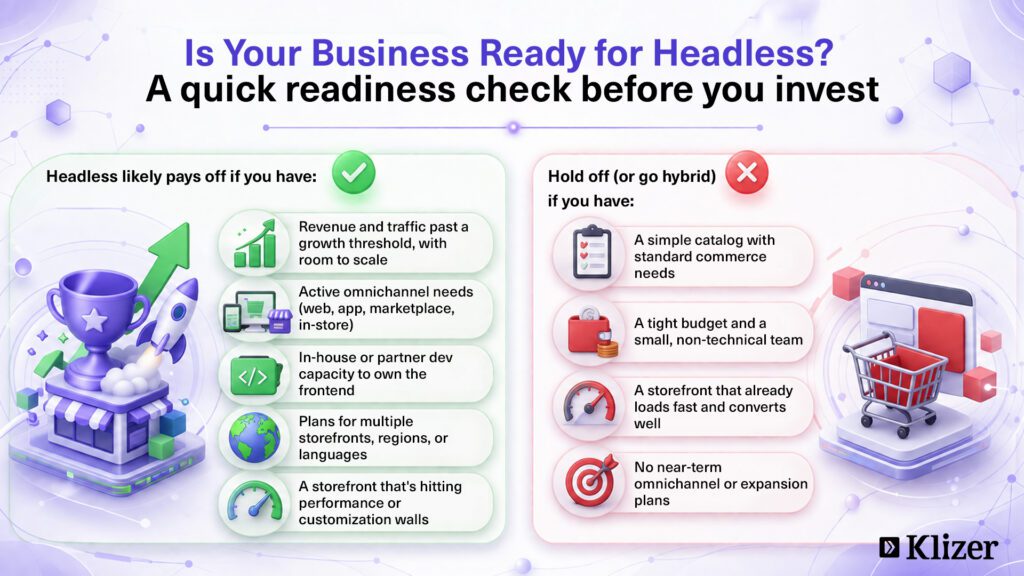
The headless vs. traditional choice is not always binary. Many mid-market distributors adopt a hybrid approach: traditional commerce backend for most workflows with a headless frontend layer for specific high-value surfaces like mobile, kiosks, or performance-critical landing pages.
This captures the core performance and flexibility benefits of headless without the full complexity and cost of a complete architectural rebuild. For distributors who need better performance and omnichannel consistency but lack the in-house development capacity for a full headless build, hybrid headless is worth evaluating before committing to either extreme.
What Is the Difference Between Headless and Composable Commerce?
Headless separates the frontend from the backend. Composable commerce goes further: the entire stack is built from modular, independently deployable services connected through APIs, following MACH architecture (Microservices, API-first, Cloud-native, Headless).
All composable platforms are headless, but not all headless platforms are composable. A distributor on Adobe Commerce with a custom React frontend is running headless. A distributor on commercetools with independently deployed services for checkout, search, and catalog is running composable.
The distinction matters for planning because composable carries significantly higher complexity and cost. Most mid-market distributors do not need composable. They need headless done well.
Read More: Get a detailed look into headless commerce vs traditional commerce.
How to Ensure Successful Headless Commerce Migration?
Headless projects fail for predictable reasons. Understanding them before you start is what separates a successful build from an expensive recovery.
| Challenge | What Happens |
| Legacy ERP limitations | Decoupling the storefront does not fix the system behind it. In most industrial businesses, the ERP was never designed to answer thousands of API calls per minute. |
| The real point of failure | When a headless build fails, the failure is almost never in the front end. The React application is fine. The architecture underneath it was never finished. |
| Performance and data issues | Product pages wait for pricing because the ERP remains the system of record without a caching layer. Inventory falls out of sync because updates run too infrequently. |
| Integration becomes critical | In headless ecommerce, the integration layer is no longer a convenience. Once the storefront is decoupled, it becomes load-bearing, and every channel depends on it. |
| What successful modernization requires | Any ecommerce modernization effort has to treat the back end as part of the project rather than as a fixed input. Leaving the ERP untouched only moves the bottleneck behind an API instead of removing it. |
Final Thoughts
For a B2B manufacturer or distributor, the benefits of headless commerce extend beyond the storefront. It ensures your catalog, contract pricing, and inventory are available across every buyer touchpoint instead of relying on a monolith built for a single channel.
Delaying decoupling only increases integration debt, making future ecommerce modernization projects more about untangling old systems than building new capabilities. Treat headless as an architecture decision, not a design one. Evaluate whether your ERP, product data, and integration layer can support every channel you plan to run.
Klizer delivers that foundation through Connected Commerce, bringing together foundation, storefront, integration, and intelligence into one unified commerce engine.
Book a call with the Klizer team to see what Connected Commerce looks like for your catalog, ERP, and buyers.