

Traditional ecommerce relies on a monolithic architecture that tightly connects the frontend and backend. Headless commerce separates them while connecting them through APIs, allowing businesses to update each layer independently.
That single architectural difference determines how fast you can ship new experiences, how well you serve buyers across channels, and how your platform holds up as the business scales.
This blog is talking about headless commerce vs traditional commerce in detail, where each one fits, and how to choose based on your actual business stage.
ON THIS PAGE
What is Headless Commerce?
Headless commerce is an ecommerce architecture that separates the frontend from the backend. The frontend handles the customer-facing experience, while the backend manages products, inventory, orders, and payments. APIs connect the two, letting businesses update each layer independently.
- The global headless commerce market is projected to reach $7.16 billion by 2032, growing at a 22.4% CAGR.
- 73% of businesses already use a headless website architecture.
What is Traditional eCommerce?
Traditional ecommerce uses a monolithic architecture where the frontend and backend operate as a single, tightly connected system. The storefront, product catalog, inventory, checkout, and content management all share the same codebase. Changes to one part often affect the others.
- 42% of ecommerce businesses still use monolithic platforms.
- More than 4.3 million live websites use WooCommerce, one of the world’s most widely adopted monolithic platforms.
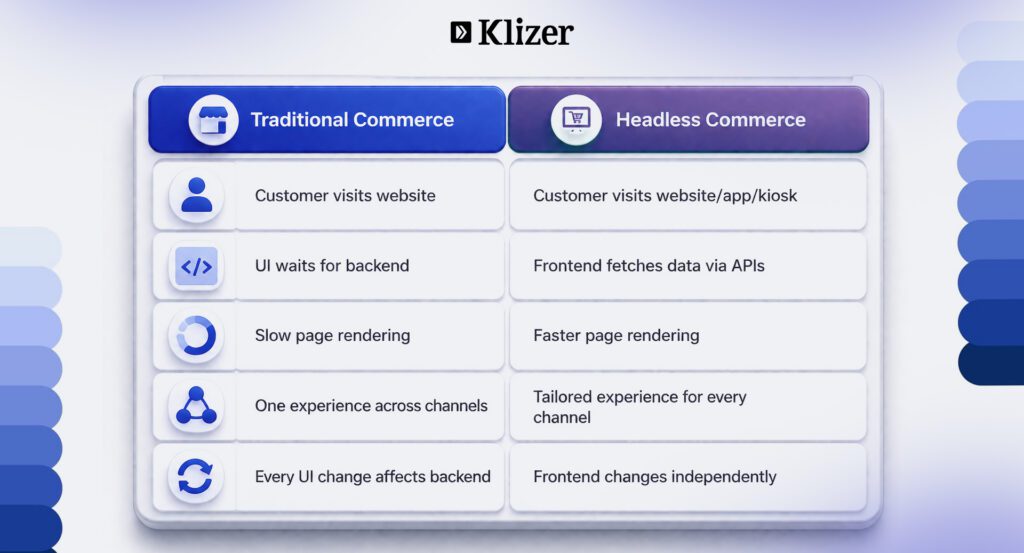
How Do Monolithic vs. Headless Architecture Differ?
| Feature | Monolithic Architecture | Headless Architecture |
| Structure | Frontend, backend, and business logic in one application | Frontend and backend separated, connected through APIs |
| Flexibility and customization | Predefined templates; customization requires core platform changes | Complete freedom to build custom experiences across any channel |
| Development and deployment | Full application deployed even for small updates | Frontend and backend teams work and deploy independently |
| Performance | Optimization constrained by the full application stack | Frontend optimized independently for faster page loads |
| Integrations | Third-party integrations require platform-specific development | APIs connect CMSs, CRMs, payment gateways, and other tools |
| Scalability | Entire application scales even when only one feature needs it | Frontend and backend scale independently |
| Setup and maintenance | Faster to launch, lower upfront cost | Higher initial investment, requires experienced developers |
| Best for | Small to mid-sized businesses with straightforward requirements | Growing businesses and enterprises needing customization and omnichannel commerce |
What Are the Biggest Benefits of Headless eCommerce?
Unlimited customization
Build unique storefronts using modern frameworks like React or Vue without backend template restrictions.
Faster website performance
Optimize the frontend independently using lightweight frameworks and CDNs to reduce page load times and improve Core Web Vitals. Klizer builds headless storefronts using modern frontend technologies to help ecommerce brands improve site speed, user experience, and search performance.
Omnichannel consistency
The average buyer engages with 8 to 10 channels during their purchase journey, according to Salesforce’s State of the Connected Customer report. Their top frustration is disconnected experiences across those channels. Headless commerce manages products, inventory, and orders from one backend while delivering consistent, tailored experiences across every touchpoint.
Personalized shopping experiences
Connect customer data platforms, AI tools, and analytics to deliver real-time product recommendations and personalized content. Nike’s headless implementation reduced their time-to-market for new storefront experiences by 50% while enabling consistent personalization across web, mobile, and in-store digital channels.
Faster development cycles
Frontend and backend teams work independently. Interface updates ship without touching backend systems, cutting deployment time significantly.
Easy third-party integrations
APIs connect CRMs, CMSs, ERPs, payment gateways, and marketing platforms cleanly.
Independent scalability
Scale the frontend and backend separately. Storefront traffic spikes do not affect backend operations.
Enhanced security
Separating customer-facing applications from backend systems reduces the attack surface and protects sensitive business data during frontend updates.
Agent-ready architecture
Headless is structurally better suited for agentic commerce. AI procurement agents query your catalog, verify pricing, and place orders through APIs. A headless architecture with clean, structured product data and well-documented APIs is agent-ready by design. A monolithic platform is not.
What Are the Advantages and Limitations of Traditional eCommerce?
Advantages
- Easy implementation: Built-in themes, checkout, inventory management, and payment processing let businesses launch quickly without custom development.
- Lower upfront costs: No custom frontend development required, making traditional ecommerce a practical starting point for startups and small businesses.
- Rich app ecosystem: Platforms like Shopify and WooCommerce offer thousands of themes and plugins for subscriptions, loyalty programs, and marketing automation without extensive coding.
- Proven for growing brands: Gymshark launched on Shopify’s monolithic platform during its early growth stage. Built-in ecommerce capabilities enabled rapid scaling before the brand later invested in more customized commerce experiences as its global business expanded.
- Best for: Startups, small and medium-sized businesses, teams without in-house developers, businesses selling through a single storefront, and brands with straightforward product catalogs and predictable growth.
Limitations
- Limited customization: Creating unique experiences requires modifying the core platform because the frontend and backend are tightly coupled.
- Slower development cycles: Even minor interface updates require changes across the entire application.
- Scaling inefficiencies: The full application scales during traffic spikes, even when only one component needs additional resources.
- Integration limitations: Connecting modern CMSs, CRMs, ERPs, and marketing platforms requires custom development.
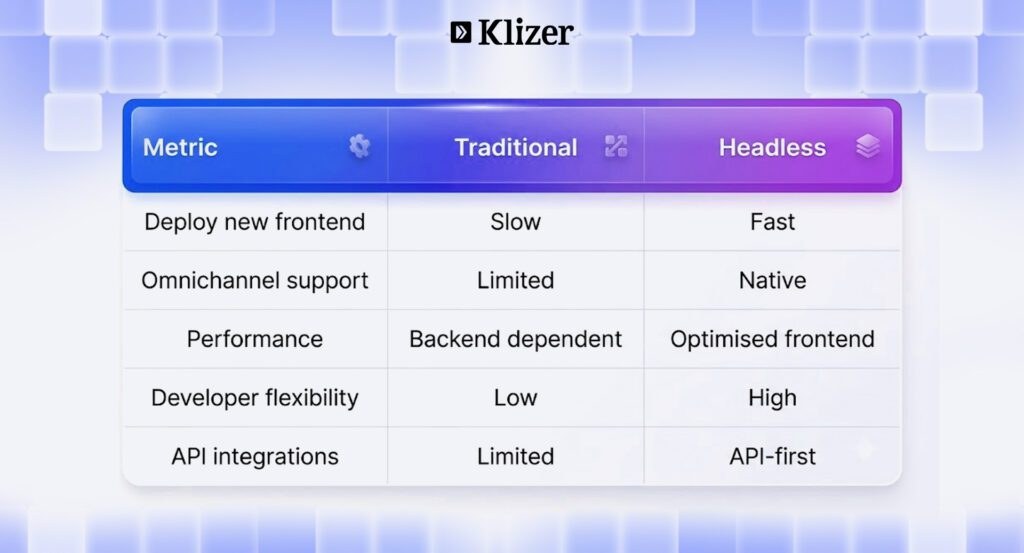
Is There a Middle Path? Hybrid Commerce
The headless vs. traditional choice is not always binary. In 2026, many mid-market businesses adopt a hybrid approach: traditional commerce backend for most workflows, headless frontend for specific high-value surfaces like mobile, kiosks, or performance-critical landing pages. This captures the core performance and flexibility benefits of headless without the full complexity and cost of a complete architectural rebuild. It is worth evaluating before committing to either extreme.
How Do the Costs Compare?
| Traditional | Headless | |
| Initial setup | Low to medium | Medium to high |
| Ongoing maintenance | Lower | Higher (API management, dev resources) |
| At $200K annual revenue | Lower total cost | Similar over 3 years |
| At $1M+ annual revenue | Higher over 3 years | Lower — faster dev cycles reduce overhead |
| Customization costs | Higher (platform workarounds) | Lower (purpose-built from the start) |
The economics favor traditional commerce at an early stage and headless at scale. The break-even point varies by catalog complexity, development team capacity, and integration requirements, but most businesses hitting $1M+ in annual revenue with omnichannel ambitions find headless delivers better long-term ROI.
How to Choose Between Both Architectures?
| Your Situation | Recommended Approach |
| Revenue under $500K, simple catalog | Traditional |
| Revenue under $500K, fast growth planned | Traditional now, plan for hybrid in 12 to 18 months |
| Revenue $500K to $1M, single storefront | Traditional |
| Revenue $500K to $1M, multiple channels or regions | Hybrid |
| Revenue $1M+, complex catalog, ERP integration required | Headless |
| Revenue $1M+, B2B with account-specific pricing and workflows | Headless |
| Strong in-house dev team, omnichannel ambitions | Headless |
| No in-house developers, need speed to market | Traditional |
| Selling across web, mobile, kiosk, and marketplaces simultaneously | Headless |
| One storefront, predictable traffic, standard checkout | Traditional |
| Planning agentic commerce or AI procurement integration | Headless |
| Budget constrained, need live in under 8 weeks | Traditional |
The rule of thumb: Traditional gets you live faster and cheaper. Headless keeps you from rebuilding in three years.
How Does Klizer Help Businesses Choose and Build the Right Architecture?
The architecture choice depends on where you are in your growth stage, what your ERP and integration requirements look like, and whether your team has the technical capacity to support a headless build. Getting that assessment wrong in either direction is expensive.
Klizer specializes in helping ecommerce businesses transition from traditional platforms to headless and hybrid architectures, and in building connected commerce systems where ERP, storefront, integrations, and AI run as one engine. With expertise across Shopify Plus, BigCommerce, Adobe Commerce, and composable architectures, Klizer builds solutions that perform at launch and hold up as the business scales.
Get in touch with Klizer to assess your current architecture and find the right path forward.
Frequently Asked Questions
Is headless commerce more expensive than traditional ecommerce?
Yes, upfront. Headless requires custom frontend development, API integrations, and ongoing technical expertise. At lower revenue scales the cost difference is significant. At $1M+ annual revenue, headless typically delivers lower total cost over three years through faster development cycles and lower maintenance overhead.
Can small businesses use headless commerce?
It depends on goals and resources. Small businesses with straightforward needs benefit more from traditional ecommerce. Those planning rapid growth, custom experiences, or omnichannel selling may find headless a worthwhile investment earlier than expected.
Can I migrate from traditional ecommerce to headless?
Yes. Many businesses start traditional and migrate as requirements grow more complex. A well-planned migration preserves data, minimizes downtime, and protects SEO rankings.
Does headless commerce improve SEO?
Yes. Faster page load speeds, better Core Web Vitals, and greater control over technical SEO elements all contribute. Performance improvements depend on implementation quality.
What is the difference between headless and composable commerce?
Headless separates the frontend from the backend. Composable commerce goes further: the entire stack is built from modular, independently deployable services connected through APIs (MACH architecture). All composable platforms are headless, but not all headless platforms are composable.
Which ecommerce platforms support headless commerce?
Shopify Plus, BigCommerce, Adobe Commerce, commercetools, and Salesforce Commerce Cloud all support headless architectures with varying degrees of native API-first capability.