

A customer may be looking for a product you already sell, but can they find it? And once they do, does your product page give them enough information to make a purchase?
For manufacturers and distributors managing thousands of SKUs, missing specifications, unclear descriptions, and inconsistent product details can make selling online harder than it needs to be.
The problem is not always the product. Sometimes, it is the information behind it.
Product data enrichment helps businesses improve product information, make catalogs easier to search, and give buyers the details they need to make confident purchasing decisions.
ON THIS PAGE
Understanding Product Data Enrichment
Product data enrichment is the process of improving product information by adding missing details, correcting errors, standardizing attributes, and making descriptions more useful.
For example, a product listing that only says “Industrial Pump, Model X200” may not tell buyers enough about its flow rate, material, power requirements, or applications.
Enriched product data makes these details easier to find and understand.
For B2B manufacturers and distributors, this can include:
- Adding missing technical specifications and product attributes
- Improving product titles and descriptions
- Standardizing measurements and naming conventions
- Adding compatibility details and product applications
- Organizing data for ecommerce stores, marketplaces, and PIM systems
It helps customers find the right products and understand what they are buying.
5 Ways Poor Product Data Is Costing You Sales
1. Your Products Are Harder to Find in Search Results
Imagine a buyer searching for a stainless steel valve with a specific pressure rating. Your catalog has the right product, but the listing only includes a generic product name.
The buyer may never find it.
Search engines use page content and other signals to understand what a product page offers. When titles, descriptions, and attributes lack useful details, it becomes harder to match product pages with relevant searches.
Poor product data can also affect internal site search. If product attributes are missing or inconsistent, customers may struggle to find products using filters or technical specifications.
What can help?
- Write descriptive product titles.
- Include relevant specifications in product descriptions.
- Add accurate attributes such as material, size, model number, and application.
- Use consistent product terminology across your catalog.
- Implement appropriate product structured data.
Product data enrichment gives search engines and customers clearer information about your products. It supports SEO, although rankings also depend on technical performance, competition, content quality, and other factors.
2. Incomplete Product Pages Push Buyers Away
B2B buyers often need detailed information before placing an order. They may need to confirm dimensions, check compatibility, compare specifications, or verify whether a component meets their requirements.
If your product page does not answer these questions, buyers must look elsewhere.
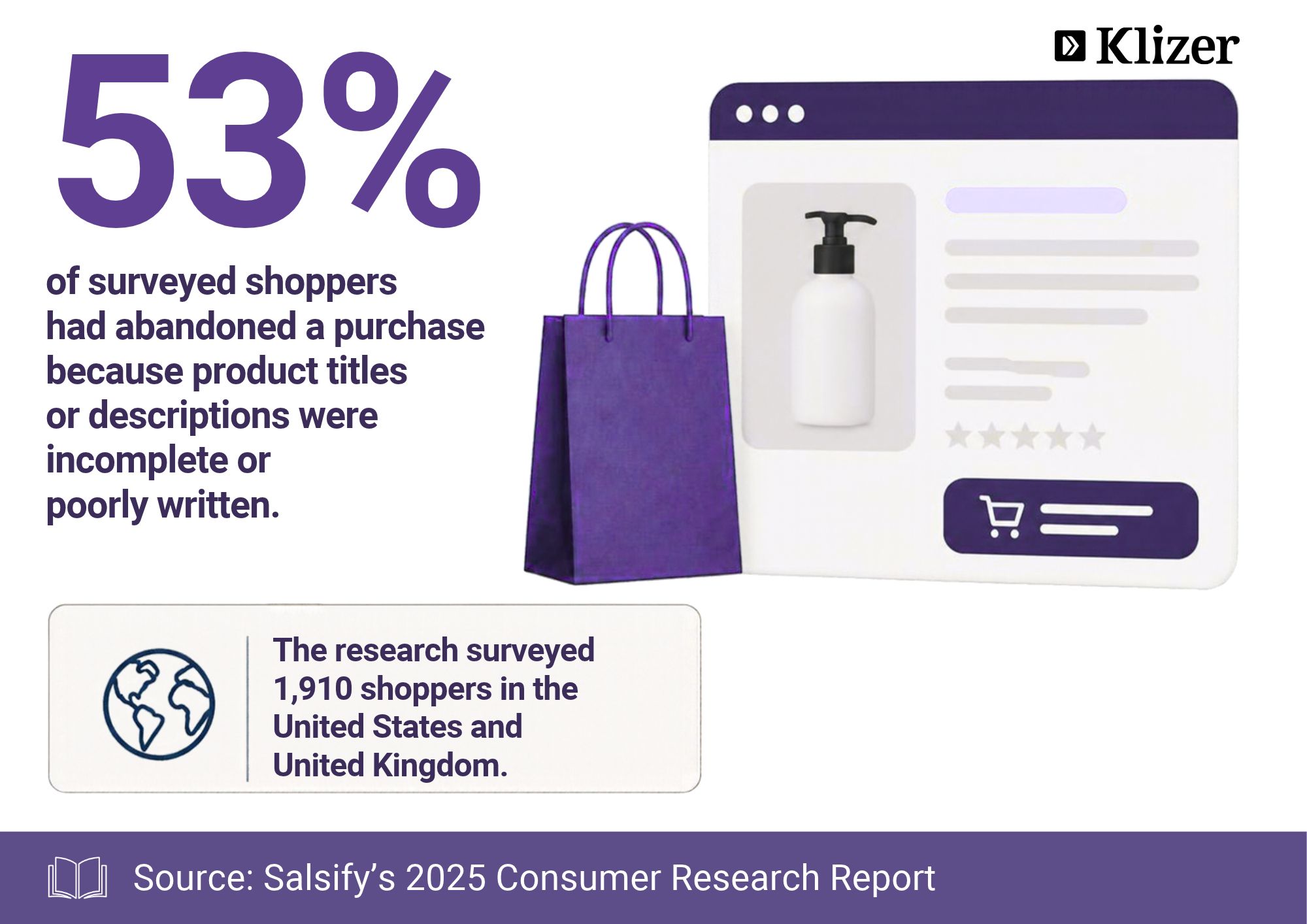
Although this research focuses on general online shoppers, the underlying challenge also matters in B2B ecommerce. Buyers need accurate, relevant information to evaluate products.
When product pages fall short, businesses may face:
- Fewer add-to-cart actions and product inquiries
- More questions for sales and customer service teams
- Longer purchasing cycles
- Lost sales to competitors with more informative listings
Product descriptions should do more than name a product. They should explain its features, applications, specifications, and suitability for the intended use.
3. Inconsistent Information Damages Customer Trust
Product information often comes from multiple sources, including supplier catalogs, spreadsheets, ERP systems, and PIM platforms.
Without consistent data management, the same product may have different specifications or descriptions across sales channels.
A buyer might see one measurement on your ecommerce store and another in a supplier datasheet. Even a small discrepancy can create doubts about product accuracy.
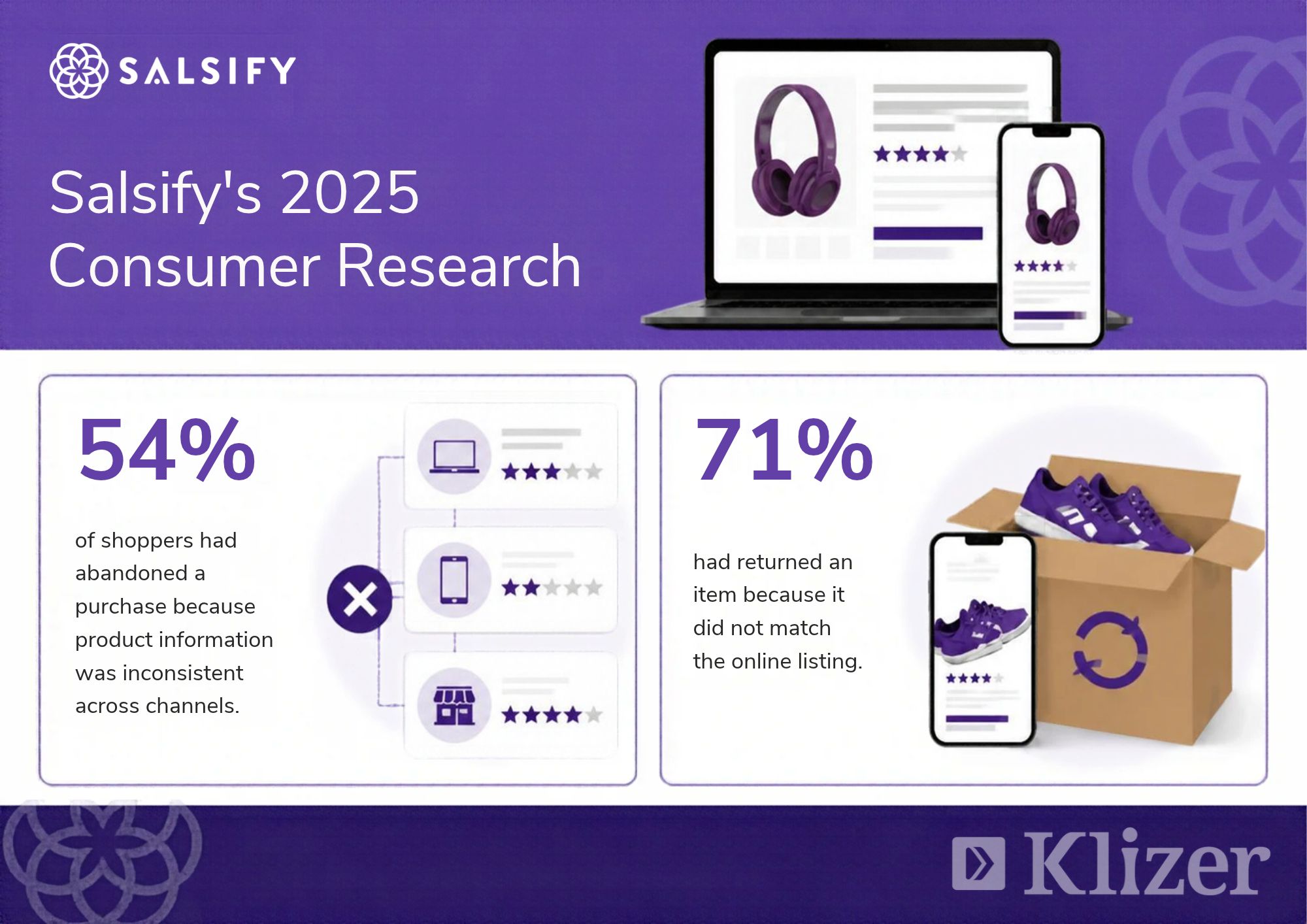
For industrial distributors and manufacturers, incorrect product details can lead to avoidable returns, shipping costs, procurement delays, and compatibility problems.
To reduce these risks, businesses should:
- Establish a trusted source for product specifications.
- Standardize attribute names and measurement units.
- Validate product information against approved sources.
- Synchronize updates across relevant sales channels.
- Review product data regularly.
Consistent product information helps customers make informed decisions and sets accurate expectations before they place an order.
4. Poor Product Attributes Limit Product Discovery
Product discovery is not just about Google rankings. Your own ecommerce store needs to help buyers navigate large catalogs and find suitable products quickly.
Consider a distributor selling thousands of electrical components. Buyers may search by voltage, material, connector type, manufacturer, or part number.
If these attributes are missing or stored inconsistently, relevant products may not appear when customers use search filters.
This creates unnecessary friction, particularly for buyers who know the specifications they need but not the exact product name.
Product data enrichment can improve discovery by:
- Filling missing product attributes
- Standardizing technical terminology
- Organizing products into relevant categories
- Improving search filters and facets
- Adding accurate compatibility and application details
For businesses with complex catalogs, these improvements help customers narrow down options and locate the right products with less effort.
5. Manual Product Updates Slow Down Your Team
Managing product information manually becomes difficult as catalogs grow.
Supplier specifications may arrive in PDFs, spreadsheets, and lengthy technical documents. Catalog teams must extract the information, enter it into the correct fields, write descriptions, and check for errors before publishing products.
This work takes time and can delay product launches.
AI-powered product data enrichment can automate parts of the process by extracting specifications, mapping attributes, identifying missing fields, and preparing structured product content.
Instead of manually processing every product from scratch, teams can focus on validating information and resolving exceptions.
This is especially useful for manufacturers and distributors onboarding products from multiple suppliers or maintaining large catalogs across several sales channels.
How AI Improves Product Data Enrichment
AI can help businesses enrich large product catalogs without relying entirely on manual data entry.
A typical workflow includes five steps:
- Extract product information: Identify relevant details in supplier PDFs, spreadsheets, technical datasheets, and catalogs.
- Standardize attributes: Map information to the correct fields and apply consistent naming conventions and measurement units.
- Identify missing data: Flag incomplete specifications, inconsistent values, and potential errors.
- Improve product content: Generate clearer titles and descriptions based on verified product information.
- Validate and publish: Review enriched data and prepare it for the relevant PIM, ecommerce platform, or marketplace.
Human review remains important for technical specifications, safety information, compatibility claims, and other details where accuracy is critical. AI should not invent missing product information.
When combined with validation rules and clear data standards, AI can help catalog teams improve consistency and manage product information more efficiently.
How to Identify Product Data Problems in Your Catalog
Before investing in product data enrichment, review your current catalog to understand where information gaps are affecting sales and search visibility.
Start with these questions:
- Are product pages complete? Check for missing specifications, generic titles, and incomplete descriptions.
- Are customers finding your products? Review organic search performance and internal search queries.
- Are buyers struggling to choose? Look for repeated product questions, low conversion rates, and zero-result searches.
- Is product information consistent? Compare details across your ERP, PIM, ecommerce store, and supplier sources.
- Is catalog management taking too long? Identify repetitive manual tasks that delay product onboarding and updates.
Once you identify the gaps, prioritize products with high traffic, frequent searches, strong sales potential, or recurring customer complaints.
Track improvements through organic search clicks, product page conversions, internal search success, catalog completeness, product onboarding time, and returns caused by inaccurate information.
Establish a baseline before making changes so you can measure whether your enrichment efforts are delivering results.
Conclusion
Poor product data can make products harder to find, harder to evaluate, and harder to buy. For manufacturers and distributors managing large catalogs, fixing these gaps manually can become increasingly difficult.
Product data enrichment helps improve catalog accuracy, search relevance, and the buying experience. AI can make the process more scalable by extracting product information, standardizing attributes, and identifying missing details.
Klizer’s AI eCommerce Product Data Enrichment Services help businesses automate product data extraction, enrichment, and standardization while preparing information for existing PIM systems, ecommerce platforms, and marketplaces.
FAQs
1. What is product data enrichment in ecommerce?
Product data enrichment improves existing product information by adding missing specifications, correcting inconsistencies, standardizing attributes, and improving product titles and descriptions.
2. How does poor product data affect SEO?
Incomplete titles, descriptions, and product attributes can make it harder for search engines to understand product pages and match them with relevant searches. Enriched product data supports SEO but does not guarantee higher rankings.
3. Can AI automate product data enrichment?
Yes. AI can extract information from supplier documents, standardize attributes, identify missing fields, and assist with product descriptions. Validation and human review help ensure accuracy.
4. Why is product data enrichment important for B2B ecommerce?
B2B buyers often need detailed technical specifications, compatibility information, and accurate product attributes. Enriched data helps them evaluate products and navigate complex catalogs.
5. How can businesses measure product data enrichment results?
Businesses can track organic search performance, product page conversions, internal search success, catalog completeness, product onboarding time, and returns related to inaccurate product information.