

Laboratory equipment buyers have specific requirements when purchasing products online. Researchers need accurate specifications, lab managers need reliable product availability, and procurement teams need a simple way to compare products, manage budgets, and place orders.
For distributors, meeting these expectations requires more than listing products on a website. A well-planned laboratory equipment distributor ecommerce strategy can make product discovery easier, simplify purchasing, and help businesses reach more customers.
However, managing a large catalog of scientific instruments, laboratory consumables, chemicals, and specialized equipment comes with its own challenges. Product information must be accurate, inventory needs to stay updated, and customers may require different pricing and purchasing options.
So, how can laboratory equipment distributors increase online sales? Here are eight practical strategies to improve the online buying experience and create more sales opportunities.
ON THIS PAGE
Why Should Laboratory Equipment Distributors Focus on eCommerce?
Laboratory purchasing is becoming increasingly digital. Buyers often research products online, compare specifications across brands, and check availability before contacting a supplier.
According to DKSH’s research on laboratory procurement, laboratory buyers increasingly expect convenient online purchasing experiences, transparent product comparisons, and fewer manual interactions during procurement.
Traditional ordering methods, such as phone calls, emails, and manual purchase orders, can make the process time-consuming. Customers may need to contact sales representatives to check stock, confirm prices, or request product documentation.
A strong B2B ecommerce website can reduce these challenges by giving buyers access to product information, pricing, ordering tools, and account details in one place.
For distributors, this creates opportunities to:
- Reach new laboratory buyers through online searches.
- Make large product catalogs easier to navigate.
- Reduce manual work involved in processing orders.
- Encourage repeat purchases of laboratory supplies.
- Provide a more convenient experience for existing customers.
- Identify opportunities to cross-sell related products.
The goal is not to replace sales representatives. It is to make routine purchasing easier while allowing sales teams to focus on more complex customer requirements.
8 Ways Laboratory Equipment Distributors Can Increase Online Sales

1. Make Product Discovery Easier with Better Search and Navigation
Laboratory equipment catalogs can contain thousands of products across different categories, manufacturers, and applications. Finding the right product can become difficult when a website relies on basic search functionality.
For example, a researcher looking for a specific centrifuge may need to compare capacity, speed, temperature range, and rotor compatibility before making a purchase.
If the website only supports searches by product name, customers may struggle to find suitable options.
A better approach is to improve product discovery with:
- Advanced search: Allow buyers to search using product names, SKUs, manufacturer part numbers, and keywords.
- Category-based navigation: Organize products into categories such as analytical instruments, microscopes, laboratory glassware, chemicals, and safety equipment.
- Specification filters: Let customers narrow results by capacity, dimensions, material, measurement range, and other relevant attributes.
- Brand filters: Help buyers find products from their preferred manufacturers.
- Compatible product suggestions: Display related accessories, replacement parts, and compatible consumables.
A well-organized search experience helps customers find suitable products without spending time browsing through unrelated listings.
It also gives distributors a better opportunity to convert visitors who already know what they want to purchase.
2. Create Detailed Product Pages with Accurate Information
Laboratory equipment purchases often involve technical evaluation. Buyers need to understand whether a product meets their laboratory’s requirements before placing an order.
A product page with only a name, image, and short description may not provide enough information to support purchasing decisions.
A laboratory distributor website should provide detailed product information, including:
- Technical specifications and product dimensions.
- Manufacturer and model information.
- Product images and available documentation.
- Operating requirements and compatibility details.
- Available accessories and replacement parts.
- Packaging details and unit of measurement.
- Warranty and support information, where applicable.
For example, a buyer comparing two laboratory microscopes may need information about magnification, illumination, objective lenses, and camera compatibility.
Providing these details directly on product pages helps customers evaluate their options without repeatedly contacting the sales team.
Product comparisons can also improve the experience. Allow buyers to compare specifications across similar products so they can understand the differences before making a decision.
Accurate and complete product information can reduce uncertainty and help customers move closer to purchasing.
3. Simplify Bulk Ordering and Repeat Purchases
Laboratories regularly purchase consumables such as pipettes, gloves, test tubes, reagents, filters, and other essential supplies.
Many of these products are ordered repeatedly. However, customers may still need to search for individual products and add them to their carts every time they place an order.
This creates unnecessary work for both buyers and distributors.
Lab equipment ecommerce platforms can make repeat purchasing easier through features such as:
Quick order forms: Allow customers to enter multiple SKUs and quantities to add products directly to their carts.
Saved shopping lists: Let buyers create lists of frequently purchased laboratory supplies for future orders.
Reorder functionality: Provide access to previous orders so customers can quickly purchase the same products again.
Bulk quantity options: Support case quantities, pack sizes, and minimum order requirements where applicable.
Purchase order support: Allow business customers to use their preferred purchasing and approval processes.
These features are particularly useful for research institutions, universities, hospitals, and industrial laboratories that regularly purchase the same supplies.
Making repeat orders easier can encourage customers to continue purchasing through the distributor’s website instead of switching to another supplier for convenience.
4. Offer Personalized B2B Buying Experiences
Not every laboratory customer has the same purchasing requirements.
A university research department may purchase through an approved institutional account, while a pharmaceutical company may follow negotiated pricing and internal procurement procedures.
A standard ecommerce experience may not support these differences.
B2B laboratory ecommerce should provide account-based features that reflect how business customers actually purchase.
Important capabilities include:
- Customer-specific pricing: Display negotiated prices based on customer accounts or contracts.
- Custom catalogs: Show products relevant to specific institutions, departments, or customer groups.
- Multiple user accounts: Allow purchasing managers, researchers, and finance teams to access the same company account with appropriate permissions.
- Approval workflows: Support internal purchasing approvals before orders are submitted.
- Flexible payment terms: Offer approved customers suitable payment options, including purchase orders and agreed credit terms.
- Order history: Give customers access to previous purchases, invoices, and order information.
For example, a university may have multiple research departments purchasing from the same distributor. Account-based purchasing allows each department to manage its requirements while following the institution’s purchasing rules.
These capabilities make the buying process more convenient and help distributors serve different customer segments through one ecommerce platform.
5. Integrate eCommerce with ERP for Accurate Business Information
A well-designed storefront cannot deliver a reliable purchasing experience if the information displayed online does not match the distributor’s actual business data.
For example, a customer may place an order based on an available stock quantity, only to discover later that the product is out of stock. Similarly, outdated pricing or incorrect order information can create confusion.
This is where ERP integration becomes important.
Connecting the ecommerce platform with an ERP system helps synchronize essential business information, including:
- Product details and SKUs.
- Inventory availability across warehouses.
- Customer-specific pricing.
- Customer account information.
- Sales orders and order statuses.
- Shipping and fulfillment information.
For example, when a customer places an order through the website, the order can flow into the ERP for processing. Inventory and order status updates can then be reflected on the storefront.
This reduces the need for manual data entry and helps keep information consistent across systems.
For laboratory equipment distributors managing multiple warehouses, brands, and product categories, ERP integration also supports more reliable inventory visibility and order management.
A connected ecommerce and ERP environment makes it easier to manage online sales without creating additional operational complexity.
6. Make Product Inquiries and Quote Requests Easier
Not every laboratory purchase can follow a standard add-to-cart and checkout process.
High-value instruments, specialized equipment, bulk purchases, and customized configurations may require additional discussions before an order is confirmed.
For these products, distributors should provide convenient ways for customers to connect with the sales team.
Consider adding:
Request a Quote: Allow buyers to submit quote requests directly from product pages or shopping carts.
Product Inquiry Forms: Give customers a way to ask questions about specifications, availability, compatibility, and product applications.
Live Chat: Provide assistance when buyers need clarification during product research or purchasing.
Sales Representative Support: Allow customers to connect with representatives for complex purchases or technical discussions.
Quote Management: Enable sales teams to review requests, prepare pricing, and share quotations with customers.
These options help prevent potential customers from leaving the website when they cannot complete a purchase immediately.
They also support a combination of self-service ordering and sales-assisted purchasing, which is important for distributors handling both routine supplies and complex equipment.
7. Improve Search Engine Visibility with SEO and Educational Content
A well-designed ecommerce website needs relevant traffic to generate sales.
Laboratory buyers often use search engines to find specific products, compare equipment, and research technical requirements. Distributors can reach these buyers by improving their website’s search visibility.
Start with product and category page optimization.
Focus on relevant keywords: Use product names, model numbers, manufacturer names, and application-related search terms in page titles, descriptions, headings, and product content.
Create useful category pages: Develop dedicated pages for important product groups, such as laboratory instruments, analytical equipment, microscopes, and scientific supplies.
Publish educational content: Create articles that answer common questions about equipment selection, product comparisons, applications, and maintenance.
For example, a distributor selling analytical balances could publish content explaining how to choose the right balance for different laboratory applications.
Optimize product information: Use descriptive URLs, relevant image alt text, structured product information, and appropriate internal links.
Improve technical SEO: Ensure the website is mobile-friendly, loads efficiently, supports secure browsing, and allows search engines to crawl important product pages.
Educational content can attract buyers during the research stage, while optimized product and category pages help them find products when they are ready to purchase.
Together, these efforts can bring more relevant visitors to the website and create additional opportunities for online sales.
8. Use Customer Data to Improve the Buying Experience
Understanding customer behavior can help laboratory equipment distributors identify what is working on their ecommerce websites and where buyers are facing difficulties.
Website analytics can provide useful information about:
- Products and categories receiving the most visits.
- Search terms customers use on the website.
- Products frequently added to carts.
- Pages where customers leave without completing a purchase.
- Repeat purchasing patterns.
- Products commonly purchased together.
For example, if customers frequently search for a particular product but leave without placing an order, the distributor can investigate whether the product information, pricing, availability, or checkout process needs improvement.
Customer data can also support relevant product recommendations.
A customer purchasing a microscope may also need compatible slides, lenses, or cleaning accessories. Showing relevant products can help buyers discover additional items while creating cross-selling opportunities.
Distributors can also use purchase history to identify customers who may need replenishment reminders for regularly purchased consumables.
The important part is to use this information to make the buying experience more relevant and convenient, rather than simply displaying more products.
What Should Laboratory Equipment Distributors Look for in an eCommerce Platform?
Implementing the right ecommerce platform is an important part of building a reliable online sales channel.
Laboratory distributors should consider their catalog size, customer requirements, existing business systems, and ordering processes before selecting a platform.
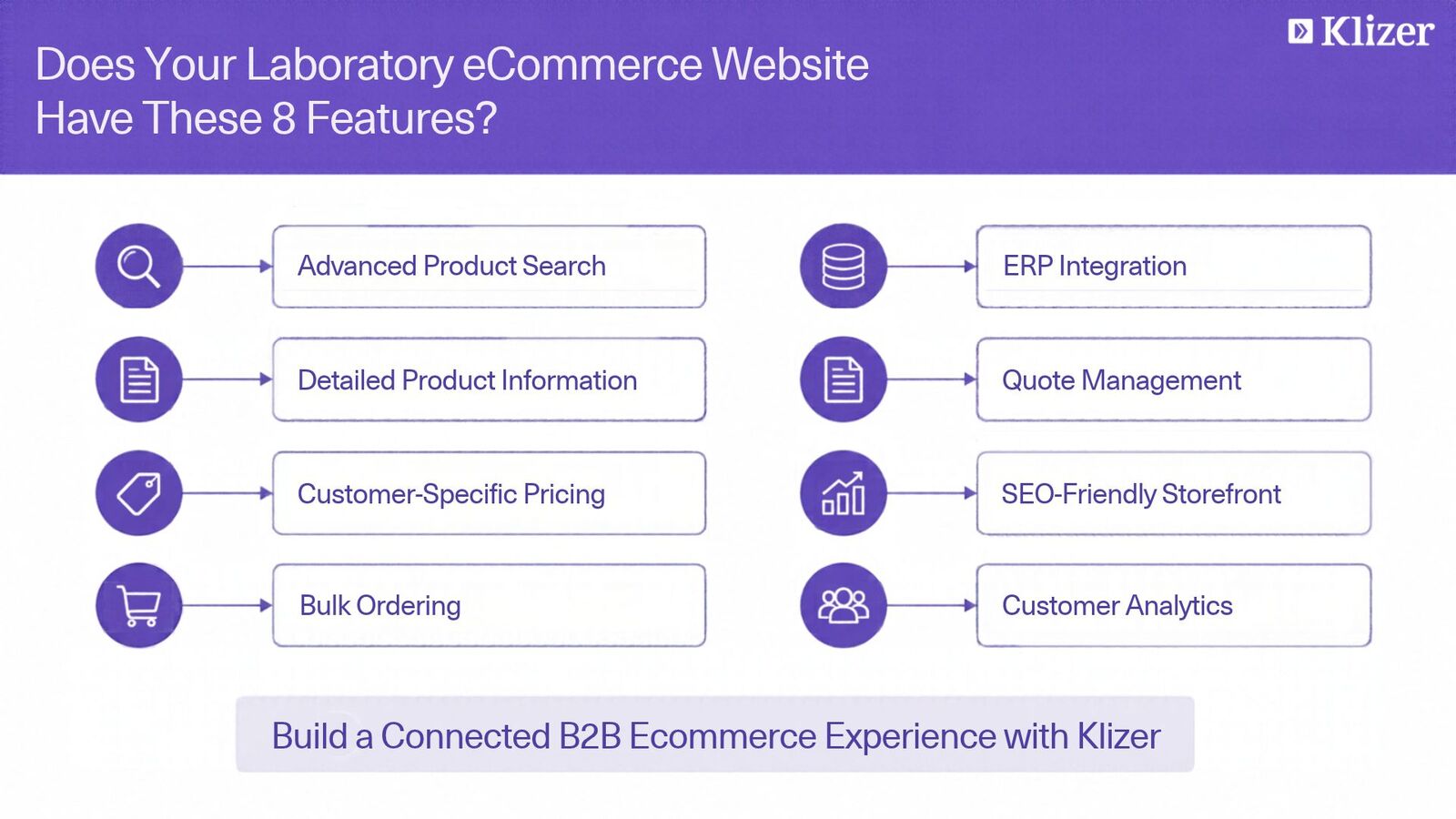
Here are some important capabilities to evaluate:
| eCommerce capability | Why it matters |
| Advanced product search | Helps buyers find products using SKUs, names, and specifications. |
| Product information management | Keeps technical details, images, and documentation organized. |
| B2B account management | Supports customer-specific pricing, catalogs, and purchasing permissions. |
| Bulk ordering | Makes large and recurring orders easier to place. |
| ERP integration | Keeps product, inventory, pricing, and order information synchronized. |
| Quote management | Supports complex equipment purchases and negotiated pricing. |
| SEO capabilities | Helps product and category pages reach relevant buyers. |
| Analytics | Provides insights into customer behavior and sales opportunities. |
Platforms such as Adobe Commerce and Shopify Plus can support different B2B ecommerce requirements. The right choice depends on the distributor’s business model, integration needs, catalog complexity, and expected growth.
It is also important to consider how the platform will support future requirements. Adding new product categories, customer accounts, integrations, and ordering capabilities should not require rebuilding the entire ecommerce experience.
Conclusion
Increasing online sales requires laboratory equipment distributors to make purchasing easier at every stage. From product discovery and detailed product information to bulk ordering, personalized pricing, and ERP integration, each improvement can help remove barriers in the buying process.
A well-planned B2B ecommerce solution also gives distributors more opportunities to attract new customers, encourage repeat purchases, and support complex buying requirements.
Klizer’s ecommerce development services help B2B distributors build connected ecommerce experiences with the right storefront capabilities, integrations, and business processes.
Looking to improve your laboratory distributor website and grow online sales? Book a consultation with Klizer.