

B2B ecommerce is fundamentally different from traditional B2C commerce.
A distributor may manage tens or hundreds of thousands of products, serve thousands of business customers, maintain customer-specific pricing, connect with ERP and warehouse systems, and support complex ordering rules. Customers may also expect real-time stock availability, minimum order quantities, purchase restrictions, approval workflows, and fast repeat ordering.
For distributors, the challenge is not simply building an online storefront. The real challenge is creating a high-performance commerce platform that can connect multiple enterprise systems while delivering a simple buying experience.
This is where Shopware’s API-first architecture becomes valuable.
Instead of forcing every business process into the storefront, Shopware can act as a commerce orchestration layer, exposing commerce capabilities through APIs and allowing external systems such as ERP, PIM, WMS, CRM, pricing engines, and customer portals to participate in the overall architecture.
For B2B distributors, this approach provides three important advantages:
- Flexibility — business processes can be extended without rebuilding the entire platform.
- Integration — enterprise systems can communicate with commerce through APIs and events.
- Performance — frontend, backend, search, caching, and integrations can be scaled independently.
ON THIS PAGE
Why API-First Matters for B2B Commerce
A simple B2C store typically has one storefront talking to one backend. A B2B distributor’s architecture is significantly more complex: a storefront communicating with an ERP for pricing and inventory, a PIM for product content, a WMS for fulfillment status, a CRM for account management, and potentially a separate pricing engine for contract-based rates. Without an API-first foundation, each of these connections requires bespoke point-to-point integrations that break during upgrades and resist change.
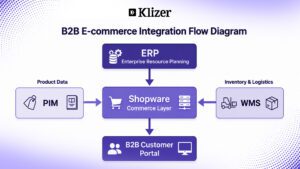
Shopware exposes three distinct API surfaces for different integration purposes. The Store API serves customer-facing requests: product data, categories, pricing, inventory, carts, and checkout. The Admin API handles backend operations including product management, order processing, and administration workflows. The Sync API handles bulk data operations and high-volume synchronization tasks such as catalog imports.
For example, the data flows in a B2B distributor architecture typically look like this:
- PIM to Shopware: product information, categories, attributes, media, and product relationships.
- ERP to Shopware: inventory, customer accounts, pricing, order status, and payment information.
- Shopware to ERP: orders, customer information, addresses, and order changes.
- WMS to Shopware: available stock, fulfillment status, and delivery information.
The result is a modular Shopware integration architecture where each system does what it is best at, and Shopware acts as the orchestration layer that connects them.
Customer-Specific Pricing
Pricing is one of the most important requirements in B2B distribution.
A distributor may have:
Customer A → €100
Customer B → €95
Customer C → €90
Customer D → Contract Price
Pricing may depend on customer, customer group, contract, quantity, product, product category, sales region, currency, and promotional rules.
Instead of maintaining all pricing logic inside the frontend, the commerce architecture can retrieve the appropriate price through backend services:
GET /api/product/{productId}/price
The commerce layer evaluates the customer context, applicable price list, contract terms, and quantity breaks, then returns the correct price. This approach allows distributors to integrate external pricing engines or ERP-based pricing without tightly coupling the frontend to the pricing implementation.

Real-Time Inventory for Distributors
Inventory accuracy is critical for distributors. Customers often need to know: “Can I order 50 units today?”
The answer may depend on stock across multiple warehouses and incoming purchase orders. The commerce platform can expose inventory information through APIs while keeping the storefront independent of the ERP implementation:
json

{

  "product": "P10045",

  "availableStock": 125,

  "minimumOrderQuantity": 10,

  "purchaseStep": 5,

  "deliveryTime": "2-3 days"

}
The frontend consumes this response and renders an accurate purchasing experience: the buyer sees real availability, the correct minimum order quantity, and a reliable delivery estimate, all sourced from the ERP in real time rather than from a cached approximation.
Caching for High-Volume B2B Catalogs
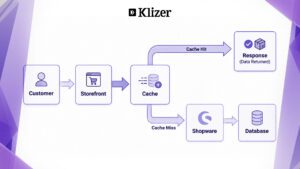
Distributors often have large catalogs. If 100,000 products exist in the system, repeatedly querying the database for the same product information creates unnecessary load and slows the storefront for every buyer.
Good candidates for caching include relatively stable data such as product information, categories, CMS content, navigation, search results, and configuration data. Highly dynamic information such as customer-specific prices or real-time inventory requires more careful cache strategies: invalidation on change, per-customer cache keys, and short TTLs where freshness matters.
The key principle is: cache stable data aggressively and handle dynamic B2B data intelligently.
Explore our Shopware development services for B2B distributors and manufacturers
Asynchronous Processing
Not every operation needs to happen synchronously during a customer’s request.
For distributors, large processes can be moved to asynchronous workers. Examples include product imports, price updates, inventory synchronization, image processing, ERP synchronization, order exports, and customer data synchronization.
Large data operations can be handled asynchronously: the request creates a job, the job enters a queue, a worker processes the data in the background, and Shopware is updated once processing is completed. This prevents long-running background operations from blocking customer-facing requests.
For large distributors, this is an important part of maintaining predictable application performance during bulk imports, nightly ERP syncs, and peak traffic periods simultaneously.
Headless B2B Commerce
API-first architecture also enables different customer experiences from the same commerce backend.
A distributor may need to serve: a traditional storefront for general buyers, a customer portal for account management and reordering, a mobile application for field sales, a sales representative portal, a dealer portal, a marketplace integration, and an internal ordering application for the operations team.
Without API-first architecture, each of these requires its own commerce logic. With Shopware’s headless commerce model, the same commerce backend serves all of them through the Store API. Pricing, inventory, catalog entitlements, and ordering rules are resolved once, in one place, and delivered to whichever frontend is making the request.
This is particularly useful for distributors that want to provide different interfaces to different customer groups without maintaining separate commerce stacks for each.
Read More: Shopware Multi-Company Accounts: How to Build a Multi-Company B2B Portal
B2B Ordering Workflows
B2B purchasing often involves multiple people.
The B2B ordering workflow enables buyers to create and submit orders, route them through the appropriate approval process, and automatically send approved purchase orders to the ERP for fulfillment, reducing manual intervention and improving order accuracy.
The commerce platform needs to support business rules around: customer accounts, roles, permissions, approval processes, purchase limits, company structures, addresses, and payment terms.
API-first architecture makes these processes accessible to custom B2B applications and external enterprise systems. This means a distributor can build a workflow around its existing business process rather than forcing employees to change how they work.
API-First Architecture and Scalability
The biggest benefit is not simply having APIs. It is the ability to scale different parts of the commerce architecture independently.
A monolithic platform scales as one unit: when the catalog search is under load, the checkout scales with it even if checkout is idle. In an API-first architecture, each component can be optimized for its own workload:
- High traffic: scale application nodes.
- Large catalog: optimize search and caching.
- Large imports: increase worker capacity.
- ERP integration load: use queues and asynchronous processing.
- Database pressure: optimize queries, indexes, caching, and infrastructure.
This is significantly more effective than simply increasing the size of a single server, and it is the reason large B2B distributors consistently choose composable, API-first architectures over monolithic platforms as their order volumes and catalog complexity grow.

Business Benefits for Distributors and B2B
- Faster digital transformation: Distributors can connect existing ERP, PIM, WMS, and CRM systems instead of replacing everything.
- Better customer experience: Customers can access personalized pricing, real-time availability, faster search, quick reorder, order history, and account-specific catalogs.
- Lower integration coupling: APIs and events provide defined communication boundaries between systems. When one system changes, the others are insulated.
- Improved scalability: Application, search, cache, database, and workers can be optimized independently based on actual workload.
- Faster feature development: Developers can build custom B2B portals, mobile experiences, and integrations without rewriting the entire commerce platform.
- Better operational efficiency: Automation can reduce manual work in product synchronization, pricing updates, inventory synchronization, order processing, and customer management.
Read more: Shopware B2B Commerce: Developer Guide to Features & Best Practices
Conclusion
For B2B distributors, the future of ecommerce is not simply about building a faster storefront. It is about creating a connected commerce ecosystem that can handle complex products, customer relationships, pricing, inventory, orders, and enterprise integrations at scale.
Shopware’s API-first architecture provides a strong foundation for this model. The real value comes from combining APIs, events, caching, asynchronous processing, search, ERP/PIM/WMS integration, and scalable infrastructure. Together, these capabilities allow Shopware to operate as more than an online store. It becomes the commerce orchestration layer between a distributor’s customers and its enterprise systems. This is also the foundation of composable commerce: building a full stack from modular, independently deployable services that each do one job well.
For distributors looking to modernize B2B commerce, this architecture provides a path to build experiences that are flexible, scalable, integration-ready, and performance-focused.
Klizer builds connected commerce systems for manufacturers and distributors on Shopware, Adobe Commerce, Magento, Shopify Plus, and BigCommerce. If you are evaluating Shopware’s API-first architecture for a B2B implementation, book a free consultation to map your integration requirements and build a system that scales.