
B2B buyers today expect the same relevance they get as consumers: account-specific pricing, role-based catalogs, and content that reflects their actual procurement context. Most B2B storefronts still deliver none of that.
That means the storefront experience carries most of the weight, and generic experiences are losing deals before your sales team ever gets involved.
Personalized B2B content helps businesses deliver relevant experiences at scale while improving engagement, conversion rates, and customer relationships.
This guide covers what B2B ecommerce personalization is, how it differs from B2C, the strategies that work at scale, the challenges that derail most implementations, and what the data foundation actually needs to look like.
ON THIS PAGE
What is B2B eCommerce Personalization?
B2B ecommerce personalization is the process of tailoring the online buying experience to meet the unique needs of individual business customers, accounts, or buyer groups.
A wholesale distributor purchasing industrial equipment does not need the same recommendations as a healthcare supplier ordering medical products. Yet most B2B websites still treat every buyer the same: same homepage, same catalog, same pricing regardless of contract terms.
Personalization for B2B ecommerce fixes that. It helps businesses present the right products, content, and offers to the right accounts at the right time. For example, a returning customer might see:
- Account-specific pricing and discounts
- Products frequently reordered by their organization
- Relevant industry resources and guides
- Customized product recommendations based on previous purchases
- Personalized promotions aligned with their buying patterns
How B2B Personalization Differs from B2C
B2B and B2C personalization share the same goal but require completely different data models and strategies.
| B2C | B2B | |
| Buying unit | Individual shopper | Procurement team, multiple stakeholders |
| Pricing | Public prices, occasional promotions | Contract rates, volume discounts, account-specific pricing |
| Purchase pattern | One-off or seasonal | Recurring, scheduled, planned |
| Decision driver | Convenience and emotion | ROI, compliance, risk reduction |
| Personalization focus | Browsing behavior, preferences | Account recognition, role-based catalogs, contract terms |
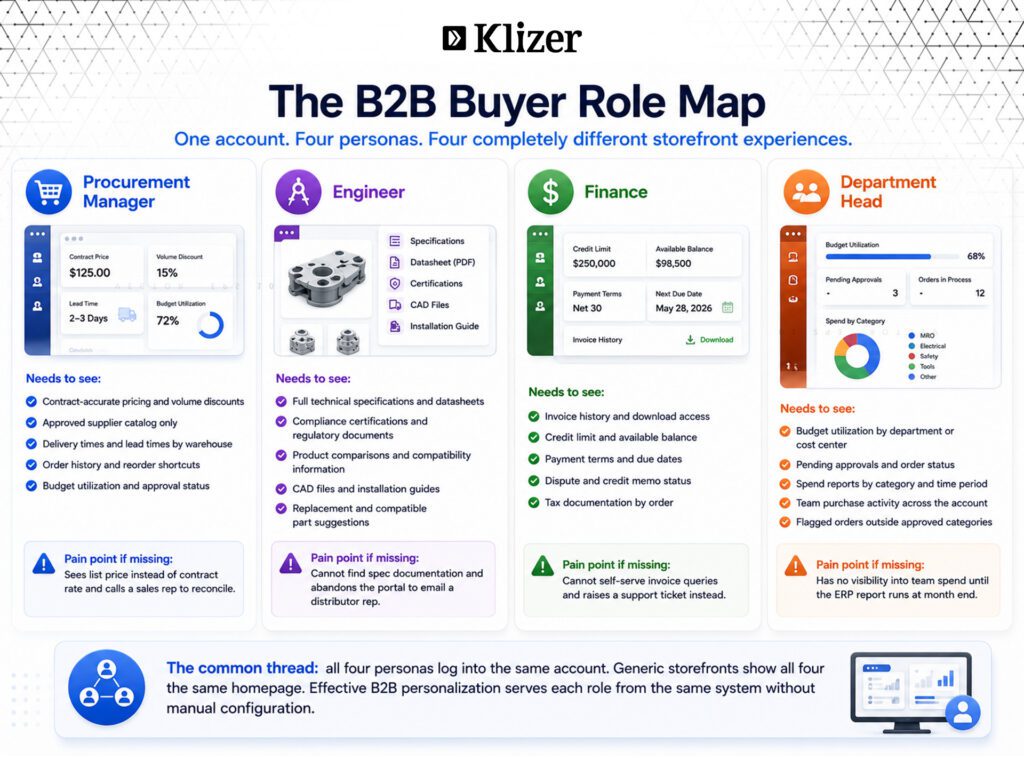
In B2B, a procurement manager wants to see pricing, discounts, and delivery times. An engineer on the same account wants technical specs and compliance documents. Effective personalization serves both from the same system, without requiring manual configuration for every account.
How AI Is Changing B2B Personalization in 2026
Rule-based personalization has a ceiling. It applies predefined logic: if the buyer is in segment A, show catalog B. AI removes that ceiling by reading real-time signals and adapting continuously. 49% of B2B decision-makers cite the ability to personalize the customer experience as a top reason for choosing a search solution with AI capabilities.
The four capabilities that matter most in B2B:
1. Predictive recommendations and intent prediction
AI analyzes purchase history, browsing behavior, and account-level signals to predict what a buyer needs before they search for it. In B2B this means surfacing replenishment items, flagging components that pair with a recent order, and predicting reorder timing based on purchase cycles. Product recommendations account for up to 31% of ecommerce revenues.
2. Dynamic search ranking and personalized search
AI-powered search combines behavioral context, historical purchase data, and situational signals to understand why a customer is searching, enabling predictive discovery that surfaces relevant products before customers have fully articulated their needs. In B2B, this means an engineer searching “seal” on an industrial distributor’s site sees hydraulic seals ranked first based on their account’s purchase history, not generic popularity.
3. AI-assisted quoting
For B2B sellers with complex pricing structures, AI can pre-populate quote requests with contract-accurate pricing, flag items outside a buyer’s approved catalog, and suggest alternatives when a line item is out of stock. This reduces the back-and-forth between buyers and sales teams on routine RFQs. By 2026, at least one in five B2B sellers will be compelled to respond to AI-powered buyer agents with dynamically delivered counteroffers via seller-controlled agents, according to Forrester.
4. Agentic commerce
McKinsey projects agentic commerce could drive as much as $1 trillion in US retail revenue and $3 to $5 trillion globally by 2030. In B2B, this means procurement agents that query your catalog, verify contract pricing, check stock, and place orders autonomously. Personalization in this context is not about what the storefront shows. It is about whether your catalog, pricing, and inventory data is structured well enough for an agent to read and act on it without human intervention.
What are the Top Benefits of Personalization in Marketing for B2B Companies?
1. Increases Conversion Rates and Revenue
Brands that excel at personalization generate 40% more revenue from these activities compared to average players. Relevant recommendations drive purchasing decisions. By leveraging customized product recommendations, businesses can surface complementary products, replenishment items, and frequently purchased bundles based on account history and buyer behavior.
Amazon Business applies this at scale, using purchasing insights and account history to surface products relevant to each organization’s procurement needs, reducing search time and increasing order frequency.
2. Strengthens Customer Retention and Loyalty
Customer retention is often more profitable than customer acquisition, especially in B2B industries where relationships drive long-term revenue. Personalization for B2B ecommerce helps businesses maintain those relationships by delivering consistent value through tailored experiences.
Industrial manufacturers using Adobe Commerce can create account-specific catalogs and personalized purchasing experiences that support long-term customer engagement. In implementations we have worked on for manufacturers running Epicor or Prophet 21, connecting ERP pricing to the storefront directly reduced off-contract purchasing and increased repeat order rates within the first quarter post-launch.
3. Enhances Account-Based Marketing Performance
Successful Account-Based Marketing relies on delivering highly relevant experiences to target accounts. Through personalized B2B content, companies can address the specific challenges, priorities, and goals of different industries or buyer groups. Salesforce uses account-based strategies and customer data to deliver tailored experiences across multiple touchpoints.
4. Drives Better B2B Sales Outcomes
When buyers receive relevant content, tailored recommendations, and account-specific experiences, they make purchasing decisions more quickly and confidently. Schneider Electric has invested in digital customer experiences to help business buyers access relevant products, technical resources, and purchasing information more efficiently, directly reducing reliance on sales rep involvement for routine orders.
What are the Core Strategies for Personalization for B2B eCommerce?
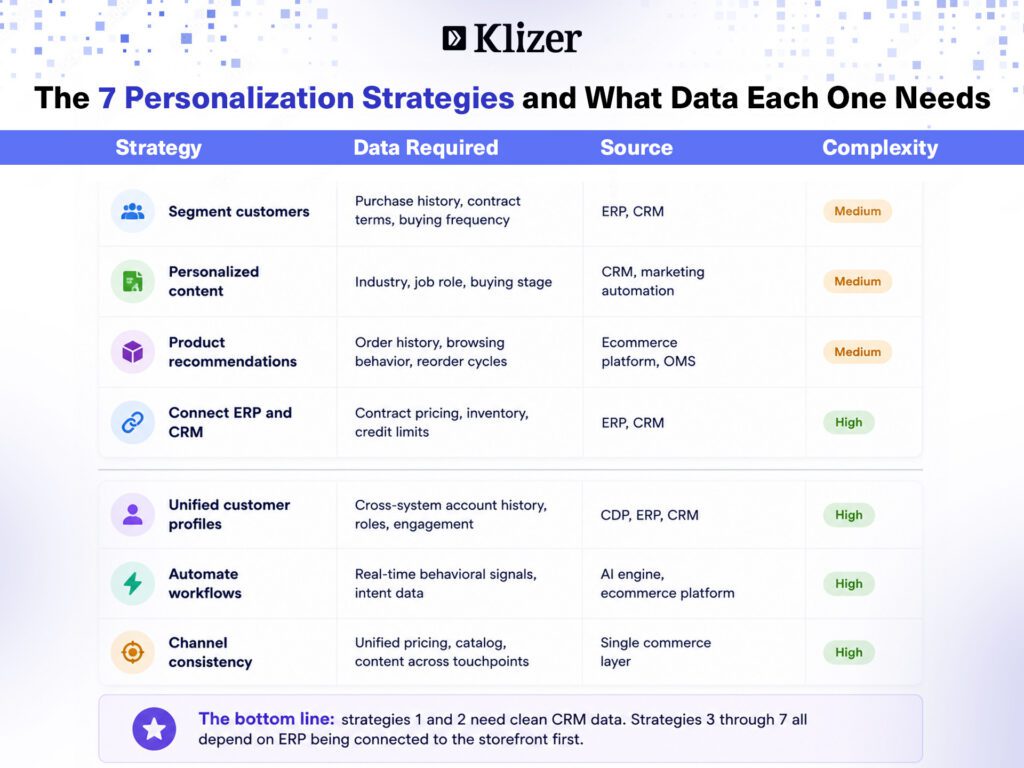
1. Segment Customers Beyond Basic Demographics
Not every customer has the same needs, even within the same industry. Segment accounts based on:
- Purchase history
- Product preferences
- Industry-specific requirements
- Contract terms
- Customer lifetime value
- Buying frequency
2. Deliver Personalized B2B Content
Generic content fails to address the unique challenges different buyers face. Leading organizations invest in personalized B2B content tailored to specific industries, job roles, and buying stages. Examples include:
- Industry-specific case studies
- Customized landing pages
- Targeted email campaigns
- Product guides for different buyer personas
- Personalized resource recommendations
3. Implement Customized Product Recommendations
Personalized recommendations drive 24% of total orders, according to Salesforce. One of the most effective B2B ecommerce personalization tactics is offering customized product recommendations based on behavioral and transactional data:
- Previously purchased items and natural replenishments
- Frequently bought combinations within the same account
- Industry-relevant product bundles
- Reorder reminders based on purchase cycles
4. Connect ERP and CRM as the Data Foundation
This is where most B2B personalization implementations fail before they start. Personalization is only as good as the data feeding it, and most B2B storefronts are running on incomplete data because ERP and CRM systems are never properly connected to the commerce layer.
The pattern we see consistently in Magento and Adobe Commerce implementations: ERP holds contract pricing, but the storefront falls back to list price because the sync is either broken, delayed, or was never built correctly. The buyer sees the wrong price, loses trust in the portal, and calls a sales rep instead. The personalization investment is wasted.
When ERP and CRM data flows directly into the commerce layer in real time, the storefront can surface contract-accurate pricing, account-specific catalogs, and role-based content automatically. For manufacturers and distributors on Adobe Commerce or Magento, this means connecting Prophet 21, Epicor, or SAP directly to the storefront, not relying on nightly batch syncs that are stale by morning.
5. Build Unified Customer Profiles
A unified customer profile enables teams to deliver consistent pricing, product recommendations, and content experiences across every touchpoint. When customer data is siloed across systems, personalization breaks at the seams: a buyer gets a personalized email but sees generic pricing when they log in.
6. Automate Personalization Workflows
By leveraging AI and personalization engines, companies can automatically trigger product recommendations, personalized emails, targeted promotions, and content suggestions based on customer behavior and intent signals, without increasing operational overhead as the customer base grows.
7. Ensure Consistency Across Channels
B2B buyers interact through websites, customer portals, email campaigns, sales representatives, and mobile applications. Personalization should remain consistent across every interaction. Buyers should receive the same relevant recommendations, pricing, and messaging regardless of where they engage.
What are the Common Challenges in B2B eCommerce Personalization?
1. Disconnected Customer Data
Many B2B organizations store customer information across CRM platforms, ERP software, marketing automation tools, and ecommerce websites that do not communicate with one another. A customer may have negotiated pricing in the ERP, but the ecommerce platform does not reflect those terms, which is one of the most common and damaging personalization failures in B2B.
2. Managing Complex Buyer Journeys
A single B2B account may include procurement managers, department heads, technical evaluators, and financial decision-makers, all with different priorities and information needs. Delivering the right message to the right stakeholder at the right stage requires both role-based data and a well-defined personalization strategy.
3. Scaling Personalized Content
A software company serving healthcare, manufacturing, retail, and financial services customers may need separate case studies, landing pages, email campaigns, and product resources for each vertical. Content volume is one of the most underestimated operational challenges in B2B personalization.
4. Technology and Integration Challenges
Effective personalization requires CRM systems, ecommerce platforms, customer data platforms, marketing automation tools, analytics, and AI-powered recommendation engines to work together. Integrating these systems is significantly harder for organizations operating with legacy infrastructure or disconnected technology stacks.
5. Balancing Personalization with Privacy
Organizations must ensure their personalization strategies comply with GDPR, CCPA, and other regional data protection requirements. Clear processes for data collection, consent management, storage, transparency, and governance are prerequisites for sustainable personalization, not afterthoughts.
Conclusion
The benefits of personalization in marketing for B2B companies are well established. The gap between knowing that and executing it consistently is almost always an infrastructure problem, not a strategy problem.
For manufacturers and distributors, the right starting point is the ERP connection, not the personalization engine. Most teams invest in recommendation tools before their pricing and catalog data is clean enough to personalize. Getting the data layer right first is what separates B2B ecommerce personalization implementations that hold from ones that require constant manual correction and generate buyer distrust instead of loyalty.
Klizer builds connected commerce systems for manufacturers and distributors: storefront, ERP integration, and Operational AI under one roof. If you are ready to deliver personalized, account-based experiences that drive measurable results, contact Klizer today.