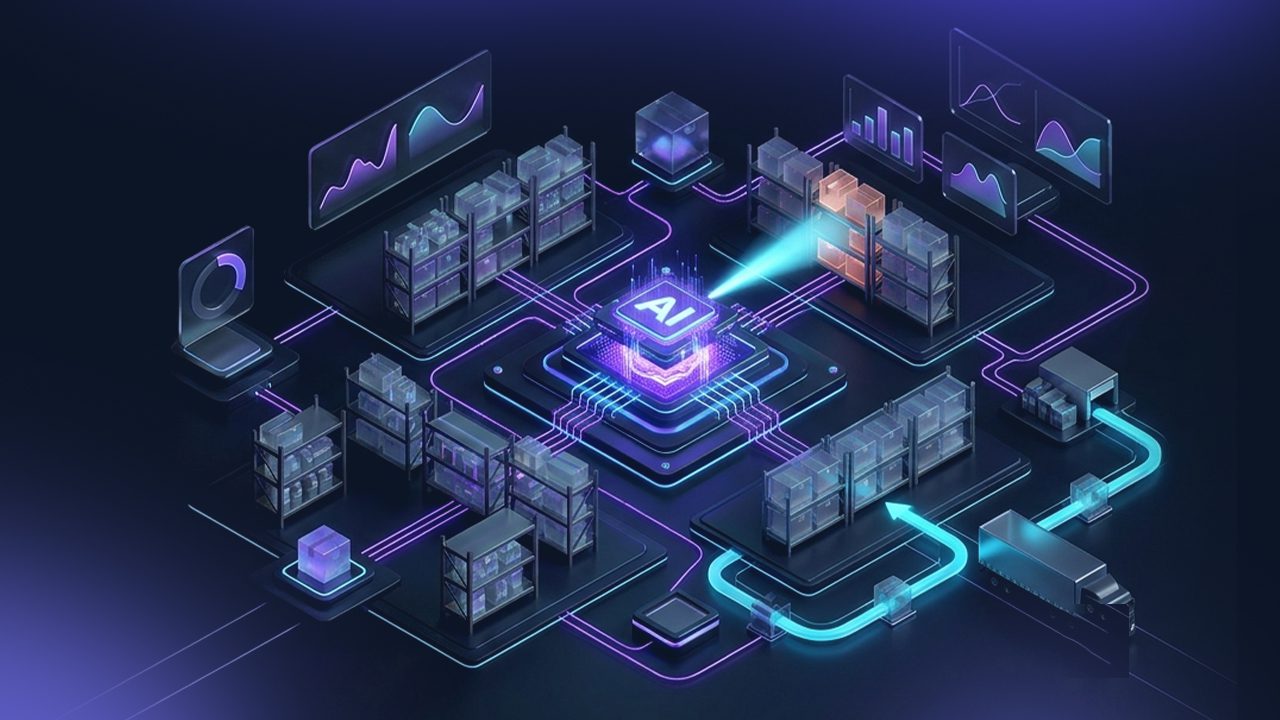

Picture a purchase order landing in your system at 2 A.M. No human placed it. An AI agent compared your price against three competitors, checked your stock, confirmed it matched its buyer’s contract, and bought. Nobody from the customer’s team ever opened your storefront.
This is agentic commerce, and it is already running in production. AI agents have moved from suggesting purchases to completing them. For manufacturers and distributors, that breaks a thirty-year assumption: that there is a person on the other end of the sale. Increasingly, there is software.
The question for 2026 is not whether this arrives. It is whether your systems can answer when an agent comes knocking.
This guide breaks down what agentic commerce means for B2B, how Google’s Universal Cart and the major protocols work, what it takes to become agent-ready, and how to sequence the work.
What Agentic Commerce Actually Means in B2B
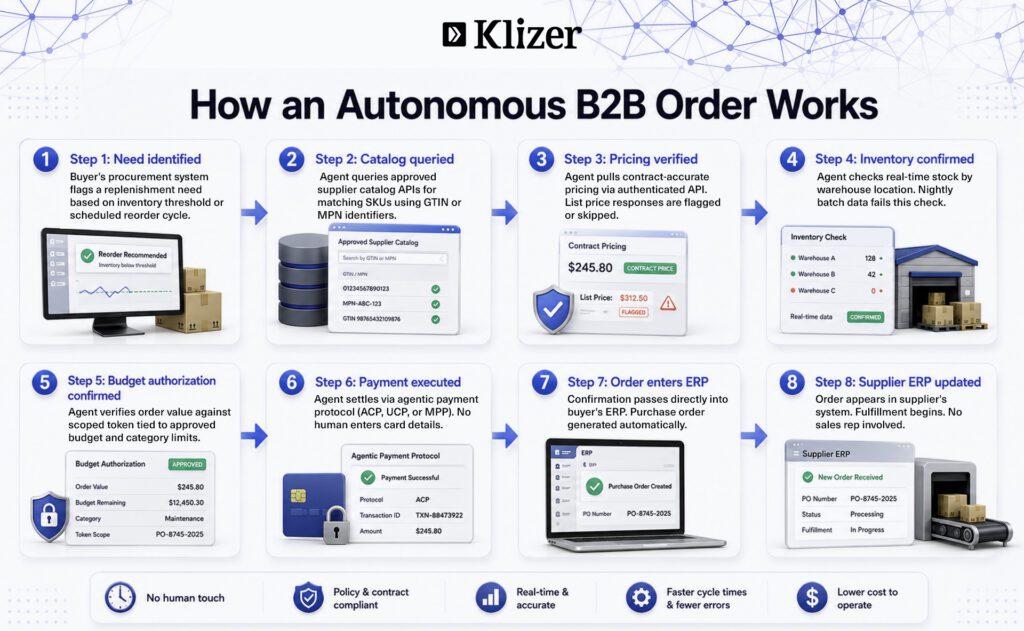
Agentic commerce is the use of AI agents that perceive, decide, and act to finish a transaction, not just recommend one.
There is a clean test for what qualifies:
- Autonomous purchase. The agent selects and commits to the order.
- Autonomous payment. The agent pays without a human entering card details.
- Autonomous fulfillment. The order flows through without manual handoff.
If a human still clicks “buy,” it is a copilot, not an agent. Most tools sold as agents today are assistants that surface options, but leave a person to authorize the final order. The gap between those two things is real, and the infrastructure needed to cross it is exactly what most B2B sellers do not have yet.
B2B is structurally better suited to autonomy than retail. A consumer agent has to predict taste, preference, and intent from limited signals. A B2B agent executes known rules: Does this order match our contract? Is it inside budget? Is the supplier on the approved list? Those are data lookups, not guesses. The decisions are easier to automate. The plumbing is harder to build.
Why Agentic Commerce Is Essential in 2026
Three forces have converged to move this from concept to production faster than most B2B teams expected.
GPT-level reasoning has crossed a practical threshold. Earlier AI models could surface options. Current models can reason through exceptions, interpret purchase order documents, handle spec mismatches, and negotiate within defined parameters. The cognitive gap between “assistant” and “agent” has narrowed to an engineering problem, not a research one. Adobe Commerce 2.4.9, for example, now natively supports UCP and ACP, turning the storefront into an agent-ready transaction layer.
Enterprise APIs and ERP modernization have caught up. The back-office systems that hold pricing, inventory, and contract logic are more API-accessible than they were three years ago. Cloud ERP adoption, particularly across mid-market manufacturers and distributors, has made the data layer that agents need to operate both cleaner and more reachable.
Agent payment protocols are now live. ACP, UCP, and AP2 have given agents a standardized, secure way to authorize and settle transactions. Before these protocols existed, autonomous purchasing required custom point-to-point integrations. Now there is a shared infrastructure layer that any compliant merchant can plug into.
Is Agentic Commerce Living Up to the Hype Yet?
Hype is running ahead of behavior, and that is useful to know before you spend.
OpenAI scaled back its consumer Instant Checkout in early 2026. As reported by CNBC, only around 30 Shopify merchants had gone live with the feature out of millions on the platform, and OpenAI had not yet built infrastructure to collect sales tax on purchases — a clear signal that transaction volume never materialized. Shopify president Harley Finkelstein confirmed the bottleneck was on the AI firms’ side, not the merchants.
Reporting from Forrester pointed to merchant onboarding complexity and catalog data quality as the primary sticking points, not the payment technology itself. Keeping inventory, pricing, and product data accurate and synchronized across large merchant networks at the speed agents require remains the hardest part of the problem.
This is actually reassuring for industrial sellers. The failure mode was messy, unstandardized consumer catalog data — exactly the opposite of what structured B2B commerce looks like. B2B transactions are rule-based, contract-defined, and repeat-oriented. That is a far better fit for autonomous execution than retail ever was.
How Agentic Commerce Differs From the Retail Story
B2B does not follow the consumer playbook, and treating it like retail leads to expensive mistakes.
The buying motion is different at every layer:
- Relationships come first. The buyer often already knows the supplier. The agent works inside an existing agreement, not across an open marketplace.
- Pricing is negotiated. Contract terms, volume tiers, and payment windows are set in advance. There is no single public price to read.
- Approval chains are real. A high-value purchase moves through procurement and finance with a documented audit trail. Autonomous execution has to compose with those governance structures, not bypass them.
- EDI already exists. It automates repeat orders but breaks on exceptions like stockouts, specification changes, and new supplier onboarding.
Agentic systems add the flexibility EDI never had. They adapt to new suppliers, handle exceptions, and optimize across price, lead time, and total landed cost in ways that rigid automation cannot. This is where AI agents in business buying start to outperform rule-based workflows — they reason through the exception instead of failing on it.
What Is Google’s Agentic Checkout and the Universal Cart?
At NRF in January 2026, Google introduced the Universal Commerce Protocol, co-developed with Shopify, Target, Walmart, Etsy, and Wayfair, and endorsed by more than 20 payments and retail companies including Visa, Mastercard, Stripe, and Adyen. It powers the Universal Cart announced at Google I/O in May 2026.
That cart spans Search, Gemini, Gmail, and YouTube. It runs on a Shopping Graph of more than 60 billion product listings.
For B2B, the important detail sits underneath the checkout layer. Google’s checkout infrastructure composes with its Agent Payments Protocol, which means a procurement agent can verify a corporate policy mandate, confirm budget authorization, and execute payment in a single exchange. That fits industrial buying better than a consumer card token. The agent proves it is authorized, in budget, and inside policy before the order is placed — creating the kind of non-repudiable audit trail that enterprise procurement requires.
The lesson for B2B sellers is not to chase one vendor’s standard. It is that the front of the buying journey is already being rewired at infrastructure level. Discovery and research now run through agents, whether your catalog is ready or not.
Which Agentic Commerce Protocols Should B2B Teams Track?
There is no single winner yet. An agentic commerce protocol is forming at several layers simultaneously, and the standards are still converging.
A few names for B2B planning:
- ACP (OpenAI and Stripe). Open source, built around a shared payment token. The merchant stays merchant of record. Originally designed for in-chat native checkout; now evolving toward app-based and discovery flows following OpenAI’s Instant Checkout pivot.
- UCP (Google). Covers the full journey from discovery through post-purchase support. Compatible with Agent2Agent, AP2, and Model Context Protocol. Designed for global scale with retailer-controlled checkout.
- AP2 (Google). Represents each purchase as signed, verifiable mandates for intent, cart, and payment. Creates a tamper-proof audit trail that is particularly relevant for enterprise B2B governance requirements.
- MPP (Stripe and Tempo, with Visa). Built for machine-to-machine payments, a strong fit for repeatable B2B transactions. Forrester expects AI to be involved in roughly a third of B2B payment workflows by the end of 2026, reflecting growing automation across invoicing, reconciliation, and payment operations.
You do not need to bet on one protocol. The product data and API requirements behind these standards are nearly identical. Build a protocol-agnostic foundation and then support whichever wins.
What Must B2B Sellers Do to Become Agent-Ready?
When the buyer is an agent, your storefront effectively becomes your API. Human buyers still exist, and storefront design still matters for them. But for agent-mediated orders, API completeness, response speed, and machine-readable data decide whether the agent can transact with you at all.
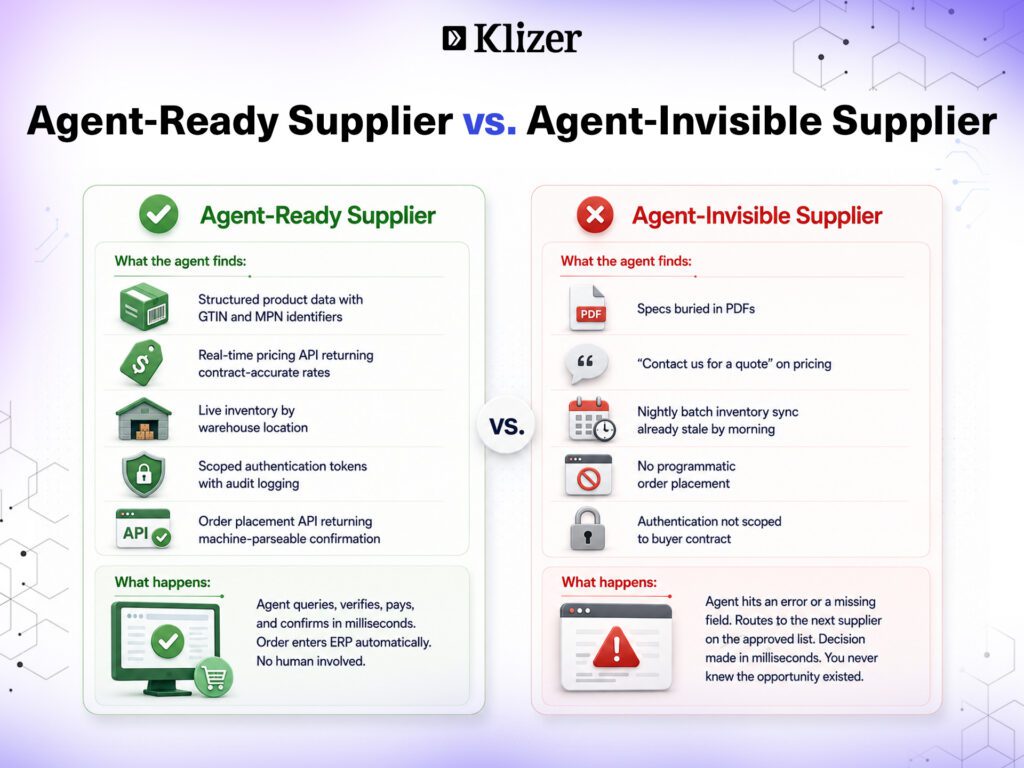
Supplier readiness is close to binary. An agent that hits an error or a missing spec does not call to ask. It routes to a competitor whose data answers cleanly, and that routing decision happens in milliseconds.
The work is concrete:
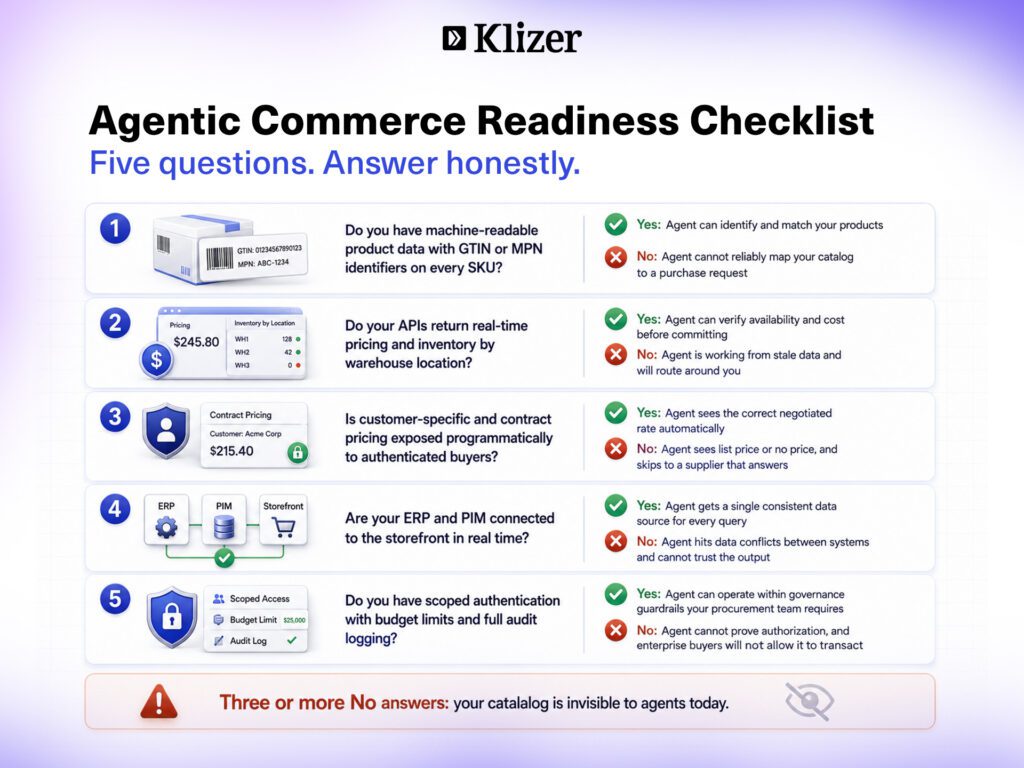
- Machine-readable product data. Structured attributes, standard taxonomies, and GTIN or MPN identifiers. Specs buried in PDFs are invisible to agents.
- Real-time commerce APIs. Pricing, inventory by location, and lead times accurate to the second. Nightly batch syncs fall short for agent-driven workflows that depend on live data to make purchase decisions.
- Programmatic pricing. Customer-specific and contract pricing exposed through API to authenticated buyers. “Contact us for a quote” is friction an agent skips entirely.
- ERP and PIM integration. The back office feeds the agent-facing layer. ERP supplies cost, inventory, and pricing logic. PIM structures the content. Without both connected, the data an agent needs to transact does not exist in a form it can read.
- Scoped authentication. Tokens tied to budget limits and approved categories, with full audit logging for procurement governance.
This is where agentic AI workflows live or die. The agent needs to query, price, and order against your real systems in one clean exchange, whatever agentic commerce protocol sits in front of it.
Is Agentic Commerce Already Running in B2B?
Yes. Autonomous procurement is in production in industrial settings right now, not in pilots.
In MRO and spare-parts distribution, Go Autonomous reports that Laerdal Medical cut manual steps per order from 93 to 5 using autonomous order entry, while distributor Mediq now processes around 4,000 orders per week autonomously, including urgent requests, with no added headcount.
In sourcing, AI agents in business procurement are running end-to-end RFQ automation: supplier invitation, bid scoring, and multi-round negotiation. Samsung reported an 85% reduction in RFQ time using autonomous sourcing bots and, in the same deployment, ran its largest-ever ground freight event — $100M in spend — in just two weeks.
These are agentic AI workflows handling real spend against live ERP systems, not controlled demonstrations.
What Are the Risks B2B Teams Should Plan For?
Autonomy at scale carries real exposure, and governance is lagging the technology. Plan for these before you scale:
- Bad data executes faster. An agent acting on a wrong unit of measure or an outdated price list does not pause to verify. It places the order. Data quality becomes transaction accuracy in ways that manual processes never required.
- Credentials carry more weight. An agent token can place orders without per-order human approval, which means a compromised credential or a misconfigured scope does significantly more damage than a stolen password.
- Liability is unsettled. Who owns a wrong autonomous order is not yet clear in law or contract. Legal frameworks have not caught up with operational reality.
- Channel conflict. If agents always select on price, then delivery guarantees, certifications, and service-level commitments need to be machine-readable to factor into the decision — not communicated verbally by a sales rep.
The fix is not to wait for these issues to resolve. It is to start where your data is strongest, build in guardrails from the beginning, and expand autonomy incrementally as each layer proves stable.
How Should You Sequence the Work?
You do not need to solve everything at once. Stage it by risk and return:
- Audit and unify. Find where pricing, specs, and customer records actually live across your systems. Consolidate into a clean PIM with documented business rules before exposing anything to an agent.
- Expose APIs. Build the full transactional surface: catalog, contract pricing, inventory, RFQ, and order placement, all returning machine-parseable responses with consistent error handling.
- Automate the safe wins. Start with document and PO processing, where ROI is measurable and the risk of an autonomous error is low.
- Pilot bounded autonomy. Begin with consumables and standard components that have multiple qualified suppliers, where an agent error is recoverable.
Final Thoughts
Agentic commerce rewards sellers whose systems are connected and whose data is clean. For manufacturers and distributors, that is a single architecture problem, not four separate projects. The sellers who win agent-driven demand will not be the ones who adopted the most protocols. They will be the ones whose catalog, pricing, and inventory data are answered cleanly when an agent comes to buy.
Klizer is built for manufacturers and distributors. We connect ERP, B2B ecommerce, integrations, and Operational AI into one connected commerce system, under one roof.
Foundation. Storefront. Integration. Intelligence. Four layers. One commerce engine. That structure is what makes a catalog readable, a price programmatic, and an order executable by an agent.
The buyers are getting ready to send agents. The question is whether your systems will be ready to answer them.
Book a free consultation with Klizer about building an agent-ready commerce foundation.