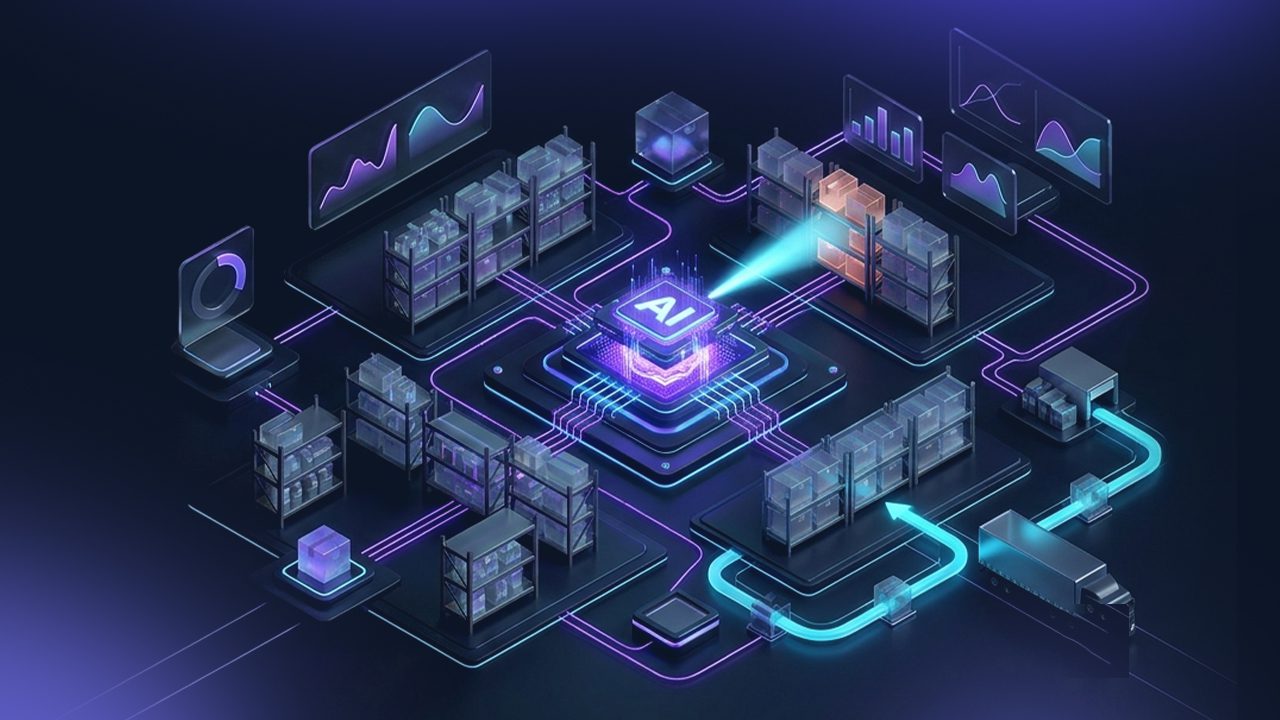

Every “where’s my order?” email costs you money, and so does every call asking for a price, a lead time, or whether a part is still in stock. Multiply that across a catalog of thousands of SKUs and a few hundred accounts, and you are paying skilled people to spend their day reading data out of an ERP and typing it back into an email.
Conversational AI agents close that gap by understanding what a buyer actually means, pulling the real record from your systems, and finishing the task instead of handing back a scripted reply. The answer comes from your live data, not a scripted response that sends the buyer back into a queue.
For businesses, that is the difference between a bot that deflects and a system that resolves. This guide covers what these agents are, how they work, where they fit, and what to check before you deploy one.
ON THIS PAGE
What Are Conversational AI Agents?
Conversational AI agents are software systems that understand natural language, reason through a request, and take action across connected systems. They use natural language processing to read intent, machine learning to improve over time, and integrations to act on real records.
The difference between an agent and a chatbot is action. A chatbot matches keywords to scripted replies. It breaks the moment a customer phrases a question differently.
A conversational AI agent works differently. It identifies intent across many phrasings, retrieves the right record, applies logic, and confirms the outcome. A bot that cannot act is just a faster FAQ. An agent resolves the request.
That distinction is the whole point. One deflects. The other does the work.
How Does Conversational AI Work?
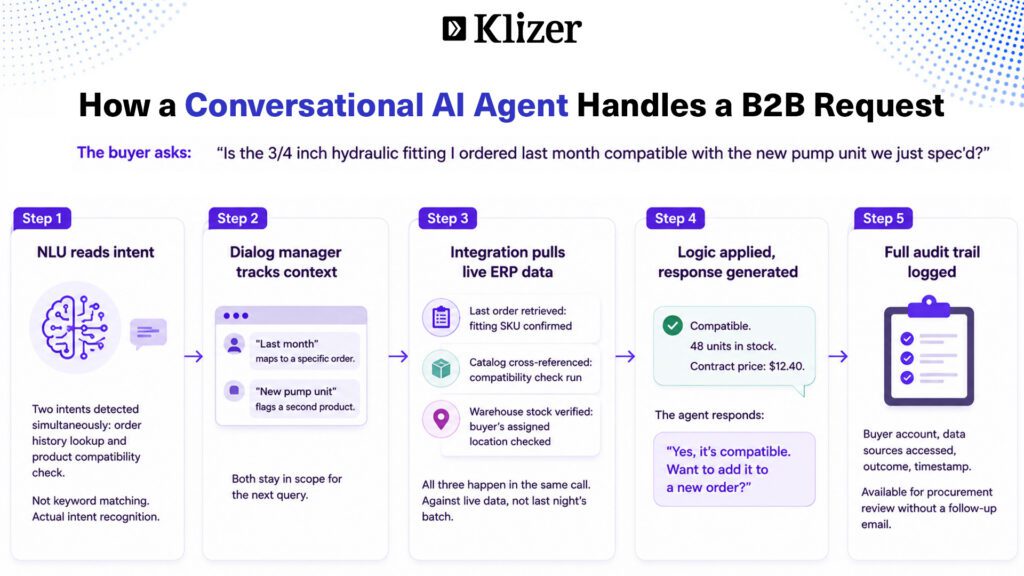
How does conversational AI work under the hood? It runs on a few core components that pass information between each other in sequence.
- Natural language understanding (NLU): Reads the message and detects intent. “I can’t log in” gets routed to account access, not a literal interpretation.
- Dialog management: Tracks context across turns. The system remembers the customer started with a billing question before they asked to dispute a charge.
- Natural language generation (NLG): Turns the result into a response that reads like a human wrote it.
- System integration: Connects to the databases, ERP, and order systems that actually hold the answer.
The first three make the conversation feel natural. The fourth makes it useful. Without integration, an agent can describe a process but never execute it.
That last point is where most deployments succeed or fail. An agent is only as capable as the systems it can reach.
Types of Conversational AI
The category is broad, so it helps to separate the types of conversational AI by what each one is built to do.
- Rule-based chatbots: Scripted decision trees. Reliable for simple, fixed tasks. They stall on anything they were not programmed for.
- AI chatbots: Use language models to generate flexible, context-aware replies. Better conversation, limited action.
- Voice assistants: Convert speech to text, interpret intent, and respond by voice. Useful for hands-free and phone channels.
- Conversational AI agents: Understand intent, hold context, and take action across connected systems. The most capable of the group.
Most businesses end up running more than one type. A simple chatbot can handle FAQs while an agent handles the work that touches the ERP.
The line that matters is autonomy. Can the system act on its own, or does it just talk? That answer tells you which type you are actually looking at.
Benefits of Conversational AI
The benefits of conversational AI are operational, not abstract. They show up in cost, speed, and capacity. Here is where the value lands.
- Lower cost per interaction: Routine requests get resolved without an agent in the loop. Staff move to complex, higher-value work.
- Faster response: Customers get answers in seconds, at any hour, without a queue.
- Scale without headcount: One system handles thousands of conversations at once, including seasonal spikes.
- Multilingual support: A single agent can serve customers in many languages without separate builds.
- Operational insight: Every conversation surfaces data on demand, friction, and recurring problems.
For manufacturers and distributors, the scale benefit is the one to underline. Order status, stock checks, and reorder requests arrive in high volume and repeat constantly. That is exactly the work an agent absorbs well.
The other benefits of conversational AI compound from there. Lower handling cost, cleaner data, and faster service all pull in the same direction.
Use Cases of Conversational AI
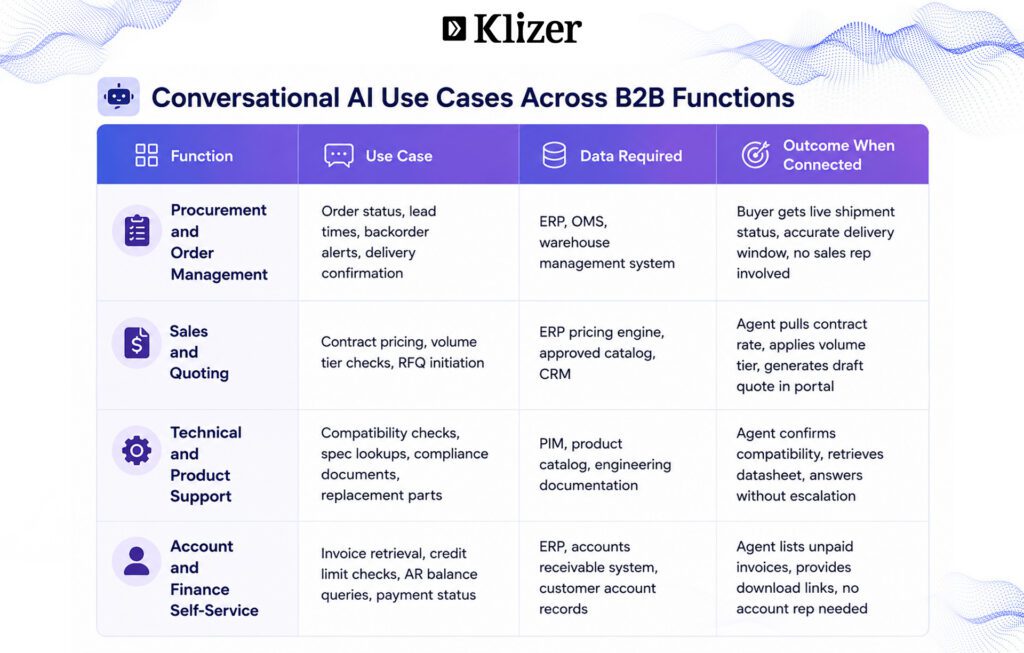
The use cases of conversational AI go well beyond a support widget. Across functions, the pattern is the same: repetitive, structured work that benefits from instant access to a system of record.
1. Customer Support
Order tracking, returns, account questions, and troubleshooting. The agent pulls the live record and resolves the request instead of describing how.
2. Sales and Lead Qualification
Agents qualify inbound interest, answer product questions, and route high-intent buyers to the right rep. They nurture leads without manual follow-up.
3. Internal Operations
HR, IT, and procurement teams use agents to handle repetitive internal requests. Password resets, policy questions, and status checks stop landing in a human queue.
4. Conversational AI Agents for eCommerce
This is the use case that matters most for commerce operators. Conversational AI agents for ecommerce guide product discovery, answer specification questions, check inventory, and surface accurate pricing in real time.
In industrial B2B, that work is heavier than in retail. Catalogs run deep. Products have technical specs. Pricing is account-specific. A buyer asking “is this fitting compatible with my last order” needs an answer drawn from order history and the product catalog at once.
That is where these agents earn their place. They connect the storefront conversation to the data behind it.
Chatbot vs. Conversational AI Agent: What’s the Difference?
| Feature | Chatbot | Conversational AI Agent |
| Understands intent | No | Yes |
| Uses ERP data | No | Yes |
| Takes action | No | Yes |
| Context aware | Limited | Yes |
| Learns over time | No | Yes |
| Handles multi-turn conversations | No | Yes |
| Accesses live inventory | No | Yes |
| Surfaces account-specific pricing | No | Yes |
| Escalates with full context | No | Yes |
| Handles catalog of 10,000+ SKUs | No | Yes |
| Works across channels | Limited | Yes |
| Audit trail and governance | No | Yes |
Where These Agents Fit in a Connected Commerce System
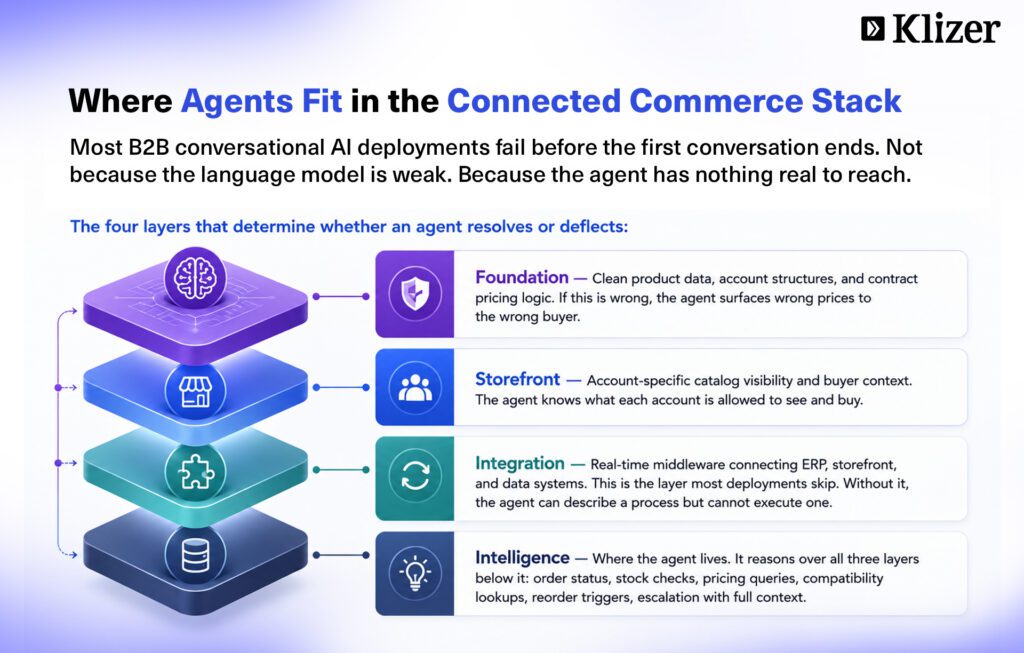
An agent is only as good as what it can reach. This is the part most guides skip. A conversational layer with nothing underneath it is a demo, not a system.
For industrial B2B, the agent has to sit on top of a connected stack:
- ERP: For real inventory, pricing, and order data.
- B2B eCommerce: For the storefront, catalog, and account context.
- Integration layer: The middleware that keeps those systems in sync.
- Operational AI: The intelligence that reasons over connected data and acts.
Klizer builds exactly this. Foundation. Storefront. Integration. Intelligence. Four layers. One commerce engine. The agent does not float on top of disconnected tools. It runs on a system where the data already moves.
That architecture is the difference between an agent that answers and an agent that resolves. When the integration layer is solid, the conversation has something real to act on.
Enterprise Customization and Control
Off-the-shelf agents handle generic questions. Industrial operations are not generic. This is where AI conversational agents enterprise customization becomes the deciding factor.
Customization means the agent knows your catalog, your pricing logic, your account tiers, and your workflows. It means escalation rules that match your compliance needs and audit trails your teams can review.
A few things to confirm before you commit:
- Integration depth: Can it read and write to your actual ERP and commerce systems, not just sit beside them?
- Governance: Are there escalation triggers, confidence thresholds, and audit logging?
- Data ownership: Does customer and order data stay inside your environment?
- Handoff quality: When the agent escalates, does full context transfer to the human?
Get these wrong and the agent becomes another disconnected tool. Get them right and it becomes part of how the business runs.
What Are the Challenges of Conversational AI?
Conversational AI is capable, not effortless. A few challenges show up in nearly every deployment, and naming them early saves rework later.
- Integration gaps: The most common failure point. Poor connection to ERP and CRM, not weak language models, is what stalls projects.
- Data privacy: Agents handle account and order data. Compliance with GDPR and similar rules has to be designed in.
- Language drift: Slang, new terms, and edge phrasings need ongoing tuning.
- Over-automation: Some interactions need a human. Knowing where to draw that line is part of the design.
None of these are reasons to wait. They are reasons to deploy on a connected foundation instead of a standalone bot.
How to Get Started
Start narrow. Pick one high-volume, structured use case where the data already lives in a connected system. Order status is a common first move.
Measure resolution rate and cost per interaction from day one. Resolution, not deflection, is the number that tells you whether the agent is doing real work.
Then expand, once the agent proves itself on one workflow, the same foundation extends to the next. The hard part was never the conversation. It was the connection underneath it.
Final Thoughts
Conversational AI agents are not a bolt-on feature. They are an operating layer that only works when the systems beneath it are connected. The conversation is the easy part. The architecture is what makes it resolve.
Most agents fail for the same reason: they sit on top of disconnected tools and have nothing real to act on. Klizer fixes that at the root, with ERP, B2B eCommerce, integrations, and Operational AI running as one connected commerce system.
Your competitors are already wiring this up. The longer your stack stays disconnected, the more orders, quotes, and buyers you hand them.
Book a call with us today. We will map your systems, show you where an agent can do real work, and build the foundation it runs on