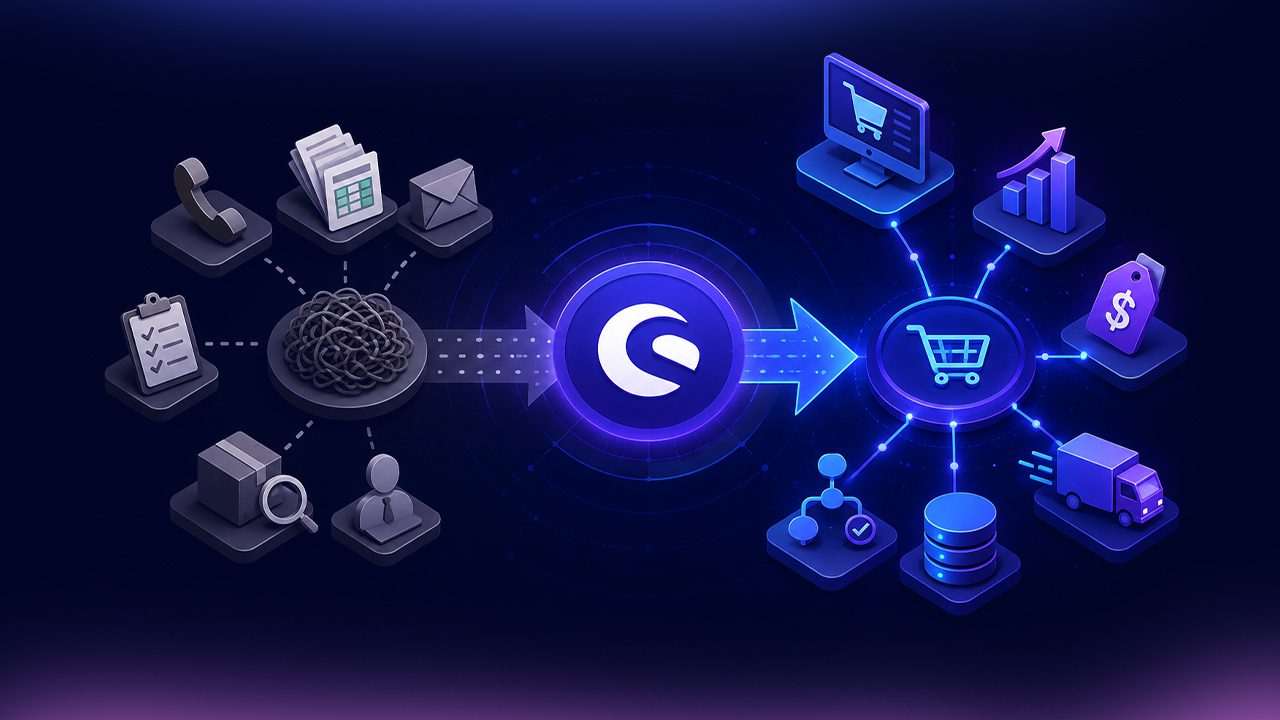

eCommerce now accounts for most of the manufacturing and distribution B2B sales, making it the fastest-growing revenue channel for wholesale distributors. Yet most distributor platforms are still processing orders manually, showing wrong pricing to buyers, and running on ERP data that syncs overnight rather than in real time.
It is the online buying and selling of products or services between businesses through a B2B ecommerce platform built for complex wholesale transactions. Unlike traditional sales processes, it supports customer-specific pricing, bulk ordering, account-based purchasing, and integration with ERP and CRM systems.
ON THIS PAGE
What Is the Difference Between B2B and B2C in eCommerce?
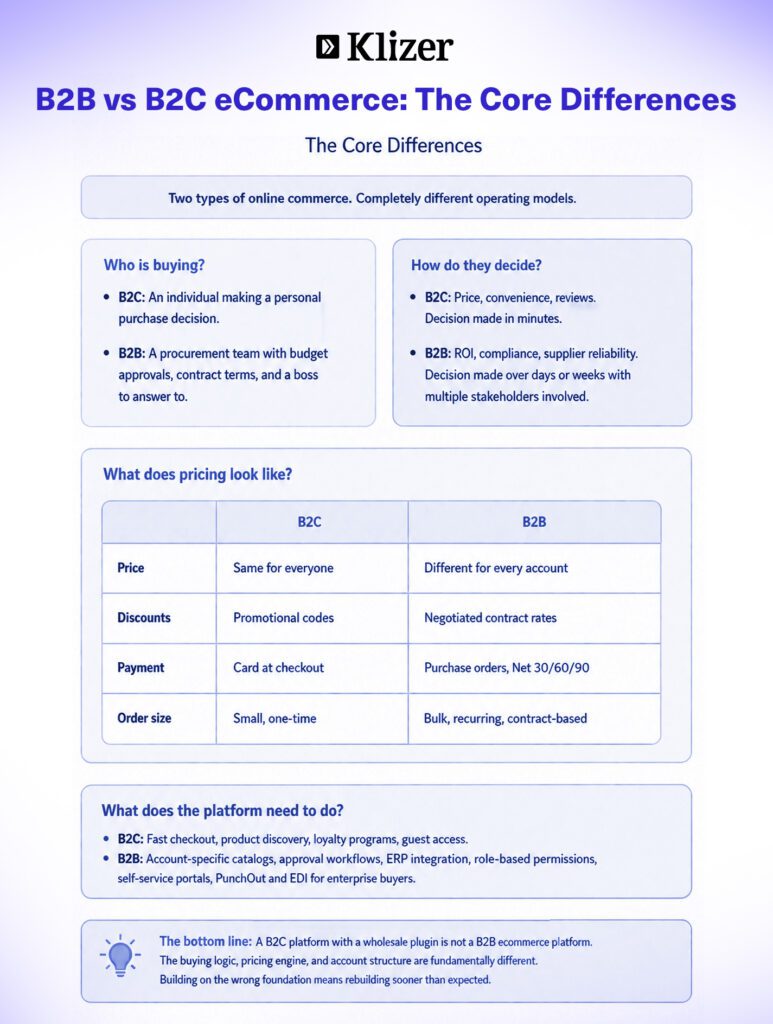
Understanding the difference between B2B and B2C in ecommerce is the starting point for any platform decision. The two models look similar on the surface but run on completely different logic.
| Factor | B2B eCommerce | B2C eCommerce |
| Target audience | Businesses, wholesalers, manufacturers, and distributors | Individual consumers buying for personal use |
| Decision-making | Multiple stakeholders evaluate based on budget, approvals, and ROI | Individual buyers decide based on price and convenience |
| Purchase volume | Bulk, recurring, and contract-based orders | Smaller, one-time purchases |
| Pricing | Customer-specific pricing, negotiated contracts, volume discounts | Fixed pricing for all customers |
| Buying process | Longer sales cycle with RFQs, approvals, and purchase orders | Short buying journey with quick checkout |
| Payment methods | Purchase orders, credit accounts, Net 30/60/90 payment terms | Credit cards, digital wallets, BNPL |
| Platform features | Custom catalogs, bulk ordering, approval workflows, ERP integration | Product recommendations, guest checkout, promotions |
| Business objective | Build long-term partnerships and maximize customer lifetime value | Increase conversions and repeat purchases |
| Platform complexity | Supports complex workflows, account-specific experiences, enterprise integrations | Prioritizes speed, simplicity, frictionless checkout |
According to Gartner, 75% of B2B sales interactions between suppliers and buyers are expected to occur in digital channels. B2B buyers increasingly expect the same convenience they experience as consumers, while still requiring the pricing logic, approval chains, and account structures that consumer platforms were never built to handle.
What Are the Benefits of B2B eCommerce for Distributors?
A B2B ecommerce platform for distributors helps reduce operational costs, improve order accuracy, deliver personalized buying experiences, and build long-term customer relationships. Here are the key benefits of B2B ecommerce that drive business growth.
Increases operational efficiency
Automating order processing, invoicing, and inventory updates replaces phone and email orders with digital workflows, reducing manual effort and enabling sales teams to focus on customer relationships and business growth.
Provides 24/7 purchasing access
Buyers can place orders, check real-time inventory, view customer-specific pricing, and reorder products anytime. According to McKinsey, more than 70% of B2B decision-makers prefer digital self-service or remote interactions.
Delivers personalized buying experiences
Unlike B2C stores, B2B ecommerce supports customized product catalogs, negotiated pricing, tiered discounts, payment terms, and approval workflows tailored to each account.
Improves order accuracy and inventory management
Integrating the ecommerce platform with ERP, CRM, and warehouse systems synchronizes inventory, reduces human error, prevents overselling, and accelerates fulfillment.
Drives scalable revenue growth
One of the most valuable advantages of B2B ecommerce is the ability to upsell, cross-sell, introduce targeted product bundles, and expand into new markets without significant infrastructure investments.
Supports data-driven decisions
Access to real-time analytics lets distributors identify buying patterns, forecast demand, optimize inventory, and improve supply chain planning.
What Are the Best B2B eCommerce Websites in 2026?
The strongest B2B ecommerce websites share a common characteristic: they are built around the buyer’s operational workflow, not just a product catalog. Here are four examples that set the benchmark for distributor ecommerce.
- Amazon Business: Amazon Business serves over 6 million business customers globally. Its platform offers account-specific pricing, multi-user accounts, approval workflows, and purchasing analytics. The buyer experience mirrors consumer Amazon but layers in the procurement controls and reporting that business buyers need.
- Grainger: Grainger is the most-cited benchmark for industrial distributor ecommerce. It manages over 1.5 million SKUs with real-time inventory across multiple warehouses, account-specific contract pricing, and deep ERP integration for enterprise customers. Grainger’s digital channel generates more than 70% of its revenue.
- MSC Industrial: MSC Industrial’s B2B platform handles complex MRO purchasing with customer-specific pricing, PunchOut catalog support, and EDI integration for enterprise procurement systems. Its self-service portal lets buyers manage accounts, track orders, and download invoices without contacting a sales rep.
- Thomasnet: Thomasnet connects industrial buyers with suppliers and manufacturers through a platform built for specification-driven purchasing. Its product data structure is deep enough for buyers to filter by material, tolerance, certification, and compatibility rather than just name and SKU.
What Are the B2B eCommerce Features That Improve Conversion Rates?
A high-converting B2B ecommerce platform removes friction from the buying journey and helps distributors deliver faster, more personalized purchasing experiences. These features of B2B ecommerce directly impact conversion rates.
Personalized pricing and catalogs
Show customer-specific pricing, negotiated contracts, volume discounts, and tailored product catalogs to speed up purchasing decisions.
Bulk ordering and quick reordering
Simplify large and repeat purchases with SKU-based ordering, bulk uploads, saved order lists, and one-click reorders.
Self-service portals
Enable buyers to place orders, track shipments, download invoices, and manage their accounts without contacting sales teams.
Approval workflows
Support role-based access, purchase approvals, purchase order uploads, and flexible payment terms to streamline corporate procurement.
Intelligent search and CPQ
Help buyers find products quickly with predictive search and SKU lookups, while CPQ tools generate accurate configurations and pricing instantly.
ERP and CRM integration
Sync pricing, inventory, customer data, and orders in real time to eliminate manual updates and improve operational accuracy.
Real-time inventory visibility
Display live stock availability to prevent overselling and help buyers purchase with confidence.
Mobile-first experience
Deliver a consistent ordering experience across desktops, tablets, and smartphones, allowing buyers to purchase from anywhere.
Agent-ready product data
In 2026, AI procurement agents query distributor catalogs, verify contract pricing, and place orders autonomously. A platform whose product data is structured, API-complete, and machine-readable will capture that demand. One whose data is incomplete or inconsistently formatted will not surface in agent-driven purchasing at all. Clean, governed product data is no longer just an operational concern. It determines whether your catalog is visible to the next generation of B2B buyers.
According to the Baymard Institute, 18% of shoppers abandon their carts because the checkout process is too long or complicated. For distributors, the equivalent friction point is account setup and pricing visibility: buyers who cannot see their negotiated rate within the first login rarely return.
What Are the Steps for Building a High-Converting B2B eCommerce Platform?
Building a high-converting B2B ecommerce platform requires a clear strategy, the right technology, and a buyer-first approach.
1. Define business objectives and customer journeys
Start by identifying what you want your B2B ecommerce platform to achieve before selecting technologies or features.
- Define measurable goals such as increasing online sales, reducing manual order entry, or improving repeat purchases
- Map the customer journey to identify friction points from product discovery to checkout
- Segment buyers based on purchasing behavior: first-time visitors, returning customers, wholesalers, and enterprise accounts
2. Choose the right B2B ecommerce platform
The platform you choose determines how easily your business can scale and support complex wholesale operations.
- Evaluate platforms like Shopify Plus, Adobe Commerce, or BigCommerce, based on scalability, customization, and ERP integration depth
- Prioritize platforms that support customer-specific pricing, bulk ordering, and approval workflows natively
- Ensure integration with ERP, CRM, inventory, accounting, and payment systems
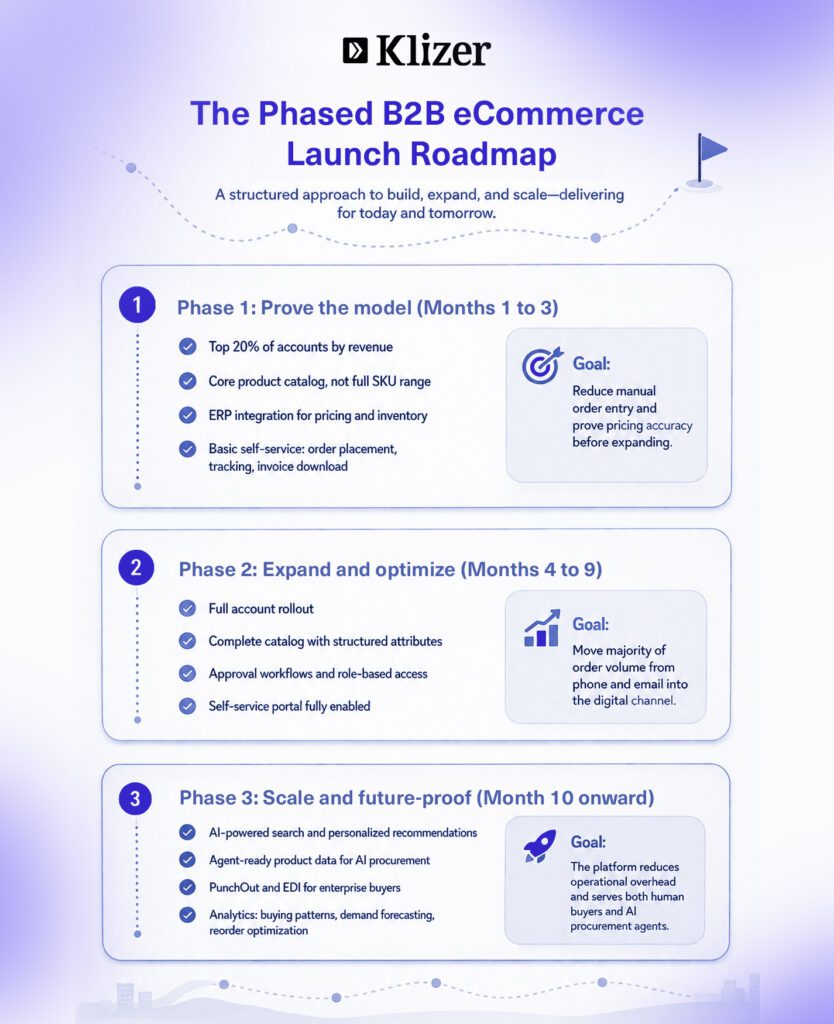
3. Start with your top accounts and a focused catalog
The distributors who see the strongest adoption launch with their top 20% of accounts and a focused subset of their catalog. A phased approach reduces integration risk, generates early proof of ROI, and gives the team time to resolve data and workflow issues before full rollout. Launching everything at once for all accounts is where most distributor ecommerce projects run over budget and timeline.
4. Build a buyer-friendly product catalog
Business buyers want to find the right products quickly without navigating unnecessary steps.
- Organize products with clear categories, technical specifications, and customer-specific pricing
- Implement AI-powered search, SKU lookup, filters, and product attributes
- Support tiered pricing, flexible order quantities, and bulk purchasing options
5. Optimize the buying experience for higher conversions
- Simplify navigation and streamline the checkout process to reduce cart abandonment
- Offer self-service portals where buyers can reorder products, track shipments, download invoices, and manage accounts
- Optimize for mobile so customers can research and purchase from anywhere
- Display customer reviews, testimonials, certifications, and case studies
What Are the Most Common B2B eCommerce Challenges and How Can Distributors Overcome Them?
As distributors scale their digital operations, they face several B2B ecommerce challenges that impact efficiency, customer experience, and revenue. The key is identifying these roadblocks early and implementing the right solutions.
| B2B eCommerce Challenge | How to Overcome It |
| Complex pricing and custom catalogs | Sync the ecommerce platform with the ERP. Automate customer-specific pricing and contract rates. Configure tiered discounts and personalized catalogs. |
| Disconnected systems and data silos | Integrate ERP, CRM, inventory, and accounting systems. Enable real-time inventory and order synchronization. Centralize customer and product data. |
| Manual approvals and slow purchasing | Automate approval workflows. Support purchase orders and role-based permissions. Enable quick reordering for repeat purchases. |
| Limited customer self-service | Offer 24/7 self-service portals. Let buyers track orders and download invoices. Allow customers to manage returns, users, and shipping addresses. |
| Complex B2B payment management | Support purchase orders and pay-on-account. Offer Net 30/60/90 payment terms. Automate credit limit verification during checkout. |
| Low product discoverability | Implement AI-powered search and SKU lookup. Add advanced filters and detailed product specifications. Organize products into clear categories. |
According to PwC, 73% of customers consider experience a key factor in purchasing decisions. Addressing these challenges of B2B ecommerce with automation, system integration, and self-service capabilities improves operational efficiency while delivering a better buying experience.
How Do You Choose the Right B2B eCommerce Platform?
Choosing the right B2B ecommerce platform is critical for improving operational efficiency, delivering better customer experiences, and supporting long-term growth. Focus on features, scalability, and integration capabilities rather than price alone.
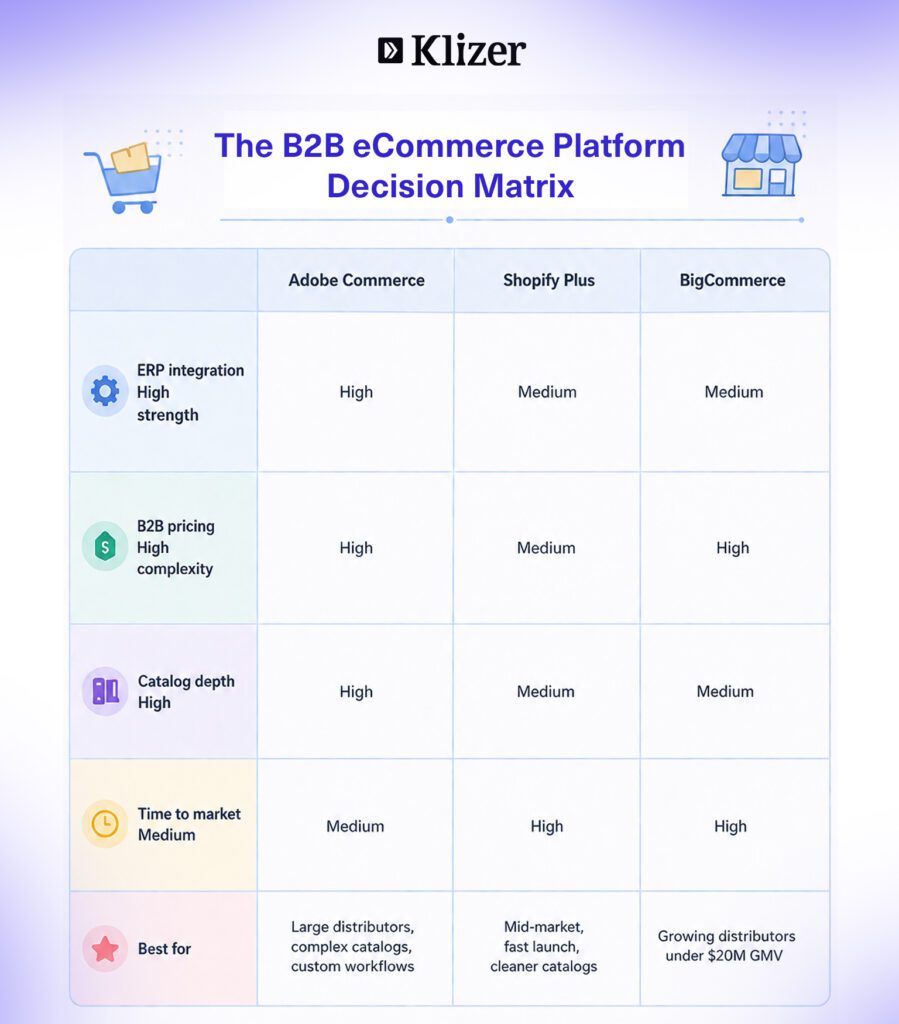
B2B eCommerce Platform Comparison
| Platform | ERP Integration | B2B Pricing | Catalog Complexity | Best For |
| Adobe Commerce | Strong, via connectors and custom API | Full support for complex pricing logic | Handles large, deep catalogs well | Large distributors with complex catalogs and custom workflows |
| Shopify Plus | Good, connector-dependent | B2B pricing maturing rapidly | Better for cleaner, mid-sized catalogs | Mid-market distributors wanting fast time to market |
| BigCommerce | Good, open API | Strong native B2B pricing tools | Solid mid-range catalog handling | Growing distributors under $20M GMV |
Key factors to evaluate
Define your business requirements: Evaluate your product catalog, customer segments, sales workflows, and growth goals before selecting a platform.
Compare B2B-specific features: Prioritize customer-specific pricing, negotiated contracts, bulk ordering, custom catalogs, approval workflows, and self-service portals.
Check integration capabilities: Ensure the platform integrates with your ERP, CRM, PIM, inventory, accounting, shipping, and payment systems to automate operations and maintain real-time data accuracy.
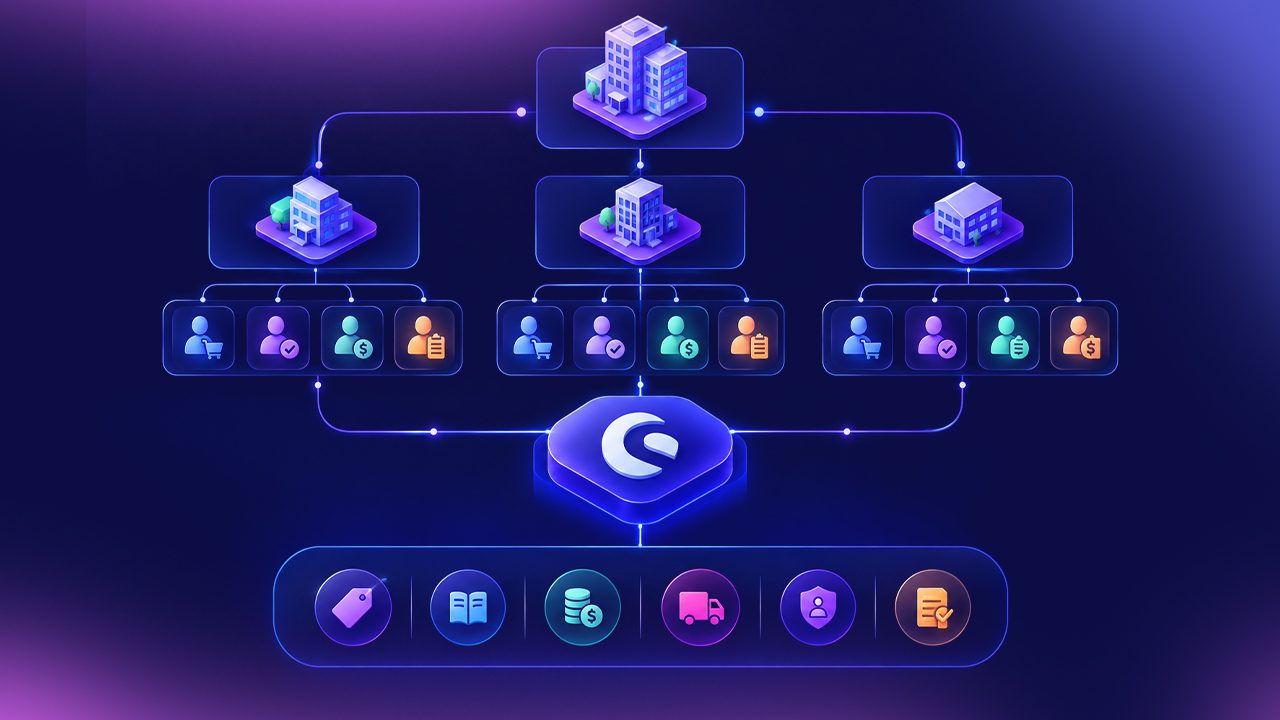
Support complex buyer accounts: Look for multi-user accounts, role-based permissions, and approval workflows that simplify purchasing for procurement teams and enterprise customers.
Evaluate enterprise connectivity: If you serve large organizations, choose a platform that supports PunchOut catalogs and EDI integrations to connect directly with buyers’ procurement systems.
Assess scalability: Select a platform that can manage large product catalogs, increasing order volumes, multiple warehouses, and future business expansion.
Analyze total cost of ownership: A thorough B2B ecommerce comparison should include implementation, customization, integrations, maintenance, and support costs, not just subscription fees.
According to Forrester, 74% of B2B buyers research at least half of their work purchases online before making a buying decision.
Conclusion
The distributors who win digitally in 2026 are not the ones with the most features. They are the ones whose platform connects cleanly to their ERP, surfaces accurate pricing and inventory to every buyer, and reduces manual work across sales, warehouse, and finance simultaneously.
Platform selection matters. Architecture matters more. And the data layer that connects both is what determines whether the investment pays for itself within the first year.
Klizer builds connected commerce systems for manufacturers and distributors — ERP integration, B2B ecommerce, and Operational AI under one roof, with 300+ successful implementations across Adobe Commerce, Shopify Plus, BigCommerce, and Shopware.
Contact Klizer to build a B2B ecommerce platform your buyers will actually use.