
A beauty brand running on Shopify is preparing for its biggest Black Friday sale. It expects a surge in traffic, wants to launch interactive landing pages for every campaign, and plans to offer personalized product recommendations based on customer behavior. While Shopify continues to manage products, inventory, and checkout, the business realizes its storefront needs more speed and flexibility than a traditional theme can deliver.
That’s where Shopify headless commerce comes in. By separating the storefront from Shopify’s backend, brands can build high-performance, customized shopping experiences while continuing to rely on Shopify’s commerce engine for products, inventory, checkout, and order management.
ON THIS PAGE
Understanding Shopify Headless Commerce
A traditional Shopify store combines the storefront customers see with the backend that manages products, inventory, checkout, and orders. While this works well for many businesses, it can become limiting as brands need more flexibility and customization.
Shopify headless commerce separates the frontend from the backend. The storefront is built independently, while Shopify continues to handle the commerce operations behind the scenes.
Using APIs, the two stay connected, allowing businesses to create faster, more customized shopping experiences without giving up Shopify’s powerful commerce engine.
How Shopify Headless Commerce Works
Think of Shopify as the engine that powers your online business. It continues to handle core commerce operations, including:
- Product management
- Inventory updates
- Pricing
- Customer accounts
- Discounts
- Checkout
- Payment processing
- Order management
The storefront becomes a separate application built using modern frontend technologies such as React, Next.js, Remix, or Hydrogen Shopify.
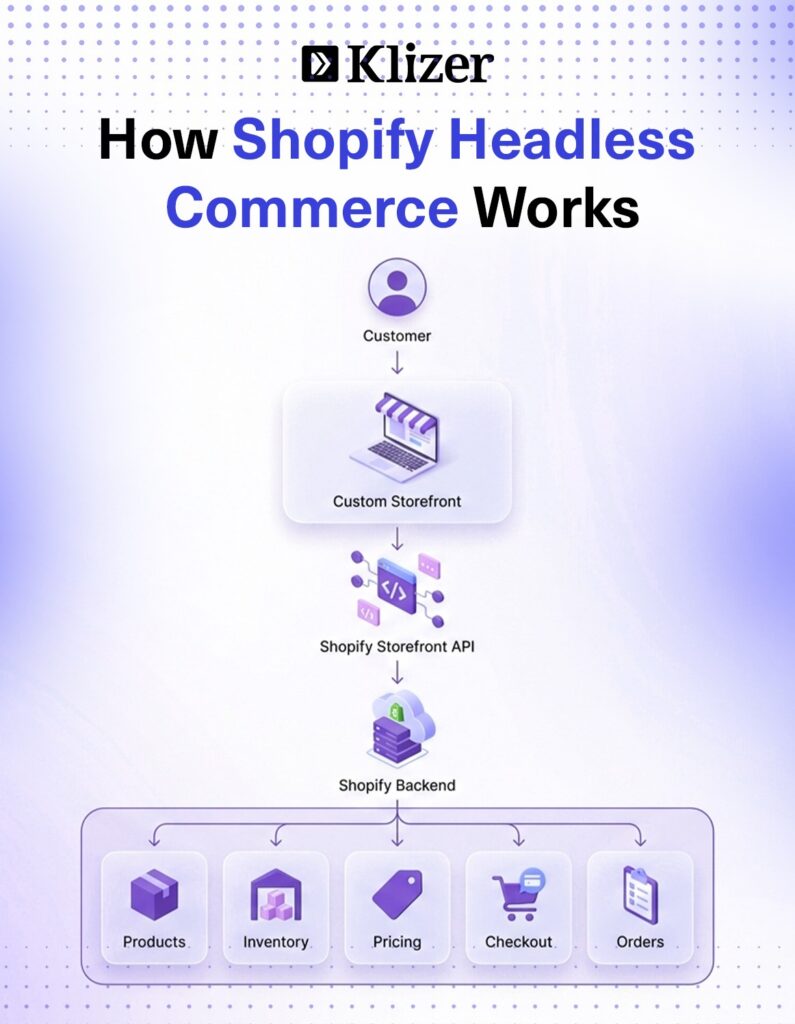
When a customer visits your website:
- The custom storefront requests product information from Shopify.
- Shopify sends product details, pricing, and inventory data through APIs.
- Customers browse products and add items to their cart.
- Shopify securely processes checkout and payments.
- Orders are stored in Shopify for fulfillment.
Because the frontend operates independently, businesses can redesign their storefront, improve website performance, or launch new features without disrupting backend operations. This flexibility is one of the main reasons companies invest in Shopify headless solutions.
Why More Brands Are Choosing Shopify Headless
Shoppers expect websites to load quickly, products to be easy to find, and shopping experiences to remain consistent across every device.
At the same time, businesses are selling through more channels than ever before. A customer may discover a product on social media, compare it on a mobile app, complete the purchase on a desktop website, and later track the order from a customer portal.
With Shopify headless commerce, businesses can use Shopify as the central commerce platform while delivering customized experiences across multiple touchpoints, including:
- Websites
- Mobile applications
- Social commerce
- Customer portals
- Digital kiosks
- Emerging digital channels
Instead of maintaining separate commerce systems, brands can manage products, pricing, inventory, and orders from one Shopify backend while delivering unique experiences wherever customers interact with the business.
Benefits of Shopify Headless Commerce
Faster Website Performance
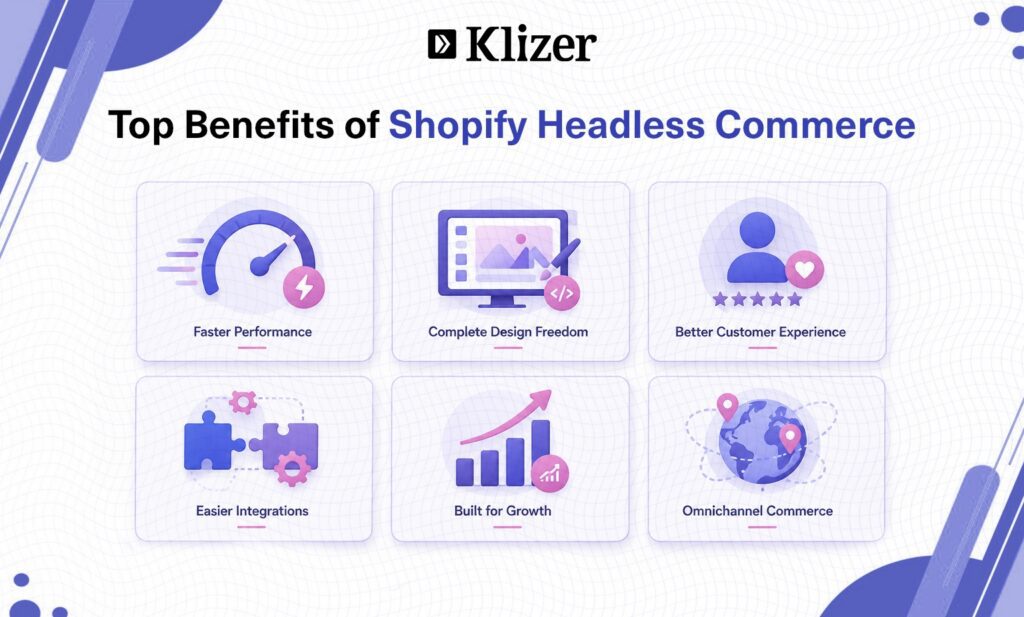
Website speed plays an important role in online shopping. A slow-loading website can frustrate customers and increase bounce rates before they even view your products.
With a custom frontend, developers can remove unnecessary code and optimize how content is delivered. This often results in faster page loading times and a smoother browsing experience.
Complete Design Freedom
Traditional Shopify themes offer customization options, but they still come with design limitations.
With Shopify headless, developers have complete control over the frontend, allowing businesses to create:
- Unique product pages
- Interactive buying journeys
- Custom landing pages
- Dynamic promotions
- Branded checkout experiences
This flexibility allows businesses to create experiences that align with their brand instead of adapting their brand to fit a theme.
Better Customer Experiences
Modern shoppers expect more than a product catalog. They want personalized recommendations, relevant promotions, fast search, and smooth navigation.
A headless architecture makes it easier to deliver:
- Personalized product recommendations
- Dynamic content based on customer behavior
- Region-specific pricing
- Customized product collections
- Interactive shopping experiences
These improvements can help increase customer engagement and encourage repeat purchases.
Easier System Integrations
Most growing businesses rely on multiple business systems, such as ERP platforms, CRM systems, Product Information Management (PIM) tools, marketing automation platforms, inventory management software, and AI-powered applications.
Because the frontend is independent, integrating Shopify with these systems becomes more flexible. Businesses can create a connected commerce ecosystem where information flows more efficiently between platforms.
Built for Long-Term Growth
Business needs change over time. You may expand into new regions, launch new product lines, introduce a mobile app, or start selling through additional channels.
With Shopify headless commerce, businesses can continue evolving the customer experience without replacing the entire commerce platform. Marketing teams can launch campaigns faster, developers can introduce new features more easily, and the business can adapt as customer expectations continue to evolve.
Hydrogen Shopify: Building Modern Storefronts
To make headless development easier, Shopify introduced Hydrogen Shopify, a React-based framework designed specifically for custom storefronts.
Hydrogen includes pre-built commerce components for common eCommerce features such as product pages, collections, carts, and customer accounts. Developers spend less time building these features from scratch and more time creating unique shopping experiences.
Hydrogen also supports modern development practices such as server-side rendering and optimized data loading, helping businesses build storefronts that are both fast and scalable.
Understanding the Shopify Storefront API
A custom storefront still needs access to Shopify’s commerce data. This is where the Shopify Storefront API plays an important role.
The Shopify Storefront API allows developers to securely retrieve:
- Products and collections
- Pricing and inventory
- Customer accounts
- Shopping carts
- Checkout data
Whenever a customer searches for a product, views a collection, or adds an item to the cart, the storefront communicates with Shopify through the API.
Because the frontend and backend are connected through APIs instead of a traditional theme, businesses have much more flexibility in designing customer experiences while keeping Shopify as the central commerce platform.
Why the Shopify Hydrogen Framework Matters
The Shopify Hydrogen framework is built specifically for Shopify commerce, making it easier for developers to create modern storefronts without solving common ecommerce challenges from scratch.
Key advantages include:
- Faster storefront development
- Pre-built commerce components
- Better website performance
- Easier scalability
- Simplified maintenance
To support Hydrogen storefronts, Shopify also offers Shopify Oxygen, its global hosting platform built specifically for headless commerce. Oxygen provides optimized hosting, automatic scaling, fast deployments, and edge delivery, helping businesses improve page load speeds while reducing the complexity of managing infrastructure.
Together, Hydrogen Shopify and Shopify Oxygen provide a complete development and hosting solution for businesses looking to build secure, scalable, and high-performing headless storefronts.
Shopify Headless Commerce vs Traditional Shopify
| Traditional Shopify | Shopify Headless Commerce |
| Uses Shopify themes | Uses a custom frontend |
| Faster to launch | Longer development time |
| Limited design flexibility | Complete design freedom |
| Easier to maintain | Requires ongoing development |
| Lower upfront investment | Higher initial investment |
| Best for simple online stores | Best for growing and enterprise businesses |
For many small businesses, Shopify themes provide everything needed to run a successful online store. However, businesses with complex customer journeys, multiple sales channels, or advanced integration requirements often benefit from the additional flexibility that headless architecture provides.
Is Shopify Headless Commerce Right for Your Business?
Headless commerce is not the right choice for every business.
If your store has straightforward requirements and uses standard Shopify functionality, a traditional storefront may be the most practical option.
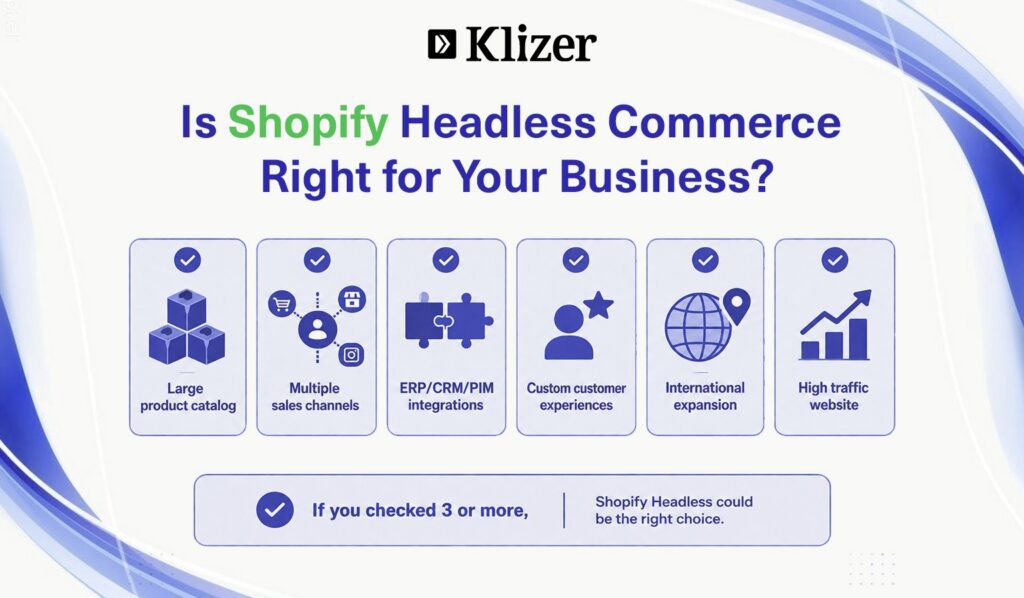
However, Shopify headless commerce is worth considering if your business:
- Wants complete control over the customer experience
- Needs better website performance
- Sells across multiple channels
- Requires ERP, CRM, or PIM integrations
- Has a large product catalog
- Plans international expansion
- Frequently launches custom campaigns or landing pages
Moving to a headless architecture is an investment, but for businesses focused on long-term digital growth, it can provide greater flexibility and a stronger foundation for innovation.
How Klizer Helps You Build Shopify Headless Commerce
Building a successful headless storefront involves much more than frontend development. It requires the right architecture, seamless integrations, performance optimization, and ongoing support.
At Klizer, we help businesses design and implement Shopify headless commerce solutions that align with their growth strategy.
Our team can help you with:
- Shopify Headless consulting
- Custom storefront development
- Hydrogen Shopify development
- Shopify Storefront API implementation
- ERP integrations
- CRM integrations
- PIM integrations
- Performance optimization
- Shopify migration
- Ongoing maintenance and support
Whether you are modernizing an existing Shopify store or building a new commerce experience, we help create connected solutions that are scalable, flexible, and built for long-term success.
Shopify Headless Commerce Is Ready for AI
The future of ecommerce is becoming increasingly AI-driven, and Shopify headless commerce is designed to support that evolution.
With Shopify’s implementation of the Model Context Protocol (MCP), AI assistants and intelligent shopping agents can securely interact with headless storefronts to perform real commerce actions. Instead of simply answering questions, AI can search products, compare options, recommend items based on customer preferences, build shopping carts, and even guide shoppers through checkout.
Combined with Hydrogen Shopify, the Shopify Storefront API, and Shopify Oxygen, businesses have a flexible foundation for building AI-powered shopping experiences while keeping Shopify as the central commerce engine. As agentic commerce continues to evolve, a headless architecture makes it easier to adopt new AI capabilities without rebuilding the entire ecommerce platform.
Final Thoughts
Customer expectations continue to evolve, and businesses need technology that can evolve with them. Shopify headless commerce gives brands the flexibility to create unique shopping experiences while continuing to use Shopify’s trusted commerce platform.
Technologies like the Shopify Storefront API, Hydrogen Shopify, and the Shopify Hydrogen framework make it easier to build fast, scalable storefronts that support personalization, omnichannel selling, and future business growth.
If you’re planning to move to a headless architecture or want to explore whether it’s the right fit for your business, partnering with an experienced Shopify development company like Klizer can make the transition much smoother. At Klizer, we help businesses design, build, and optimize Shopify headless solutions that align with their goals and growth plans.
Get in touch with the Klizer team to discuss your project and build a storefront that’s ready for the future.