
Our Expertise
What Breaks When Your Systems Aren't Connected
Fragmented systems don't just create technical problems. They create customer experience problems that show up as lost orders, pricing disputes, and buyers who stop using your digital channel.
Buyers See the Wrong Price
Contract pricing, volume discounts, and customer-specific rates live in the ERP. When those don't reach the storefront accurately, buyers either order at the wrong rate or pick up the phone to confirm before placing an order.
Inventory Is Always Out of Date
Without real-time sync, your storefront shows availability that's already stale. Overselling follows. So do backorders, delayed fulfillment, and the customer service calls that come with them.
Orders Don't Post Automatically
Orders placed on the storefront that don't flow into the ERP and OMS automatically mean someone is re-keying line items by hand. For distributors processing high order volumes, that's where errors accumulate and inside sales time disappears.
Product Data Lives in Too Many Places
When product content sits in a PIM, a spreadsheet, and the ERP at the same time with no single source of truth, catalog errors, missing attributes, and outdated specifications reach the storefront and stay there.
No Visibility Across the Operation
Without connected systems, your team is working from partial pictures. Inventory in one system, orders in another, customer data in a third. Decisions get made on data that's already wrong.
Buyers Can't Self-Serve
Account history, open orders, invoices, and reorder capability all require connected back-office data. Without it, every account inquiry becomes a customer service call and your digital channel adds work instead of removing it.
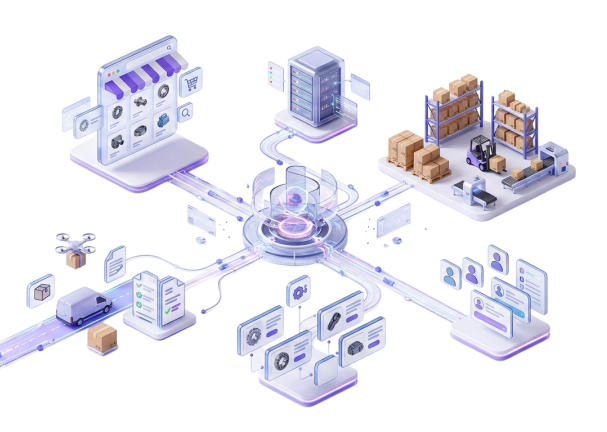
Systems We Connect
Every system in your commerce stack needs to talk to every other system. Here's what we connect and what flows between them.
ERP
The system of record for pricing, inventory, orders, and customer accounts. Real-time sync between your ERP and storefront is what makes customer-specific pricing, accurate availability, and automated order posting possible. We work with Epicor Prophet 21, Microsoft Dynamics 365, SAP, NetSuite, and Epicor ERP.
PIM
Product data managed once in your PIM, published accurately everywhere. Attribute structures, specifications, digital assets, and variant data flow from a single source to your storefront, marketplace listings, and any other channel your products appear on.
CRM
Customer records, account history, sales rep assignments, and activity data kept consistent between your CRM and your ecommerce platform. Your sales team and your digital channel work from the same customer picture.
OMS
Order data flows from storefront to OMS to fulfillment without manual touchpoints. Order status, shipment tracking, and invoice data synced back to customer accounts in real time.
WMS
Warehouse management system connections for real-time fulfillment status, multi-location inventory routing, and accurate ATP across every location your business ships from.
Payment Gateways
Payment processors, credit card vaults, and B2B payment methods including ACH, purchase orders, and net terms connected to your checkout and synced with your ERP's accounts receivable.
Tax Engines
Automated tax calculation connected to your storefront and order management system. Avalara and similar platforms integrated so tax compliance doesn't require manual intervention at the transaction level.
EDI and Procurement Protocols
EDI, cXML, and PunchOut connections for enterprise buyers on corporate procurement platforms. B2B buyers can order from your storefront without leaving their procurement system.
Marketplaces
Product listings, inventory, and order data synced between your commerce platform and marketplace channels, including Amazon, eBay, and industry-specific distributors. One catalog, multiple channels, no duplicate management.
CPQ and Quoting Tools
Configure-price-quote systems connected to your storefront and ERP so complex product configurations and custom pricing requests move through a structured workflow instead of email and spreadsheets.
How We Build Your Integration Layer
Bidirectional Sync, Not One-Way Export
Data needs to flow in both directions. Orders from the storefront post into the ERP. Fulfillment status from the WMS updates back to the customer account. Pricing changes in the ERP reflect on the storefront. One-way connections create the gaps that show up as customer complaints.
API-First Architecture
Every integration we build uses current, supported API versions with documented endpoints. Not workarounds, not screen scraping, not deprecated connectors that break on the next platform release.
A System of Record for Every Data Flow
Pricing lives in the ERP. Product content lives in the PIM. Customer data lives in the CRM. Every data flow is assigned a source of truth before the build begins so there's no ambiguity about which system wins when data conflicts.
Monitoring After Go-Live
An integration that worked on launch day can fail silently after an ERP update or a platform release. We monitor sync health, error rates, and data consistency after go-live and handle upstream changes before they cause problems downstream.
Error Handling and Retry Logic
Integration failures happen. An ERP that's briefly unreachable, a malformed payload, a timeout during a high-traffic window. Every integration we build includes error handling, retry logic, and alerting so failures surface immediately and resolve automatically where possible.
How We Work
Systems and Data Audit
We map every system in your stack, every data flow that needs to exist between them, and every business rule that governs how data moves. Most projects surface undocumented dependencies at this stage that would have caused problems mid-build.
Integration Architecture
Based on the audit, we design the integration architecture, defining which systems connect to which, what data flows in which direction, how conflicts are resolved, and what sync frequency each data type requires.
Build and Configuration
Development happens in a staging environment against your actual systems and real data. Business logic, pricing rules, inventory routing, and edge cases are all handled before anything touches your live environment.
Testing and Validation
Every integration point is tested against real business scenarios. Pricing accuracy, inventory sync, order posting, and account data are validated against your actual system configurations, not a generic test dataset.
Go-Live
We move to production during a low-traffic window with a rollback plan ready. For B2B operations running continuous order volume, go-live timing is coordinated around your business schedule, not ours.
Monitoring and Maintenance
We monitor sync health and error rates after go-live and stay on to handle ERP updates, platform releases, and business rule changes that affect the integration before they cause downstream problems.
Why Choose Klizer for eCommerce Integration
Built for Manufacturing and Distribution
Most of our integration work is with manufacturers and distributors running complex pricing matrices, contract rules, multi-warehouse inventory, and EDI connections. These aren't edge cases for us, they are the standard.
Epicor Implementation Partner
Certified implementation-level knowledge of Prophet 21 and Microsoft Dynamics 365 means we understand how your ERP actually works, not just how to connect to its API.
The Integration Is the Product
In B2B commerce, ERP integration routinely consumes more budget and time than the storefront itself. We scope it that way on purpose. If pricing, inventory, and order data are wrong, nothing about the design matters.
Full-Stack Commerce Capability
Integration doesn't exist in isolation. Understanding how the integration layer interacts with the storefront, the product data layer, and the order management layer is what prevents the problems that surface six months after go-live.
Success Stories
See Connected Commerce Performance in Practice

How Western Pacific Rebuilt Its eCommerce Platform and Eliminated Manual Pricing
Client Experiences, in Their Words

We have been a partner for Klizer for five years now, and the experience has been terrific. They have been an excellent partner to help us grow and sustain our business.
Ryan Van Hoozer
VP of Operations,
Marysville Marine Distributors
Klizer’s communication skills were above and beyond what I have
experienced with vendors. The relationship was such a great fit that we brought on Klizer employees in-house to work with us directly.
Dan Schuessler
Digital Project Manager,
Riddell
Klizer delivered a high-functioning website that perfectly coordinates with our company branding while enhancing our ecommerce capabilities for our customers
Jennifer Krach
Vice President Sales, Marketing, &
Customer Service, C-Line
Insights from Our Experts


Frequently Asked Questions
What is ecommerce integration?
Which systems do you integrate with?
Which ecommerce platforms do you connect to?
Is real-time sync possible for all data types?
What happens when the ERP or platform updates?
How long does an integration project take?
Do you support EDI and PunchOut?
How do I get started?
Ready to Connect Your Commerce Stack?
Whether you're connecting an ERP for the first time or rebuilding a fragile integration layer, our certified team will map your systems and tell you exactly what it involves before any work begins.