
As technology evolves, the way developers build software evolves with it.
Software development has moved from punch cards to modern IDEs, from manual deployments to CI/CD pipelines, and now from writing every line of code manually to collaborating with AI.
Each evolution has changed how developers work, but the purpose has remained the same: solve problems, build better software, and deliver value.
Today, AI is becoming another important tool in a developer’s toolkit. It can generate code, explain errors, write tests, suggest solutions, and automate repetitive tasks.
But does AI make developers less important?
Not necessarily. AI is changing the role of developers rather than simply replacing it.
ON THIS PAGE
From Punch Cards to Modern IDEs
The early days of programming were very different from today.
Developers used punch cards to write and submit programs. Making even a small change could require significant effort and time.
Over the years, programming languages, text editors, and eventually modern Integrated Development Environments (IDEs) transformed the development experience.
Today, developers have access to features such as:
- Intelligent code completion
- Syntax highlighting
- Debugging tools
- Refactoring
- Integrated version control
- Real-time error detection
- Extensions and plugins
These tools didn’t eliminate the need for developers. They helped developers write, debug, and maintain software more efficiently.
The developer still made the decisions. The tools simply made the process faster and easier.
From Manual Deployments to CI/CD
The evolution continued beyond coding.
Earlier, deployments often involved many manual steps. Developers or operations teams had to build applications, package them, configure environments, and deploy them manually.
With the adoption of Continuous Integration and Continuous Deployment (CI/CD), many of these repetitive activities became automated.
CI/CD pipelines can automatically:
- Build applications
- Run automated tests
- Perform code quality checks
- Create deployment packages
- Deploy applications
- Validate deployment results
Instead of spending time repeating deployment tasks, developers can focus more on solving problems and improving the product.
Automation didn’t replace developers. It changed where developers spend their time.
This pattern is important when looking at the current shift toward AI-assisted development.
From Writing Every Line of Code to Collaborating With AI
Now another major shift is taking place.
Developers are no longer limited to writing every line of code manually. AI tools can generate code from natural language requirements, explain existing code, suggest fixes, create test cases, and help investigate errors.

For example, instead of starting from an empty file, a developer can describe a requirement and ask AI to generate an initial implementation.
This can significantly reduce the time spent on repetitive coding tasks.
But generating code is only one part of development.
The developer still needs to ask:
- Does this solve the actual business requirement?
- Does it fit the existing architecture?
- Is it secure?
- Is it scalable?
- Does it handle edge cases?
- Will it be maintainable?
- Has it been properly tested?
This is where a developer’s experience and judgment remain essential.
AI can help create a solution, but developers still need to understand why the solution is needed, how it should work, and whether the generated output is appropriate.
What Developers Bring That AI Cannot Easily Replace
AI has become highly capable at generating code, explaining errors, writing tests, and automating repetitive development tasks.
However, software development involves much more than writing code.
Developers bring context, judgment, creativity, problem-solving ability, and accountability to the development process.
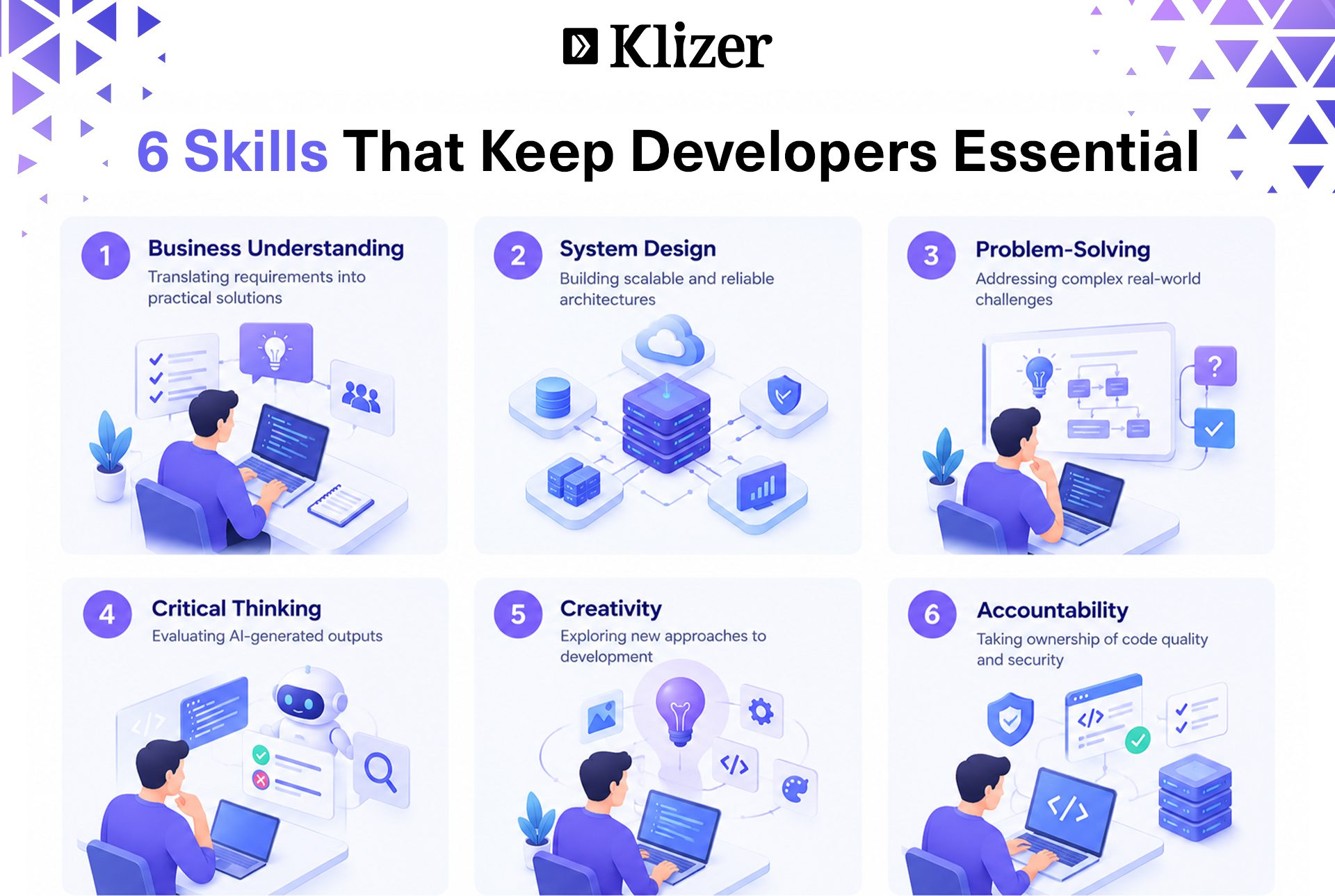
1. Understanding Business Requirements
Developers need to understand the business problem behind a requirement, not just the technical request.
For example, a requirement such as “improve the checkout experience” requires an understanding of user behavior, business rules, existing functionality, integrations, and expected outcomes.
AI can suggest possible implementations, but developers need to understand what the business actually needs.
The technical solution is only valuable when it addresses the underlying business problem.
2. Architecture and System Design
Developers make important decisions about how different parts of a system should work together.
They need to consider:
- Scalability
- Performance
- Security
- Maintainability
- Integration requirements
- Existing architecture
- Long-term technical impact
AI can suggest different approaches, but developers need to evaluate which approach is appropriate for the actual system and its requirements.
A solution that looks correct in isolation may not work well within an existing architecture.
3. Real-World Problem Solving
Production issues are rarely straightforward.
A single issue may involve application code, databases, APIs, third-party services, configurations, infrastructure, or external systems.
AI can analyze logs and suggest possible causes, but developers need to investigate the actual environment and identify the root cause.
This is where system knowledge and practical experience become especially valuable.
Developers understand how different components interact and can use that knowledge to investigate issues that may not be obvious from code alone.
4. Critical Thinking and Decision-Making
AI can provide multiple solutions, but developers still need to decide:
Which solution is actually right for the situation?
A developer evaluates trade-offs, edge cases, risks, performance implications, and business impact before implementing a solution.
Knowing when to question an AI-generated answer is becoming an important developer skill.
An answer that looks technically correct may still introduce security risks, performance problems, unnecessary complexity, or maintenance challenges.
5. Creativity
Software development often involves problems that don’t have a single predefined answer.
Developers need to think beyond the immediate requirement and create solutions that are practical, scalable, maintainable, and suitable for users.
AI can provide ideas and alternatives, but developers bring the context needed to turn those ideas into effective solutions.
The value comes not only from generating ideas, but also from knowing which ideas are worth pursuing.
6. Code Ownership and Accountability
AI-generated code still needs to be:
- Reviewed
- Tested
- Secured
- Validated
- Maintained
Ultimately, developers and engineering teams are responsible for the software they deliver.
AI can assist with implementation, but accountability remains with the people building and maintaining the system.
This makes code review and validation even more important as AI becomes a larger part of development workflows.
AI Is Changing the Developer, Not Eliminating the Developer
When the history of software development is viewed as a whole, a consistent pattern emerges:
Punch cards → IDEs → Automation → CI/CD → AI-assisted development
Each major advancement reduces repetitive work and allows developers to focus on higher-value activities.
AI is another step in this evolution.
The developer’s role is moving from simply writing code toward understanding problems, designing solutions, validating implementations, and collaborating with intelligent tools.
This doesn’t mean coding becomes unimportant.
Instead, the value of coding is increasingly connected to the developer’s ability to understand the larger system and use the right tools effectively.
The Real Future: AI + Developers
The future isn’t necessarily AI vs. Developers.
It is more likely to be:
AI + Developers
AI can help developers:
- Write code faster
- Generate test cases
- Explore possible solutions
- Understand unfamiliar code
- Analyze errors
- Automate repetitive tasks
- Learn new technologies
Developers provide:
- Business context
- Technical judgment
- Architecture
- Creativity
- Critical thinking
- System knowledge
- Accountability
When these strengths are combined, developers can spend less time on repetitive tasks and more time on meaningful engineering problems.
The goal isn’t to let AI make every development decision.
The goal is to use AI where it can provide value while keeping human judgment at the center of the development process.
The Developer Skillset Is Evolving
The most valuable developer skill in the future may not simply be the ability to write code quickly.
Developers will increasingly need to know how to:
Understand → Ask → Generate → Review → Test → Improve
Understand
Understand the business requirement, technical environment, and problem that needs to be solved.
Ask
Provide clear instructions and context to AI tools to get useful results.
Generate
Use AI to create code, test cases, documentation, or possible solutions.
Review
Evaluate the output for accuracy, security, architecture, performance, and maintainability.
Test
Validate the implementation against requirements, edge cases, and real-world scenarios.
Improve
Refine the solution and make it ready for production.
AI can help accelerate the generation stage, but developers remain responsible for the other stages.
This makes AI literacy an important part of modern software development.
Developers don’t necessarily need to become AI researchers. They need to understand how AI tools work, where they can help, where they can fail, and how to incorporate them into existing development workflows.
How AI Can Support Developers
AI can support developers across different stages of the software development lifecycle.
Code Generation
Developers can use AI to create initial implementations, functions, components, or repetitive code structures.
Code Explanation
AI can help developers understand unfamiliar codebases, functions, libraries, or implementation patterns.
Testing
AI can generate test cases, identify potential edge cases, and assist with test coverage.
Debugging
Developers can use AI to analyze errors, review logs, and explore possible causes of issues.
Documentation
AI can help create technical documentation, code comments, release notes, and other development documentation.
Learning
Developers can use AI to explore unfamiliar technologies, understand concepts, and compare different approaches.
The key is to treat these capabilities as assistance, not automatic approval.
Every output still needs to be evaluated within the context of the application.
Challenges of AI-Assisted Development
AI can improve development workflows, but it also introduces new challenges.
Accuracy
AI-generated code may contain errors or make incorrect assumptions.
Security
Generated code can introduce vulnerabilities if it is not properly reviewed and tested.
Context
AI may not understand the complete business or technical context of an application.
Maintainability
A generated solution may work initially but introduce unnecessary complexity or technical debt.
Over-Reliance
Developers who accept AI-generated output without understanding it can create additional risks for the project.
This is why human review remains an important part of AI-assisted development.
The most effective approach is not to blindly accept or reject AI-generated output. It is to evaluate it carefully and use it where it adds genuine value.
The Future of Software Development
Software development has always evolved alongside technology.
Developers moved from punch cards to text editors, from text editors to IDEs, from manual processes to automation and CI/CD, and now toward AI-assisted development.
Each shift has changed the tools developers use and the way they spend their time.
AI is continuing that evolution.
Developers who learn to work effectively with AI can reduce repetitive work, explore solutions faster, and spend more time on architecture, problem-solving, and innovation.
The future developer won’t necessarily be the person who writes the most code.
It will be the person who can understand complex problems, make sound technical decisions, use AI effectively, and take ownership of the solution.
Conclusion
AI is changing how developers build, test, and maintain software, but technical judgment and problem-solving remain essential. The future lies in combining AI capabilities with developer expertise to build reliable, scalable solutions.
Explore Klizer’s Advanced AI for eCommerce to discover how AI can support smarter ecommerce experiences and business operations. Get in touch with Klizer to explore the right approach for your business.
Frequently Asked Questions
1. How is AI changing the role of developers?
AI is automating several repetitive development tasks, including code generation, test creation, error analysis, and documentation. This allows developers to spend more time on problem-solving, architecture, decision-making, and validating solutions.
2. Will AI replace software developers?
AI is unlikely to completely replace software developers because software development involves more than writing code. Developers still need to understand business requirements, make architectural decisions, evaluate trade-offs, validate AI-generated code, and take responsibility for the final solution.
3. What skills will developers need in an AI-driven development environment?
Developers will increasingly need skills such as AI literacy, critical thinking, system design, problem-solving, code review, testing, and understanding business requirements. Knowing how to effectively prompt, evaluate, and validate AI-generated output will also become increasingly important.
4. How can developers use AI in software development?
Developers can use AI to generate code, explain unfamiliar code, create test cases, identify potential issues, analyze errors, automate repetitive tasks, and explore different implementation approaches. AI works best as a development assistant rather than a replacement for developer judgment.
5. What are the risks of using AI-generated code?
AI-generated code can contain bugs, security vulnerabilities, incorrect assumptions, or solutions that do not fit the existing architecture. Developers should review, test, validate, and secure AI-generated code before using it in production.
6. What is the future of software development with AI?
The future of software development is likely to involve closer collaboration between developers and AI tools. AI can handle more repetitive and time-consuming tasks, while developers focus on understanding complex problems, designing solutions, making technical decisions, and taking ownership of the final product.