
ON THIS PAGE
Unseen Friction in the Customer Journey
Right now, on your website, a potential customer may be struggling. They find your product through Google, but the landing page takes more than 3 seconds to load, which is slow enough for 40% of visitors to leave.
They see a promotional banner for an event that already ended. Recommendations show products unrelated to their search. They try to find a spec sheet, but the search bar shows nothing. Frustrated, they leave.
You have just lost a sale to something invisible, which is called digital experience debt.
This is not a rare problem. Many businesses face this every day as their digital systems struggle under modern demands. However, there is a solution that does not just patch problems, it rebuilds the foundation for the future.
The Five Key Issues Costing Your Business
Here are the main challenges that Adobe Experience Manager (AEM) is designed to fix:
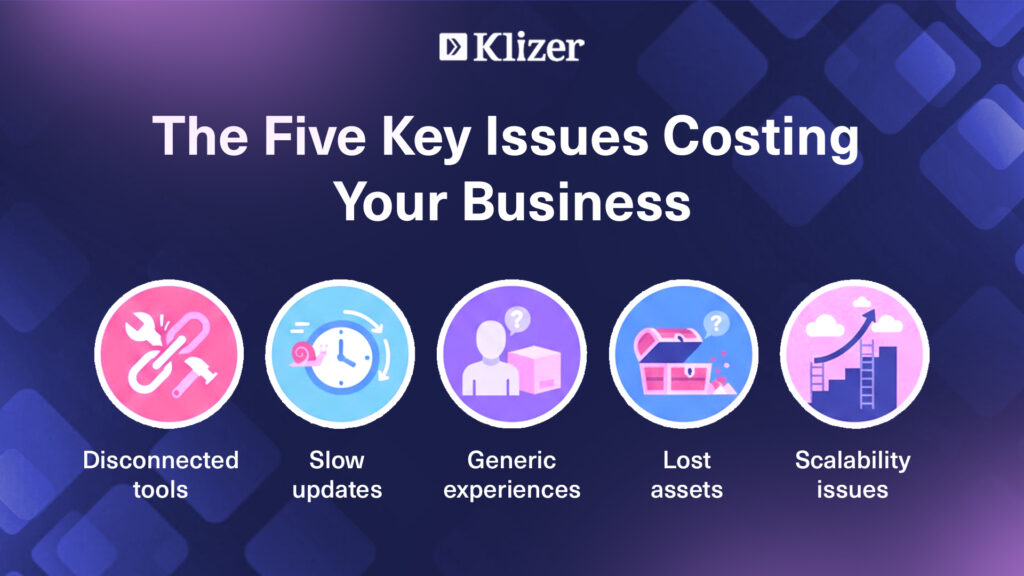
- Disconnected Tools
Marketing, design, product, and analytics live in separate systems.
Impact: Inconsistent branding, outdated content, and broken customer journeys.
- Slow Updates
Competitors launch campaigns in hours, while your updates take weeks.
Impact: Missed opportunities in a fast-moving digital world.
- Generic Experiences
You have plenty of customer data, but everyone sees the same website.
Impact: Low engagement and conversion.
- Lost Assets
Teams spend 17 hours per week searching for or recreating digital assets.
Impact: Brand consistency suffers and productivity drops.
- Scalability Issues
Viral campaigns cause website crashes because your infrastructure cannot handle sudden traffic spikes.
Impact: Lost revenue when it matters most.
How AEM Solves These Problems
Adobe Experience Manager treats these issues as parts of a single problem: disconnected systems. Here is how AEM works as the central nervous system for your digital presence:
1. Unified Content Platform
AEM combines all content in one system. Updates in AEM Assets instantly reflect across websites, apps, emails, and in-store displays. This allows you to deliver consistent, on-brand experiences quickly.
Example: A global retailer reduced launch time for new countries from 6 months to 3 weeks using AEM as their single content hub.
2. Easy Content Authoring
Marketers can create pages using drag-and-drop components without coding. Pre-approved blocks follow brand and compliance rules automatically.
Example: A financial services company allowed its compliance team to update disclaimers across 500+ pages instantly, removing a 2-week review delay.
3. Personalized Experiences at Scale
AEM, combined with Adobe Sensei AI and Real-Time Customer Data, delivers personalized content. For example:
- Show different hero images for new versus returning visitors
- Adjust navigation based on user intent
- Optimize content automatically based on real-time performance
Example: An automotive brand increased lead generation by 37% by personalizing recommendations based on browsing behavior and location.
4. Cloud-Native Reliability
AEM as a Cloud Service scales automatically for traffic spikes, applies updates with zero downtime, and protects against security threats.
Example: An entertainment company handled 8 times normal traffic during a product launch without extra planning.
Why AEM is Future-Ready
The future of digital experience isn’t just about solving today’s problems—it’s about building a foundation for tomorrow’s possibilities. Here’s why AEM is positioned as the lasting solution:
The AI Integration Advantage
While standalone AI tools offer point solutions, AEM has AI woven into its DNA. Future capabilities already in development include:
- Predictive Content Assembly: AI suggesting optimal content combinations based on conversion goals
- Automatic Accessibility Compliance: Real-time correction of WCAG violations as authors create content
- Voice-Optimized Publishing: Single content creation automatically optimized for screen, voice, and emerging interfaces
The Ecosystem Multiplier
AEM doesn’t exist in isolation—it’s the content powerhouse within the Adobe Experience Cloud. This integration creates a flywheel effect:
- Content created in AEM fuels personalized experiences in Adobe Target
- Engagement data from Analytics informs what content to create next
- Customer profiles in Real-Time CDP make every interaction more relevant
- Each system makes the others more valuable—a multiplier effect no standalone tool can match
The Headless-Ready Architecture
As the digital world expands to AR interfaces, smart devices, and platforms that don’t exist yet, AEM’s hybrid headless architecture ensures your content is future-ready. Create once in a visual editor, deploy everywhere through APIs—to known channels today and unknown ones tomorrow.
Conclusion
88% of customers say experience is as important as the product. Companies that succeed are not the ones with the most content, but the ones that deliver seamless, personalized, and scalable experiences.
Adobe Experience Manager replaces friction with speed, intelligence, and reliability. The question is not whether you can implement AEM, it is whether you can afford to lose customers to poor digital experiences.
The future of digital experience is already here. Build it on the right foundation with AEM.
If you need any help, reach out to Klizer, an enterprise ecommerce solution partner.