

Shoppers no longer search with simple keywords. They ask detailed, intent-driven questions: “comfortable running shoes for flat feet” or “noise-canceling headphones for remote work.” Businesses using traditional ecommerce search engines struggle to interpret these queries because they rely on exact keyword matching, leading to higher bounce rates, abandoned searches, and lost sales.
AI ecommerce search addresses this directly. Powered by machine learning, natural language processing, and semantic understanding, it analyzes user intent instead of matching exact keywords. It evaluates search context, customer behavior, and product data to deliver highly relevant results in real time.
ON THIS PAGE
How Does AI Product Search Work?
An AI product search engine combines multiple AI technologies to deliver accurate and personalized search results in real time. The process follows these steps:
- Understands user intent: Natural Language Processing (NLP) interprets the meaning behind search queries instead of focusing only on exact keywords.
- Analyzes product data: AI evaluates product titles, descriptions, specifications, categories, images, and metadata to identify the most relevant matches.
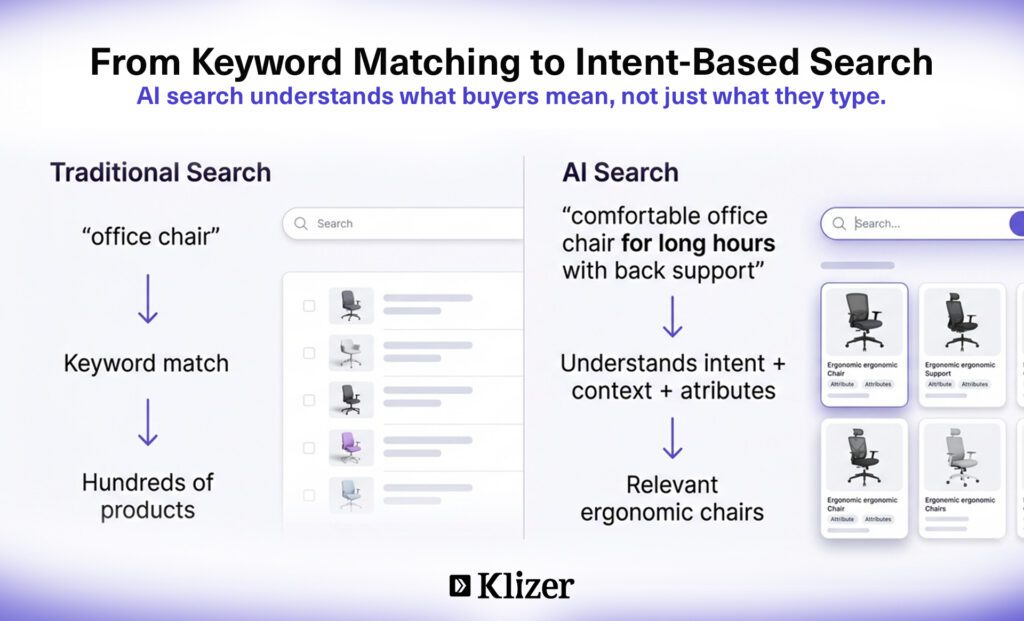
- Uses semantic search: Through semantic search in ecommerce, the system recognizes synonyms, related concepts, and contextual relationships. For example, a search for “office chair for back pain” can return ergonomic chairs even if the product description does not contain the exact phrase. In B2B, this means a distributor buyer searching “3/4 inch hydraulic fitting compatible with Parker pump” gets accurate results based on specification attributes rather than requiring an exact SKU match.
- Personalizes search results: Machine learning considers browsing history, previous purchases, location, and customer preferences to rank products according to individual interests.
- Continuously improves performance: The system learns from user interactions such as clicks, purchases, and abandoned searches, allowing search accuracy to improve over time.
What Is Semantic Search in eCommerce?
Semantic search in ecommerce is an AI-powered search approach that understands the intent, context, and meaning behind a shopper’s query instead of relying on exact keyword matches. It interprets natural language, recognizes synonyms, and connects related concepts to deliver more relevant product results.
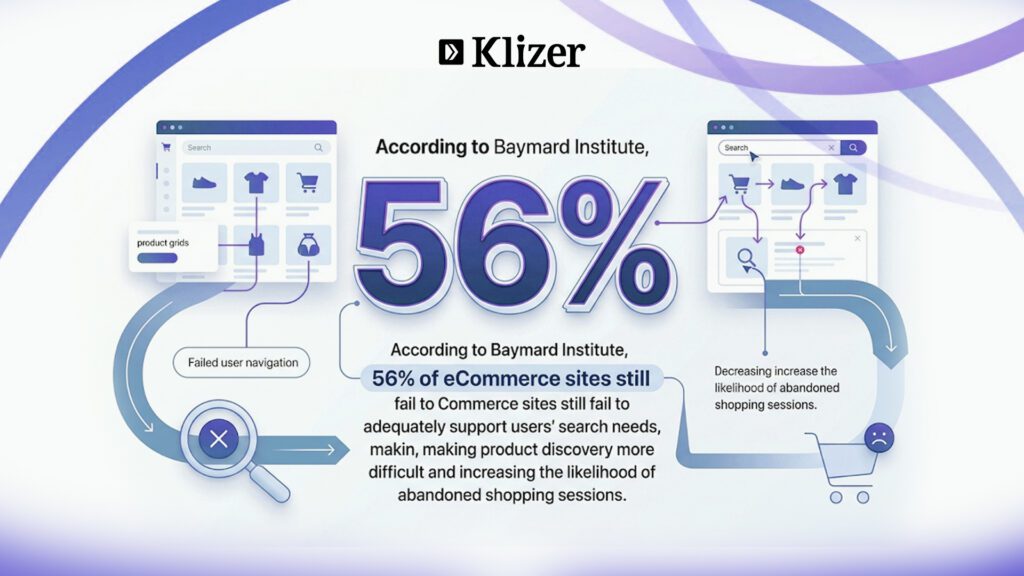
According to Baymard Institute, 56% of ecommerce sites still fail to adequately support users’ search needs, making product discovery more difficult and increasing the likelihood of abandoned shopping sessions.
- Bridges vocabulary gaps: Matches customer queries with relevant products, even when the wording differs from the product catalog
- Understands search intent: Interprets context and meaning instead of relying on exact keyword matches
- Reduces search abandonment: Minimizes zero-result pages and handles descriptive or conversational queries
- Simplifies product discovery: Helps shoppers find the right products without guessing exact product names
- Boosts conversions: Delivers relevant results that lead to faster purchase decisions and higher sales
What Are the Benefits of AI eCommerce Search for Headless Commerce?
AI ecommerce search helps businesses improve product discovery, personalize shopping experiences, and increase conversions across every digital channel.
- Understands natural language: NLP interprets conversational and long-tail queries, helping customers find products without using exact keywords.
- Delivers personalized search results: AI analyzes customer behavior, purchase history, and real-time context to display the most relevant products.
- Improves product discovery: Semantic search in ecommerce identifies synonyms, corrects spelling mistakes, and reduces zero-result searches.
- Boosts conversion rates: Relevant search results and intelligent recommendations help shoppers make faster purchasing decisions.
- Enables omnichannel search: Businesses are investing in intelligent ecommerce search technologies to deliver faster, more relevant, and personalized search experiences across websites, mobile apps, voice assistants, and other digital touchpoints.
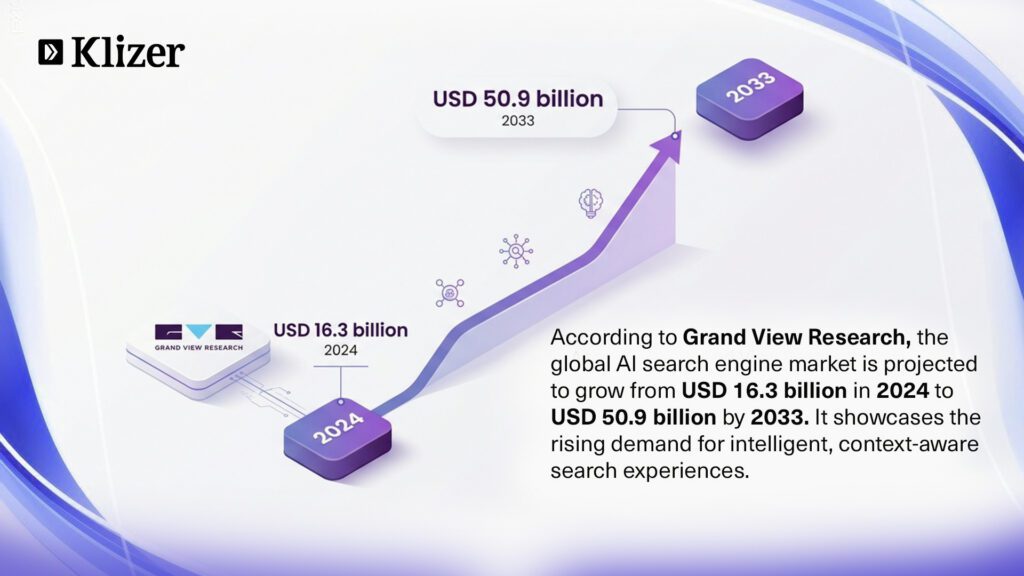
According to Grand View Research, the global AI search engine market is projected to grow from USD 16.3 billion in 2024 to USD 50.9 billion by 2033, reflecting the rising demand for intelligent, context-aware search experiences. - Supports headless flexibility: API-first integration allows businesses to update or replace AI search capabilities without disrupting the backend, making headless commerce more scalable and future-ready.
Read More: How AI Improves Shopping Experience and Helps Your eCommerce Business
AI eCommerce Search vs Traditional Search
| Feature | Traditional eCommerce Search | AI eCommerce Search |
| Query understanding | Relies on exact keywords and predefined rules | Interprets intent, context, and conversational queries using AI |
| Complex product matching | Struggles with product variants, partial SKUs, measurements, and compatibility rules | Maps attributes, product relationships, and compatibility data to return accurate matches |
| Search optimization | Requires manual updates to rules, metadata, and categories | Continuously improves rankings using search behavior, clicks, and conversions |
| Adaptability | Offers limited flexibility as catalogs grow | Scales easily with large catalogs and changing customer behavior |
| Headless commerce support | Requires custom development for updates and integrations | Connects through APIs, making it easy to upgrade or replace search capabilities without affecting the backend |
| Business impact | Slower product discovery can reduce engagement and sales | Improves search relevance, customer experience, and conversion rates |
How to Implement AI eCommerce Search in a Headless Commerce Platform
Implementing AI ecommerce search in a headless commerce platform requires a decoupled architecture, high-quality product data, AI-powered search models, and continuous optimization.
1. Build a Decoupled Search Architecture
A flexible architecture forms the foundation of AI ecommerce search. Separating the search layer from the commerce engine allows you to upgrade, scale, or replace search capabilities without disrupting backend operations.
- Keep the AI search engine independent of the core commerce platform
- Connect product catalogs, PIM, ERP, CMS, inventory, and pricing systems through APIs
- Enable real-time indexing with webhooks or event-driven synchronization to keep product and inventory data current
2. Enable AI-Powered Search Intelligence
The effectiveness of the AI product search depends on how well it understands customer intent and product data.
- Implement NLP to understand conversational and long-tail search queries
- Configure semantic search in ecommerce and vector search to match customer intent instead of exact keywords
- Train ranking models using product attributes, catalog relationships, and business rules to improve search relevance
Read More: The Future of Headless Commerce: Trends for 2026 & Beyond
3. Connect AI Search Across Customer Touchpoints
A headless architecture allows a single search engine to serve every digital experience through APIs.
- Connect the AI search engine to websites, mobile apps, kiosks, and other digital channels through APIs
- Enable autocomplete and predictive search suggestions to help shoppers find products faster
- Configure dynamic filters for attributes such as brand, price, size, color, and availability
For B2B distributors on Adobe Commerce or Magento, this means account-specific catalog visibility and contract-accurate pricing can be surfaced in search results. A buyer searching within their entitled catalog sees only the products and prices their account is authorized to access, not a generic list.
4. Continuously Improve Search Relevance
Intelligent ecommerce search becomes more accurate as it learns from customer interactions.
- Monitor search queries, clicks, conversions, and zero-result searches
- Analyze customer behavior to refine search rankings and product recommendations
- Update AI models regularly using search analytics and merchandising insights to improve relevance over time
What Is the Future of AI Search in Headless Commerce?
The future of AI search in headless commerce is intent-driven, conversational, and API-first.
- Intent will replace keywords: AI ecommerce search will use NLP and contextual understanding to interpret conversational queries instead of exact keyword matches.
- Multimodal search will expand: Customers will search using text, voice, and images, while headless APIs deliver consistent experiences across channels. For industrial distributors, image-based search means a buyer can photograph a worn component and find the matching replacement part by visual attribute matching rather than needing a part number.
- AI agents will simplify purchasing: Autonomous AI assistants will recommend products, compare options, and complete transactions with minimal user effort. In B2B, this means procurement agents querying your catalog programmatically — and the quality of your product data determines whether your products surface or get skipped. This is where conversational commerce AI and agent-ready architecture converge.
- Conversational shopping will grow: Conversational commerce AI will enable customers to discover, compare, and purchase products through chatbots, voice assistants, and AI agents.
- Headless commerce will drive innovation: API-first, decoupled architectures will help businesses integrate new AI capabilities and optimize search experiences without modifying the core commerce platform.
- Personalization will become smarter: Intelligent ecommerce search will continuously refine rankings and recommendations using real-time customer behavior and search insights.
Build AI-Powered Headless Commerce with the Right Technology Partner
As customer expectations continue to evolve, traditional keyword-based search is no longer enough. AI-powered search enables businesses to understand shopper intent, improve product discovery, support conversational interactions, and increase conversions across every digital touchpoint.
At Klizer, we design and implement composable, API-first ecommerce solutions that integrate AI product search into modern headless commerce development. Our team specializes in semantic search, NLP-driven query processing, vector search, real-time catalog synchronization, and personalized search experiences across websites, mobile apps, and other digital touchpoints.
Partner with Klizer to build an AI-powered search experience that drives conversions.
FAQs
1. Is AI ecommerce search worth the investment?
Yes, for businesses that want to improve product discovery, increase conversions, and deliver personalized shopping experiences. It helps customers find relevant products faster, reduces search abandonment, and scales efficiently as product catalogs grow.
2. What technologies power AI ecommerce search?
AI ecommerce search uses natural language processing, machine learning, vector search, and semantic search to deliver relevant results. These technologies help the search engine understand user intent, recognize context, and rank products based on relevance instead of exact keywords.
3. Can AI ecommerce search handle large product catalogs?
Yes. It indexes millions of products, understands product relationships, and delivers accurate results without slowing the shopping experience.
4. How long does it take to implement AI ecommerce search?
Most implementations take a few weeks to a few months, depending on platform, catalog complexity, and integration requirements. Data quality and API integrations are the biggest variables.
5. Does AI ecommerce search improve customer retention?
Yes. Faster product discovery and personalized recommendations encourage repeat purchases and increase customer satisfaction.
6. Can AI ecommerce search integrate with a PIM system?
Yes. Real-time synchronization ensures customers always see the latest product details, attributes, and inventory information pulled directly from the PIM.
7. How does AI ecommerce search improve merchandising?
It automatically prioritizes relevant products based on customer intent, behavior, and business goals, reducing manual merchandising effort while helping businesses promote products more effectively.