
The way people buy is changing faster than most commerce platforms can keep up with. Buyers move across websites, mobile apps, marketplaces, and sales reps in a single purchase. They expect the same accurate pricing and availability everywhere.
Headless commerce has become the architecture brands lean on to keep pace, and the next few years will push it further than the split between frontend and backend.
ON THIS PAGE
What Is Driving the Future of Headless Commerce?
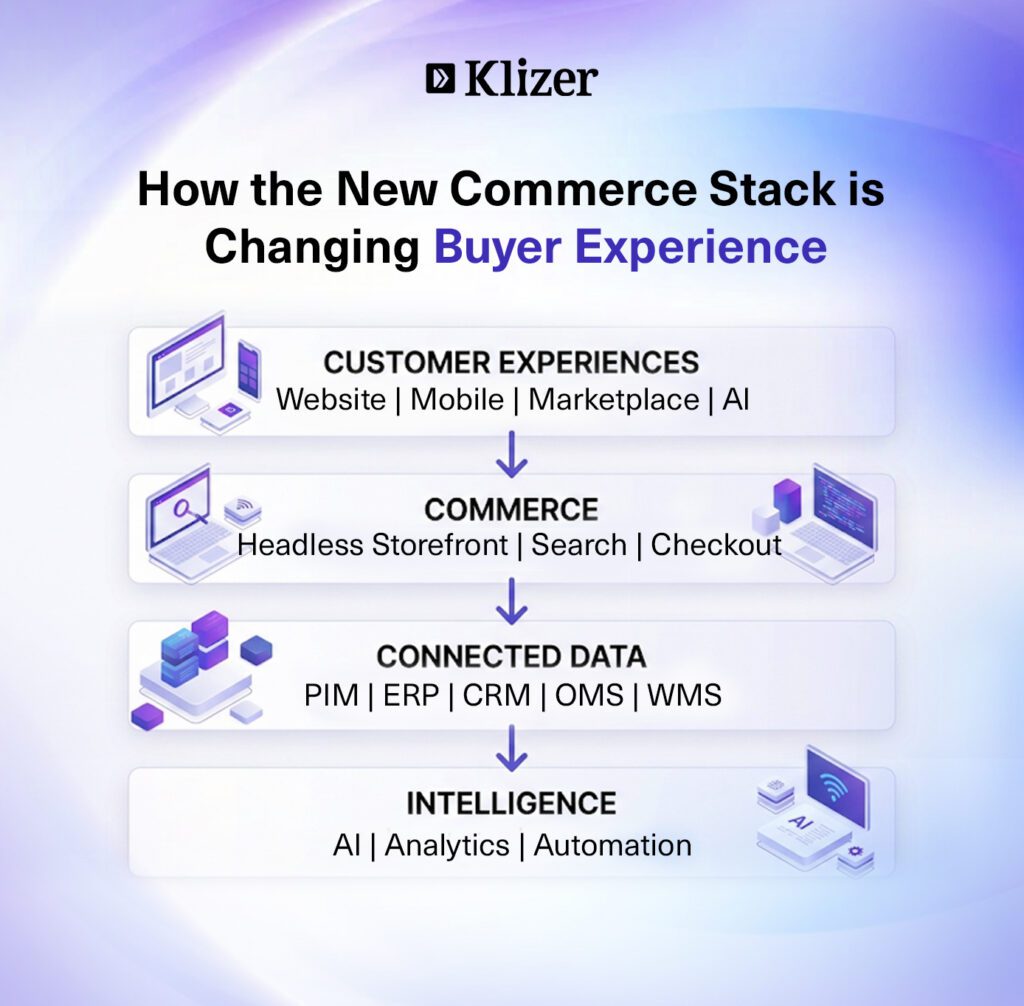
Every trend below traces back to one question: how well does the storefront connect to the systems of record behind it? The most useful headless commerce trends in 2026 are not about rendering pages faster. They are about moving accurate pricing, inventory, and account data across every channel a buyer touches.
The integration part is where the real gains are being decided, and it is what separates a modern stack from a faster version of the old one.
8 Headless Commerce Trends in 2026
1. Composable Commerce Becomes the Default
Composable commerce extends headless by breaking the backend into modular, swappable services: search, checkout, CMS, and payments each run independently and connect through APIs. This is quickly becoming the default for enterprises that need to change one component without rebuilding the whole platform.
The momentum shows in the numbers: the headless commerce market is projected to grow from $2.13 billion in 2026 to $7.24 billion by 2033. For distributors managing multiple brands or regions, that modularity is what makes these composable commerce trends more practical.
2. Personalization Moves to Commercial Data
Most personalization advice assumes a behavioral-ML problem: track clicks, predict the next purchase. In B2B, that framing misses the point. The data that matters is commercial and already sits in the ERP: contract pricing, negotiated terms, credit status, and reorder history.
The headless commerce trends worth following here connect the storefront to that record so a logged-in buyer sees their price, not a list price. Personalization becomes an integration outcome, not just a machine-learning experiment.
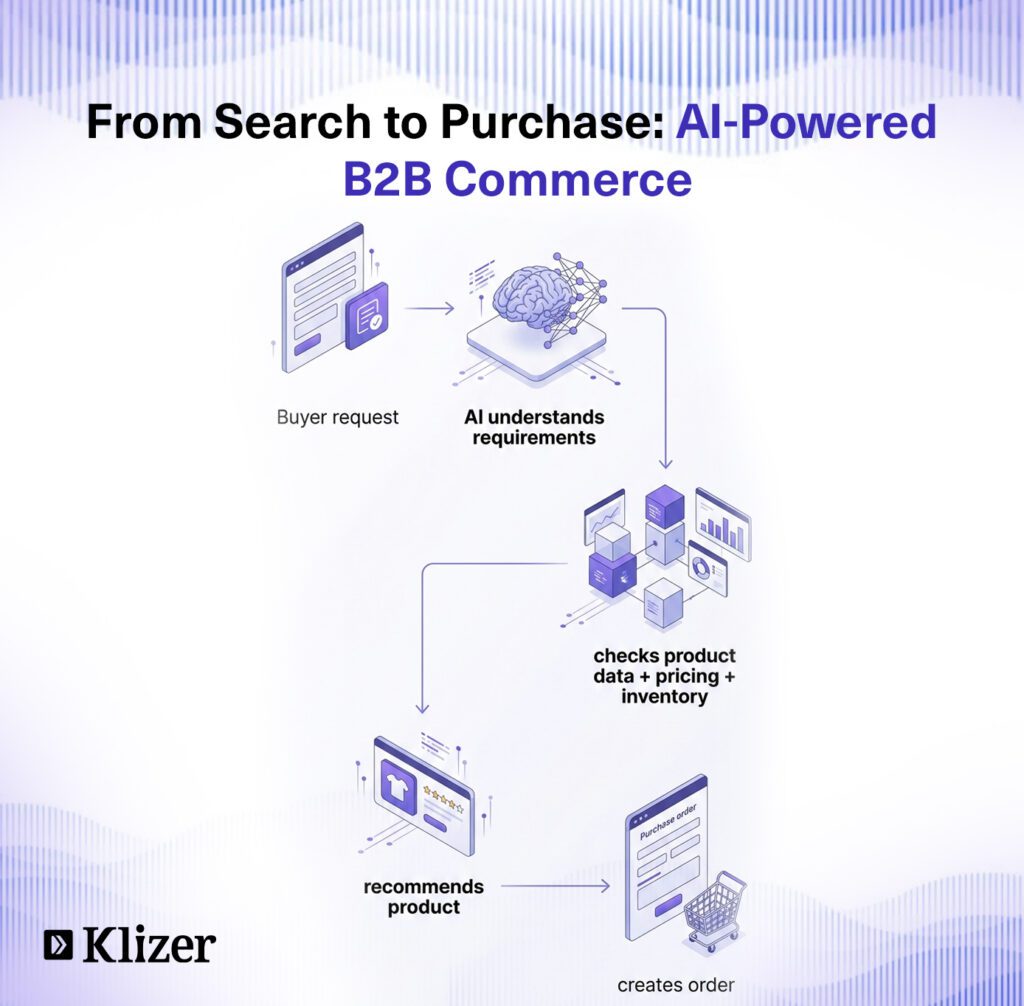
3. Agentic Commerce and Operational AI
The newest shift is from AI that drafts content to AI that takes action. Agentic systems watch for triggers in connected systems and respond without a human prompt. A new SKU in the PIM can kick off description drafting, tagging, and localization. A stock level crossing a threshold can update a storefront banner or reprioritize fulfillment.
The infrastructure enabling this is now live. Shopify’s Model Context Protocol implementation and Google’s Universal Commerce Protocol give AI agents a standardized way to query catalogs, verify pricing, and execute transactions directly against commerce systems. For manufacturers and distributors, this means a buyer’s procurement agent can place a reorder against your catalog without a human touchpoint, as long as your product data is structured and your APIs are clean.
This is part of operational AI, and it only works when the storefront and the systems of record share a live data layer.
4. The Unified Data Layer
Channel silos are really data silos. When the website, the mobile app, and the sales desk each read from a different source, pricing drifts and inventory shows stock that is already committed.
A unified data layer treats the ERP as the single source of truth and syncs identity, inventory, and pricing across every touchpoint. For industrial sellers, this is less a technology upgrade than an integration discipline, and it is the foundation the other trends depend on.
5. Real-Time Search and Product Discovery
Industrial catalogs are large, technical, and unforgiving: buyers search by part number, SKU, or specification, and near-misses cost sales. Modern search engines integrate through APIs and interpret intent rather than matching strings, so a query for a fitting by dimension returns the right product.
Connected to live ERP data, search can also respect account-level pricing and availability, which turns discovery into a step that reflects what the buyer can actually order. For distributors with 10,000 to 100,000 SKUs, the difference between string-matching search and intent-aware search is measurable in abandoned sessions and lost orders.
6. Edge Performance and Modern Rendering
Speed is a revenue lever, and headless architecture gives teams the control to manage it. Rendering strategies like static generation, server-side rendering, and Incremental Static Regeneration (ISR) let each page load with minimal latency, chosen per page rather than platform-wide.
Delivered from the edge, storefronts stay fast across regions and score well on Core Web Vitals, which feeds search visibility. Among ecommerce trends 2026 will keep pushing, this one directly connects technical performance to conversion. Headless storefronts built with modern rendering consistently deliver 35% faster page loads than coupled platforms running equivalent catalogs.
7. Smart OMS and Fulfillment Orchestration
Order management has moved from a back-office function to the operational core of the stack. A modern OMS consolidates inventory across warehouses and locations, routes each order to the optimal fulfillment point, and updates counts everywhere in real time.
For distributors running complex logistics, this orchestration is what keeps delivery promises accurate. It depends entirely on the OMS reading true inventory from the ERP rather than a cached approximation. When that connection is clean, stock promises made at checkout hold through fulfillment. When it is not, the gap shows up in customer escalations and manual intervention.
8. Omnichannel Expansion to New Interfaces
Buyers now reach brands through more than a website, and the channel list keeps growing: mobile apps, progressive web apps, voice, and AR-based product visualization for complex equipment. Headless architecture is the only practical way to serve consistent product data to all of them from one backend.
For industrial distributors, the most immediate version of this is not AR: it is ensuring that the sales rep’s portal, the buyer’s procurement system, and the website all read from the same ERP record at the same time. Channel consistency at that level is both the most achievable and the most commercially consequential version of omnichannel expansion.
This channel expansion is one of the composable commerce trends with the longest runway, and among the ecommerce trends 2026 buyers will increasingly expect it as standard.
What These Trends Mean for the Future of eCommerce for B2B Manufacturers and Distributors
These trends point in one direction. The payoff from headless commerce comes not from the storefront itself but from how tightly it connects to the systems that price products, track stock, and manage accounts.
A fast frontend on top of disconnected data is still a disconnected business. Manufacturers and distributors that treat modernization as an integration project, rather than a redesign, are the ones positioned to benefit as these shifts mature.
Final Thoughts
Start by finding where your storefront and your systems of record fall out of sync, fix that foundation first, then layer on composable services, personalization, and Operational AI as the connected data makes each one possible.
Get that right, and you are building the future of ecommerce.
At Klizer, we build Connected Commerce for industrial manufacturers and distributors, bringing ERP, B2B ecommerce, integrations, and Operational AI together under one roof. This structure is what turns the headless commerce trends above from concepts into working systems, because the storefront is only as strong as what it connects to.
If your storefront needs that same connection, book a free consultation with Klizer today.