

Five to seven years. That is how long the average industrial distributor’s new storefront lasts before the same story repeats.
Pages slow down, the integrations start breaking, and the pile of workarounds grows until a full rebuild looks cheaper than another patch. So the team runs an RFP, argues for months over which storefront looks best, migrates the catalog, and quietly resets the clock.
That loop is the real problem with B2B eCommerce replatforming. It happens because businesses often treat the storefront as the main thing they are choosing, when it is actually the least important layer in the decision.
The distributors who escape that loop stopped shopping for storefronts and started choosing architectures. In this guide, we will walk through what that means in practice: where replatforming budgets really go, how to match a platform to your ERP and catalog, and how to migrate without downtime.
ON THIS PAGE
Replatforming, Migration, Rehosting: What Is the Difference?
These three terms are used interchangeably in vendor conversations and internal planning documents, but they describe very different scopes of work.
Replatforming is a full platform change: new software, new workflows, and usually new integrations. Functionality changes, design changes, and the way data is structured often changes too. This is the highest-effort, highest-risk option and the one most distributors mean when they say they need to replatform.
Migration refers specifically to the transfer of data and digital assets from one system to another, whether or not the platform itself changes. You can migrate data without replatforming, but you cannot replatform without migrating.
Rehosting is a lift-and-shift: the existing site moves to new hosting infrastructure with minimal changes to code or features. Faster and cheaper, but it solves hosting problems, not platform problems. If the integration layer is broken, rehosting does not fix it.
Most distributors who say they need a new platform actually need a replatform, not a rehost. The distinction matters because the budget, timeline, and team structure are completely different for each.
Why Do Distributors Keep Replatforming Every Few Years?
The storefront is rarely what fails first. What fails is the connection between the storefront and the systems that run the business, because your ERP holds the real pricing, the real inventory, and the customer-specific terms that make B2B different from retail. The storefront is only a window onto that data.
Most ecommerce replatforming projects inherit this weakness by design. A distributor buys a storefront, bolts integrations onto it after the fact, and those integrations quietly become the weakest part of the stack. A few patterns show up almost every time:
- Pricing drifts out of sync, so the storefront shows one number while the ERP holds another
- Inventory shows available when it is not, because the sync runs on a delay nobody remembers setting
- Every new customer tier or contract price adds a custom connector, and someone has to maintain it by hand
- The integration layer turns into a black box, held together by whoever built it, until that person leaves
A few years of that, and the storefront still works while the system around it does not. That is when replatforming starts to feel like the only way out.
McKinsey’s B2B Pulse research puts roughly 34% of B2B revenue through digital channels, making ecommerce the top revenue-generating channel for companies that sell online. With that much riding on one system, the cost of getting the rebuild wrong is real.
Roughly 64% of data migrations overrun their budget and 54% overrun their timeline. This largely happens because teams underestimate the work of moving pricing rules, account hierarchies, and order history cleanly.
The ecommerce replatforming benefits people chase, faster pages and a cleaner catalog, are real but secondary. The durable win is a platform whose connection to the ERP does not rot. If the next round of B2B ecommerce replatforming connects to the same fragile integrations, you have not actually made progress. The clock simply resets.
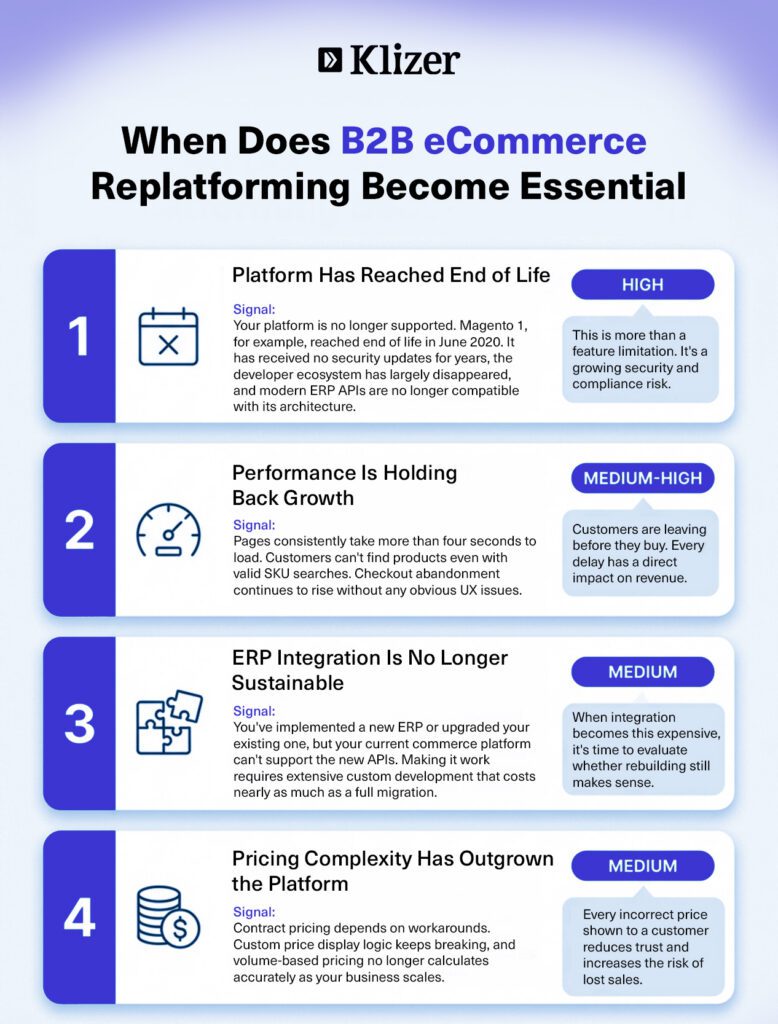
When Should a Distributor Replatform?
The right moment to replatform is not when everything has broken. By then the cost and risk are both higher than they needed to be. The signal is when the cost of staying is growing faster than the cost of moving.
Five patterns that consistently precede a replatforming decision:
- Pricing sync is breaking regularly. The storefront is showing wrong rates to buyers, and fixing it requires manual intervention from someone who understands the connector. This happened at a $45M electrical distributor we worked with: the ERP updated contract pricing quarterly, but the storefront sync ran on a schedule that nobody had touched in three years. Buyers were ordering at the wrong rates and the discrepancy was only caught in billing.
- ERP integration is maintained by one person. When the person who built the integration is the only one who can fix it, you do not have an integration. You have a dependency. When that person leaves, the next replatforming project starts.
- Catalog growth is degrading performance. A distributor who goes from 8,000 SKUs to 40,000 in two years often finds that the platform that worked at 8,000 becomes unusable at 40,000. Search slows, category pages time out, and product management becomes a bottleneck.
- New customer tiers require custom development. When adding a new account tier or a new pricing structure requires a developer rather than a configuration change, the platform is working against the business.
- The platform cannot support the buying model buyers expect. A platform built for retail checkout cannot support RFQ flows, approval workflows, or account-specific catalog access without significant custom work that someone has to maintain indefinitely.
What Are You Actually Choosing When You Replatform?
Before you evaluate anything, understand this: you are not choosing a storefront, you are choosing an architecture. For an industrial distributor, that architecture has four parts that must work as a single, unified system:
- Foundation: the ERP and data model that hold pricing, inventory, and customer terms
- Storefront: the buyer-facing catalog, search, and ordering experience
- Integration: the layer that keeps the storefront and the ERP in agreement, in real time
- Intelligence: the operational logic that acts on that connected data, from reorder prompts to quote automation
Most platform comparisons weight the storefront heavily and treat integration as one checkbox among many, which for a distributor is backwards. The integration layer is where projects succeed or fail, so it deserves the heaviest weight in your scoring.
A platform that ships a beautiful catalog but forces custom middleware to reach your ERP is a platform you will be replacing again. When you evaluate architecture first, the shortlist changes: you stop asking which storefront demos best and start asking which system keeps all four layers in sync as you scale.
One consideration that 2026 adds to this evaluation: agent readiness. Enterprise buyers are beginning to deploy AI procurement agents that query your catalog, verify pricing, and place orders without human involvement. A platform whose data layer is structured, API-complete, and machine-readable will capture that demand. One that relies on nightly batch syncs and incomplete product attributes will not. The architecture decision you make today determines whether your storefront can serve both human buyers and AI agents in the next three years.
What Are the Real Costs of Getting Replatforming Wrong?
Getting B2B eCommerce replatforming wrong is expensive in ways the pricing page never shows. Platform licensing is the number everyone benchmarks, and it is the least useful one. Across most mid-market projects, the license accounts for only 20% to 40% of the total cost, while implementation, ERP work, and data migration drive the other 60% to 80%.
Most merchants invest between $25,000 and $500,000 in a switch, according to Digital Commerce 360: roughly $15,000 to $50,000 for a sub-$1M distributor, $50,000 to $150,000 in the $1M to $10M range, and $150,000 or more above $10M, where architecture rather than licensing sets the budget.
ERP integration is consistently the largest overrun driver. Prebuilt connectors tend to run $5,000 to $30,000, while custom SAP or Oracle integrations can reach $50,000 to $250,000 or more in the first year alone. A sound ecommerce migration strategy plans for that curve from the start and carries a 25% to 40% contingency, rather than discovering the integration bill after the contract is signed.
The mistakes that inflate these budgets are predictable and mostly avoidable:
- Scoping integration last. Treating ERP connectivity as a post-launch task is how a four-week integration becomes a twelve-week one.
- Skipping data cleanup. Migrating years of duplicate SKUs and stale customer records multiplies testing hours and error rates. A $30M HVAC distributor we worked with discovered 4,200 duplicate SKUs during pre-migration data audits, records that had accumulated over eight years of manual ERP updates. Cleaning that data before migration added three weeks to the project and saved an estimated six months of post-launch correction work.
- Buying for the demo. A platform that shows well but handles your pricing logic poorly forces custom development for features that were supposed to be native.
The most expensive mistake is optimizing for the wrong layer. A distributor who saves on licensing and then spends triple that reconnecting a rigid platform to their ERP has not saved anything. Budget the replatforming ecommerce work by the layer that will actually consume the hours.
Which B2B Platform Fits Your Use Case?
There is no single best platform for distributors, only the right fit for your catalog complexity, ERP setup, and growth stage. The platform fit decision is not a preference. It is a project outcome determinant.
The table below scores the common options on the criteria that matter to a distributor, with ERP integration weighted heaviest because that is what determines longevity.
| Platform | ERP Integration | Catalog and Pricing Complexity | B2B Workflows | Best-Fit Use Case |
| Adobe Commerce | Strong, via connectors and API | Handles deep catalogs and complex pricing | Mature B2B feature set | Large distributors, $20M+ GMV, complex catalogs |
| Shopify Plus | Good, connector-dependent | Better for cleaner catalogs | B2B features maturing | Mid-market distributors wanting speed to launch |
| BigCommerce | Good, open API | Solid mid-range catalog handling | Strong native B2B tooling | Growing distributors under ~$20M GMV |
| OroCommerce | Built for B2B, ERP-oriented | Strong on complex B2B pricing | Purpose-built for B2B | Distributors with heavy quote and contract logic |
| commercetools | API-first, integrates anywhere | Depends on your build | Composable, you build the workflows | Enterprises going headless, $50M+ GMV |
Read the table by your own numbers, not the marketing. A distributor doing $8M with a straightforward catalog does not need a composable rebuild, while a $60M distributor with three ERPs and per-account contract pricing will outgrow a packaged storefront fast.
Fit is about matching the platform to the operational reality, and this is where good ecommerce replatforming services earn their keep, by scoring your requirements honestly before anyone talks about the product.
Looking at two common migration paths to understand this better:
- The Mid-Market Pivot (e.g., Magento): An ecommerce Magento migration usually starts when a distributor hits a wall on performance or custom pricing. The real decision here is not about a prettier storefront. It is deciding whether to move to a newer packaged platform or to replatform to headless commerce, keeping your ERP as the system of record. A $15M MRO distributor that migrated from Magento 2 to Adobe Commerce B2B reduced custom module count from 34 to 11 and cut monthly developer maintenance hours by 60% in the first year.
- The Enterprise Leap (e.g., Shopify to commercetools): A Shopify to commercetools move sits at the other end. This architecture is only worth its high engineering cost above a certain financial scale. Buying a complex composable system without the internal tech team to support it is a very common and expensive mistake.
How Long Does a B2B eCommerce Replatforming Take?
Timeline is the variable that surprises most distributors because vendor estimates assume clean data, decisive stakeholders, and no integration complexity. None of those assumptions hold in practice.
| Business Size | Typical Timeline | Biggest Variables |
| Small distributor (under $5M GMV) | 8 to 14 weeks | Data cleanup, ERP connector availability |
| Mid-market ($5M to $20M GMV) | 14 to 26 weeks | Custom pricing logic, integration complexity |
| Enterprise ($20M+ GMV, complex B2B) | 26 to 52 weeks | Multiple ERPs, composable builds, account hierarchy migration |
The biggest driver of overrun is almost never the storefront build. It is the ERP integration, the data cleanup, and the time required to get internal stakeholders to sign off on how pricing rules and account hierarchies should be structured in the new system. Budget for those delays before they happen, not after.
How Do You Migrate Without Taking the Store Down?
A replatforming project is ultimately judged by whether your buyers notice a disruption. In B2B, the stakes are high: large digital orders are now routine, and most buyers prefer a self-service path. A store that goes down or displays incorrect pricing will send your highest-value accounts to a competitor.
Before the technical work starts, stakeholder alignment is the most commonly overlooked prerequisite. The organizations that run clean replatforming projects get sales, finance, customer service, and IT aligned on goals, ownership, and success criteria before any platform is selected. The ones that struggle are usually fighting internal disagreements about what the new system should do while the development team is already building it.
The core of any guide for an ecommerce migration is sequencing, because you do not flip a switch. You run the new system alongside the old one, validate the data against the source of truth, and cut over in controlled stages. A practical sequence for how to avoid downtime during ecommerce migration looks like this:
- Run in parallel: stand up the new platform and sync live ERP data before any buyer touches it
- Validate against the ERP: confirm pricing, inventory, and customer terms match the system of record exactly
- Migrate in phases: move customer segments or product lines in waves, not all at once
- Keep a rollback path: hold the old storefront live until the new one is proven under real orders
- Cut over off-peak: schedule the final switch around your buyers’ ordering patterns, not your team’s calendar

The thread running through all of it is the ERP connection. When the integration layer is solid the data stays true through every phase and buyers keep ordering. When it is fragile, no migration plan will save you, which is the whole reason architecture comes first.
One thing most replatforming guides skip: what happens after go-live determines whether the project pays for itself. A technically successful launch with poor sales team adoption delivers none of the expected ROI. Buyers who get confused by the new portal revert to phone and email ordering. Reps who were not involved in the project do not trust the system and work around it. The distributors who see strong adoption treat sales enablement as part of the migration project, not a follow-up task.
That difference separates a clean B2B eCommerce replatforming from a project that quietly bleeds orders for months after launch.
Final Thoughts
The distributors who escape the five-year loop stopped buying storefronts and started buying connected systems. When the ERP, the storefront, the integration layer, and the operational logic are designed as one engine, the connection does not rot, and the next rebuild never has to happen.
That is what Klizer builds: Connected Commerce for industrial manufacturers and distributors, with ERP, B2B eCommerce, integrations, and Operational AI in one system, under one roof.
If you are weighing a rebuild, the platform is not the first decision. The architecture is. Our ecommerce replatforming services start there, scoring your ERP, catalog, and growth stage before any product enters the conversation, so the replatforming ecommerce work you invest in now is the last time you have to do it.
Book a consultation with the Klizer team today.