
B2B businesses lose revenue every day because their ecommerce platforms and ERP systems fail to talk to each other in real time.
Sales, warehousing, finance, and customer service teams operate in separate systems that do not sync. One department updates data while another works with outdated information. The result is constant operational friction: wrong inventory counts, pricing errors, delayed orders, and manual rework that scales badly as order volumes grow.
The failures are not random. They follow predictable patterns, and understanding them before you build is worth more than troubleshooting after launch.
This guide breaks down how ecommerce integration with ERP works, where B2B companies consistently go wrong, and how to build a system that supports growth rather than creating new problems.
ON THIS PAGE
What is eCommerce ERP Integration?
eCommerce ERP integration connects ecommerce platforms with ERP systems so both share real-time business data across orders, inventory, pricing, and fulfillment. It eliminates manual syncing and ensures that every order placed online immediately updates backend operations, creating a single consistent data flow across sales, finance, and logistics.
Without integration, teams manually update inventory, re-enter orders, and reconcile mismatched records. B2B companies with real-time ERP sync report 95%+ order accuracy, compared to 82-88% without integration, according to Gartner. That accuracy gap translates directly into rework hours, customer churn, and lost revenue.
Why Do B2B Companies Need eCommerce ERP Integration?
B2B companies manage complex, high-volume transactions that demand accuracy across systems. Without integration, sales platforms and backend ERP tools operate in isolation, which leads to delays, mismatched data, and manual intervention.
1. To eliminate inventory mismatches across warehouses
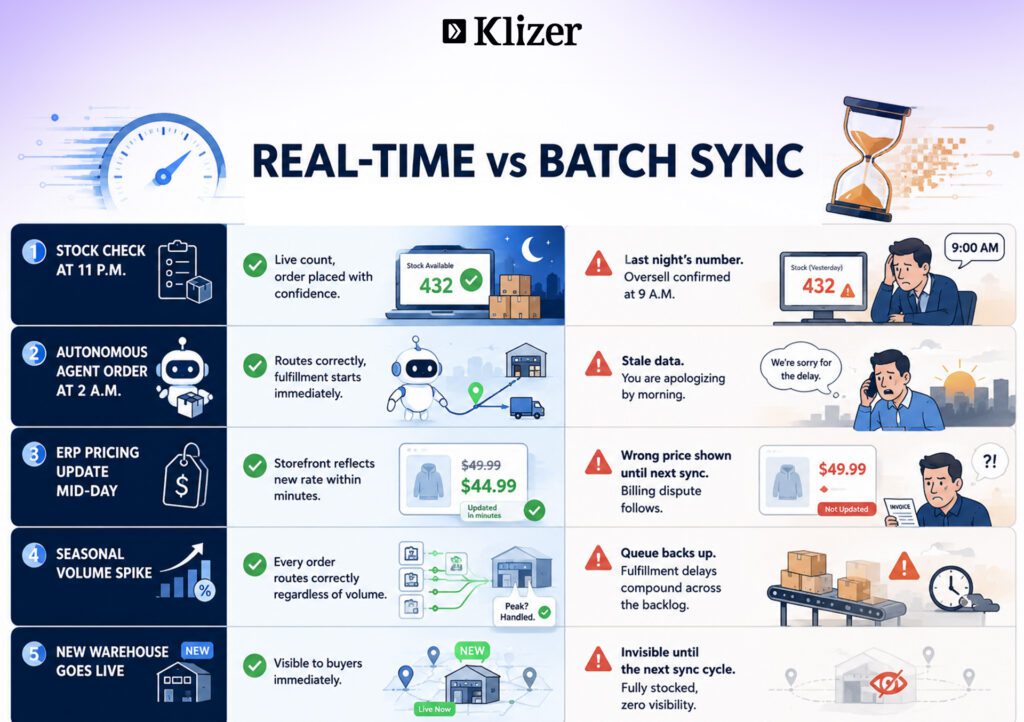
B2B distributors often manage stock across multiple warehouses. When systems do not sync, one warehouse may show available stock while another is already depleted. With b2b ecommerce ERP integration, inventory updates in real time across every location. For B2B distributors running significant daily order volume, near-real-time inventory sync every 5 to 15 minutes is table stakes, not a nice-to-have.
2. To automate complex order processing workflows
B2B orders often include bulk quantities, tiered pricing, and approval steps. Without integration, teams manually validate orders in the ERP after they appear in ecommerce systems. With ecommerce ERP integration, orders flow directly into ERP workflows without manual re-entry.
3. To manage dynamic B2B pricing structures
B2B companies frequently offer customer-specific pricing, contracts, and discounts. Without system integration, sales teams update pricing manually, which leads to errors. With integration, ERP pushes correct pricing rules into the ecommerce platform in real time. In Prophet 21 and Epicor implementations we have worked on, pricing sync failures are among the most common and most damaging problems: the storefront shows list price while the ERP holds a negotiated contract rate, and the buyer either sees the wrong price or calls a sales rep to reconcile it.
4. To improve order-to-cash speed and financial accuracy
Disconnected systems slow down invoicing and reconciliation. Finance teams often re-enter order data into ERP systems, which delays billing cycles. With ecommerce ERP integration, invoices are generated automatically once orders ship.
5. To scale operations without increasing manual workload
As order volumes grow, manual processes break quickly. Companies rely on b2b ecommerce ERP integration to scale efficiently without expanding operational teams. A food distribution company handling seasonal spikes can process thousands of additional orders during peak demand without hiring extra staff because ERP and ecommerce systems handle synchronization automatically.
Read More: How to Integrate Epicor P21 with Your B2B eCommerce Platform
What Are the Most Common Mistakes B2B Companies Make in ERP eCommerce Integration?
B2B companies often fail at ecommerce ERP integration because they focus only on system connectivity and ignore architecture, data quality, workflows, and real business usage. These mistakes create long-term instability, poor customer experience, and operational inefficiency.
1. Choosing a weak or rigid integration architecture
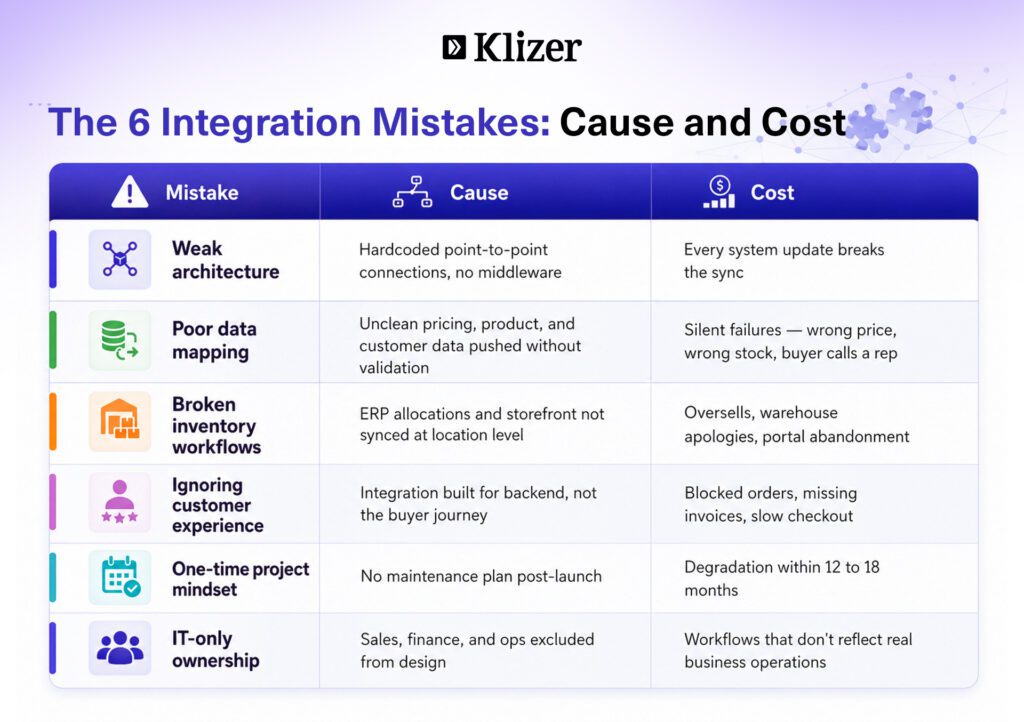
Many companies build ecommerce integration with ERP systems using point-to-point, hard-coded connections that break easily during updates. They skip middleware like iPaaS or ESB, which limits scalability and makes future integrations harder to extend. They rely on batch-based sync instead of real-time updates, which leads to outdated inventory and delayed business decisions.
The most damaging version of this mistake is building the ecommerce platform first and bolting on the ERP connection later. The integration layer has to be designed as part of the architecture from day one, not added as an afterthought once orders start flowing.
2. Poor data governance and incorrect mapping
Businesses push unclean or inconsistent data into integrated systems without validation. They fail to standardize product, customer, and pricing data before syncing and do not define a clear single source of truth between ERP and ecommerce platforms. This creates conflicts in inventory, catalog structure, and reporting.
In b2b ecommerce ERP integration projects, incorrect mapping of complex pricing rules, tier discounts, and tax structures is one of the most common causes of post-launch failures. ERP data structures rarely match ecommerce platform formats. A missing required field, an incompatible date format, or a mismatched customer group can interrupt a sync silently until a buyer notices the wrong price or a wrong stock count.
3. Broken inventory and order management workflows
Companies expose incorrect stock levels because ERP allocations and ecommerce visibility do not align. They do not design flexible workflows for B2B scenarios like split shipments, backorders, or multi-warehouse routing. Many depend on manual exception handling when integration errors occur, which slows down order processing and increases operational workload.
A distributor running four warehouses cannot show one inventory number. Buyers need to see availability at the location that actually ships to them. When that location-level sync breaks, the storefront oversells, the warehouse team calls the customer to apologize, and the buyer questions why they are using the portal at all.
4. Ignoring customer experience in integration design
Many teams design ecommerce website integration with ERP systems around backend efficiency but ignore the customer journey entirely. They block orders when credit limit checks fail instead of validating them in real time through ERP sync. They fail to push invoices, quotes, and shipment updates back to the customer portal. Heavy synchronous API calls slow down checkout performance, which directly impacts conversions.
5. Treating integration as a one-time project
This is the most common long-term failure mode. An ERP to ecommerce integration is not a static connection point. It is a living system that has to evolve with product catalog changes, ERP upgrades, new customer pricing structures, and platform updates. Organizations that treat it as a one-time build consistently see it degrade within 12 to 18 months as both systems evolve independently.
6. Poor execution and lack of cross-functional alignment
Organizations treat ecommerce ERP integration as an IT-only initiative and exclude key departments like sales, finance, and customer service. This results in incomplete workflows that do not reflect real business operations. Teams skip end-to-end testing under realistic B2B loads and edge cases, which causes production failures after launch. Without proper change management and training, internal users and customers struggle to adapt to the new system.
How ERP eCommerce Integration Eliminates Operational Challenges
eCommerce ERP integration eliminates operational friction by connecting customer-facing ecommerce platforms with backend ERP systems in real time. It aligns pricing, inventory, orders, and financial workflows into one synchronized ecosystem.
Real-time inventory updates eliminate stock errors
With ecommerce ERP integration, inventory data flows continuously between warehouses and the storefront. When stock levels change in the ERP, the ecommerce platform updates immediately, giving buyers accurate availability before they place orders. This prevents overselling and reduces backorders in high-volume B2B operations.
Automated order processing removes manual entry delays
B2b ecommerce ERP integration removes the manual step of converting emails, PDFs, or phone orders into ERP entries by pushing orders directly from the ecommerce platform into the ERP system. This reduces human error, shortens processing cycles, and allows teams to focus on fulfillment instead of data entry.
Unified pricing ensures contract accuracy
With ecommerce integration with ERP systems, the ERP acts as the pricing authority and pushes accurate customer-specific pricing to the ecommerce storefront in real time. This ensures consistency and reduces billing disputes.
Automated invoicing and faster financial reconciliation
Integrated systems trigger invoicing automatically once an order is confirmed or shipped. This accelerates the order-to-cash cycle, reduces reconciliation effort, and ensures financial records stay aligned across ERP and ecommerce platforms.
Explore how we helped one of our clients establish seamless ERP integration.
Self-service access reduces support workload
eCommerce website integration with ERP systems enables self-service portals where customers can track orders, view invoices, and check account balances in real time, without contacting support.
Stop Losing Orders to Disconnected Systems
See how Klizer integrates ERP and eCommerce platforms without disrupting operations.
ERP eCommerce Integration Cost Breakdown
eCommerce ERP integration costs vary widely depending on business size, system complexity, and integration depth.
| Business Size | Cost Range | Key Inclusions |
| Small Business | $10,000 – $30,000 | Basic ecommerce ERP integration, pre-built connectors, simple inventory sync, limited automation |
| Mid-Market B2B | $30,000 – $50,000 | B2B ecommerce ERP integration, middleware (iPaaS), custom APIs, real-time sync, advanced pricing and inventory logic |
| Enterprise | $50,000 – $100,000+ | Full-scale ecommerce website integration with ERP systems, custom architecture, global real-time sync, complex workflows, security and compliance layers |
Note: Actual costs vary based on ERP type, ecommerce platform, number of integrations, customization level, data complexity, and whether the system requires real-time or batch processing architecture.
Conclusion
eCommerce ERP integration is the foundation that B2B commerce operations run on. When it is built correctly, orders flow automatically, pricing stays accurate, inventory reflects reality, and finance teams stop chasing reconciliation errors. When it is built wrong or treated as a one-time project, it degrades silently until a customer notices.
The most expensive integration mistakes in B2B ecommerce are not technical failures. They are planning failures: wrong architecture, unclean data, no cross-functional alignment, and no maintenance plan after launch.
Klizer builds and maintains ERP integrations for manufacturers and distributors on Adobe Commerce, Magento, Shopify Plus, and BigCommerce. We connect Prophet 21, Epicor, SAP, and NetSuite to your storefront as a managed integration layer, not a one-time project.
Ready to streamline your operations with a properly integrated ERP and ecommerce ecosystem? Connect with Klizer to plan and implement a solution built around how your business actually operates.