

Managing a modern Adobe Commerce storefront often means dealing with slow frontends, complex release cycles, and development bottlenecks that get in the way of actually moving fast.
Adobe Edge Delivery Services is Adobe’s answer to that problem. And it is more than an upgrade. It is a fundamental shift in how commerce storefronts are built, maintained, and scaled.
ON THIS PAGE
How Adobe Commerce Frontend Changed Over the Years
When Magento 2 launched, Luma became the default frontend. It offered extensive feature coverage and deep platform integration. However, over time, its limitations became clear: slower performance, outdated technologies, heavy customization effort, and limited flexibility. While reliable, Luma struggled to meet modern user expectations.
Adobe’s next step was PWA Studio, which introduced progressive web app capabilities and improved performance. It delivered modern experiences, but at the cost of a steep learning curve, high development investment, and complex architecture. Only well-resourced teams could fully leverage its potential. Adobe needed a simpler, more scalable solution.
What are Edge Delivery Services?
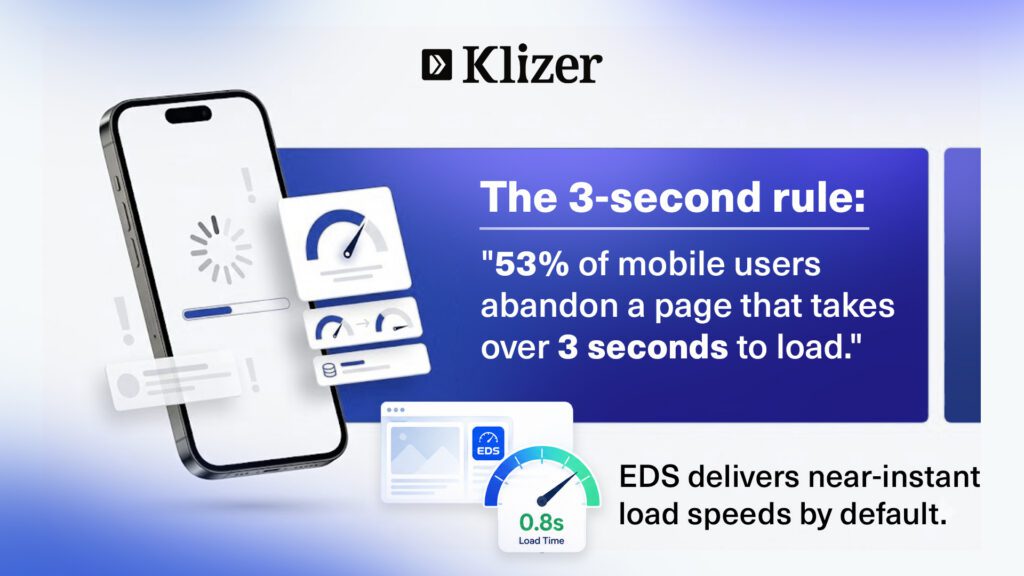
Edge Delivery Services is a cloud-native delivery platform built into Adobe Experience Cloud that serves web content from globally distributed edge nodes, placing pages physically closer to the end user to reduce latency and deliver near-instant load speeds by default.
Instead of relying on centralized server rendering, Adobe Edge Delivery Services distributes processing across a global network, making performance a built-in feature rather than something teams optimize for after launch. Pages load faster, servers carry less load, and the entire storefront becomes more reliable at scale.
In Adobe Experience Manager, AEM Edge Delivery Services replaces the traditional publishing pipeline with this edge-optimized delivery layer. Content authors continue working in familiar tools like Google Docs, Microsoft Word, and Google Sheets, while the platform automatically structures and serves that content from the edge. This eliminates the performance bottlenecks common to traditional AEM publishing and removes the need for dedicated frontend rendering infrastructure.
At its technical core, EDS is headless and framework-agnostic, relying on HTML, CSS, and vanilla JavaScript with no dependency on heavy frontend frameworks. Commerce functionality connects through GraphQL APIs, Catalog Services, App Builder, and Commerce drop-ins, enabling frontend teams to evolve the storefront independently from backend commerce logic. It also unifies content management across Experience Manager, allowing editorial teams to manage both marketing and commerce content from a single authoring environment.
Adobe reinforces this through its Keeping it 100 principle, which involves continuous Lighthouse monitoring to maintain near-perfect performance scores across speed, SEO, and accessibility. This makes edge delivery services Adobe’s most complete answer yet to the challenge of running fast, content-rich storefronts at enterprise scale.
Adobe EDS vs PWA Studio: Which Is Right for Your Commerce Build?
One of the most common questions teams face when planning an Adobe Commerce project is whether to build on Edge Delivery Services or stick with PWA Studio. Both are headless approaches, but they serve different teams, timelines, and technical profiles.
| Factor | Edge Delivery Services | PWA Studio |
| Architecture | Headless, edge-native, framework-agnostic | React-based PWA framework |
| Frontend Stack | HTML, CSS, Vanilla JavaScript | React, GraphQL |
| Performance | Edge-optimized by default, near-perfect Lighthouse scores | Requires optimization effort to achieve high scores |
| Content Authoring | Document-based (Google Docs, Word, Sheets) | Developer-dependent for most updates |
| Learning Curve | Low for web developers, accessible to marketers | High, requires React and PWA expertise |
| Development Speed | Faster with boilerplate, drop-ins, and SDKs | Slower due to framework complexity |
| Customization | Modular via drop-ins and SDKs | Highly customizable but at a higher cost |
| Integration with Adobe Commerce | Native via GraphQL, Catalog Services, App Builder | Native via GraphQL and REST APIs |
| Team Requirements | Standard web skills, broader talent pool | Specialized React and PWA developers |
| Migration Flexibility | Incremental adoption possible | Typically requires a more complete rebuild |
| Long-term Adobe Roadmap | Strategic investment, active development | Maintained but not the primary direction |
| Best For | Teams prioritizing speed, performance, and content agility | Teams with existing React investment or PWA-specific requirements |
The key takeaway is that PWA Studio remains a viable option for teams that have already built on it or have deep React expertise. But for new Adobe Commerce projects, edge delivery services that Adobe is actively investing in represent the clearer long-term direction. The lower barrier to entry, faster content publishing, and edge-native performance make EDS the more practical choice for most enterprise teams today.
A Headless and Lightweight Architecture
EDS embraces a truly headless and framework-agnostic approach. Its core technologies are HTML, CSS, and vanilla JavaScript, with no dependency on heavy frontend frameworks. Integration with Adobe Commerce happens through GraphQL APIs, Catalog Services, App Builder, and Commerce drop-ins. This enables teams to evolve frontends independently from backend systems.
Composable Storefronts: Boilerplate, Drop-Ins, and SDKs
Edge Delivery Services follows a modular design built around three layers.
- Boilerplate for Accelerated Foundations: The boilerplate provides a standardized project structure, deployment patterns, and edge-optimized configuration so teams can start quickly with proven best practices.
- Drop-Ins Provide Ready-Made Commerce Features: Drop-ins deliver core ecommerce experiences, including product pages, listings, cart, and checkout. They reduce development time while maintaining enterprise-grade quality.
- SDKs for Customization and Extension: SDKs enable custom components, third-party integrations, and advanced experiences, all within the EDS ecosystem.
Together, these layers provide structure without sacrificing flexibility.
Explore our Adobe Commerce Services here.
Reinventing Content Authoring and Workflows
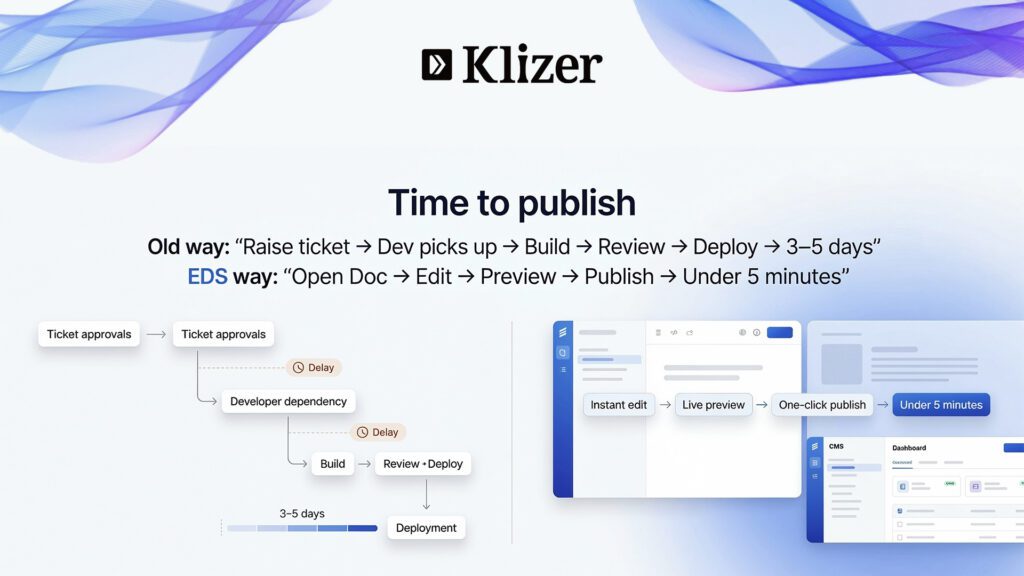
One of the most significant innovations of EDS is its approach to content creation. Marketing and content teams can use familiar tools such as Google Docs, Google Sheets, Microsoft Word, and Excel. These documents are automatically converted into structured web pages, complete with embedded images and videos, metadata and SEO configuration, section-based layouts, and spreadsheet-driven APIs.
This dramatically reduces dependency on development teams. With Sidekick and Workfront integration, content can be previewed instantly, approvals are streamlined, version history is preserved, and rollbacks are simplified. Marketing teams can move quickly without disrupting commerce operations.
Operational Benefits of Using EDS
- Decoupled Release Pipelines: EDS enables separate delivery streams for commerce logic, marketing content, and campaign pages. This eliminates bottlenecks and improves release velocity.
- Automated Quality Assurance: Every code change can be validated through Lighthouse performance checks, SEO audits, and accessibility scans. Issues are detected early, reducing risk in production.
Flexible Migration and Real-World Adoption
Edge Delivery Services does not require a full platform replacement. Many organizations adopt EDS incrementally, starting with blogs and landing pages, then moving to product and catalog pages, and gradually migrating checkout flows. This reduces risk and improves ROI. Existing React and micro-frontend applications can also be reused and served through EDS, protecting previous investments.
Organizational Impact
EDS changes more than technology. It transforms team dynamics. Because EDS uses standard web technologies, organizations can hire more easily, reduce reliance on niche specialists, and improve knowledge sharing. Teams shift their attention from platform constraints to customer experience and API-driven innovation.
Key Benefits of Edge Delivery Services for Adobe Commerce
From a technical standpoint, EDS delivers edge-native performance, a headless composable architecture, a lightweight frontend stack, and deep Commerce integration. Operationally, it enables parallel release cycles, automated quality checks, reduced maintenance overhead, and faster time to market. For the business, this translates to higher conversion rates, improved SEO and accessibility, faster campaign launches, lower total cost of ownership, and a future-ready architecture.
Why Edge Delivery Services Is the Future of Adobe Commerce
Edge Delivery Services is not a short-term experiment. It is the foundation of Adobe’s long-term content and commerce strategy. By unifying delivery across AEM, Commerce, Assets, Forms, and Experiences, EDS creates a single, scalable platform for digital engagement. For Adobe Commerce organizations, this means preserving existing investments, modernizing storefronts gradually, delivering high-performance experiences, and staying competitive in a fast-changing market.
Conclusion
Many Adobe Commerce teams today are maintaining storefronts built for a different era, patching performance issues, working around technical limitations, and struggling with slow workflows. Adobe Edge Delivery Services offers a new path forward.
It enables teams to build fast by default, empower content creators, scale globally, and innovate continuously. Rather than maintaining inherited systems, organizations can now design storefronts that reflect modern customer expectations.
Edge Delivery Services is not just improving storefronts. It is redefining how commerce experiences are created.
Looking for expert help on Adobe Commerce Development or Edge Delivery Services in general? Reach out to our team right away.
Frequently Asked Questions
-
What are Adobe Edge Delivery Services?
Adobe Edge Delivery Services is Adobe’s flagship content and commerce delivery platform, built into Adobe Experience Cloud. It combines edge-native performance with a document-based authoring model, allowing teams to publish from Google Docs or Microsoft Word while serving content at speed from edge locations worldwide. It integrates natively with Adobe Commerce, AEM, and other Adobe products. -
What are Edge Delivery Services in AEM?
In Adobe Experience Manager, AEM Edge Delivery Services replaces the traditional publishing pipeline with an edge-optimized delivery layer. Content authors work in familiar tools like Google Docs and Word, while the platform automatically structures and serves that content from the edge. This eliminates the performance bottlenecks common to traditional AEM publishing and removes the need for dedicated frontend rendering infrastructure. -
Who offers cutting-edge content delivery services for Adobe Commerce?
Klizer is a specialized Adobe Commerce partner offering edge delivery services implementation and ongoing support for enterprise eCommerce teams. With 20+ years of eCommerce experience, Klizer helps manufacturers and distributors modernize their storefronts using EDS, moving from legacy frontends to edge-native architectures without disrupting existing operations. If you are evaluating who offers cutting-edge content delivery services for your Adobe Commerce build, Klizer’s team is equipped to guide the full implementation. -
Do I need to rebuild my entire Adobe Commerce store to use EDS?
No. EDS supports incremental adoption. Many teams start by migrating marketing pages, blogs, and landing pages first, then progressively move product listings and checkout flows. This reduces risk and protects existing investments. -
How does EDS improve SEO for Adobe Commerce?
EDS continuously monitors performance through Lighthouse scoring, ensuring pages maintain high scores for speed, accessibility, and SEO. Faster load times, clean HTML output, and proper metadata configuration all contribute to stronger organic search rankings. -
Can existing React or PWA Studio components be reused with EDS?
Yes. Existing React and micro-frontend applications can be reused and served through EDS. This means teams do not have to discard previous development work when migrating to an edge-native architecture. -
Is EDS suitable for B2B Adobe Commerce stores?
Yes. EDS supports complex catalog structures, multi-channel content delivery, and deep backend integrations through APIs and App Builder, making it well-suited for B2B manufacturers and distributors managing large product catalogs across multiple storefronts. -
How does document-based authoring work in EDS?
Content authors create and edit pages directly in Google Docs, Google Sheets, or Microsoft Word. EDS automatically converts those documents into structured, optimized web pages. Changes can be previewed instantly using the Sidekick tool before publishing to the live storefront. -
What is the difference between EDS and a traditional headless commerce setup?
Traditional headless commerce separates the frontend from the backend but still relies on centralized servers for rendering and delivery. EDS goes a step further by moving delivery to the edge, closer to the end user. This results in faster performance, lower infrastructure overhead, and a simpler frontend stack compared to most traditional headless implementations.