
Adobe Summit 2026 ran April 20–22 in Las Vegas, with preconference sessions on April 19. If you attended expecting the usual mix of platform updates and roadmap slides, you probably left with something bigger on your mind.
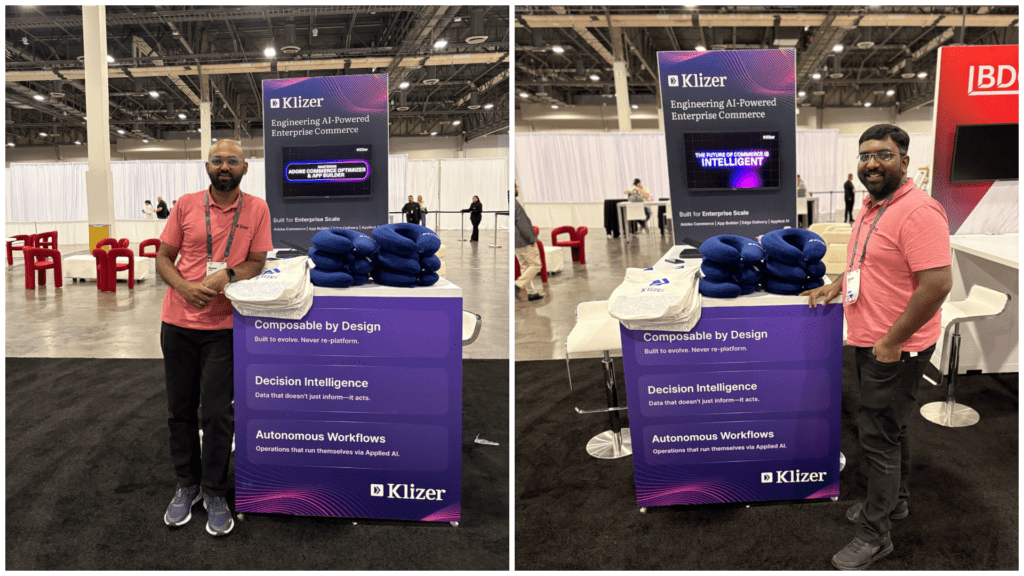
Klizer was once again part of the event as a Showcase Sponsor. Our very own Head of Sales, Alfred Vivek, and Senior Technical Accounts Manager, Yassar Saleh, were there at the three-day conference representing us.
The real conversation at Summit this year was not about a single feature or release. It was about a fundamental shift in how commerce platforms need to operate, serving both human shoppers and AI agents at the same time.
This blog breaks down what Adobe announced, what it means practically, and why merchants and development teams should pay attention right now.
ON THIS PAGE
The Number that Changed the Conversation
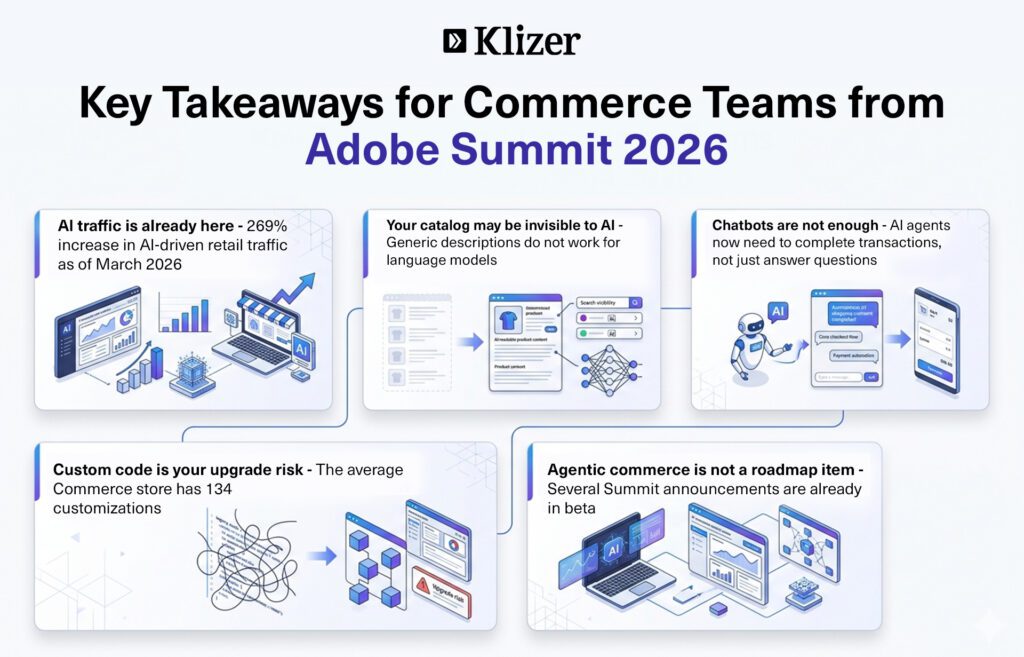
Adobe opened with a data point that set the tone for everything else: AI-driven traffic to U.S. retail sites jumped 269% year-over-year as of March 2026.
This was not a forecast. It was measured traffic from Adobe’s own analytics across retail sites. Shoppers are already using tools like ChatGPT, Gemini, and Perplexity to research products, compare options, and get buying recommendations before they ever land on a brand’s website.
The challenge Adobe put on the table: most product catalogs were built for humans scanning a page, not for language models trying to reason about which product fits a specific buyer’s needs. The announcements at Summit were designed to close that gap.
What Adobe Announced at Summit 2026
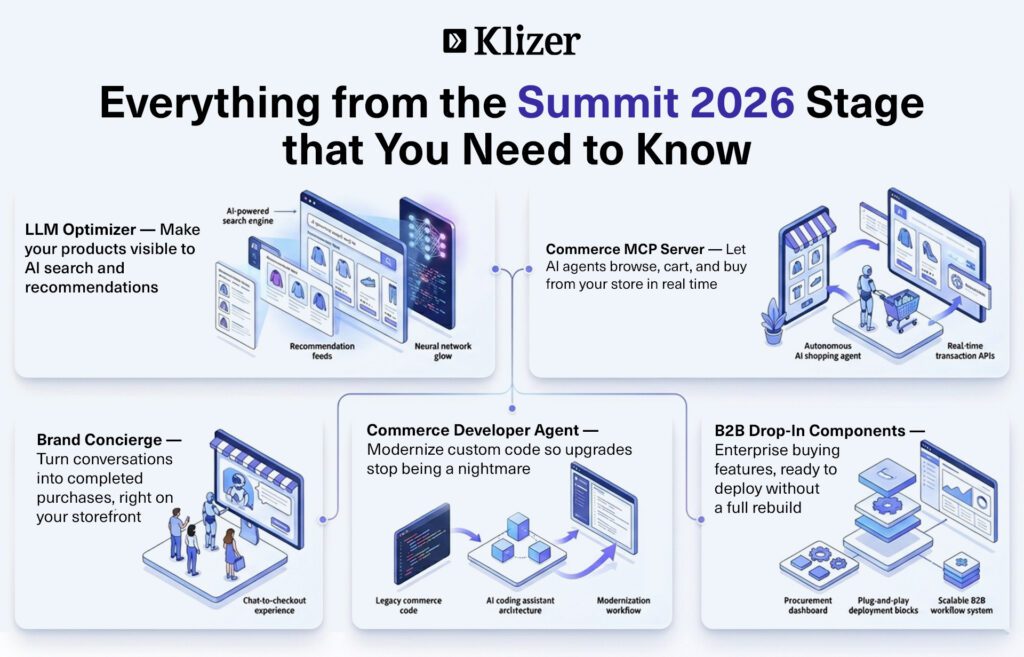
1. LLM Optimizer
The LLM Optimizer connects to your Adobe Commerce catalog and reviews every SKU. It analyzes existing attributes, category context, product names, and descriptions to identify where the language is too generic or too vague for an AI system to interpret.
Where it finds gaps, it generates enriched alternatives: narrative-driven content that helps language models understand what a product is, who it is for, and why someone would want it.
A few things worth knowing about how it works:
- Every suggestion is previewed before anything goes live. Nothing updates your catalog without your approval.
- The enrichments are visible to both AI systems and human shoppers. They update the product pages and every channel pulling from your Commerce catalog.
- Adobe tested this internally and saw a fivefold increase in brand mentions across AI search queries within one week of applying enrichments.
The feature is currently in beta for Adobe Commerce customers. You can reach out to your Account Manager to request access.
2. Commerce MCP Server
MCP stands for Model Context Protocol, a standardized way for AI systems to securely access external platforms.
Adobe’s Commerce MCP server exposes real-time data from your store (catalogs, pricing, inventory, and order workflows) to external AI agents. This allows AI systems to go beyond describing your products and actually perform commerce functions: searching inventory, building carts, applying discounts, and processing checkout.
This is the infrastructure difference between a chatbot that talks about your products and an AI agent that can close a sale, handle a reorder, or manage a B2B quote, all without the buyer leaving the AI interface they started in.
Know more about our Adobe Commerce Services here.
3. Brand Concierge
Brand Concierge is Adobe’s conversational AI assistant that runs directly on your storefront. It pulls live catalog data, real-time pricing, and current inventory, so it is never working with stale information.
What makes it different from a typical chatbot is its transaction capability. Customers can complete their entire purchase inside the conversation. No redirect to a checkout page. No context switching. From the first question to the completed order, everything happens in one flow.
For brands selling complex B2B catalogs, configurable products, or high-consideration items, this compresses the traditional browse-compare-checkout funnel into a single experience.
4. Commerce Developer Agent
Adobe shared a data point at Summit that made a lot of technical leaders uncomfortable: the average Commerce customer has 134 customizations on their storefront.
Every one of those is a potential break point during a core upgrade. That is the real reason upgrades get delayed: not the release notes, but the custom code.
The Commerce Developer Agent tackles this directly. It scans existing custom PHP code, breaks it down into its component use cases, and helps teams convert in-process extensions into out-of-process App Builder applications written in JavaScript.
The practical impact:
- You describe what you need in plain language, and the agent generates the code, creates architectural blueprints, and maps out a migration path.
- Adobe demoed this live using AWS’s Kiro. What previously took weeks of manual assessment was happening in minutes.
- Once custom logic is moved into standalone App Builder microservices, the platform core and your custom code can evolve independently, meaning future upgrades stop being hostage to your customizations.
5. B2B Drop-In Components
Adobe also rolled out pre-built B2B components covering enterprise features that merchants have historically spent months building from scratch.
What ships as independently deployable modules:
- Negotiable quotes
- Requisition lists
- Company accounts with roles and permissions
- Purchase order workflows
These are rolling out through 2026 and do not require a full platform migration to adopt.
What This Means for Magento Open Source Users
App Builder, the Commerce Developer Agent, B2B drop-in components, Brand Concierge, and the Commerce MCP server are all exclusive to Adobe Commerce.
The gap between Open Source and Commerce has been widening, but after Summit 2026, it looks structural rather than incremental. If your roadmap includes any of these AI or agentic commerce capabilities, the platform question is worth revisiting sooner rather than later.
Key Takeaways for Commerce Teams
Adobe Summit 2026 was not a product announcement event in the traditional sense. The theme running through every session was preparation: specifically, whether your commerce stack is ready to operate in an environment where AI agents are a primary discovery and purchase channel.
The tools Adobe announced are not roadmap concepts. Several are already in beta, and the rest are shipping through 2026.
The merchants who treat the current window as a planning opportunity, auditing their catalog quality, assessing their customization footprint, and exploring agentic capabilities, are going to be better positioned as AI-driven commerce matures.
The ones who wait are going to be playing catch-up in a market that has already moved.
Ready to Evaluate Your Commerce Stack?
If you are an Adobe Commerce merchant trying to understand what these announcements mean for your specific setup (catalog readiness, upgrade complexity, or agentic commerce strategy), our team is available to help.
With 50+ certified experts and experience across 300+ commerce implementations, Klizer works with merchants who need clear, practical guidance, not generic advice.