
Mid-sized businesses outgrow traditional, monolithic commerce platforms because customers expect personalized shopping experiences across websites, mobile apps, marketplaces, and other digital channels. However, meeting these expectations requires a flexible commerce architecture that supports rapid innovation, clean integrations, and consistent omnichannel experiences.
Many businesses are investing in headless commerce for ecommerce to improve flexibility, enhance performance, and support long-term growth. It simplifies integrations with CMS, PIM, ERP, CRM, and payment systems, which supports faster deployment of new digital experiences.
Implementing headless commerce, however, requires investment in development, infrastructure, and maintenance, making it essential to evaluate whether the expected headless commerce ROI justifies the cost.
ON THIS PAGE
What is Headless Commerce for eCommerce?
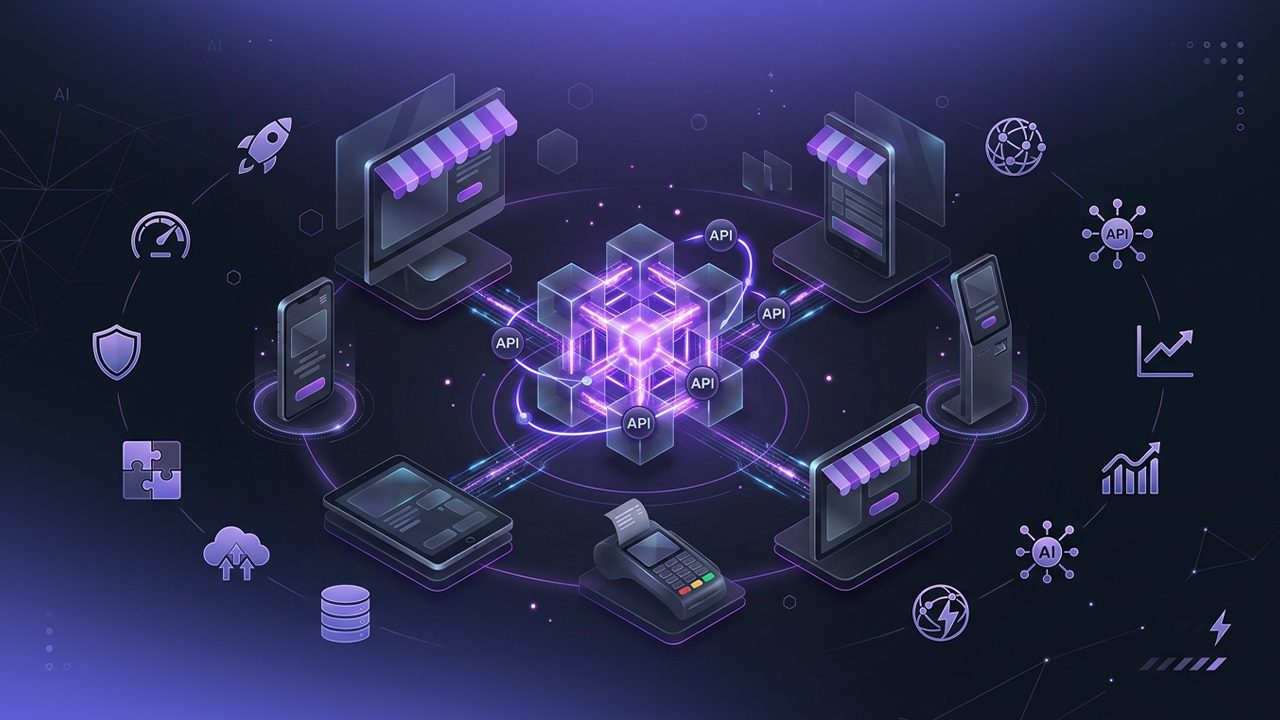
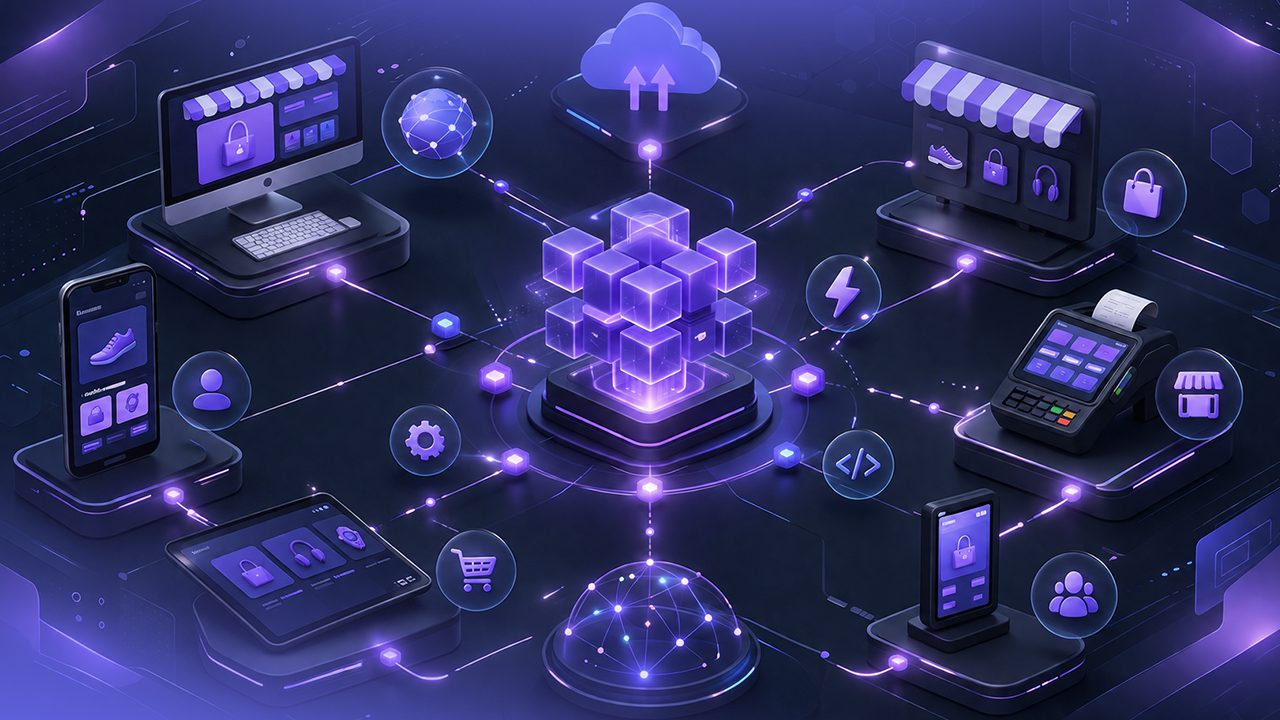
Headless commerce for ecommerce separates the customer-facing storefront from the backend commerce system. The frontend handles the user experience, while the backend manages products, inventory, orders, payments, and other business operations. APIs connect these two layers, allowing them to communicate without depending on each other.
Unlike traditional ecommerce platforms, where the frontend and backend operate as a single system, headless commerce allows each layer to evolve independently. Businesses can launch new storefronts, integrate new technologies, improve site performance, and support omnichannel growth without replacing their existing backend.
When Does the Headless Commerce ROI Math Actually Work?
Before evaluating features and platforms, the most important question for a mid-sized business is whether headless makes financial sense at your current revenue level.
The economics typically shift around $2M to $5M in annual revenue. Below that threshold, the same budget spent on conversion rate optimization and customer acquisition usually returns more. Above it, the performance gains, omnichannel capability, and development speed advantages of headless architecture compound into measurable ROI.
For mid-market brands generating $5M to $20M annually, payback on a well-executed headless build typically lands in 12 to 18 months. Sennheiser documented a 136.7% increase in ecommerce conversion rate after migrating to a headless architecture, with a global launch completed in 11 weeks.
Why Are Mid-Sized Businesses Considering Headless Commerce?
Headless commerce for ecommerce offers a flexible architecture that supports faster innovation, better customer experiences, and long-term ecommerce scalability. Here are the benefits of headless commerce.
1. Deliver Consistent Omnichannel Experiences
Customers interact with brands through websites, mobile apps, social media, marketplaces, and in-store channels. Headless commerce uses a single backend to manage products, inventory, and orders while delivering consistent experiences across every touchpoint.
2. Launch Personalized Experiences Faster
Headless commerce separates the frontend from the backend, allowing marketing and design teams to update storefronts, run campaigns, and test new user experiences without affecting core commerce operations.
3. Improve Site Performance and SEO
A decoupled frontend enables developers to optimize website performance independently of the backend. Faster page loads improve Core Web Vitals, reduce bounce rates, enhance user experience, and support better search visibility. These improvements can increase conversions while strengthening the overall headless commerce ROI over time.
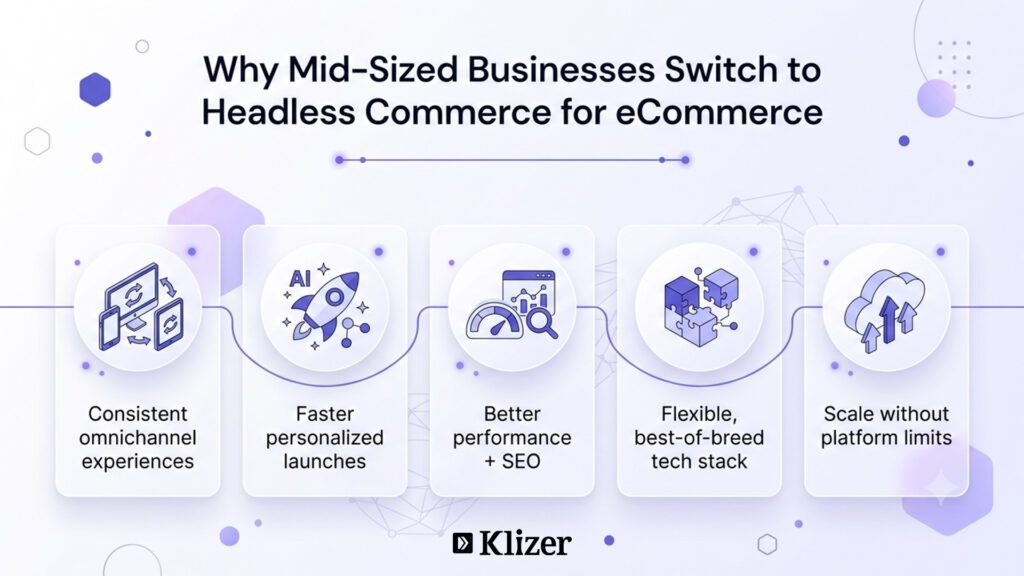
4. Build a Flexible Technology Stack
A modern ecommerce architecture should adapt to changing business needs. Headless commerce allows businesses to integrate best-of-breed solutions, including CMS platforms, AI-powered search, ERP systems, CRM software, and payment gateways, through APIs. As AI procurement agents become a real purchasing channel in 2026, companies with mature headless architecture achieve clear AI ROI significantly more often than those without it.
5. Scale Without Platform Limitations
As businesses expand into new markets, launch multiple storefronts, or handle seasonal traffic spikes, they need technology that grows with them. Headless commerce supports higher traffic volumes, larger product catalogs, and multiple customer touchpoints without requiring a complete platform rebuild, making it a strong foundation for ecommerce scalability.
Is Hybrid Headless a Middle Path?
Not every mid-sized business needs a full headless rebuild. Many adopt a hybrid approach: traditional commerce backend for most workflows, headless frontend for specific high-value surfaces like mobile, performance-critical landing pages, or campaign microsites. This captures the core performance benefits of headless commerce without the full complexity and cost of a complete architectural overhaul. For businesses under $5M annual revenue with near-term performance goals, hybrid headless is worth evaluating before committing to a full build.
When Should You NOT Go Headless?
Hold off or consider a hybrid approach if your business has:
- A simple catalog with standard commerce needs
- A tight budget and a small, non-technical team
- A storefront that already loads fast and converts well
- No near-term omnichannel or expansion plans
What Is the Actual ROI of Headless Commerce?
Although the initial headless commerce cost may be higher than that of a traditional platform, businesses often recover the investment through a future-ready ecommerce architecture.
1. Increased Conversion Rates
A key benefit of headless commerce for ecommerce is faster page speed. Since developers can optimize the frontend independently of the backend, websites load faster and provide a smoother shopping experience. Faster navigation, personalized product recommendations, and frictionless checkout encourage more customers to complete their purchases, increasing conversion rates.
2. Accelerate Time to Market
Headless commerce allows frontend developers and marketing teams to launch landing pages, seasonal campaigns, and A/B tests without waiting for backend updates. Faster releases help businesses respond quickly to customer demand, test new ideas, and stay ahead of competitors.
3. Improve Website Performance and SEO
A modern architecture improves Core Web Vitals, mobile responsiveness, and overall site performance. These factors strengthen SEO, attract more organic traffic, and reduce bounce rates. Better search visibility also lowers customer acquisition costs and contributes to a stronger headless commerce ROI over time.
According to Shopify, as page load time increases from 1 second to 3 seconds, the probability of a visitor bouncing increases by 32%. A faster storefront not only improves the shopping experience but also increases the likelihood of conversions, making website speed a key driver of headless commerce ROI for businesses investing in headless commerce for ecommerce.
4. Increase Customer Engagement
Headless commerce enables businesses to deliver consistent and personalized experiences across websites, mobile apps, and other digital channels. Tailored content, relevant product recommendations, and faster browsing encourage repeat purchases and strengthen customer loyalty.
5. Expand Revenue Through Omnichannel Commerce
With headless commerce for ecommerce, businesses can manage products, inventory, and orders from a single backend while selling through websites, mobile apps, marketplaces, social commerce, and in-store kiosks.
How Much Does Headless Commerce Cost?
The headless commerce cost for mid-market businesses typically ranges from $50,000 to $200,000 for implementation. Enterprise builds exceed $250,000. Ongoing maintenance typically costs 15% to 25% of the initial project cost annually. Here is the breakdown of the complete headless commerce cost.
| Cost Component | Average Cost (USD) |
| Frontend development | $20,000 to $100,000+ |
| API integrations | $5,000 to $30,000 |
| CMS implementation | $500 to $5,000/month |
| Cloud hosting and CDN | $500 to $5,000/month |
| Data migration | $5,000 to $25,000 |
| Testing and deployment | $3,000 to $15,000 |
| Ongoing maintenance and support | 15% to 25% of initial project cost per year |
The actual headless commerce cost depends on factors such as project complexity, the number of integrations, customization requirements, and whether you build the solution in-house or work with an implementation partner.
How Does Headless Commerce Improve eCommerce Scalability?
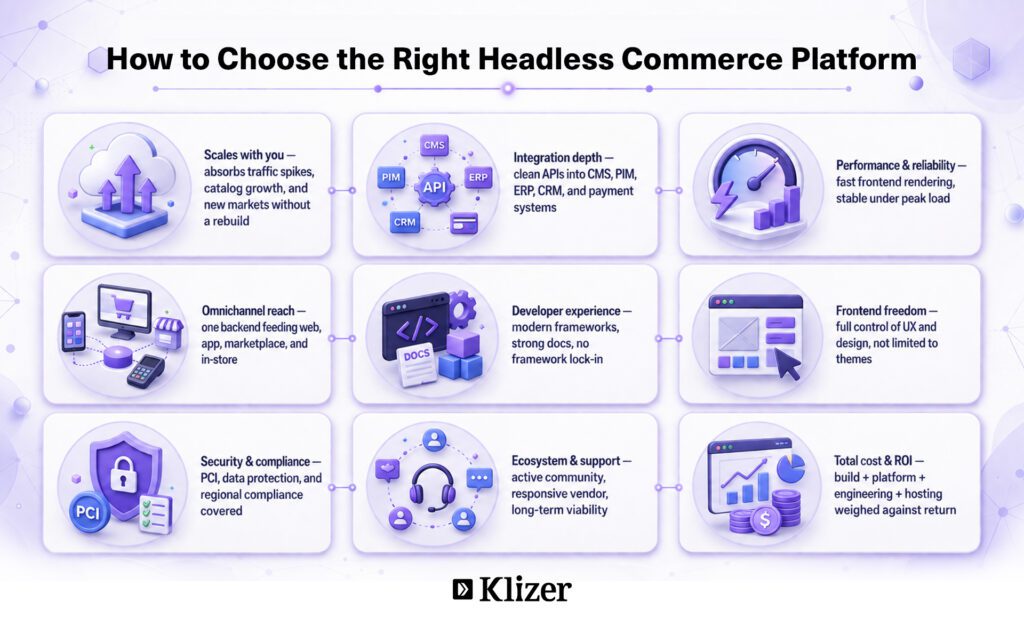
Headless commerce for ecommerce improves scalability by allowing businesses to grow without replacing their existing platform.
1. Scale Resources Independently
Traditional ecommerce platforms often require businesses to scale the entire system during traffic spikes. Headless commerce allows teams to allocate resources where they are needed most. For example, they can scale the frontend using a CDN while the backend focuses on processing orders, inventory, and payments.
2. Maintain Fast Website Performance
Modern frontend frameworks enable businesses to build lightweight, high-performing storefronts. Combined with API-driven data delivery and intelligent caching, headless commerce delivers faster page loads, stronger Core Web Vitals, and a better shopping experience. Improved performance also supports higher conversion rates and contributes to a stronger headless commerce ROI.
3. Expand Across Multiple Sales Channels
Customers shop through websites, mobile apps, marketplaces, social commerce, and emerging channels such as voice assistants and IoT devices. Headless commerce for ecommerce allows businesses to connect all these touchpoints to a single backend through APIs.
According to Harvard Business Review, omnichannel customers spend an average of 4% more in-store and 10% more online than customers who use only one channel. Expanding across multiple touchpoints can therefore increase customer lifetime value while improving headless commerce ROI.
4. Launch New Storefronts and Markets Faster
Businesses can use one backend to support multiple brands, regions, or language-specific storefronts. Teams can create unique customer experiences for each market while managing products, inventory, and orders from a centralized system.
5. Integrate New Technologies Without Disruption
As business needs change, companies can add AI-powered search, personalization engines, CRM platforms, ERP software, and payment gateways through APIs. This modular ecommerce architecture eliminates vendor lock-in and allows businesses to adopt new technologies without interrupting core operations.
Comparing Traditional vs Headless eCommerce Architecture
The biggest difference between traditional and headless ecommerce architecture is that traditional platforms tightly connect the frontend and backend, while headless commerce separates them through APIs.
| Feature | Traditional eCommerce | Headless Commerce |
| Architecture | Frontend and backend as a single connected system | Frontend and backend decoupled through APIs |
| Customization | Limited to themes, templates, and plugins | Complete control over frontend using React, Vue, or Next.js |
| Website Performance | Platform-constrained | Independently optimized for faster page loads |
| Omnichannel Support | Primarily web and mobile | Web, app, marketplace, smart devices, and emerging channels |
| Technology Integrations | Platform-specific plugins | Best-of-breed tools through APIs |
| Scalability | Full system scales even for one component | Frontend, backend, and integrations scale independently |
| Development Approach | Non-technical teams manage most updates | Requires ongoing developer expertise |
| Long-Term Flexibility | Platform limits slow future growth | Modular architecture supports continuous innovation |
| Best Fit | Small businesses with standard requirements | Mid-sized and enterprise businesses focused on growth |
Build a Future-Ready eCommerce Architecture with Klizer
Choosing the right ecommerce architecture is only the first step. When it comes to maximizing headless commerce ROI, businesses need a strategy that aligns technology with their growth goals. A successful implementation requires the right platform, clean integrations, and a storefront designed for performance and ecommerce scalability.
At Klizer, we help businesses plan, build, and optimize headless commerce development based on their unique requirements. Our team works closely with clients to create flexible solutions that improve customer experiences while supporting long-term ecommerce scalability.
Ready to explore headless commerce? Connect with Klizer to discuss your business goals and discover the right solution for your ecommerce growth.