
Ever visited an online store and left because the experience felt slow, difficult to navigate, or frustrating?
Customers today expect fast, personalized experiences across websites, mobile apps, social platforms, marketplaces, and other digital touchpoints. However, many traditional eCommerce platforms were not built to deliver this level of flexibility.
This is where headless eCommerce comes in.
Headless commerce has evolved from a niche technical approach into a strategic solution for brands looking to improve performance, personalization, and omnichannel experiences.
The headless commerce market is expected to grow significantly as more businesses adopt flexible commerce architectures.
However, headless commerce is not the right choice for every business. For some brands, it creates a competitive advantage. For others, it may introduce unnecessary complexity and cost.
So, how do you know if it is the right approach?
In this guide, we’ll explain what headless commerce means, how headless architecture works, its benefits, challenges, platforms, implementation process, and whether it fits your business.
ON THIS PAGE
What is Headless Commerce?
Headless commerce is an eCommerce architecture where the frontend (what customers see and interact with) is separated from the backend (where products, inventory, orders, payments, and business operations are managed).
The frontend and backend communicate through APIs, allowing businesses to customize and improve customer experiences without making major changes to their core commerce system.
Unlike traditional platforms where the storefront and backend are tightly connected, headless commerce gives businesses more control over how they create and deliver digital experiences.
For brands selling across websites, mobile apps, marketplaces, and other channels, headless commerce architecture provides the flexibility needed to maintain consistent experiences everywhere.
How Does Headless Commerce Architecture Work?
A headless commerce setup separates the customer-facing layer from the commerce engine and connects them through APIs.
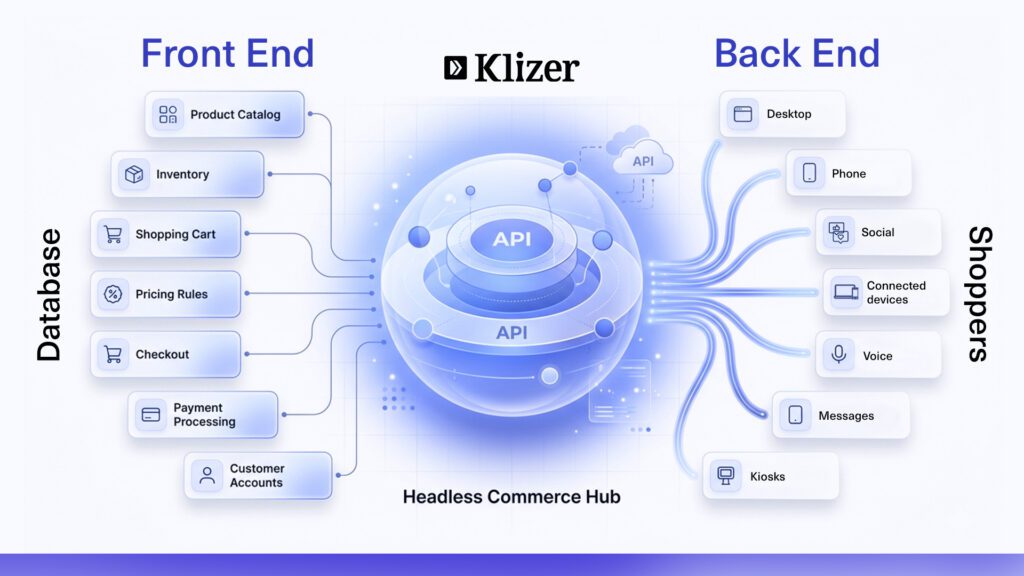
Here’s how the architecture works:
Frontend (Presentation Layer)
The frontend is the part customers interact with, including:
- Websites
- Mobile applications
- Digital marketplaces
- Other customer touchpoints
Businesses can use modern frontend technologies to create customized shopping experiences.
Backend (Commerce Engine)
The backend manages core commerce operations, including:
- Product catalog
- Inventory
- Pricing
- Promotions
- Orders
- Customer accounts
- Payments
APIs
APIs connect the frontend and backend by transferring data between both systems.
For example, when a customer opens a product page, the frontend sends a request through APIs. The backend returns product information, pricing, availability, and other details, which are displayed to the customer.
The same process happens when customers add products to their cart, update orders, or complete purchases.
Headless Commerce vs Traditional Commerce
Not every business needs a headless commerce platform. The right choice depends on your growth plans, technical resources, customer experience goals, and operational requirements.
| Feature | Traditional Commerce | Headless Commerce |
| Architecture | Frontend and backend are tightly connected | Frontend and backend are separated |
| Customization | Limited by platform capabilities | Greater customization flexibility |
| Omnichannel Support | Requires additional configurations | Built for multiple channels |
| Development Flexibility | Restricted by platform framework | Frontend can use modern technologies |
| Scalability | Scaling can impact the complete system | Components scale independently |
| Performance Optimization | Limited frontend control | More control over speed and experience |
| Maintenance | Easier for non-technical teams | Requires technical expertise |
| Best Suited For | Smaller stores and simple setups | Growing brands and enterprise businesses |
If your roadmap includes omnichannel expansion, advanced personalization, frequent frontend updates, or multiple integrations, headless commerce can provide a stronger foundation.
Benefits of Headless Commerce
Businesses adopt headless commerce because it provides more control over customer experiences while supporting long-term growth.
1. Greater Flexibility and Customization
Headless commerce allows businesses to create unique storefront experiences without being limited by traditional platform themes or templates.
Development teams can design customer journeys based on specific business requirements and user expectations.
2. Faster Time to Market
Because the frontend and backend work independently, teams can launch new features, update designs, and test experiences without disrupting core commerce operations.
3. Improved Website Performance
Headless architecture gives developers greater control over frontend performance, allowing them to optimize page speed and deliver smoother shopping experiences.
A faster website improves customer experience and can directly impact conversions.
4. Better Omnichannel Experiences
Customers interact with brands across multiple channels. Headless commerce allows businesses to deliver consistent experiences across websites, mobile apps, marketplaces, and other digital platforms.
5. Easier Scalability
As businesses grow, their commerce needs become more complex. Headless commerce allows individual components to scale independently instead of requiring changes to the entire platform.
Ready to Explore Headless Commerce for Your Business?
Find out whether a headless architecture is the right fit for your growth strategy with expert guidance on platform selection, architecture, and implementation.
Challenges of Headless Commerce
While headless commerce offers greater flexibility and scalability, businesses should also consider the challenges before making the switch.
1. Higher Development Costs
Unlike traditional eCommerce platforms that provide ready-made themes and storefronts, headless commerce often requires custom frontend development.
Businesses may need investment in:
- Frontend development
- Design resources
- API integrations
- Ongoing maintenance
This can increase implementation costs compared to traditional commerce setups.
2. Greater Technical Complexity
A headless architecture requires teams to manage multiple components, including APIs, frontend frameworks, hosting environments, and integrations.
Businesses without strong technical resources may face a steeper learning curve.
3. Not Always Suitable for Smaller Businesses
Headless commerce is designed to solve complex scalability and customization challenges.
However, businesses with simple requirements, limited channels, or smaller operations may not benefit enough from the additional investment and complexity.
What are the Best Headless Commerce Platforms?
The success of a headless commerce strategy depends on selecting a platform that aligns with your business needs, technical capabilities, and growth plans.
Some popular headless commerce platforms include:
Shopify (Hydrogen + Oxygen)
Shopify supports headless implementations through Hydrogen and Oxygen.
Hydrogen is a React-based framework for building custom storefronts, while Oxygen provides hosting infrastructure for those storefronts.
Best for: Growing brands, DTC businesses, and companies already using Shopify.
BigCommerce
BigCommerce follows an API-first approach that supports headless implementations through multiple frontend frameworks and CMS integrations.
Businesses can connect BigCommerce with tools like content management systems and modern frontend technologies while continuing to use BigCommerce for commerce operations.
Best for: Small to mid-sized businesses looking for flexibility without excessive complexity.
Commercetools
Commercetools is built around APIs and microservices, making it suitable for enterprises with complex commerce requirements.
It provides high flexibility for businesses managing multiple systems, regions, and customer experiences.
Best for: Enterprise organizations and large-scale retailers.
| Platform | Pricing Model | Flexibility | Technical Complexity | Best For |
| Shopify | Subscription-based with enterprise options | High | Moderate | Growing brands |
| BigCommerce | Subscription-based | High | Moderate | SMBs and mid-market businesses |
| Commercetools | Custom enterprise pricing | Very High | High | Enterprises |
How to Choose the Right Headless Commerce Platform?
Before selecting a headless commerce platform, evaluate:
Business Goals
Choose a platform that supports your current requirements and future expansion plans.
A growing brand may prioritize flexibility, while an enterprise business may need advanced customization and scalability.
Technical Resources
Headless commerce requires development expertise.
Evaluate whether your team has the skills needed to manage frontend development, APIs, integrations, and ongoing optimization.
Integration Requirements
Review the systems you already use, including:
- CMS
- CRM
- ERP
- Payment solutions
- Marketing tools
The platform should support seamless integrations through APIs.
What is the Difference Between Headless and Composable Commerce?
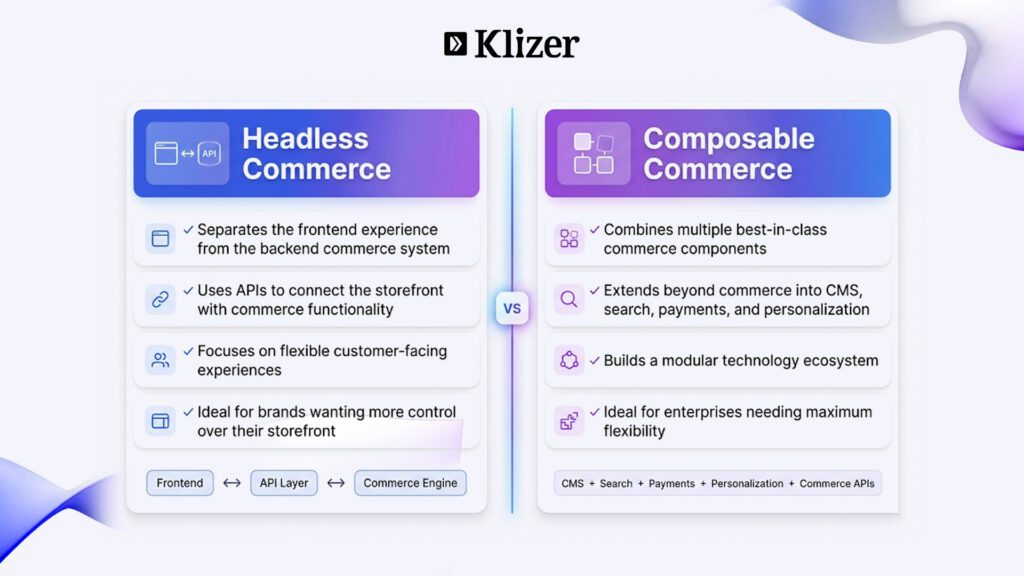
Headless commerce and composable commerce both focus on flexibility, but they solve different challenges.
| Headless Commerce | Composable Commerce |
| Separates frontend and backend | Combines multiple modular commerce components |
| Focuses on presentation layer flexibility | Focuses on the complete technology stack |
| Uses APIs to connect systems | Uses APIs and interchangeable services |
| Commonly used for custom storefronts | Used for highly customized enterprise ecosystems |
Headless commerce can be considered one part of a broader composable commerce approach.
How to Implement Headless Commerce?
A successful headless commerce implementation starts with clear goals, the right technology stack, and a structured approach.
Step 1: Audit Your Current Setup
Review your existing infrastructure and identify challenges such as:
- Slow performance
- Limited customization
- Poor omnichannel support
- Integration limitations
Step 2: Define Your Goals
Determine what you want to achieve, such as:
- Better customer experience
- Faster performance
- More sales channels
- Improved scalability
Step 3: Select Your Technology Stack
Your technology stack may include:
- Commerce platform
- CMS
- Frontend framework
- API layer
- Search solution
- Analytics tools
Step 4: Build or Migrate the Frontend
Create a custom storefront or move your existing storefront to a headless setup.
The frontend connects with the backend through APIs to deliver experiences across channels.
Step 5: Test and Optimize
Before launch, test:
- API performance
- Checkout flow
- Integrations
- Mobile experience
- Site speed
After launch, monitor user behavior and conversion metrics to identify improvements.
Is Headless Commerce Right for Your Business?
Headless commerce is a strong fit for businesses that need flexibility, customization, and scalable digital experiences.
It works well for:
- Enterprise ecommerce brands
- Businesses selling across multiple channels
- Companies requiring custom storefront experiences
- Brands planning rapid growth
However, businesses with simple storefronts and limited technical resources may find traditional commerce platforms or solutions like PWAs more practical.
Conclusion
Headless commerce helps businesses create flexible, high-performing, and scalable digital experiences by separating the storefront from the commerce engine.
It enables brands to improve performance, support multiple channels, and customize customer journeys without being limited by traditional ecommerce structures.
However, choosing headless commerce requires careful evaluation of business goals, technical capabilities, and long-term growth plans.
The right platform, architecture, and implementation strategy can help businesses build future-ready ecommerce experiences.
Frequently Asked Questions
What is headless commerce in simple terms?
Headless commerce is an eCommerce approach where the frontend experience is separated from the backend commerce system.
How does headless commerce work?
The frontend and backend communicate through APIs. The backend manages commerce operations, while the frontend delivers the customer experience.
What is headless commerce architecture?
Headless commerce architecture separates the storefront from the commerce engine and connects them through APIs.
Which headless commerce platform is best?
The best platform depends on business needs. Shopify works well for growing brands, BigCommerce suits mid-market businesses, and Commercetools supports enterprise requirements.
How much does headless commerce development cost?
Costs depend on platform choice, integrations, customization, and development requirements. More complex enterprise implementations generally require higher investment.