Individual AI agents can automate specific business functions, but coordinating reliable workflows across multiple systems typically requires an orchestration layer to manage shared context, dependencies, handoffs, and execution controls. Without coordinated workflow management, agents can produce duplicated processing, inconsistent outputs, and limited operational visibility when tasks span multiple systems.
AI orchestration provides a coordination layer that connects AI agents, models, enterprise data, APIs, and business applications. It manages how these components interact throughout a business workflow, so that tasks can be assigned, information is exchanged, and actions follow defined processes.
For B2B manufacturers and distributors, AI orchestration can connect processes across product data, pricing, orders, customer service, inventory, and fulfillment, enabling specialized AI capabilities to work together across business functions and systems.
ON THIS PAGE
What Does an AI Orchestration Architecture Include?
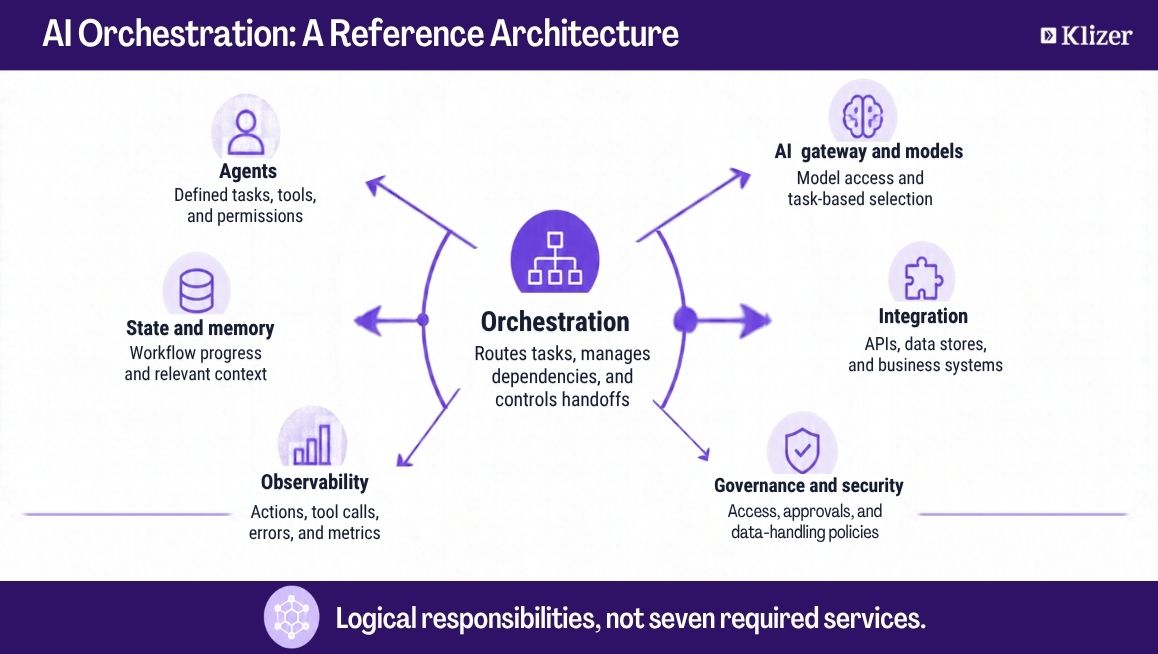
A useful AI orchestration reference architecture includes the following responsibilities for managing agents, models, data, tools, and enterprise systems throughout a workflow. These are logical layers, not a requirement to deploy seven separate services.
1. Orchestration Layer
Manages execution flow, agent routing, task dependencies, and transitions between workflow stages.
2. AI Gateway and Model Layer
Provides centralized access to AI models and supports model selection based on capability, task requirements, availability, latency, or cost.
3. Agent Layer
Contains specialized AI agents with defined responsibilities, instructions, tools, and permissions for performing specific tasks.
4. Integration Layer
Connects APIs, databases, vector stores, data pipelines, legacy applications, and other business systems that agents need to access or interact with.
5. State and Memory Layer
Stores session history, workflow state, intermediate results, and context required for workflow execution.
6. Observability Layer
Captures agent actions, tool calls, model interactions, errors, and performance metrics to provide visibility into system behavior.
7. Governance and Security Layer
Defines the security and compliance controls that govern agent access, data handling, system interactions, and business actions.
What Are the Benefits of AI Orchestration for B2B Enterprises?
1. Automates Multi-Step Processes
AI orchestration reduces manual handoffs by coordinating dependent activities across complex B2B processes.
2. Improves Workforce Productivity
Orchestrated processes reduce repetitive work and delays, giving teams more time to manage exceptions, approvals, customer requests, and higher-value decisions.
3. Matches AI to Specific Tasks
Enterprises can route different tasks to the agents or models best suited to them, supporting use cases such as product enrichment, customer support, sales assistance, and document processing.
4. Creates Consistent Processes
AI orchestration applies defined workflows and business rules across recurring processes. Model outputs still require validation before they drive business actions.
5. Improves Cross-Functional Execution
AI orchestration connects activities across product management, sales, order management, inventory, and fulfillment, reducing process gaps between functions and systems.
6. Scales AI Across Operations
Enterprises can add agents and workflows as new processes become suitable for AI, expanding automation as integration capacity, governance, and performance requirements allow.
7. Strengthens Decision Support
Orchestrated processes bring data from customers, products, orders, pricing, and inventory into decision-making activities, helping teams evaluate operational issues using information from multiple business functions.
How Does AI Orchestration Connect Enterprise Systems and AI Agents?
An orchestration architecture defines the components involved, while workflow execution determines how those components work together. A typical B2B workflow moves through four core activities: task routing, system interaction, context transfer, and controlled execution.
1. Decompose and Route Tasks
The orchestration layer breaks a business request into dependent tasks, assigns each task to the appropriate agent or workflow, and controls the order in which those tasks execute.
2. Connect Agents to Enterprise Systems
AI agents need controlled access to business applications to retrieve data and perform approved actions, such as:
- Accessing commerce platforms, along with ERP, PIM, OMS, WMS, CRM, EDI, and marketplaces.
- Retrieving product, customer, order, inventory, and pricing information.
- Performing approved updates or transactions within integrated applications.
Relevant commerce platforms include:
- Adobe Commerce
- Shopify Plus
- BigCommerce
- Shopware
3. Maintain Context Across the Workflow
The orchestration layer passes relevant outputs from one stage to the next so each agent can act on the information generated earlier in the workflow. This includes transferring intermediate results, task-specific context, and workflow state between agents.
4. Control Agent and System Interactions
Before an agent can perform a business action, the orchestration layer can enforce permissions, validation checks, and approval gates. It can also log the action and route exceptions to human teams when predefined conditions are not met.
What Are the Key AI Orchestration Use Cases in B2B Commerce?
AI orchestration can coordinate AI agents and business systems across sales, customer service, product data, orders, pricing, inventory, and fulfillment. DHL’s 2025 E-Commerce Trends Report found that 61% of surveyed B2B retailers use AI across their ecommerce platforms.
1. Sales and Quote-to-Order Automation
B2B sales can involve lead qualification, product selection, quote preparation, approvals, and order creation across commerce, ERP, and sales workflows. The orchestration layer can connect these stages, pass validated information between them, and reduce repeated data entry as an opportunity moves toward purchase.
2. Intelligent Order Processing and Fulfillment
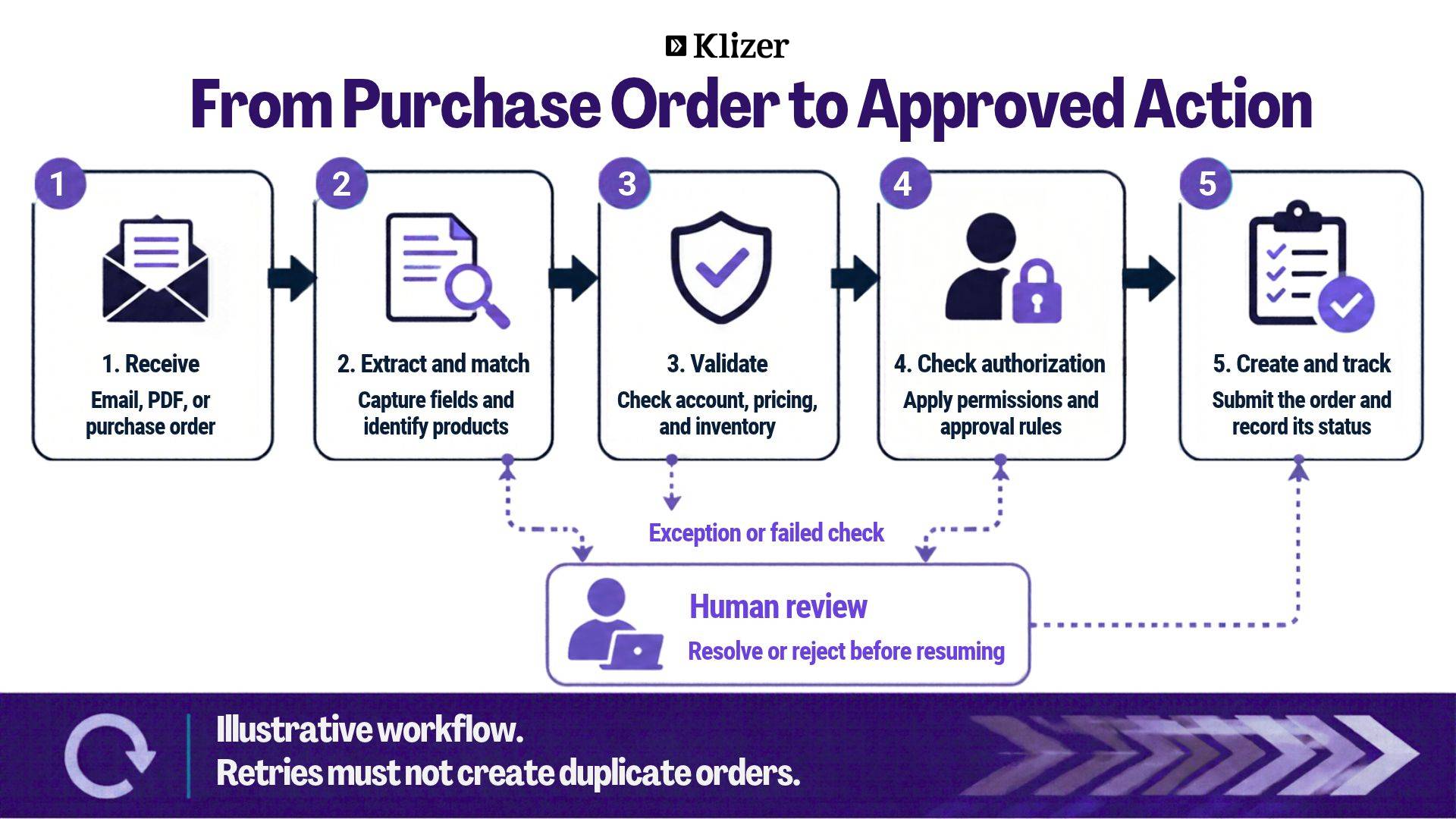
Purchase orders may arrive through emails, PDFs, or other unstructured formats and require several checks before processing. An orchestrated workflow can coordinate data extraction, product matching, inventory validation, order creation, and fulfillment activities while routing exceptions for review.
3. Multi-Agent Customer Service
B2B support requests can require information from customer, product, order, and inventory systems before teams can resolve them. The orchestration layer can classify incoming requests, route them to the appropriate agent, gather information from connected systems, and escalate cases that require human judgment.
4. Product Information Management
Large B2B catalogs contain extensive product descriptions, technical specifications, and attributes that must remain accurate across sales channels. An orchestrated workflow can assign extraction, enrichment, classification, and validation tasks to specialized agents before approved product information moves into PIM and commerce systems.
5. Pricing Rules and Contract Alignment
B2B pricing often varies by customer, product, quantity, and negotiated commercial terms. An orchestrated pricing workflow can combine customer agreements, product data, quantities, and commercial terms to apply approved pricing rules consistently across sales and commerce processes.
What Are the Technical Challenges of Implementing AI Orchestration?
AI orchestration introduces challenges around agent coordination, context management, system integration, performance, cost control, monitoring, and failure recovery. Gartner reported in September 2026 that only 22% of surveyed organizations had successfully scaled AI across multiple business units or adopted an AI-first approach.
- State Synchronization Across Agents: Different agents may produce or modify workflow state at different stages, creating inconsistencies if state changes are not synchronized.
- Context Fragmentation and Overload: Agents may receive incomplete or excessive context, affecting accuracy, latency, and workflow continuity.
- Non-Deterministic AI Outputs: AI-generated outputs can vary between executions, requiring validation rules and safeguards before downstream actions.
- Integration Complexity and Tool Sprawl: Connecting agents to multiple APIs, applications, and tools increases integration dependencies and maintenance requirements.
- Performance and Cost Management: Multi-step workflows can increase model calls, processing time, infrastructure demand, and overall AI costs.
- Observability and Failure Recovery: Teams need visibility into agent actions, tool calls, errors, and workflow state to diagnose failures and recover without disrupting business operations.
What Are the Best Practices for Implementing AI Orchestration?
1. Start With a Focused, High-Value Workflow
Begin with one well-defined process, measure its results, and expand orchestration after the workflow meets its defined accuracy and execution criteria. Track completion rate, exception rate, latency, and cost per completed workflow against the existing process. Test representative cases and failure paths before production deployment.
2. Maintain Data Quality and Context
Ensure the data supplied to agents is accurate, current, and relevant to the task, and define data-quality requirements for each workflow stage.
3. Build Modular, Decoupled Integrations
Separate orchestration logic from individual applications and AI components so teams can update models or integrations without disrupting dependent workflow stages.
4. Design Reliable Fallbacks and Error Handling
Use bounded retries for recoverable failures, define alternative execution paths, and escalate unresolved exceptions to human teams. Make transactional operations idempotent where supported, so a retry does not create a duplicate order or charge. Check the destination system’s transaction status before repeating an uncertain write.
5. Strengthen Governance and Monitoring
Monitor workflow outcomes, agent actions, system interactions, and errors, while assigning clear ownership for access policies, approvals, compliance, and performance management. Enforce least-privilege access and validate tool inputs outside the model; treat retrieved documents and messages as untrusted data rather than instructions.
Frequently Asked Questions
1. What is the difference between AI orchestration and AI automation?
AI automation uses AI to perform tasks or processes. AI orchestration coordinates the models, tools, agents, and systems involved. They overlap: orchestration can support an automated process, and automation can also span multiple steps.
2. Can AI orchestration reduce dependence on a single AI model?
Yes. A flexible orchestration setup can route tasks across different models based on capabilities, performance, availability, or cost.
3. How does AI orchestration affect existing B2B technology investments?
AI orchestration can extend existing commerce and enterprise systems by coordinating AI-driven workflows across the applications, APIs, and data sources businesses already use.
4. Does AI orchestration replace human decision-making?
No. It can automate routine decisions while directing sensitive, uncertain, or high-impact decisions to human teams for approval.
5. When should a business consider AI orchestration?
A business should consider AI orchestration when AI initiatives involve multiple tasks, systems, or decision points that a standalone AI solution cannot manage effectively. If a deterministic workflow or a single model call meets the requirement reliably, additional agents may add unnecessary cost and latency.
Conclusion
AI orchestration becomes more valuable when the underlying commerce ecosystem is connected, giving agents access to consistent business data and the systems required to complete workflows. Judge success by whether a business process completes accurately, within its permissions and approval rules, rather than by the number of agents deployed.
At Klizer, we apply this approach through our Connected Commerce architecture, aligning Foundation, Storefront, Integration, and Intelligence. We help industrial B2B manufacturers and distributors implement AI orchestration within their existing commerce environment, connecting AI capabilities with the systems, data, and workflows required for business execution.
Talk to Klizer about AI orchestration to plan an orchestration strategy aligned with your existing architecture and business goals.