Business automation becomes difficult when a process spans multiple systems, data sources, business rules, and decisions. A complex order process may require ERP data, customer information, inventory checks, pricing validation, and approval before a transaction can be completed. A single AI agent may need to manage these different tasks and system interactions within the same execution flow, making it harder to track what has been checked and who can approve the order.
Multi-agent AI addresses this problem by distributing work across specialized AI agents. Each agent performs a defined function, while agent orchestration coordinates their execution within the overall process. The orchestration layer determines which agents participate, how tasks move between them, and how the system progresses through the workflow.
ON THIS PAGE
What Are the Core Components of a Multi-Agent AI Architecture?
A multi-agent AI architecture needs a way to assign work, pass the right context to each agent, and control what agents can do. McKinsey reports that nearly two-thirds of enterprises worldwide had tried AI agents, but fewer than 10% had seen tangible value at scale.
Orchestration Layer
Coordinates agents, manages workflow state and task dependencies, and controls transitions between execution steps.
AI Agents
Perform defined tasks or business functions using instructions, models, context, tools, and execution constraints.
Model Layer
Provides the language and reasoning capabilities agents use to interpret inputs, generate outputs, determine actions, and produce tool-call requests.
State and Context Layer
Maintains execution-specific information such as task status, intermediate results, prior outputs, and the context required by each agent.
Memory and Knowledge Layer
Provides information beyond the immediate execution context, including persisted memory and information retrieved from governed knowledge sources.
Tools and Integration Layer
Connects agents to external capabilities through functions, APIs, databases, search systems, and Adobe Commerce.
Security and Control
Enforces authentication, authorization, access policies, input and output validation, and audit requirements across agent and tool activity.
Observability
Captures logs, metrics, traces, execution state, tool calls, failures, and latency needed to monitor and troubleshoot the system.
How Does Agent Orchestration Coordinate Multiple AI Agents for Business Automation?
Agent orchestration controls task assignment, execution order, dependencies, and workflow transitions across multiple AI agents. Deloitte’s 2026 survey included 501 senior business and IT leaders in the United States whose organizations were already piloting agentic AI. Of those respondents, 42% reported testing or deploying AI agents, while 15% reported using coordinated groups of agents at scale across business functions.
1. Decompose the Business Objective
The orchestrator breaks the objective into tasks or follows a workflow defined in advance. The decomposition process includes:
- Identifying the tasks required to complete the objective.
- Defining dependencies between tasks.
- Separating sequential tasks from independent tasks.
- Specifying the required inputs and expected outputs for each task.
2. Assign Tasks to Specialized Agents
The orchestrator routes each task to the agent whose capabilities, tools, and permissions match the task requirements. Its routing logic can evaluate:
- Agent capabilities and specialization.
- Available tools and data access.
- Task requirements and execution constraints.
- Policies that determine which agent can perform the task.
3. Manage Task Handoffs
Completed tasks can produce outputs that downstream agents require as inputs. The orchestrator controls these transitions and preserves the workflow state. During a handoff, the system:
- Receives the completed task output.
- Verifies that the required result is available.
- Passes the relevant output to the next task.
- Updates the workflow state before execution continues.
4. Control Sequential and Parallel Execution
Task dependencies determine whether the system should execute tasks sequentially or concurrently. Gartner predicts that by 2027, one-third of agentic AI implementations will combine agents with different skills to manage complex tasks across application and data environments. The orchestrator can:
- Execute dependent tasks sequentially when one output is required by another task.
- Execute independent tasks in parallel.
- Wait for the required results before advancing a dependent task.
- Aggregate parallel outputs before triggering the next workflow stage.
5. Determine the Next Workflow Transition
Task outputs, workflow state, and predefined conditions determine how the workflow should proceed. The orchestrator can:
- Trigger the next task when its conditions are satisfied.
- Pass the output to another specialized agent.
- Retry an operation when the workflow permits another attempt.
- Route an exception to a recovery or approval path.
- End the workflow after all required tasks are completed.
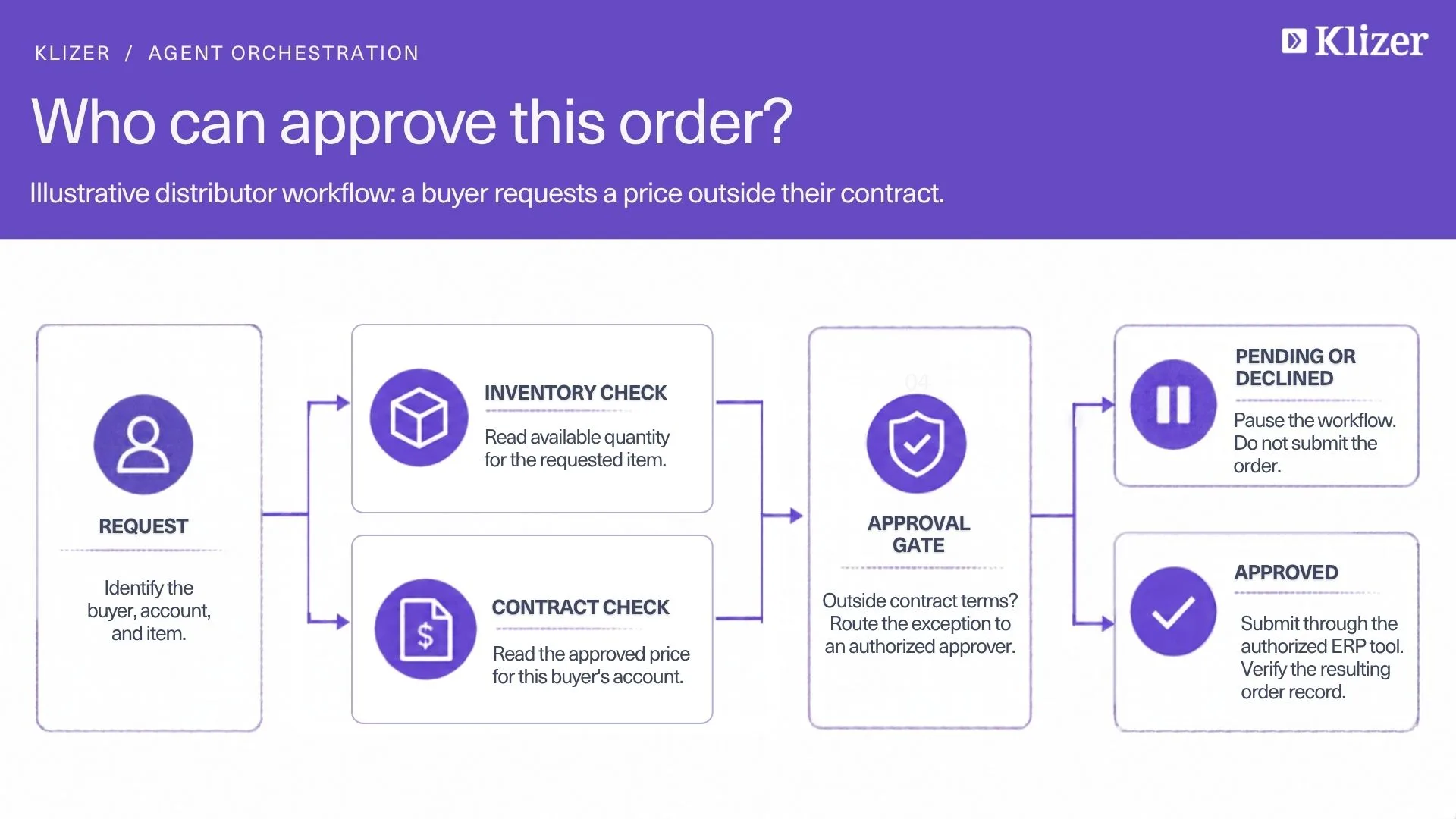
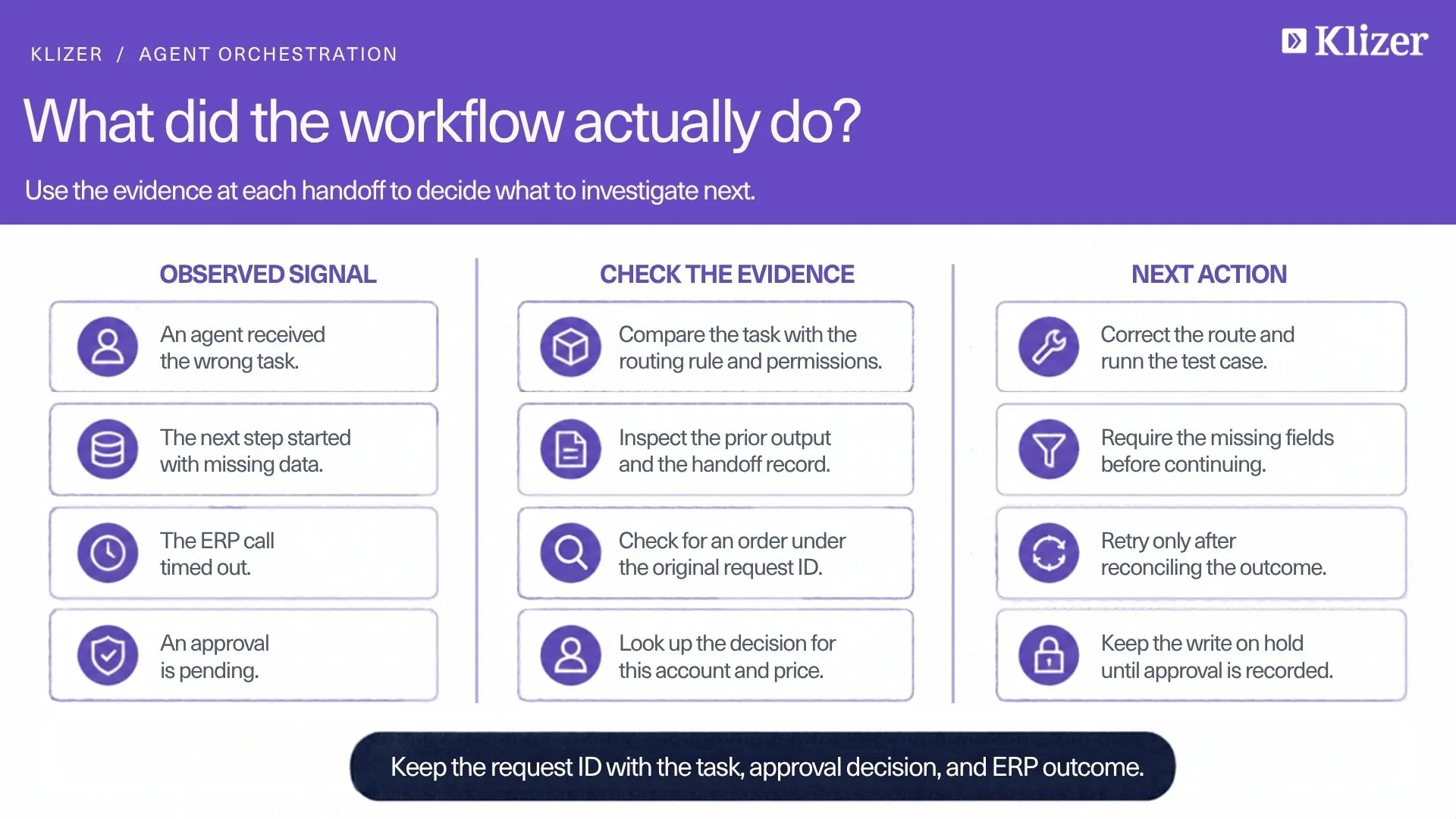
For example, a distributor receives a buyer’s request for a nonstandard price. Once the item and account are known, inventory and contract-price checks can run in parallel. If the requested price falls outside the account terms, route it to an authorized approver. A pending approval is a reason to pause, not permission to write the order to the ERP.
How Do You Monitor and Evaluate Multi-Agent AI Workflows?
Teams evaluate multi-agent AI workflows by measuring execution performance, output quality, reliability, and workflow outcomes. Evaluation should assess the complete workflow rather than treating each agent as an isolated component.
Measure Workflow Performance
Track end-to-end latency, agent execution time, token and model usage, tool-call success rates, and retry frequency. Use these metrics to identify execution bottlenecks and quantify workflow efficiency.
Evaluate Task and Output Accuracy
Compare agent outputs and final workflow results against predefined criteria or expected outcomes. The evaluation should consider routing decisions, tool selection, task completion, and the accuracy of the resulting action or output.
Test Workflow Reliability
Use defined test cases and regression testing to verify that changes to models, prompts, agent configurations, or orchestration logic do not break previously validated workflows. Testing should cover expected execution paths and defined failure conditions.
Analyze Execution Failures
Review failed tasks, incorrect handoffs, unsuccessful tool calls, and unexpected workflow transitions to identify recurring issues. Use these findings to refine orchestration rules, validation logic, recovery procedures, and agent configurations. For an order workflow, a successful API response alone does not establish that the intended order was recorded. Check the outcome in the system that owns the order before retrying the write.
When Should Businesses Use Multi-Agent AI?
Businesses should use multi-agent AI when workflows require multiple specialized capabilities, systems, or coordinated decisions that are difficult to manage within a single execution path. Adoption also varies by organization size. McKinsey’s 2026 Global Survey found that 40% of respondents at organizations with more than $1 billion in annual revenue reported scaling AI agents, compared with 22% at smaller organizations.
For Complex Workflows
Consider multiple agents when the tasks require distinct capabilities and the handoffs can be defined and tested.
For Cross-System Workflows
For B2B distributors, a workflow may span an ERP, a CRM, and an ecommerce platform. Use separate agents when those tasks need different tools, permissions, or judgment. Whether the ERP is Epicor Prophet 21, SAP, NetSuite, or Microsoft Dynamics, the number of systems alone does not justify the extra coordination.
For Parallel Execution
Use multiple agents when independent tasks can run concurrently before their results are combined.
When Conventional Automation Is Enough
Prefer conventional automation or deterministic workflow logic when the process follows fixed rules with predictable inputs and outputs. Use an AI agent only when the workflow requires interpretation, judgment, or dynamic decision-making.
Conclusion
For industrial B2B manufacturers and distributors, the decision often comes down to a single handoff: can the team tell who approved a price and whether the ERP recorded the order? In Klizer’s Connected Commerce framework, the ERP supplies the account terms, the storefront captures the request, integrations carry the approved transaction, and AI helps interpret exceptions.
That division of responsibilities applies whether the storefront runs on Adobe Commerce, Magento, Shopify Plus, BigCommerce, or Shopware. Start with one workflow whose outcome the business can verify before adding more agents.
Book a consultation with Klizer to review one workflow and decide where an agent, a fixed rule, or a human approval belongs.
Frequently Asked Questions
Can Different AI Models Work Together in a Multi-Agent System?
Yes. Different agents in the same system can use different AI models when their tasks have different reasoning, latency, context, or cost requirements.
How Do Multi-Agent Systems Manage Model Selection?
Model selection can occur at the orchestration layer, where routing logic evaluates the task requirements and selects an available model that meets the workflow’s performance, context, and cost constraints.
What Is the Difference Between Multi-Agent AI and Agentic AI?
Multi-agent AI refers to systems in which multiple specialized agents collaborate or coordinate, while agentic AI broadly describes systems that can pursue goals, make decisions, and take actions with varying degrees of autonomy.
How Do Businesses Measure the ROI of Multi-Agent AI?
Businesses can measure ROI by comparing implementation and operating costs against measurable changes in processing time, manual effort, throughput, and error rates.
Can Multi-Agent AI Replace Traditional Automation Completely?
No. Deterministic automation is generally more appropriate for predictable, rule-based processes, while multi-agent AI is more suitable when workflows require dynamic reasoning, coordination, or decisions across specialized tasks.