

Adobe Commerce 2.4.9 is one of the most technically significant releases in the 2.4.x line. This release is an infrastructure-first modernization, overhauling the platform’s core dependencies, tightening security, and aligning Adobe Commerce with the latest PHP, search, and caching technologies. Whether you’re a merchant, developer, or agency partner, understanding what’s coming in 2.4.9 will help you plan your upgrade path with confidence.
ON THIS PAGE
Adobe Commerce 2.4.9 Release Date
Adobe Commerce 2.4.9 is officially scheduled for General Availability (GA) on May 12, 2026. The release is expected to focus heavily on making the security stronger, platform compatibility, and infrastructure modernization.
The release follows a structured pre-release cycle that began with alpha releases in late 2025 and progressed through multiple stages:
| Stage | Version | Notes |
| Alpha 1–3 | 2.4.9-alpha1/2/3 | Early testing builds |
| Beta 1 | 2.4.9-beta1 | March 10, 2026 |
| General Availability | 2.4.9 | May 12, 2026 |
Pre-release packages use -alphaX and -betaX suffixes, are distributed via Composer on repo.magento.com, and Adobe does not provide standard support for pre-release versions. Feedback is submitted through GitHub issues.
What’s New According to Adobe Commerce 2.4.9 Release Notes
1. Platform and Infrastructure Modernization
Adobe Commerce 2.4.9 primarily focuses on the product’s future direction rather than adding new features. The release concentrates on three areas:
- Strengthening payment flows to reduce failed transactions
- Updating the system to reduce future maintenance burden
- And, aligning with modern hosting environments
a. PHP Support
Starting with Adobe Commerce 2.4.9-beta1, the platform is fully compatible with PHP 8.5, while retaining support for PHP 8.4 and allowing PHP 8.3 for upgrade-only scenarios. PHP 8.2 is no longer supported.
b. Symfony Replaces Zend for Cache Layer
The Zend_Cache component has been replaced by the Symfony Cache component. This update enhances cache performance and maintainability, and ensures long-term compatibility with PHP 8.x and future platform updates. Existing cache backends and cache management commands remain fully supported, with no changes required for current integrations.
c. Native Implementation Replaces Laminas for MVC
Adobe Commerce has introduced a native MVC implementation, replacing the legacy Laminas MVC, to ensure long-term compatibility and stability beyond PHP 8.5.
d. Composer Compatibility
Adobe Commerce 2.4.9-beta1 is fully compatible with Composer 2.x, including Composer 2.9, preserving backward compatibility and ensuring a stable build and deployment experience
2. Search Upgrade with OpenSearch 3.x Support
Adobe Commerce 2.4.9-beta1 is fully compatible with OpenSearch 3.x. This update enables merchants to benefit from improved performance, security, and long-term support while maintaining backward compatibility with OpenSearch 2.x.
For stores relying heavily on layered navigation, B2B catalogs, or advanced filtering, validating your OpenSearch setup in a staging environment before upgrading is strongly recommended.
3. Valkey 8.x is the The Redis Alternative
Adobe Commerce 2.4.9-beta1 adds comprehensive support for Valkey 8.x as a Redis-compatible cache backend, including full CLI command parity with Redis. Admin and Cloud configuration options have been updated for seamless Valkey setup. This support is driven by the end-of-support for Redis 7.2 and licensing changes, giving merchants a reliable, fully supported alternative to Redis across Commerce release lines 2.4.5 through 2.4.9.
4. Apache ActiveMQ Artemis is the RabbitMQ Alternative
Support has been added for Apache ActiveMQ Artemis as a strategic alternative to RabbitMQ, driven by end-of-support risks associated with RabbitMQ 4. ActiveMQ Artemis is now fully supported across Commerce release lines 2.4.6 through 2.4.9-beta1, including Adobe Commerce Cloud with AWS ActiveMQ for cloud-native deployments.
5. WYSIWYG Editor: HugeRTE Replaces TinyMCE
Due to the end of support for TinyMCE 5 and 6, and licensing incompatibilities with TinyMCE 7, the Adobe Commerce WYSIWYG editor has been migrated to the open-source HugeRTE editor. This migration ensures Adobe Commerce remains compliant with open-source licensing, avoids known TinyMCE 6 vulnerabilities, and delivers a modern, supported editing experience for merchants and developers.
Ready to Upgrade to Adobe Commerce 2.4.9?
Upgrading Adobe Commerce requires careful planning, environment testing, and expert execution. Our team specializes in Adobe Commerce upgrades, helping merchants migrate smoothly without disrupting operations.
6. Security Fixes
A patch for CVE-2025-54236 fixes a security issue in the REST API. Adobe had already released a hotfix, and this fix is now included in 2.4.9. A patch for CVE-2025-47110 fixes a security issue in email templates, helping stop the misuse of template processing. The admin password policy now complies with PCI DSS 4.0 requirements, allowing admins to set minimum password lengths.
When CAPTCHA is enabled for the Create Account form, the same CAPTCHA validation is now enforced for customer account creation via REST and GraphQL APIs.
7. Admin UX Improvements
The Catalog Price Rules grid in the Commerce Admin now includes an Actions menu, allowing merchants to activate, deactivate, or delete multiple catalog price rules at once, bringing catalog price rule management in line with the existing bulk actions available for Cart Price Rules, significantly reducing the time required to manage large rule sets.
The staging preview feature in the Admin now enables browser-simulated mobile device previews to be rendered accurately, providing a visual representation of how a staging update will appear on a mobile device.
8. Shipping Integrations
To comply with USPS’s retirement of legacy Web Tools APIs, Adobe Commerce’s USPS integration has been migrated to the new RESTful USPS APIs. The update includes dual API support (legacy and RESTful), OAuth 2.0 authentication, and a transition from XML to JSON for cleaner communication.
9. JavaScript Library Updates
Several frontend libraries have been updated: jQuery Validate upgraded to version 1.21.0, jQuery UI to version 1.14.1, Less.js to 4.2.2, Moment Timezone to 0.5.43, and Underscore.js to version 1.13.7, improving form validation, accessibility, CSS compilation performance, and browser compatibility across admin and frontend interfaces.
10. Enhanced API Reliability and Integration
If your Adobe Commerce setup is connected to ERP, CRM, or PIM systems, this update will make your life noticeably easier. Earlier, if something went wrong in an API call, you’d often get a vague “500 error” that didn’t help. Now, Magento returns proper “400 Bad Request” responses when the issue is with the request itself. When updating products via API, especially at the store-view level, you now have better control, preventing accidental overrides of global product data like images or videos. Validation rules for attribute codes are also now aligned between the Admin panel and APIs, so you no longer end up in situations where something works in the UI but fails via API.
11. Important Fixes for B2B Features
If you’re running a B2B store, 2.4.9 addresses several recurring pain points:
- Faster shared catalog updates: Managing large shared catalogs has been a challenge, especially when removing categories, it could be slow or even fail. This has now been improved, so changes happen much faster.
- Negotiable quote issue fixed: There was a problem where placing an order from a negotiable quote using certain payment methods could get stuck and never complete. That issue is now resolved.
- Requisition list fixes: Adding grouped products to requisition lists now works properly, even when category permissions are enabled, no more unexpected crashes.
- Improved company validation: During guest checkout, if the company field is required, it now behaves correctly and validates as expected.
These may look like small fixes, but they remove the kind of daily friction your team deals with, less time fixing issues, fewer disruptions in B2B workflows, and a smoother experience for your customers where it actually matters.
12. Foundational Rebuild for Agentic Commerce
Adobe Commerce 2.4.9 is not a routine update. Beyond replacing aging framework components, the platform has been rebuilt to support specific protocols and tools that allow AI assistants, like ChatGPT or Gemini, to discover, recommend, and execute transactions. Key enablements include:
- Support for UCP and ACP: Adobe Commerce now supports the Universal Commerce Protocol (UCP) and Agentic Commerce Protocol (ACP), allowing AI assistants to move beyond mere recommendations and perform actions like product searches, auto-cart creation, and order tracking directly within the AI’s user interface.
- Commerce Storefront MCP: A new Model Context Protocol (MCP) server exposes real-time data, such as catalog, pricing, and inventory, securely to custom AI systems, turning conversations into transactions.
- LLM Optimizer: This feature enriches Product Detail Pages (PDPs) with AI-readable content.
- Structured AI Feeds: The platform can now generate structured data feeds specifically optimized for LLMs, ensuring products are accurately represented in AI research and comparison journeys.
- Commerce Developer Agent: This tool accelerates the refactoring of legacy PHP modules into modern App Builder apps automatically.
- Migration Assessment Agent: Reduces weeks of discovery into days by generating a readiness score and a clear roadmap for migrating to SaaS-based or Cloud-native services.
- Adobe Brand Concierge: An integration that brings conversational shopping directly to the storefront, guiding customers from a simple question to a purchase using real-time catalog data.
By aligning its architecture with these emerging AI standards, Adobe Commerce 2.4.9 ensures that products are not only discoverable by AI agents but also seamlessly purchasable wherever customer engagement occurs.
What Changes were Introduced in Magento 2.4.9-Alpha
The alpha phase of Adobe Commerce 2.4.9 served as the earliest public testing ground for the release’s foundational changes.
The alpha fixed 67 issues in Magento Open Source core code, spanning APIs, cart and checkout, inventory, and orders. Notable fixes include updating the pre-selected store in “Pick in Store” when the shipping address changes, adding a missing website filter option when exporting products, and fixing the cart price rule for multi-shipping carts.
Key infrastructure items introduced during the alpha cycle included:
- Full CLI command support for Valkey, mirroring existing Redis functionality, with Admin and Cloud configuration updated for seamless Valkey setup.
- Nginx version updated from 1.26 to 1.28 for development and testing environments, confirming full compatibility across all supported Adobe Commerce versions.
- Fixes to performance degradation in bulk asynchronous web API endpoints introduced after the APSB25-08 security patch.
Key Business Benefits of Upgrading
| Area | Before (older versions) | After (2.4.9) | Impact |
| Performance | Slower under peak loads | Optimized & scalable | Higher conversions |
| Security | Growing vulnerability risk | Hardened & compliant | Lower breach risk |
| Stability | Frequent bugs & crashes | Reliable operations | Fewer lost sales |
| Cost | High maintenance & debugging | Lower operational cost | Better ROI |
Magento 2.4.9 Beta1
Adobe officially kicked off the 2.4.9 release cycle with the launch of Magento 2.4.9-beta1 on March 10, 2026. This release is a strategic move to modernize the platform’s core dependencies and patch critical security gaps before the General Availability release in May.
Beta1 consolidated all alpha-stage improvements and introduced several production-ready validations:
- Full PHP 8.5 compatibility confirmed
- OpenSearch 3.x and Valkey 8.x integration finalized
- ActiveMQ Artemis support across Cloud deployments
- HugeRTE WYSIWYG migration completed
- PCI DSS 4.0 compliant admin password policy enforced
- CVE patches (CVE-2025-54236, CVE-2025-47110) integrated into core
Beta1 also simplified 2FA configuration. Admin users are now required to configure only one of the merchant’s enabled 2FA providers to access the Admin panel. Previously, all enabled providers had to be configured before sign-in, creating friction for users without access to all authentication factors.
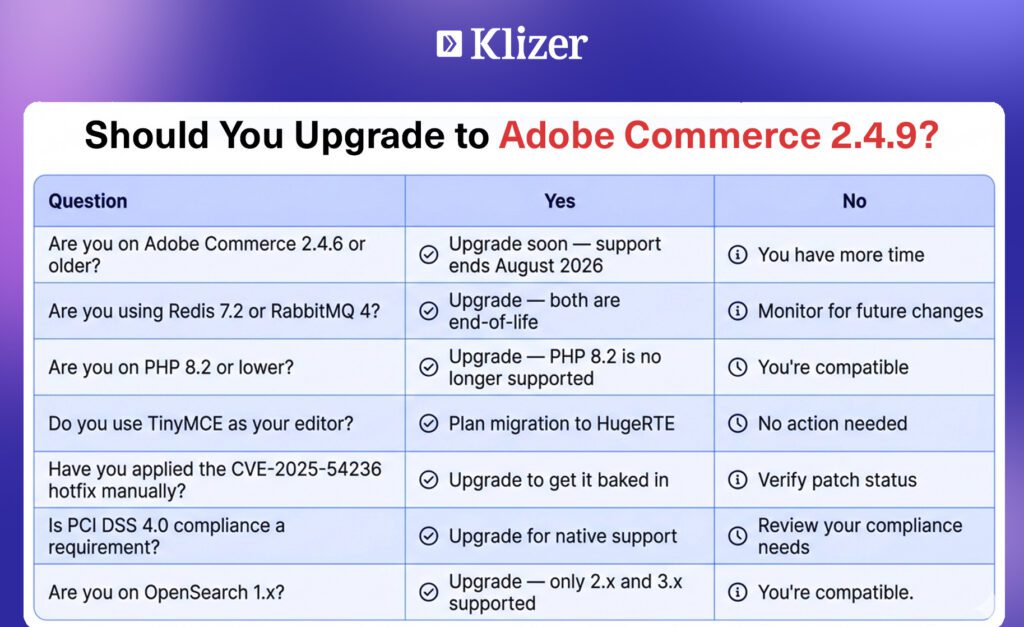
Should You Upgrade to Adobe Commerce 2.4.9?
Merchants do not have to migrate right away. However, they can begin to validate against the latest components in lower environments. This makes it safer to update systems without having to do everything at once.
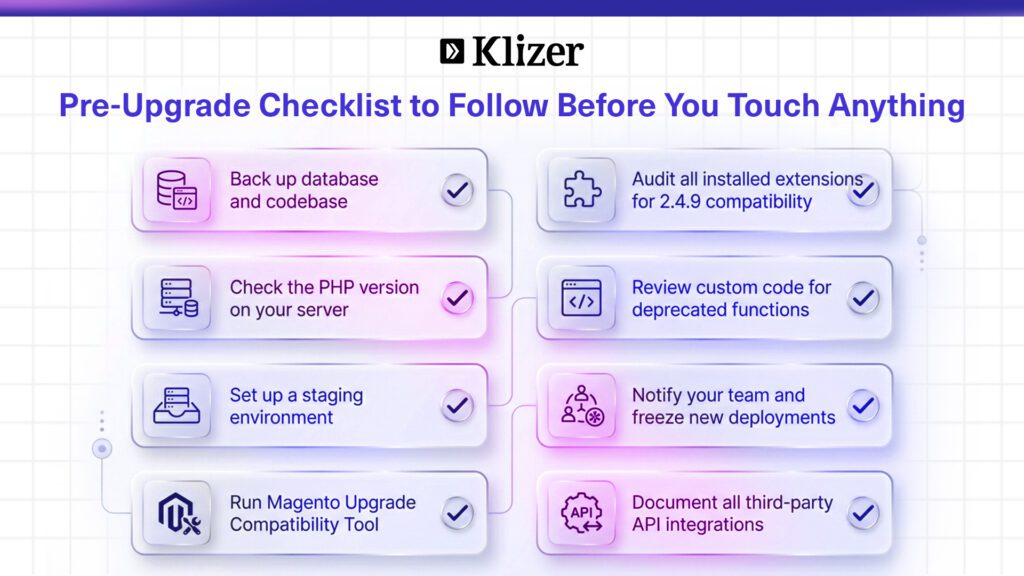
Here’s a quick readiness checklist before upgrading:
| Area | Action |
| PHP Version | Validate PHP 8.3, 8.4, or 8.5 in staging |
| Cache Backend | Plan migration from Redis to Valkey if needed |
| Search Engine | Test OpenSearch 3.x compatibility |
| Extensions | Check third-party extension compatibility |
| Custom APIs | Review against the new REST API security enforcement |
| WYSIWYG Content | Test content rendering in HugeRTE |
| 2FA Configuration | Audit Admin user 2FA settings |
Businesses with complex integrations should expect to conduct full regression testing, especially across checkout, API endpoints, and admin workflows.
How to Prepare and Execute the Upgrade
Upgrading to 2.4.9 is not just running a few commands. Here’s a practical step-by-step approach:
- Step 1: Prepare your environment
Move to MySQL 8.4 or MariaDB 11.4, use PHP 8.3+ (ideally 8.5), upgrade to OpenSearch 3, plan migration from Redis to Valkey, and review your message queue setup (RabbitMQ or ActiveMQ). - Step 2: Review your code and extensions
Older extensions may need updates. Custom modules might break if they rely on legacy Laminas or Zend components. Editor and cache-related customizations should be checked early. Don’t assume everything will just work; test your critical modules before starting. - Step 3: Run the upgrade in staging first
Never run upgrades directly on production. Take a full backup of code and database, enable maintenance mode, and run composer update for 2.4.9. Validate in integration or staging environments before touching production. - Step 4: Test real business flows
Don’t just check if the site loads. For B2B stores, focus on quotes to orders, requisition lists, shared catalogs, and ERP/PIM integrations. Check API responses since error handling has changed, and test admin content editing with the new HugeRTE editor. - Step 5: Think beyond the upgrade
Once on 2.4.9, clean up unused or outdated modules, plan to modernize custom logic over time, and start preparing your content and data for AI-driven discovery. The goal is not just to upgrade, but to make your platform easier to manage going forward.
Support Lifecycle Context
For context on where 2.4.9 fits in the broader support picture, regular support for the 2.4.8 release line ends April 2028, 2.4.7 ends April 2027, and 2.4.6 ends August 2026. Merchants still on 2.4.6 should treat the 2.4.9 GA release as a timely prompt to plan their upgrade path.
Final Thoughts
Adobe Commerce 2.4.9 may be one of the most important ones in years. By replacing aging components (Zend_Cache, Laminas MVC, TinyMCE, Redis) and adding support for next-generation alternatives (Symfony Cache, Valkey, ActiveMQ Artemis, HugeRTE), while also ensuring PHP 8.5 readiness well ahead of PHP 8.4’s end-of-life, Adobe is laying the groundwork for a more secure, maintainable, and future-proof platform.
Are you looking for Adobe Commerce Development services or help in migration? With over 50 certified experts and experience in launching over 300+ stores, our team is right here to help you. Reach out now!