

Managing inventory across thousands of SKUs and multiple warehouse locations is one of the most operationally demanding challenges distributors face. A single inaccurate forecast creates a chain reaction: excess stock ties up capital in the wrong products, stockouts lose sales that never recover, and delayed shipments damage customer relationships built over years.
Demand forecasting and inventory management solve this problem by replacing guesswork with structured, data-driven planning. Modern AI inventory forecasting takes this further by adapting to real-time demand signals, detecting patterns across large SKU sets, and triggering replenishment before a shortage becomes visible in the warehouse.
This guide covers the demand forecasting definition, demand forecasting methods, types of demand forecasting, forecasting in inventory management, and the benefits of demand forecasting for distributors operating at scale.
ON THIS PAGE
What Is Demand Forecasting and Why Does It Matter for Distributors?
Demand forecasting is the process of predicting future customer demand using historical sales data, market trends, and external factors such as seasonality, pricing changes, and promotions. It helps businesses estimate how much of a product they will need over a specific time period.
For a distributor managing electrical components across four warehouse locations, that prediction determines how much safety stock to hold at each site, when to place supplier orders, and how to allocate inventory when a regional demand spike hits. Get it right and the operation runs without friction. Get it wrong and the consequences show up in missed shipments, overstocked shelves, and capital tied up in slow-moving product.
According to a 2026 Phocas Software report, 70% of distributors manage more than 5,000 SKUs, and 63% believe they lose sales because they do not have the right stock available. Yet 54% are still planning to overhaul their demand forecasting approach this year, which means most operations are still running on methods that are no longer fit for the complexity they face.
Demand forecasting strengthens inventory forecasting by reducing uncertainty and helping businesses maintain optimal stock levels. When connected to inventory planning software, forecasting outputs feed directly into procurement decisions, cutting the lag between a market signal and an operational response.
How Do Demand Forecasting and Inventory Management Work Together?
Demand forecasting strengthens inventory management by aligning stock decisions with real customer demand patterns rather than historical averages or manual estimates.
Improves stock accuracy through structured planning: Demand forecasting enables teams to predict future requirements and plan inventory levels with greater precision. Instead of replenishing based on the last three months of sales, the system accounts for seasonality, promotion calendars, and supplier lead times simultaneously.
Improves supply chain agility and responsiveness: Strong forecasting in inventory management allows businesses to respond quickly to market changes, seasonal demand shifts, and unexpected disruptions. An HVAC distributor heading into peak summer demand can pre-position stock weeks in advance based on forecast signals rather than reacting when shelves start to empty.
Minimizes stockouts and prevents backorders: Forecasting helps businesses anticipate demand spikes and prepare in advance. For a medical equipment distributor, a stockout is not just a lost sale. It disrupts a customer’s procurement cycle and creates compliance risk. Structured forecasting in inventory management prevents that by maintaining sufficient stock ahead of known and predicted demand windows.
What Are the Main Types of Demand Forecasting?
Demand forecasting falls into several structured categories. The right type depends on time horizon, data availability, and the decisions the forecast needs to support.
- Short-term forecasting covers daily, weekly, or monthly demand. It supports operational decisions like replenishment, staffing, and near-term inventory management. A spare parts distributor uses short-term forecasting to ensure fast-moving components are always in stock without holding excess across the whole catalog.
- Long-term forecasting focuses on trends over months or years. Businesses use it for strategic decisions such as capacity planning, supplier contracts, and warehouse expansion. It aligns inventory planning software outputs with long-range business goals.
- Passive forecasting uses historical sales data with minimal external adjustments. It works in stable markets where demand patterns remain consistent and strengthens baseline demand forecasting accuracy without frequent recalibration.
- Active forecasting incorporates market intelligence, promotions, pricing changes, and external factors. A manufacturer running a Q4 promotion needs active forecasting to account for the demand spike that passive models cannot anticipate.
- Micro-level forecasting focuses on individual SKUs, product categories, or location-level demand. It is the most operationally relevant type for distributors managing large, variant-heavy catalogs through inventory forecasting software.
- Macro-level forecasting examines broader economic trends and industry performance. Organizations use it to guide high-level planning across multiple product lines and geographies.
What Are the Common Inventory Forecasting Challenges Distributors Face?
Most demand forecasting failures in distribution trace back to a small set of recurring problems. Recognizing them before implementation saves significant rework.
- Demand volatility: Customer demand in industrial distribution rarely follows a smooth curve. A single large order from one account, a competitor going out of stock, or a regional construction boom can spike demand in ways that historical averages never anticipated. Forecasting models that rely solely on past sales data struggle to adapt quickly enough.
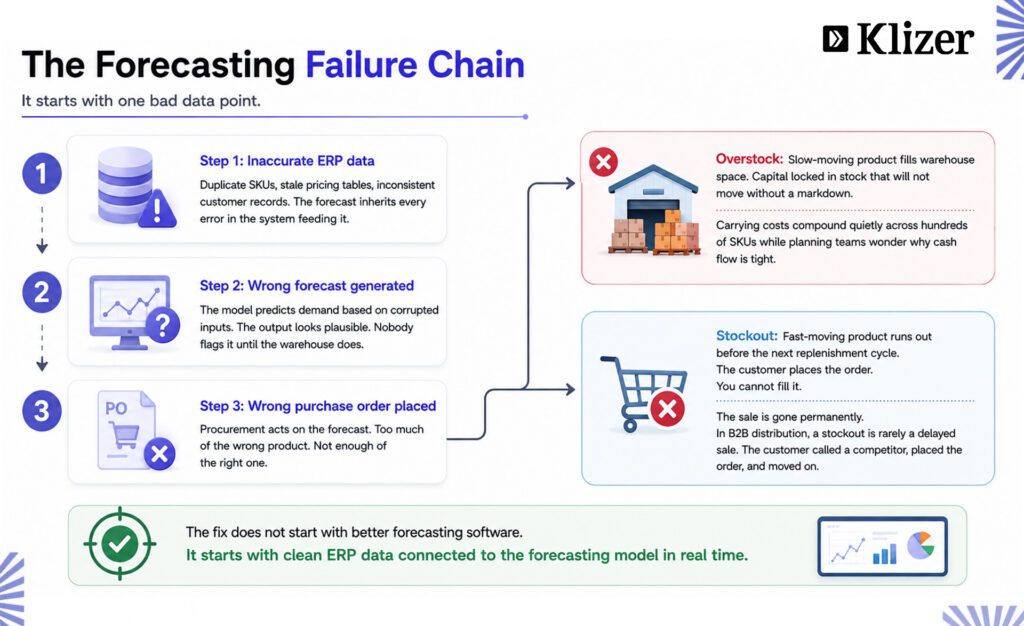
- Inaccurate ERP data: Forecasting is only as reliable as the data feeding it. When ERP records contain duplicate SKUs, inconsistent customer records, or pricing tables that have not been updated in years, the forecast inherits those errors. In Prophet 21 and Epicor implementations we have worked on, data quality issues in the ERP are among the most common reasons AI forecasting models underperform in the first months after deployment.
- Supplier delays: A forecast can accurately predict demand but still fail operationally if supplier lead times are inconsistent. A distributor ordering based on a four-week lead time who then faces six-week delays will hit stockouts even with a perfect demand forecast. Forecasting systems need to incorporate supplier performance data, not just customer demand signals.
- Seasonality: Many distributors manage product lines with sharp seasonal demand curves. HVAC components peak in summer, roofing materials peak in spring, and safety equipment spikes before regulatory deadlines. Forecasting models that do not account for seasonality create either excess inventory in off-peak periods or shortages during peak demand.
- Obsolete inventory: Slow-moving and end-of-life SKUs are a persistent drain on warehouse capacity and cash flow. Without forecasting that identifies declining demand trajectories early, distributors hold products that are losing value while capital is locked in stock that will eventually require markdown or disposal.
- Promotions: A promotional event changes demand patterns in ways that standard forecasting models do not anticipate. A price reduction, bundle offer, or marketing campaign can double order velocity on a specific SKU for a short window. Without promotional signals built into the forecasting model, the operation either oversells the promotion or overstocks after it ends.
- Multi-location warehouses: Distributors running multiple warehouse locations face a forecasting challenge that single-location operations do not: demand needs to be forecast not just in aggregate but by location. A product in surplus at one warehouse and in shortage at another represents a planning failure even if total inventory looks balanced. Inventory forecasting software that cannot model location-level demand does not solve the problem.
How Does Inventory Forecasting Work in Supply Chain Operations?
Inventory forecasting in supply chain operations refers to predicting future stock requirements based on expected customer demand, historical sales patterns, and supply chain variables. It directly informs procurement, production, and distribution decisions rather than sitting as a standalone planning function.
In practice, a wholesale distributor running five regional warehouses does not just need to know how much demand to expect next month. They need to know which warehouse will face the demand, when it will arrive, and whether current supplier lead times allow restocking before the gap opens.
Modern organizations rely on inventory forecasting software and inventory planning software to automate these decisions. These tools analyze real-time data, generate demand projections, and trigger replenishment actions when stock reaches predefined thresholds, replacing the manual monitoring that breaks down as catalog size grows.
What Does Inventory Forecasting Software Actually Do?
Inventory forecasting software translates demand data into operational decisions. For a distributor managing 15,000 SKUs across three warehouses, the value is not just prediction accuracy but the speed at which predictions convert into purchasing actions.
Core functions include:
- Predicting future demand at the SKU and location level
- Optimizing stock across sites to prevent both shortages and excess
- Automating replenishment based on forecasted thresholds
- Aligning procurement and logistics with expected demand cycles
- Surfacing insights that improve pricing and purchasing decisions
The teams that see the strongest results from inventory planning software are the ones that connect it directly to their ERP rather than running it alongside the ERP as a separate tool. When forecasting draws from live ERP data on orders, inventory positions, and supplier lead times, it produces projections that operations teams can actually act on. When it draws from exports and spreadsheets, the forecast is already stale before the planning meeting starts.
What Are the Key Benefits of Demand Forecasting?
The benefits of demand forecasting show up in operations, not just reports.
Improves inventory accuracy by helping businesses estimate stock requirements precisely using historical data, trends, and demand signals rather than manual estimates.
Reduces stockouts and lost sales by ensuring businesses anticipate demand surges and maintain adequate stock during peak periods. For distributors, a stockout is often a permanent lost sale since the customer places the order with a competitor who has stock.
Minimizes excess inventory by identifying slow-moving periods and reducing purchasing against products that will not move at the projected rate. One distributor we worked with reduced carrying costs significantly in the first six months after implementing structured forecasting connected directly to their ERP data.
Optimizes cash flow by preventing unnecessary purchasing and helping businesses allocate capital to fast-moving products rather than filling warehouses with slow sellers.
Enhances supply chain efficiency by aligning procurement, production, and logistics with predicted demand, giving supplier relationships a structured planning foundation instead of reactive purchase orders.
Supports advanced planning tools by improving the effectiveness of inventory forecasting software, enabling automated, data-driven decisions across the supply chain.
How Is AI Transforming Inventory Forecasting for Distributors?
Traditional statistical forecasting models have a fixed ceiling: they can analyze historical patterns but cannot adapt when those patterns change. AI removes that ceiling by learning continuously from new data and adjusting predictions as market conditions shift.
AI-driven demand forecasting and inventory management delivers measurable operational improvements across several areas:
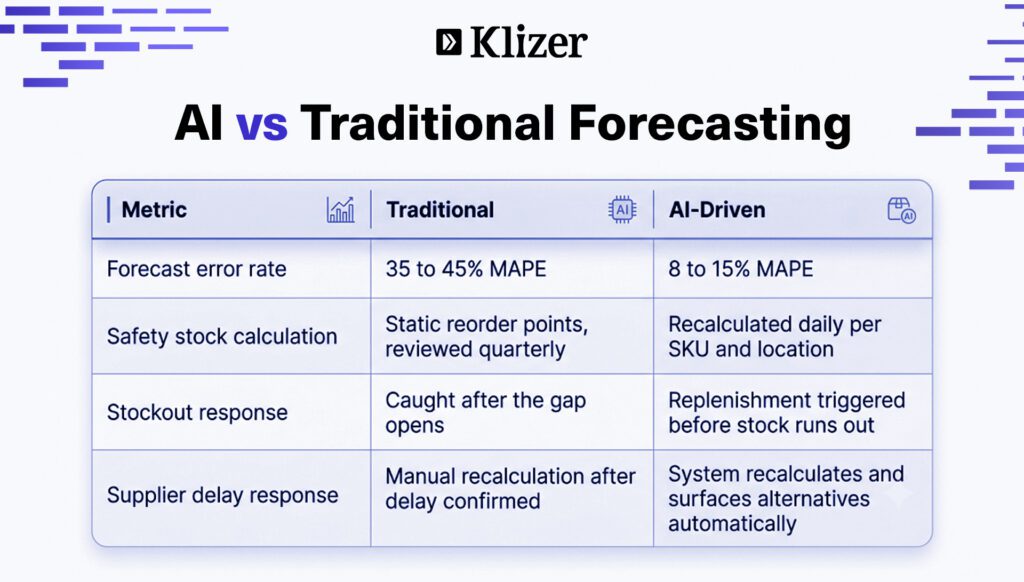
- Improves prediction accuracy beyond statistical limits: AI models analyze large datasets, detect non-linear patterns, and improve inventory forecasting accuracy beyond what traditional statistical methods can achieve. According to research across AI demand forecasting deployments, AI models typically achieve 8 to 15% mean absolute percentage error compared to 35 to 45% for traditional averages.
- Processes real-time demand signals: It captures live inputs such as sales velocity, market trends, and customer behavior to refine demand forecasting dynamically. When a regional weather event drives a spike in HVAC parts demand, an AI forecasting model detects the signal and adjusts replenishment recommendations before the stockout happens.
- Reduces stockouts and excess inventory simultaneously: It balances supply and demand more effectively by adjusting forecasts continuously. Unlike static reorder points, AI forecasting adapts safety stock levels at the SKU and location level as demand patterns evolve.
- Enhances supply chain responsiveness: AI improves forecasting in inventory management by adapting quickly to disruptions, seasonal shifts, and demand volatility. When a supplier flags a delay, the system recalculates affected SKU forecasts and surfaces alternative sourcing options rather than waiting for the gap to show up in a warehouse count.
- Optimizes decision-making across connected systems: It integrates with inventory forecasting software to support pricing, procurement, and distribution decisions using predictive insights drawn from the full data stack including ERP, WMS, and sales platform data.
Conclusion
Klizer helps manufacturers and distributors implement AI-driven inventory forecasting solutions that connect to your existing ERP and commerce systems, improving demand visibility and reducing costly stock imbalances across your supply chain. Our Connected Commerce model brings Foundation, Storefront, Integration, and Intelligence together under one roof, so forecasting does not sit as a standalone tool but runs as part of a live, connected system where ERP data, order history, and real-time demand signals feed the same intelligence layer that drives your storefront and operations.
Ready to improve your inventory accuracy? Book a Consultation with Klizer to build a smarter, AI-powered forecasting system for your business.