

Most product data does not live in one place, and that is the root of the problem. It tends to be spread across spreadsheets, an ERP, a handful of supplier emails, and whatever your eCommerce platform happens to store. That works until you add a new channel, expand into another region, or load a few thousand new SKUs.
At that point, the gaps show up where customers can see them, as wrong specifications, missing images, and product pages that quietly contradict each other.
A PIM exists to close those gaps before they reach a buyer.
This guide explains what Akeneo PIM is, where it sits in your commerce stack, and how it works, in plain terms for anyone meeting the category for the first time.
ON THIS PAGE
What Is Akeneo PIM?
Akeneo PIM is a Product Information Management system, and its job is to act as a central source of truth for the data you need to market and sell products across every channel. Rather than letting each team keep its own version of a product, it gives the whole organization one record to work from.
Picture it as the place where product information is collected, organized, enriched, and then sent out to the systems that display it. Marketing, merchandising, and IT all draw from the same catalog instead of maintaining separate copies that drift apart over time. The goal is straightforward: accurate, consistent, and complete product data everywhere a customer or partner encounters it.
What Problem Does a PIM Actually Solve?
Product data has a habit of fragmenting as a business grows, because different teams take ownership of different pieces of it. One team owns the technical specs, another owns the marketing copy, and a third manages the images, and none of those versions ever fully agree. The larger the catalog gets, the wider those disagreements spread.
Anyone who has run a catalog at scale will recognize the symptoms:
- The same product reads differently on the website, the marketplace, and the printed sheet.
- New products take weeks to launch because the data is never quite ready to publish.
- Teams rekey the same information into several systems by hand, introducing errors each time.
- Customers return items because the page they bought from did not match the product that arrived.
A PIM removes that scatter by giving the catalog a single home and a single set of rules. As the number of products and channels climbs, the data stays trustworthy instead of degrading, which is the difference between a catalog you can scale and one that fights you at every step.
Where Akeneo PIM Sits in Your Commerce Stack
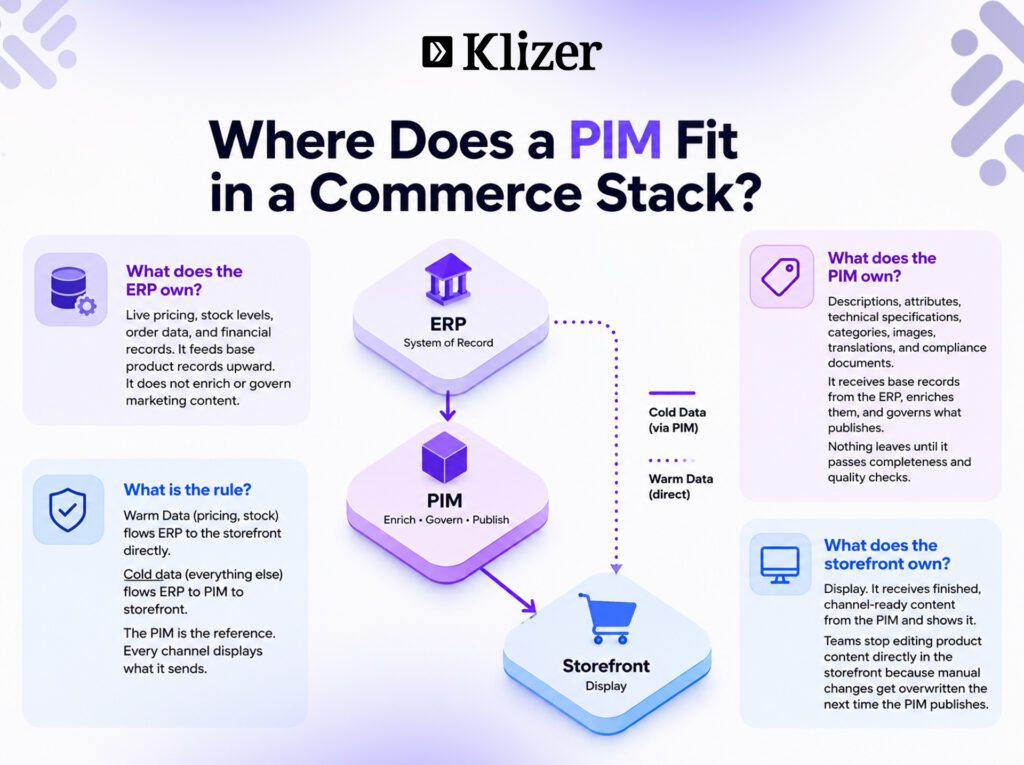
Akeneo PIM is not your storefront, and it is not your ERP. It sits between them and does a job that neither system does well on its own.
The cleanest way to understand its role is through the distinction between cold and hot data. The PIM owns what is often called cold product information, meaning the data that needs to be checked, structured, and enriched but does not change from hour to hour. Descriptions, attributes, technical specifications, categories, and media all fall into that category, because they are stable, deliberate, and worth governing carefully.
Your ERP, by contrast, owns the hot information that changes constantly through the day, like live pricing and stock levels. That data should flow straight from the ERP to your storefront rather than detouring through the PIM, since managing fast-moving operational data inside a system built for careful enrichment only creates lag. The two stay in their own lanes.
See how Klizer connects ERP, PIM, and storefront for manufacturers with AI-powered product data enrichment.
In a properly connected setup, the marketing data follows a single direction as it moves through the stack:
- The ERP feeds base product records and operational data into the system.
- The PIM enriches and governs the marketing version of that data.
- The storefront receives finished, channel-ready product content.
Once that flow is live, you stop editing product content directly inside the storefront, because any manual change there risks being overwritten the next time the PIM publishes. The PIM becomes the reference, and every downstream channel simply displays what it sends.
Getting this architecture right is the real foundation of any successful Akeneo PIM implementation, since the value comes from how cleanly the systems connect rather than from the software sitting on its own.
Key Features of Akeneo PIM
The platform is built around a set of capabilities that carry product data from raw import to finished, channel-ready output. The work moves through a clear sequence: data is collected from source systems, organized into a structured catalog, enriched and localized, then distributed to each channel.
The core Akeneo PIM features cover that entire path, which is why a single system can replace the patchwork of spreadsheets and manual exports most teams start with.
Here is what you get to work with out of the box:
- A single catalog repository that stores and manages all product information in one system.
- Families and attributes that classify products so they are easy to filter, search, and complete.
- A rules engine that automates enrichment of standardized attributes instead of leaving them to manual editing.
- Data quality tracking that measures completeness and flags what is missing before anything publishes.
- Localization and translation that manage region and language variations from the same underlying record.
- Asset management that links images, videos, and documents to each product.
- Roles, permissions, and workflows that govern who can edit and who can approve.
Among the most useful Akeneo PIM features for a growing team are the rules engine and completeness tracking, which work together to cut the manual labor that usually slows a catalog to a crawl.
Channel-specific output is another of the Akeneo PIM features operators rely on most. You select which attributes go to which channel, so a marketplace listing and your own storefront each receive the right fields without maintaining a duplicate catalog for each.
Benefits of Akeneo PIM
The point of adopting a PIM is operational rather than cosmetic, and the Akeneo PIM benefits show up in how quickly teams move and how reliably the data holds together under pressure.
The main gains are these:
- Faster time to market, since centralized data and workflows get new products live across regions and channels sooner.
- Higher data accuracy, since one authoritative source removes the contradictions between channels.
- Less manual work, since automation absorbs the updates and enrichment that used to consume hours.
- A better customer experience, since rich and consistent product content builds trust and supports the buying decision.
- Fewer returns, since a page that matches the product leaves customers knowing what they are getting.
Those Akeneo PIM benefits compound as you scale, which is easy to underestimate early on. A catalog of a few hundred SKUs is manageable by hand, but a catalog of fifty thousand products sold across six channels and three languages is not, and that gap is where a PIM earns its place.
For the technical side of the house, the Akeneo PIM benefits are just as concrete: one system to maintain in place of many disconnected spreadsheets, and a clean integration point with the ERP and storefront instead of a tangle of brittle manual exports.
Who Needs Akeneo PIM?
A PIM is not reserved for large enterprises, despite the assumption that often comes up. It fits any business with a growing catalog and more than one place to sell, and the need usually announces itself through a familiar set of signs.
You are likely a candidate if several of these describe your situation:
- You manage complex products with many variants and dense attribute sets.
- You sell across multiple channels, marketplaces, or regions at once.
- You depend on suppliers for product data and need a cleaner way to onboard it.
- Launching a new range has become a recurring headache rather than a routine task.
- You handle regulated products that require compliance data and formal sign-off.
This is where industrial B2B manufacturers and distributors feel the pressure most acutely, because their catalogs run deeper than most. They carry dense technical specifications, variant-heavy product lines, and strict requirements around accuracy and compliance that leave little room for the kind of drift a manual process invites.
For these operators, product data is not marketing decoration but the mechanism a buyer uses to confirm that a part fits, meets a standard, or matches a previous order, and a PIM gives that data the structure and governance the work demands.
What Akeneo PIM Implementation Involves
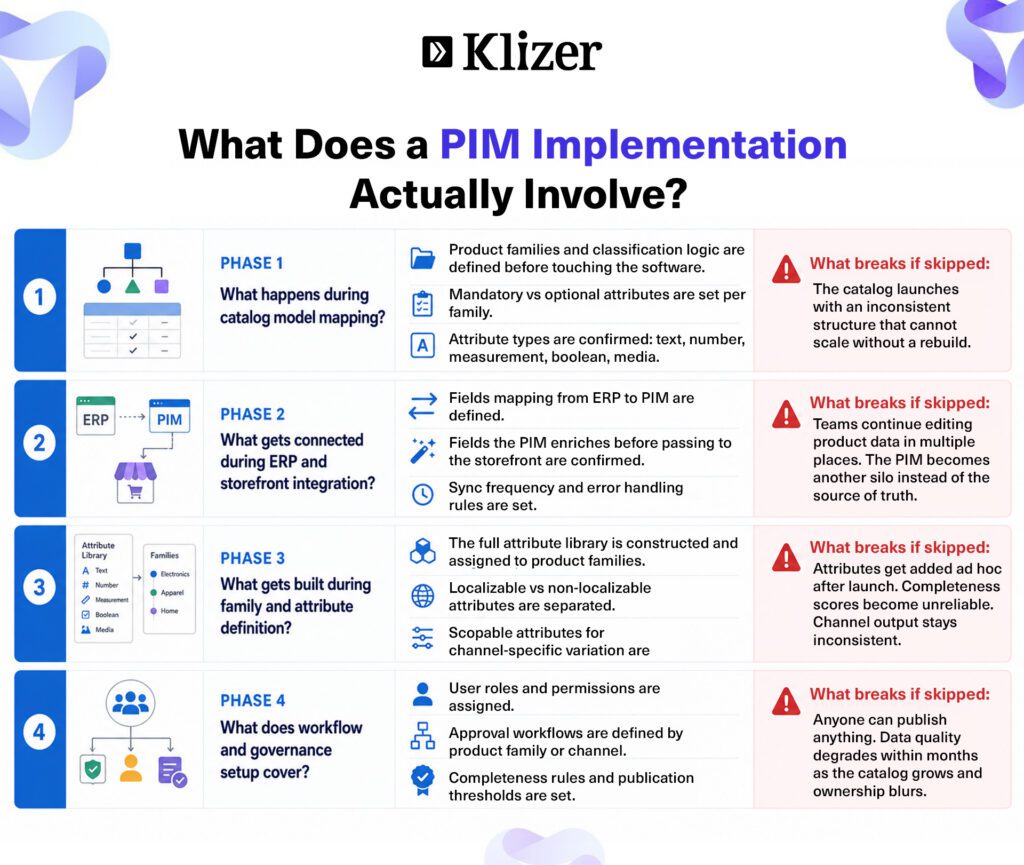
Setting up the platform is a project rather than a switch you flip, and it pays to treat it that way from the start. A typical Akeneo PIM implementation maps your catalog model, connects the ERP and storefront, defines the families and attributes your products need, and sets up the workflows your teams will use day to day.
The software itself is rarely the hard part. The architecture around it is what takes thought. The systems it connects to, the data flows you define, and the governance you put in place are what determine whether the catalog is still clean and trustworthy a year after launch.
Final Thoughts
Akeneo PIM is one layer of a larger system, and seeing it that way is what separates a tool that manages product data from an engine that drives commerce. On its own it manages that data well, but connected properly into the rest of your stack, it becomes the source that feeds accurate content to every channel you run.
That connected work is exactly what Klizer does. We build Connected Commerce for industrial B2B manufacturers and distributors, combining ERP, B2B eCommerce, integrations, and Operational AI under one roof.
If your product data is scattered today, that is where we start.
Book a FREE consultation with the Klizer team to map your commerce stack.