
Electrical distributors lose online sales when customers cannot find the products they need or place orders easily. A basic eCommerce website may display products, but it often fails to meet the specific needs of B2B buyers. They need accurate product details, customer-specific pricing, stock availability, and a simple ordering process.
Electrical distributor eCommerce helps businesses meet these needs through a website built around the way electrical buyers research and purchase products. It can also help distributors reduce manual work, process orders faster, and make buying easier for customers.
ON THIS PAGE
Why Is ERP Integration Important for Electrical Distributor eCommerce?
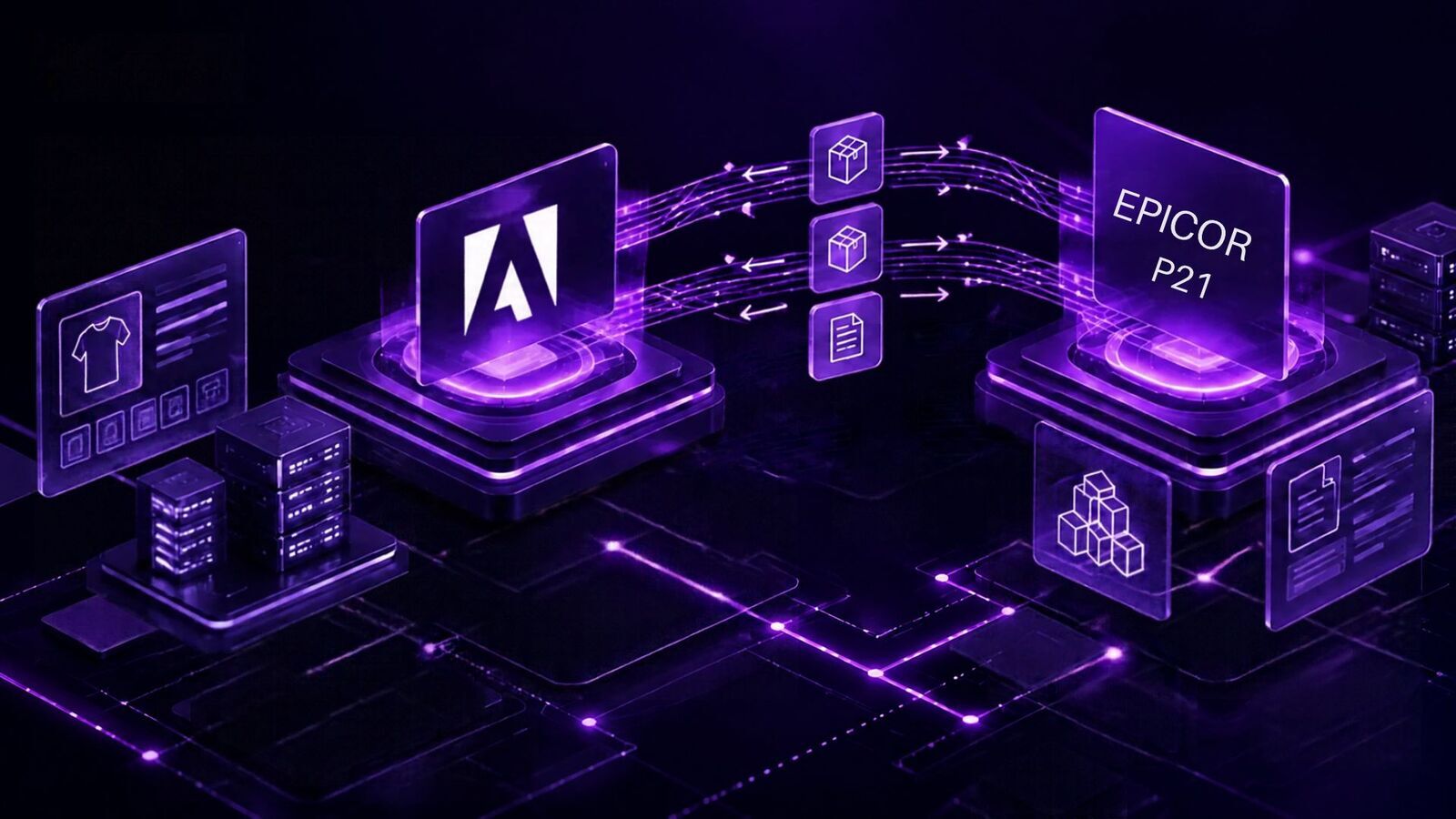
ERP and eCommerce integration connects an online store with the software a business uses to manage operations. Connecting an eCommerce store with ERP systems such as Prophet 21, Epicor, SAP, NetSuite, or Microsoft Dynamics can support several important workflows.
1. Show Updated Stock Levels
ERP integration updates website inventory using available stock data from the ERP system. Customers can check product availability before ordering, reducing the risk of orders for unavailable products.
2. Display Customer-Specific Prices
Electrical distributors often offer different prices based on customer accounts, contracts, and order quantities. ERP integration helps display the correct prices after customers log in.
3. Process Online Orders Faster
Orders placed through the eCommerce website can move directly into the ERP system. This reduces manual order entry and helps sales teams process purchases faster.
4. Keep Product Information Accurate
Product names, SKUs, descriptions, and other details can remain consistent between the eCommerce website and ERP system. This reduces incorrect product information and order-related confusion.
5. Reduce Duplicate Data Entry
Without integration, employees may need to enter the same information into multiple systems. ERP integration reduces this work and lowers the risk of data-entry errors.
Klizer’s TechSpan case study provides a relevant example. Integrating Prophet 21 with Magento 2 gave the electrical and automotive components distributor a unified dashboard for order management in the Magento admin.
How Can Electrical Distributors Increase Online Sales?
Electrical distributors can increase online sales by building an eCommerce website around the buying needs of contractors, electricians, and purchasing teams. The following six improvements can support electrical distributor online sales.
1. Build an eCommerce Store Around B2B Buying Needs
Electrical buyers often purchase in bulk and need features that standard online stores may not offer. A B2B eCommerce website for distributors may need:
- Quick-order forms: Let customers add products using SKUs or product codes.
- Quote requests: Allow customers to request prices for large orders.
- Purchase approvals: Let businesses establish approval steps before employees place orders.
- Customer accounts: Give buyers access to order history, invoices, and account details.
These features support common B2B purchasing requirements. Buyers increasingly expect to complete purchases without depending on sales representatives. A 2026 Gartner survey found that 70% of B2B buyers prefer a completely digital, self-service buying experience.
2. Improve Product Search and Navigation
Electrical distributors may sell large product ranges, from wires and cables to switches and circuit breakers. Organize products so customers can find the right items quickly.
- Group products into clear categories and subcategories.
- Add filters for brand, voltage, amperage, size, and product type.
- Enable searches by product name, SKU, manufacturer part number, and model number.
- Provide relevant alternatives when a product is unavailable or discontinued.
For example, customers searching for circuit breakers should be able to filter results by voltage, current rating, and brand. Better search and navigation can also support conversion. Master B2B’s 2026 research found that 60% of surveyed organizations reported higher eCommerce conversion rates year over year.
3. Add Detailed Product Information
Customers need technical details to select the right electrical products. Product pages should include:
- Specifications such as size, voltage, current rating, and material
- Technical data sheets and product manuals
- Images from different angles
- Manufacturer details and product certifications
- Compatibility information for related products
- Units of measure, package quantities, and minimum-order requirements
For example, buyers comparing circuit breakers should be able to check ratings, specifications, certifications, and compatibility before purchasing.
4. Make Bulk Ordering and Repeat Purchases Easier
Electrical buyers frequently order multiple products or replenish the same items. Features that reduce ordering time include:
- CSV uploads with product SKUs and quantities
- Saved lists for frequently purchased items
- Reordering from previous orders
- Bulk quantity selection on product pages
- Adding multiple products to the cart at once
For example, contractors should be able to reorder cables, connectors, and switches from a saved list instead of adding each item separately.
5. Personalize the Shopping Experience
Use customer purchase history and buying patterns to present relevant products and account information.
- Recommend products based on previous purchases.
- Highlight frequently purchased products.
- Suggest compatible accessories and replacement products.
- Tailor recommendations to the customer’s account, industry, or application.
For example, when a customer buys a particular electrical switch, the website can suggest compatible accessories. Recommendations should use accurate compatibility and account data so they do not create ordering errors.
6. Make the eCommerce Website Mobile-Friendly
Electrical buyers may browse products and place orders from job sites, warehouses, or project locations. The website should work well on mobile devices.
- Use responsive layouts that adjust to different screen sizes.
- Make menus and filters easy to use on smaller screens.
- Keep product specifications readable.
- Make buttons, quantity fields, and checkout options easy to access.
- Optimize page-loading speed for mobile devices.
BigCommerce’s 2025 industrial buyer research found that 60% of surveyed buyers said purchasing online saves them time.
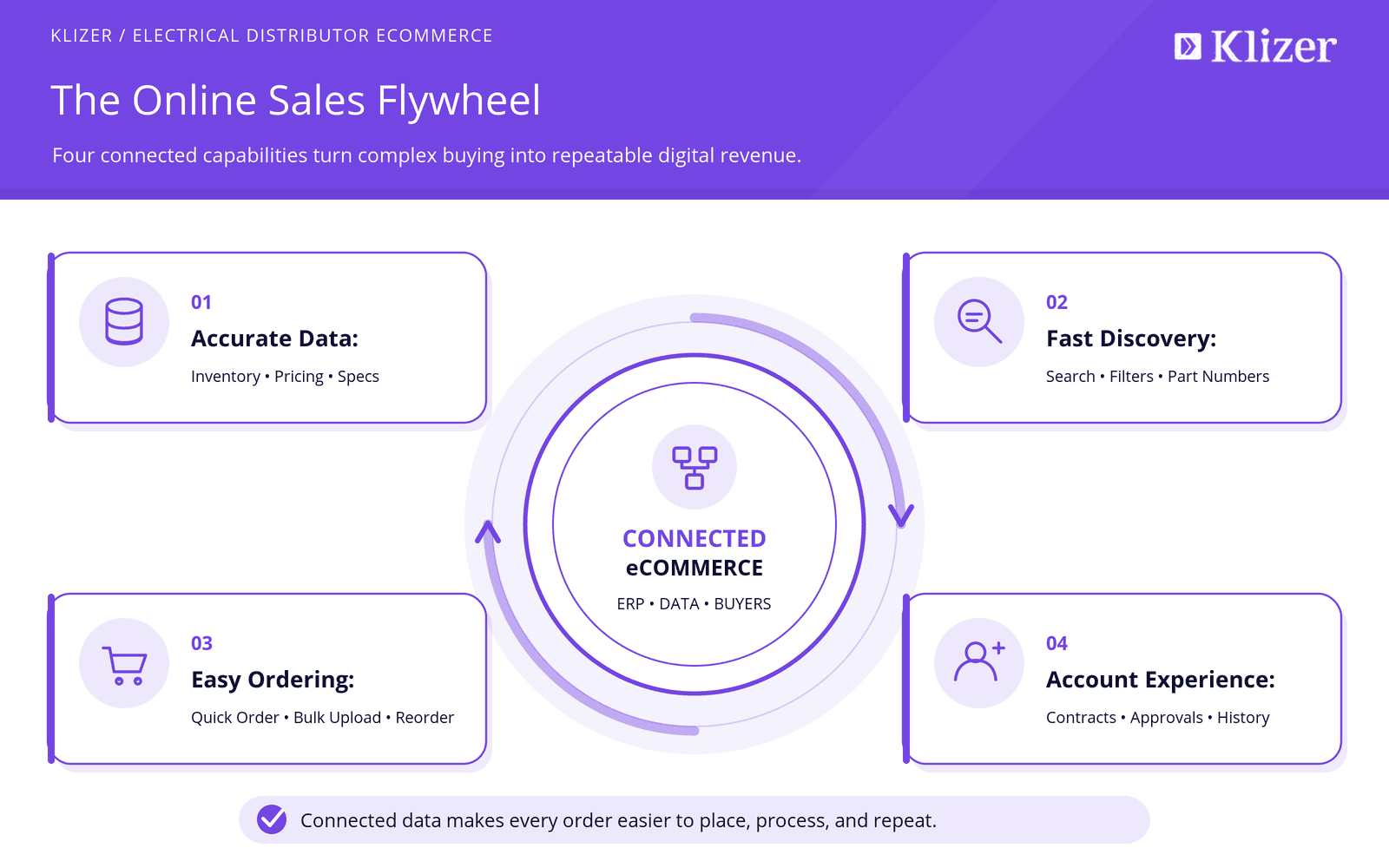
Four connected capabilities that support repeatable electrical distributor online sales.
What Mistakes Should Electrical Distributors Avoid When Selling Online?
Ignoring Website Security
Failing to update website software and protect customer accounts can expose business and customer data to security risks.
Using Unclear Return Policies
Set clear rules for returns and replacements. State product-specific conditions for items such as cut-to-length cables and special-order products.
Miscalculating Shipping Costs
Account for product weight, dimensions, packaging, and handling requirements when calculating delivery charges. Incorrect estimates can reduce profit margins.
Neglecting Website Maintenance
Review software updates, fix technical issues, test integrations, and update website features as business requirements change. Deloitte Digital’s 2026 research found that B2B buyers estimated they spend 29% more with suppliers that provide a positive purchasing experience.
Treating the Website as a Separate Sales Channel
Online orders, sales-assisted orders, pricing, inventory, and customer service should use consistent business information. Disconnected channels can create conflicting prices, stock information, and account experiences.
How Does Connected Commerce Support Electrical Distribution Digital Sales?
Connected Commerce brings the different parts of a distributor’s digital business into one coordinated system. McKinsey’s 2026 Global B2B Pulse research found that 71% of surveyed B2B companies offered eCommerce. Among those companies, roughly one-third of revenue came through digital channels.
Connected Commerce has four layers that work together:
Foundation
Establishes the technical architecture needed to support digital commerce, system connections, security, and future expansion.
Storefront
Provides the customer-facing experience, bringing the distributor’s brand, product catalog, account information, and buying journey into one online destination.
Integration
Connects eCommerce with ERP, CRM, PIM, WMS, and other operational systems so teams and customers work with consistent business information.
Intelligence
Turns commerce and operational data into useful insights. Distributors can analyze customer behavior, product demand, search performance, and digital sales patterns to identify opportunities and improve decisions.
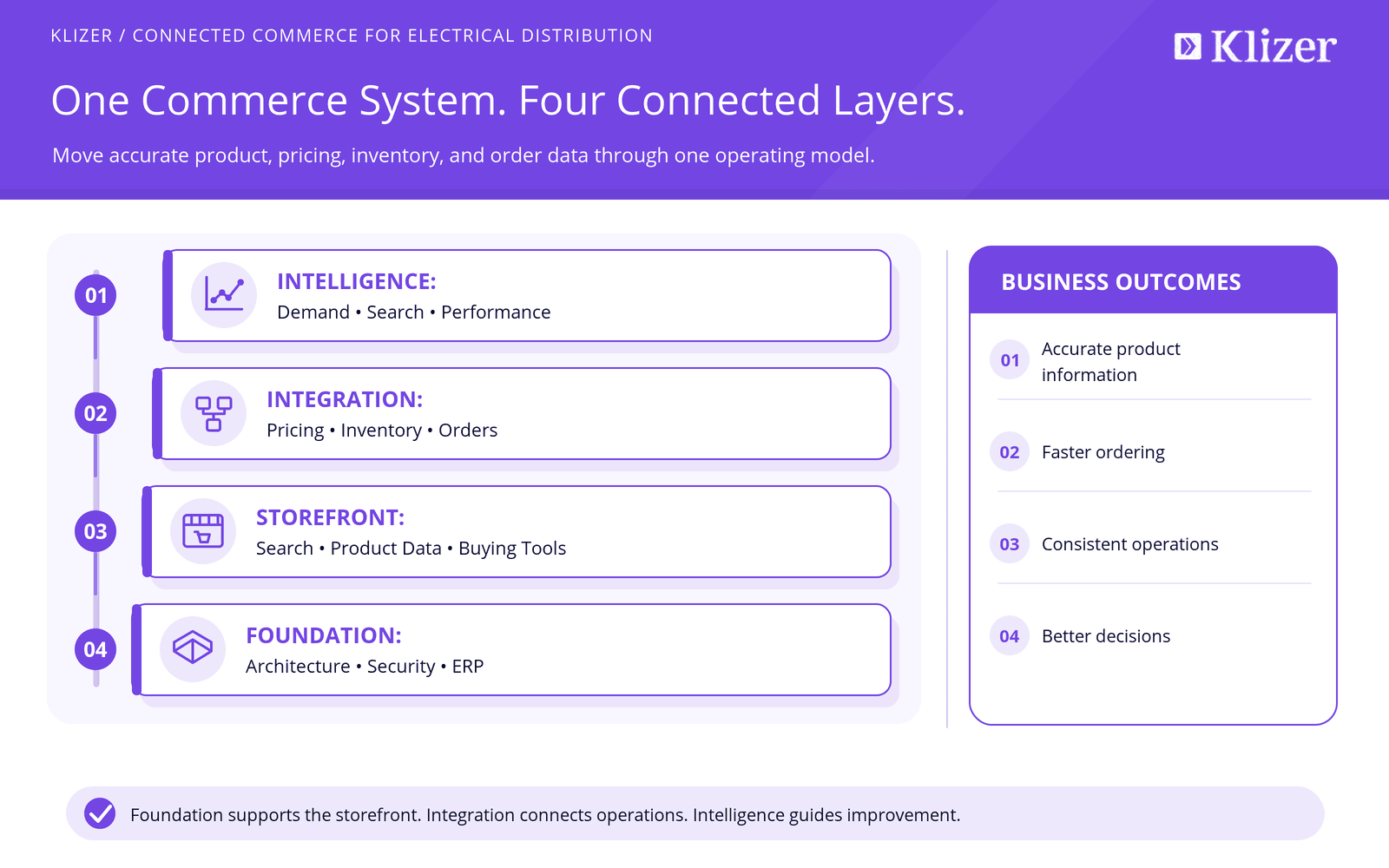
Connected Commerce links digital buying with operational systems and data.
Conclusion
Increasing online sales requires more than placing an electrical product catalog on a website. Distributors need accurate ERP data, product search designed for technical buying, account-specific experiences, efficient repeat ordering, mobile access, and ongoing operational support.
Klizer’s Connected Commerce approach brings Foundation, Storefront, Integration, and Intelligence together so the website, ERP, product data, customer accounts, and digital sales insights support the same operating model.
Book a Connected Commerce consultation to identify the systems, workflows, and buyer-experience improvements that can strengthen online sales for your electrical distribution business.
Frequently Asked Questions
What Is Electrical Distributor eCommerce?
Electrical distributor eCommerce is the online sale of electrical products through a digital platform. It allows distributors to serve business customers, manage online transactions, and support sales beyond traditional channels.
How Long Does It Take to Launch an Electrical Supply eCommerce Website?
The timeline depends on the website’s complexity, product catalog size, data quality, design requirements, custom functionality, and integrations. A B2B platform with customer-specific pricing and multiple system connections requires more planning and testing than a basic store.
Can Small Electrical Distributors Sell Products Online?
Yes. Small electrical distributors can begin with a platform that supports their current product range, customer requirements, and order volume, then add features and integrations as the business grows.
Can Electrical Distributors Sell Across Different Regions Through eCommerce?
Yes, subject to shipping coverage, delivery arrangements, tax requirements, product restrictions, and the distributor’s ability to support customers in each region.
Which ERP Systems Can Integrate With an Electrical Supply eCommerce Website?
An electrical supply eCommerce website can integrate with ERP systems such as Prophet 21, Epicor, SAP, NetSuite, and Microsoft Dynamics. The integration approach depends on the eCommerce platform, ERP version, available APIs or middleware, data ownership, and business requirements.