

Software testing has always evolved alongside software development practices. From manual testing to scripted automation, and from waterfall to Agile and DevOps, each shift has redefined how teams ensure software quality.
Today, we are witnessing another major transformation driven by Large Language Models (LLMs). Tools such as GitHub Copilot, ChatGPT, and Google Gemini are not just assisting developers. They are reshaping how test automation is designed, written, and maintained.
This blog explores how LLMs are changing test automation, what opportunities they bring, and what challenges teams must navigate to use them effectively.
ON THIS PAGE
The Traditional State of Test Automation
Before LLMs entered the scene, test automation required significant manual effort and technical expertise. Test engineers had to:
- Understand application behavior in depth
- Write automation scripts using frameworks such as Selenium, Cypress, or Playwright
- Maintain brittle locators and test data
- Continuously update scripts as UIs or APIs evolved
Automation brought speed and repeatability, but it also introduced complexity. Maintaining test suites often became a bottleneck, especially in fast-moving agile environments. Even experienced testers spent a large portion of their time writing boilerplate code, debugging flaky tests, and keeping scripts aligned with changing requirements.
What Are LLMs and Why Do They Matter?
Large Language Models (LLMs) are AI systems trained on vast amounts of text and code. They can understand natural language, generate human-like responses, and write code in multiple programming languages.
What makes LLMs transformative for test automation is their ability to bridge the gap between human intent and executable automation. Instead of writing every line of test code manually, testers can describe a scenario in plain English through prompts, and the model can generate an initial implementation.
This shifts test automation from being primarily code-driven to becoming intent-driven.
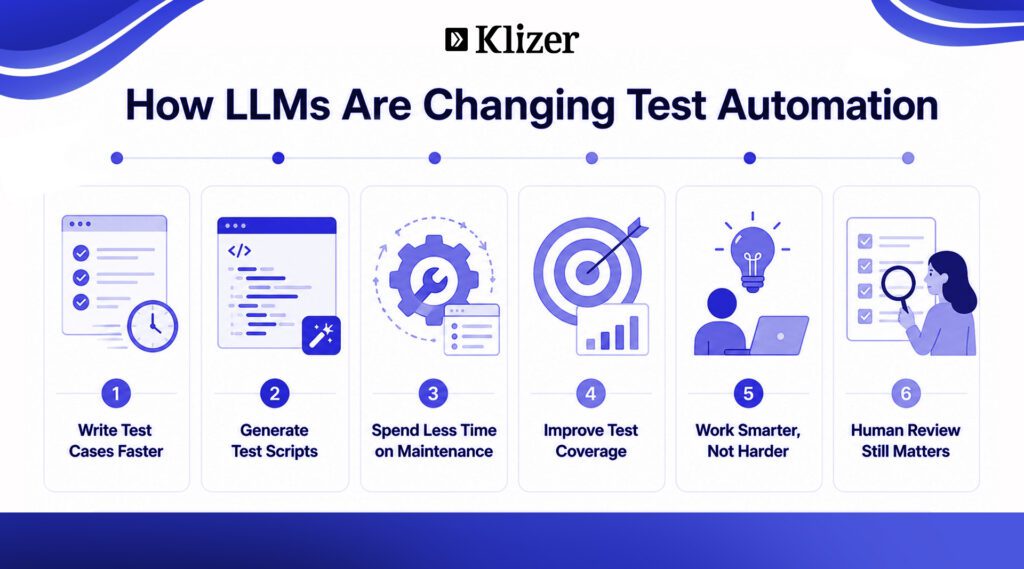
Key Ways LLMs Are Transforming Test Automation
1. Natural Language to Test Case Generation
One of the most significant changes is the ability to convert business requirements into comprehensive test cases.
Consider a user story such as:
“A user should be able to log in with valid credentials and see a dashboard.”
Using tools like ChatGPT, Gemini, Claude this can be expanded into:
- Positive test scenarios
- Negative test scenarios
- Edge cases
- Boundary conditions
The model can also structure these into formal test cases with steps, expected results, and preconditions. This dramatically reduces the time spent on test design.
2. Automated Test Script Generation
LLMs can generate automation scripts for frameworks such as Playwright, Selenium, and Cypress.
For example, using GitHub Copilot in Visual Studio Code, a tester can enter a prompt such as:
“Write a test for login functionality including valid,invalid and edge scenarios.”
Within seconds, the model can generate a working test script, including page navigation, element selectors, assertions, and reusable functions.
This accelerates:
- Initial test creation
- Rapid prototyping
- Learning new automation frameworks
- Creating reusable automation components
3. Intelligent Test Maintenance
Test maintenance has historically been one of the most time-consuming aspects of automation. UI changes break locators, APIs evolve, and test data becomes outdated.
LLMs can assist by:
- Suggesting updated selectors when UI elements change
- Refactoring outdated automation code
- Identifying duplicate or redundant tests
- Explaining test failures in plain language
Instead of manually debugging every issue, testers can use AI-generated suggestions to reduce maintenance effort and resolve failures more quickly.
4. Improved Test Coverage Through AI Suggestions
LLMs can analyze application code or existing test suites and recommend additional test scenarios that may have been overlooked.
For example, they can identify:
- Uncovered code branches
- Missing negative test cases
- Edge cases
- Boundary value conditions
These suggestions help teams improve test coverage without manually reviewing every requirement or code path.
5. Integration with Development Workflows
LLMs are increasingly becoming part of modern software development workflows.
For example:
- GitHub Copilot provides contextual code suggestions within IDEs.
- AI-generated tests can be incorporated into CI/CD pipelines after review.
- Test cases can be generated from Jira user stories or issue descriptions.
Although LLMs do not automatically integrate these systems on their own, they make it easier to move information between tools. A tester can copy a Jira ticket, generate relevant test cases using AI, review them, and commit them to GitHub within minutes.
Benefits of LLM-Driven Test Automation
Speed and Productivity
Tasks that previously took hours, such as writing test cases, generating automation scripts, or documenting test scenarios, can now be completed in minutes.
Improved Accessibility
Even team members with limited automation experience can contribute by describing test scenarios in natural language, making automation more accessible across teams.
Consistency
LLMs generate structured and standardized outputs, reducing variability in test design.
Continuous Learning
Modern AI tools continuously improve and adapt to new programming languages, frameworks, and testing practices, making them increasingly valuable over time.
Challenges and Limitations
Despite their advantages, LLMs are not a complete replacement for skilled testers. Organizations should understand their limitations before adopting them.
1. Accuracy and Reliability
AI-generated code is not always correct. It may:
- Use incorrect selectors
- Miss edge cases
- Produce flaky tests
Every output should be reviewed before it becomes part of the automation suite.
2. Limited Context Awareness
LLMs do not fully understand your application unless sufficient context is provided. Vague prompts often result in incomplete or inaccurate outputs.
The quality of the results largely depends on the quality of the prompts.
3. Risk of Over-Reliance
Depending entirely on AI can reduce critical thinking during test design.
Testers still need to:
- Validate generated outputs
- Understand application behavior
- Ensure meaningful test coverage
4. Security and Data Concerns
Sharing proprietary source code, business logic, or sensitive test data with public AI tools may introduce security and compliance risks.
Organizations should establish clear governance policies for AI usage.
5. Lack of True Automation Intelligence
LLMs can generate code and suggest improvements, but they do not independently execute, validate, or manage complete testing workflows.
More autonomous testing is becoming possible with AI agents and technologies such as the Model Context Protocol (MCP). However, human oversight remains essential to ensure quality, accuracy, and reliability.
Best Practices for Using LLMs in Test Automation
To maximize the value of LLMs, organizations should adopt a structured approach.
Write Clear Prompts
Be specific about:
- The test scenario
- The automation framework
- The programming language
- Expected outputs
Review Every Output
Always validate AI-generated code before adding it to production test suites.
Combine with Existing Tools
Use LLMs alongside automation frameworks such as Playwright, Selenium, or Cypress rather than treating them as replacements.
Build Reusable Patterns
Create standardized prompts for frequently used testing scenarios to improve consistency and productivity.
Train Teams
Help testers understand both the strengths and limitations of AI so they can use these tools effectively and responsibly.
The Future of Test Automation with LLMs
The role of LLMs in software testing is only beginning to evolve. In the coming years, we can expect:
- Deeper integration with platforms such as Jira and GitHub
- AI-assisted test generation directly from business requirements
- Self-healing test scripts
- AI-driven test optimization and prioritization
- Smarter defect analysis and root cause identification
As these capabilities mature, test automation will become less about writing scripts and more about defining testing intent, validating outcomes, and continuously improving software quality.
Conclusion
Large Language Models are transforming test automation by making it faster, more accessible, and more efficient. From generating test cases and automation scripts to simplifying maintenance and improving test coverage, LLMs are helping QA teams focus less on repetitive tasks and more on delivering high-quality software. While human expertise remains essential for validation and strategy, combining AI with established testing practices can significantly enhance productivity and software quality.
Get in touch with Klizer to start your AI testing journey, and explore our advanced AI solutions for ecommerce to see how AI can help your business grow.