

You’ve got a great product. You’ve set up your store. You’re running ads. But your conversion rate is stubbornly low, shoppers are bouncing, and returns keep piling up.
More often than not, the culprit isn’t the product, it’s the data behind it.
Both problems trace back to the same root cause: incomplete, inaccurate, or underdeveloped product content.
That’s exactly what product data enrichment is designed to fix.
This guide covers everything you need to know, what it is, why it matters, how the process works, and how to do it right, whether you’re running a small online store or managing thousands of SKUs across multiple marketplaces.
ON THIS PAGE
What is Product Data Enrichment?
Product data enrichment is the process of taking raw, basic product information and improving it by adding missing details, fixing inaccuracies, and layering in structured content that makes listings more accurate, discoverable, and persuasive.
Think of it this way: your supplier sends you a spreadsheet with a product name, an SKU, a weight, and a single blurry image. That’s raw data. It tells you something exists, but it doesn’t help a shopper decide whether to buy it.
Enriched data takes that same product and builds it into a complete, compelling listing:
- A keyword-optimized title
- A benefit-driven description
- Detailed specifications (dimensions, materials, compatibility)
- Multiple high-quality images from different angles
- Accurate categorization
- Tags, attributes, and metadata that help search engines and marketplace algorithms understand the product.
The essence of ecommerce product data enrichment is to help brands communicate the full value of their products while minimizing shopper resistance and hesitation.
Product Data Enrichment vs. Data Cleansing: What’s the Difference?
These two are often used interchangeably, but they solve different problems.
Data cleansing is about fixing what’s broken, removing duplicates, correcting errors, and standardizing formatting. Product data enrichment is about adding what was never there in the first place: richer descriptions, better imagery, structured attributes, and content tailored to each channel.
You need both. A clean dataset with thin content will still underperform in search and fail to convert. Equally, enriching a dataset full of errors just spreads inaccurate information more quickly. The practical order is to cleanse first, then enrich.
See how AI can help improve the search on your ecommerce store.
What are the Benefits of Product Data Enrichment
A whopping 87% of online shoppers base their purchasing habits on product descriptions.
That means your product content isn’t just supporting the sale; it is the sale.
Here’s what enriched data actually moves:
- Higher Conversion Rates: Detailed and appealing product information throughout your merchandising helps customers make informed decisions, reducing hesitation and increasing the likelihood of purchases.
- Better Search Visibility: Search engines and marketplace algorithms rely on structured product attributes to match listings to buyer queries. Enriched listings give search algorithms more signals to work with, resulting in better organic placement without additional ad spend.
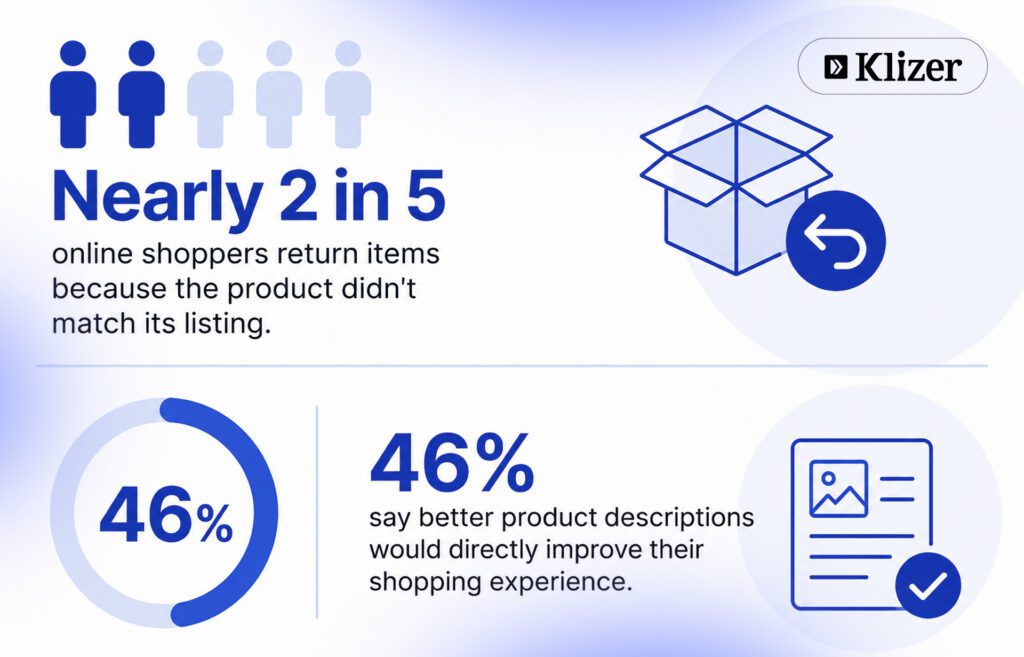
- Fewer Returns: When listings set accurate expectations, customers get what they expect and keep it.
- Stronger Ad Performance: Platforms like Google Shopping and Meta Ads pull directly from your product feed to generate dynamic ads, meaning the quality of your data has a direct impact on how your products appear in paid placements.
- Reduced Listing Rejections: Missing fields like GTIN, brand, or material can lead to product disapprovals on platforms like Google Shopping and Meta. Enriched, complete data keeps your listings live and performing.
- Increased Revenue Per Shopper: 62% of consumers say they are willing to spend more on a product that offers detailed information, making enrichment a direct revenue lever.
- Customer Trust and Loyalty: 87% of people won’t do business with a retailer displaying inaccurate product data. Enrichment isn’t just about the first sale; it’s about keeping customers coming back.
The 3 Types of Product Data You Can Enrich
Before you dive into the product data enrichment process, it helps to understand the three main categories of data you’re working with.
1. Technical Data
This covers the hard facts about your product: dimensions, weight, materials, SKUs, GTINs, compatibility information, and performance specs like battery life or load capacity. This is especially critical for supplier product data enrichment, where raw data from manufacturers is often technical but incomplete or inconsistently formatted.
2. Marketing Data
This is the content that converts product titles, descriptions, lifestyle copy, benefit-driven language, keywords, images, videos, and social proof like reviews and ratings. Marketing data is what turns a specification sheet into a story a shopper wants to be part of.
3. Logistical Data
Shipping dimensions, stock levels, warehouse location, lead times, and return policies. This is the operational layer that keeps your channels running smoothly, and your fulfillment promises accuracy.
All three types need attention. Enriching only one while neglecting the others creates gaps that hurt you in different ways, such as poor SEO, low conversions, or failed marketplace compliance.
The Product Data Enrichment Process: Step by Step
A well-run product data enrichment process isn’t a one-off project; it’s a repeatable workflow. Here’s how to do it right.
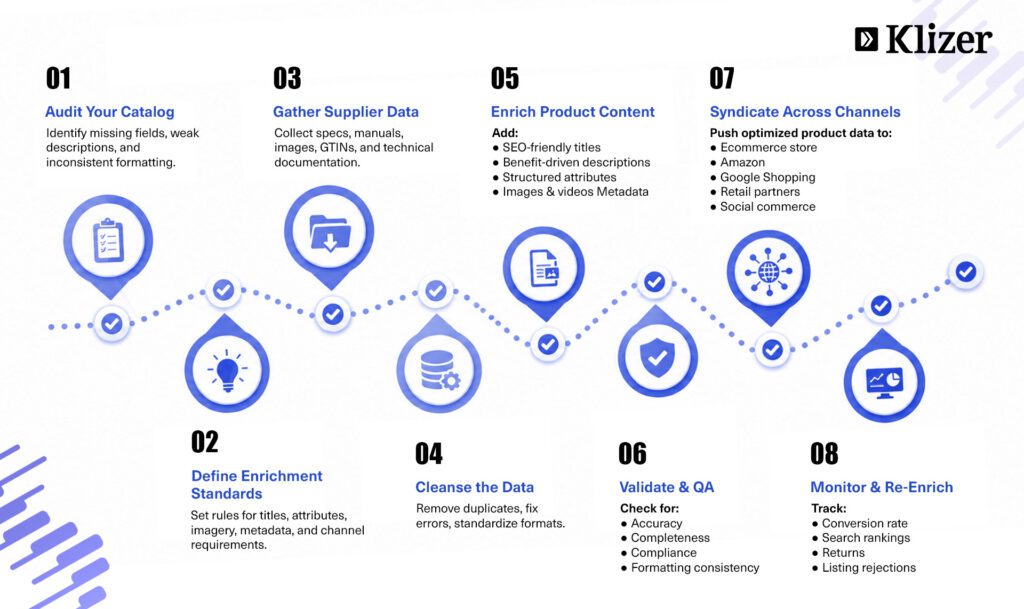
Step 1: Audit Your Catalog
Before adding anything, understand what you’re working with. Pull your full product catalog and assess it for missing attributes, outdated specs, thin descriptions, and inconsistent formatting. Most teams find that the gaps are concentrated in specific categories or supplier-sourced data. Knowing where the problems are tells you where to prioritize and how much work lies ahead.
Step 2: Define Your Enrichment Standards
What does a “complete” listing look like for your business? Define it before you start enriching. Set standards for required fields, image minimums, character counts for descriptions, and channel-specific requirements. Without this benchmark, you’ll replace one kind of inconsistency with another.
Step 3: Gather and Normalize Source Data
For supplier product data enrichment, this means pulling specs from manufacturer sheets, supplier portals, and technical documentation. Suppliers deliver data in different formats and at varying levels of completeness. Establishing a mandatory supplier data template upfront reduces the normalization work required before enrichment can begin.
Step 4: Cleanse Before You Enrich
Fix duplicates, correct errors, and standardize formatting. Enriching dirty data is counterproductive; it spreads inaccuracies further and faster across your channels.
Step 5: Enrich by Data Type
Now the real work begins. Add or improve:
- Titles (structured, keyword-rich, channel-appropriate)
- Descriptions (benefit-driven, audience-aware, clear)
- Attributes (color, size, material, compatibility, etc.)
- Imagery (multiple angles, lifestyle context, zoom quality)
- Videos (demos, unboxing, how-to content)
- Metadata (tags, keywords, category taxonomy)
Step 6: Validate
Review enriched data against your standards before publishing. Check for accuracy, completeness, formatting consistency, and compliance with platform requirements. Automated quality scoring tools within PIM platforms can flag issues at scale.
Step 7: Syndicate Across Channels
Push enriched data to your website, marketplaces, ad platforms, and retail partners. Each channel may require slightly different formatting; your enrichment process should account for this from the start.
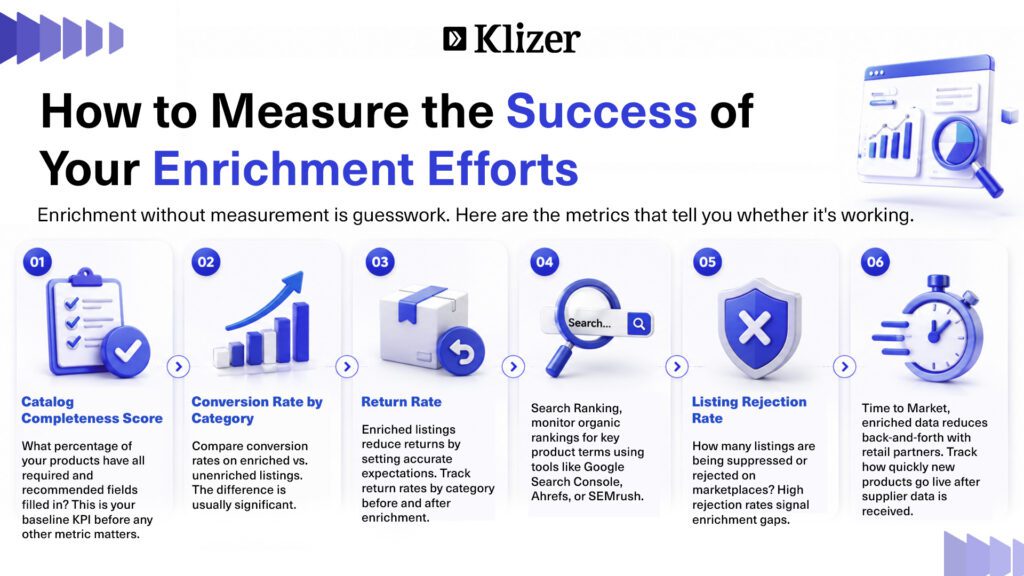
Step 8: Monitor, Measure, and Re-enrich
Track how enriched listings perform against key metrics, search ranking, conversion rate, and return rate. Flag products that underperform for a second round of enrichment, and build a process for keeping data current as products are updated, discontinued, or expanded into new markets.
Structured Product Data Enrichment: Why Structure Is Everything
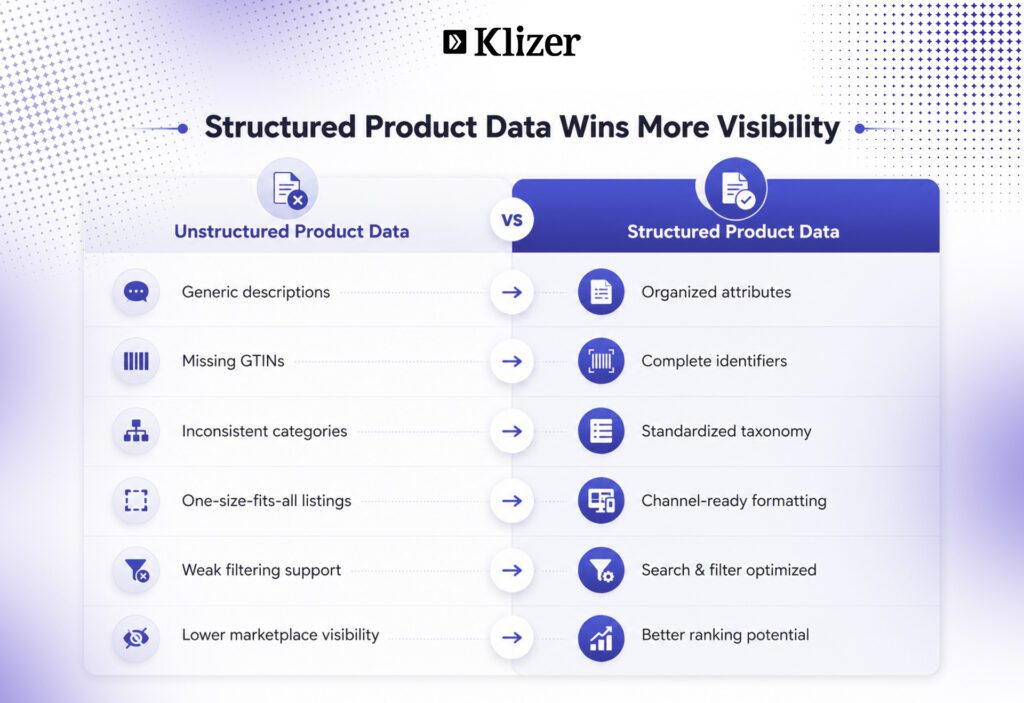
Structured product data enrichment means organizing your enriched content in a standardized, machine-readable format, not just improving what’s visible to shoppers, but making the underlying data framework consistent, categorized, and channel-ready.
Search engines, marketplace algorithms, and ad platforms don’t read listings the way humans do. They parse structured fields, title, brand, GTIN, category, and attributes, to decide where and how to show your product.
Unstructured enrichment (long descriptions with no attribute data, inconsistent category naming, missing identifiers) leaves algorithms with too little to work with. Without complete and structured product data, listings are often excluded from filtered results, resulting in reduced visibility.
Structured enrichment means:
- Using consistent attribute names and values across your catalog
- Assigning products to the most granular category available in each channel’s taxonomy
- Populating all required and recommended fields for each platform
- Maintaining a single source of truth through a PIM system so every channel gets the same clean, structured data
Product Data Enrichment for Online Stores
For independent ecommerce stores, product data enrichment for online stores is about creating a buying experience that replaces the physical store. Your customer can’t touch the fabric, try on the shoe, or feel the weight of the product in their hand. Your listing has to do all of that for them.
That means going beyond the basics:
- Rich descriptions that speak to use cases, not just features. Instead of “Water-resistant jacket,” write “Built for all-day wear in unpredictable weather, waterproof shell, sealed seams, and a packable design that fits in your backpack pocket.”
- Visual depth that builds confidence. Listings with 4+ images convert 58% better than those with just one. Include multiple angles, lifestyle shots, close-ups of materials or labels, and size comparison visuals.
- Sizing guides, FAQs, and care instructions that pre-answer the questions that would otherwise lead to an abandoned cart or a return.
- Social proof integration, reviews, ratings, and user-generated content are woven into the product page.
For Shopify, Magento, and similar platforms, enrichment is also about making sure your products are indexed correctly by Google, meaning your structured data markup (schema), meta titles, and category architecture are all working together.
Retail Product Data Enrichment
Retail product data enrichment operates at a different scale and complexity. Whether you’re a large retailer managing tens of thousands of SKUs or a multi-brand distributor syndicating data to dozens of retail partners, the challenge is consistency across a massive, constantly changing catalog.
The core priorities for retail enrichment are:
- Catalog completeness at scale. Every SKU, not just the bestsellers, needs enriched data. Thin long-tail listings bleed organic traffic and harm marketplace rankings.
- Channel-specific formatting. What works on your website doesn’t automatically work on a marketplace. Retail enrichment requires channel-specific variations of your data: different title structures, attribute requirements, and image specs for each destination.
- Supplier data normalization. Retailers source products from dozens or hundreds of suppliers, each with its own data format and quality level. A robust enrichment process standardizes this incoming data before it ever reaches the storefront.
- Compliance with retail partner requirements. Major retailers and distributors have strict content requirements. Brands that maintain enriched, complete product data reach syndication faster and maintain better digital shelf placement than competitors working from incomplete catalogs.
Marketplace Product Data Enrichment
Selling on Amazon, Flipkart, Meesho, Myntra, or any major marketplace means playing by their rules, and their algorithms heavily favor complete, enriched listings.
Marketplace product data enrichment has a specific focus: meeting and exceeding the platform’s content requirements while optimizing for its search and ranking systems.
Each marketplace has its own taxonomy, required attributes, and content scoring systems. Amazon has A+ Content and backend search terms. Google Shopping demands accurate GTINs, brand names, and condition fields. Flipkart and Meesho have their own category structures and attribute requirements.
Key enrichment priorities for marketplace selling:
- Title structure. Most marketplaces want titles in a specific format: Brand + Product Type + Key Features + Variant. Deviating from this reduces visibility.
- Attributes and filterable fields. Shoppers on marketplaces use filters heavily. If your color, size, material, or compatibility attributes are missing, your products don’t appear in filtered searches at all, regardless of how good your description is.
- GTIN and product identifiers. Missing GTINs can cause listing suppression or rejection on Google Shopping and Amazon.
- Images. Marketplace image requirements (white backgrounds, minimum resolution, multiple views) are non-negotiable. Listings that don’t meet them get suppressed or ranked lower.
- High-quality Content / Enhanced Brand Content. On Amazon and similar platforms, enriched brand content, comparison charts, lifestyle imagery, and detailed feature breakdowns directly improve conversion rates and help your listing stand out from generic competitors.
Tools and Technology That Power Enrichment
You don’t have to do this manually. A growing ecosystem of tools makes the product data enrichment process faster, more scalable, and more consistent.
- PIM Systems (Product Information Management): The backbone of serious enrichment operations. Tools like Akeneo, Salsify, Pimcore, and inRiver give you a centralized repository where all product data lives, gets enriched, and is distributed to channels. A PIM is especially critical for retail product data enrichment at scale, where managing data across spreadsheets creates version control chaos.
- Feed Management Platforms Tools like Feedonomics and DataFeedWatch handle channel-specific formatting, attribute mapping, and real-time syncing. They make sure your enriched data actually reaches each platform in the right format.
- AI Content Tools AI-powered platforms like ChatGPT, Jasper, and others can generate product descriptions, suggest attributes, and fill gaps at scale. They’re most effective when combined with human review, AI for speed and volume, and humans for quality and brand voice.
- DAM Systems (Digital Asset Management): Managing thousands of product images and videos requires a DAM, a centralized library where your visual assets are stored, organized, and distributed to the right channels in the right formats.
Common Challenges and How to Overcome Them
Even with the best intentions, product data enrichment runs into predictable obstacles.
- Inconsistent supplier data. Every supplier has a different format, level of detail, and data quality. The fix: create a mandatory supplier data template and require it as part of your onboarding process. The cleaner the incoming data, the less normalization work you have to do.
- Scale and catalog size. Manually enriching a catalog of 10,000+ SKUs is impractical. The fix: prioritize your highest-revenue and highest-traffic products first, then use AI tools and PIM automation to scale enrichment across the long tail.
- Keeping data fresh. Products change. Prices, availability, specs, and compliance requirements all evolve. The fix: build enrichment into your ongoing operations with regular audits and automated alerts for out-of-date fields.
- Team silos. Catalog teams, content writers, marketing, and tech are all involved in enrichment, but they rarely work from the same system. The fix: centralize everything in a PIM so every team works from the same source of truth.
- Channel-specific requirements. What Amazon needs is different from what Google Shopping, your website, and your retail partners need. The fix: build channel-specific variants into your enrichment templates from the start.
Best Practices: Doing Product Data Enrichment Right
A few principles that separate high-performing enrichment programs from mediocre ones:
Cleanse first, enrich second. Never skip the cleansing step. Enriching a catalog full of duplicates and errors compounds the problem.
Build a single source of truth. All product content should live in one place, usually a PIM, and flow out from there to every channel. Multiple spreadsheets with different versions of the same product create errors that are hard to trace and expensive to fix.
Write for both humans and algorithms. Your descriptions need to be compelling enough to convert a shopper and structured enough to be parsed by a search engine or marketplace algorithm. These goals aren’t in conflict if you approach them together from the start.
Don’t treat enrichment as a one-time project. Product data enrichment requires regular updates to stay compliant, accurate, and competitive. Build it into your operational calendar.
Start with your highest-impact SKUs. You don’t have to enrich everything at once. Start with the products that generate the most revenue, get the most traffic, or have the highest return rates. Prove the ROI, then scale.
Conclusion
Today’s shoppers can’t physically interact with products, and competition is a click away; the quality of your product data is the quality of your brand experience.
Whether you’re focused on ecommerce product data enrichment for your own store, optimizing retail product data enrichment across a large catalog, tackling supplier product data enrichment to normalize incoming data, or maximizing marketplace product data enrichment to rank and convert on Amazon or Flipkart, the fundamentals are the same: complete, accurate, structured, and channel-ready product content wins.
Start with an honest audit of where your catalog stands today. Identify the gaps. Build a process. Use the right tools. And treat enrichment as an ongoing competitive advantage.
For more help or information on expert product data enrichment for your store, you can let our AI experts know and find the answers you’re looking for.