

Agentic commerce is a buying model where AI agents, not humans, research products, compare options, and complete the purchase on a customer’s behalf. It’s already live. In April 2026, Ulta Beauty made its entire assortment shoppable inside Google’s Gemini app and AI Mode, where a shopper can get a recommendation, compare options, and check out without ever touching ulta.com. Six months earlier, OpenAI and Stripe shipped the protocol that lets ChatGPT users buy from Etsy and Shopify merchants mid-conversation.
If you sell physical products with complicated catalogs (manufacturers, distributors, retailers with thousands of SKUs and variants), this is the shift that matters most to you. Agents read your data, not your design. And the businesses whose product information isn’t machine-ready are about to find out what that costs in revenue.
This guide covers what agentic commerce actually is, how the underlying protocols work, who’s building the infrastructure, and the one thing that decides whether your products show up in an agent’s answer: your product data.
ON THIS PAGE
What is agentic commerce?
Agentic commerce is online buying carried out by an autonomous AI agent acting for a person. You tell the agent what you want, say “a waterproof men’s size 11 trail runner under $140, in stock, ships by Friday,” and it does the searching, filtering, and buying. You approve; it transacts.
Traditional ecommerce assumes a human is at the keyboard. Pages render, filters get clicked, reviews get skimmed, a cart gets abandoned and re-found three days later. Every part of that experience is designed to nudge a person toward a decision.
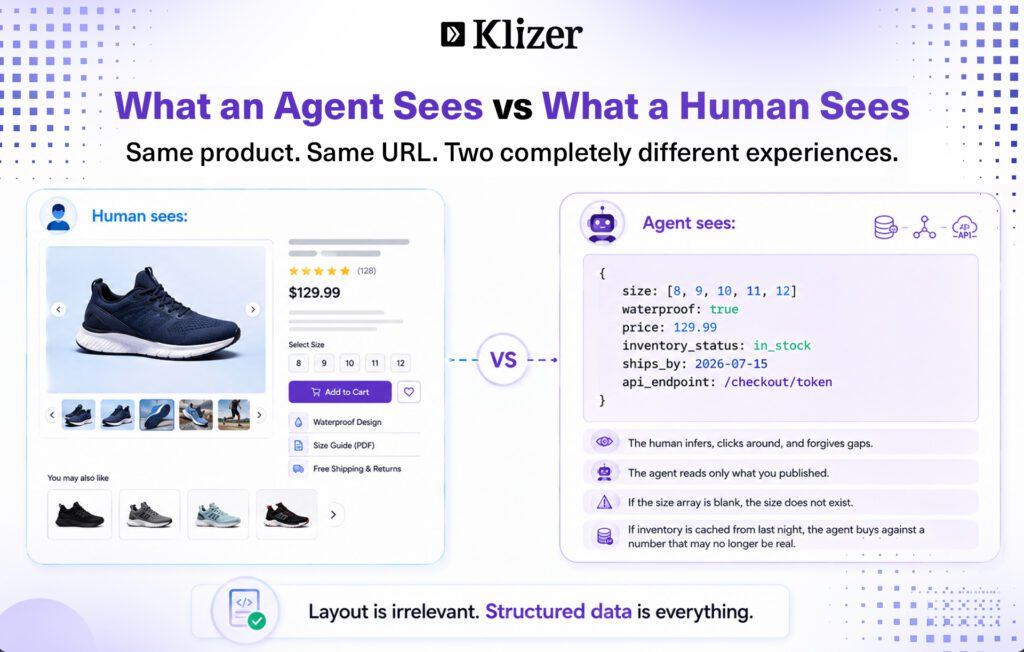
Agents skip all of it. They don’t see your hero image or your carousel. They query structured data (attributes, prices, availability, constraints) and return the option that best fits the request. Layout is irrelevant. What’s relevant is whether your catalog can answer the question without guessing.
Agentic commerce vs. traditional ecommerce
| Traditional ecommerce | Agentic commerce | |
| Who decides | A human, browsing | An AI agent, on the human’s instruction |
| What gets consumed | Pages, images, reviews, layout | Structured product data and APIs |
| Discovery | Search box, filters, category pages | Natural-language intent passed to an agent |
| Optimization target | Engagement, time on site, conversion funnel | Accuracy, machine-readability, speed of response |
| What breaks a sale | Confusing UX, slow page | Missing attribute, stale inventory, no API endpoint |
| Checkout | Human fills forms, retries CAPTCHA | Agent passes a scoped payment token via protocol |
In the old model, bad product data slowed a buyer down. In the new one, it removes you from consideration entirely. The agent never surfaces a product it can’t confidently describe.
How does agentic commerce work?
A buyer gives an agent intent. The agent pulls candidate products from merchant catalogs that have been formatted to a machine-readable feed spec. It narrows them against the buyer’s constraints: size, budget, availability, and ship date. It presents a short list, the buyer picks one, and the agent runs checkout against the merchant using a delegated payment token. The merchant stays the merchant of record. The agent never sees raw card details.
Four things have to hold for any of that to work, and they’re the four things that tend to break first:
- Product data. If your size attribute is blank on 8% of SKUs, an agent shopping for “men’s size 11 trail runners” silently skips those 8%. Quietly. You never see the lost sale because there was no session to abandon.
- Real-time inventory. Cached availability was fine for humans who’d refresh the page. An agent placing an order at 2 a.m. against stale stock data creates an oversell you’ll be apologizing for at 9.
- Machine-friendly checkout. Most checkout flows assume a person is there to solve a CAPTCHA or retry a declined card. Agents need defined API endpoints and token-based payment, not a form and a prayer.
- Fraud rules. Your fraud model probably treats “no mouse movement, no browser fingerprint, instant submit” as a bot attack. Under agentic commerce, that pattern is just a customer. Treating legitimate agent traffic as fraud is its own kind of lost revenue.
How agents get verified and trusted
The hard problem isn’t intelligence. Frontier models can already reason through a buying decision. The hard problem is trust: how does a merchant know the agent is authorized to spend this buyer’s money, and how does the buyer’s payment stay protected from a piece of software it doesn’t control?
The answer the industry has converged on is delegated, scoped tokens. The buyer authorizes a specific transaction; the agent receives a narrow token good for that purchase and nothing else; the payment provider validates it. No standing access, no raw credentials in the agent’s hands. This is the mechanism that makes “let an AI spend my money” something other than reckless.
What is the Agentic Commerce Protocol (ACP)?
A protocol is just an agreed-upon contract for how agents and businesses talk to each other. Without one, every agent-to-merchant connection is a bespoke integration, and the model doesn’t scale. Two big standards now define the space.
ACP, the Agentic Commerce Protocol, was released by OpenAI and Stripe on September 29, 2025, as an open standard under an Apache 2.0 license. It defines a contract between four actors: the human buyer, the AI agent acting for them, the business selling the product, and the payment provider handling credentials. It launched alongside ChatGPT’s Instant Checkout, which went live with Etsy and added Shopify brands like Glossier, Vuori, Spanx, and SKIMS over the following weeks. PayPal joined as a payment provider on October 28, 2025, and Stripe shipped its broader Agentic Commerce Suite on December 11, 2025, with launch partners including URBN (Anthropologie, Free People, Urban Outfitters), Coach, Kate Spade, and Ashley Furniture.
One honest footnote: ChatGPT’s original Instant Checkout feature was retired in March 2026 after only about a dozen Shopify merchants ever shipped against it. The consumer feature stumbled. The protocol kept going. That’s worth sitting with. The standard outlived its first storefront, which tells you the infrastructure bet is the durable one, not any single shopping surface.
What is the Universal Commerce Protocol (UCP)?
UCP, Google’s Universal Commerce Protocol, co-developed with Shopify, is the other major standard. It’s what powers Ulta Beauty’s agentic commerce inside Google’s AI Mode and the Gemini app. If ACP is the OpenAI/Stripe lane, UCP is the Google/Shopify lane. Most product-centric businesses will end up supporting both rather than betting on one.
The detail that matters for you: both protocols assume your product catalog is already structured to a clean feed spec. The protocol handles the transaction. It does nothing to fix a messy catalog. That part is on you.
Who’s building agentic commerce?
The infrastructure is being laid down right now by a recognizable set of companies, each owning a different layer:
- OpenAI and Stripe co-developed ACP and runs the reference implementations. Stripe’s framing, from its head of payments Kevin Miller: the company spent 15 years optimizing commerce for human buyers and is now doing the same for agents.
- Google and Shopify co-developed UCP, the open standard behind Google’s AI Mode and Gemini shopping. Shopify made its merchants shoppable inside ChatGPT in late March 2026 too, so Shopify is playing both sides of the standard.
- PayPal joined ACP as a payment provider, extending agent-initiated payments beyond Stripe’s rails.
- Etsy was ACP’s day-one merchant; Coach, Kate Spade, URBN, Ashley Furniture, and Revolve came through Stripe’s Agentic Commerce Suite.
- Visa and Mastercard are building their own agentic payment frameworks to make sure the card networks aren’t disintermediated when the buyer is software.
- Commercetools and other commerce platforms joined ACP as launch partners to give enterprises a composable path to adopt it. Its customers include Sephora and BMW.
The PIM layer, where most of this quietly succeeds or fails
Here’s the part the payment headlines skip. Every one of those protocols assumes the merchant can hand over a clean, structured, complete product feed. That assumption is doing enormous work.
This is the layer Product Information Management platforms like Akeneo occupy, and it’s the one your business actually controls. Stripe can standardize the payment. Google can standardize the conversation. Neither can it standardize your catalog for you. If your taxonomy is a mess, the most elegant protocol in the world still returns nothing when an agent queries you.
Which brings us to the part of this guide that matters more than the rest.
Why is product data the foundation of agentic commerce?
In agentic commerce, product data stops being supporting content. It becomes the thing the buying decision is actually made.
A human shopper forgives a thin product page. They’ll infer that the navy sweater probably comes in medium, click through to a review, email support, or just buy it and return it if it’s wrong. An agent does none of that. It reads the attributes you published. If “available sizes” isn’t a structured field, the size doesn’t exist as far as the agent is concerned. There’s no inference, no benefit of the doubt, no clicking around.
So the businesses that win early aren’t the ones with the flashiest AI demo. They’re the ones who finally fixed their product taxonomy.
What does agent-ready product data look like?
It’s structured, not prose. An agent can’t parse “great for cold-weather running”; it needs temperature_rating: -5C, waterproof: true, category: trail_running. It’s complete: the critical attributes are populated across the whole catalog, not just your hero SKUs. It’s consistent across regions and channels, so the agent doesn’t get one answer from your US feed and a contradicting one from your EU feed. And it’s governed: maintained as an ongoing discipline, not cleaned up once before a launch and left to rot.
Where do most product catalogs fail?
Spreadsheets. Disconnected systems where pricing lives in one place, specs in another, and inventory in a third that updates overnight. Free-text description fields doing the job that structured attributes should. Attribute coverage that looks fine on your bestsellers and collapses in the long tail, which is exactly where specification-driven agent queries dig.
How does a PIM support agentic commerce?
This is why PIM platforms like Akeneo moved from a back-office data-cleanup tool to something companies now discuss in the same breath as their commerce strategy. A capable PIM gives you a single source of truth, enforces attribute completeness, keeps regions and channels consistent, and lets you adapt product information for new consumption models, like a machine-readable agent feed, without losing governance. The discipline it imposes is precisely the discipline an agent needs to trust your catalog.
Which industries are using agentic commerce?
- Retail: Beauty is the clearest early mover. Ulta’s Google integration lets a shopper describe a skin concern and get a shoppable recommendation inside Gemini. Apparel and footwear follow fast, because they’re specification-and-variant heavy: size, color, material, fit.
- Hospitality and travel: Bookings are specification-driven and repeatable: dates, location, amenities, price band. An agent that can rebook a preferred room type on command is a natural fit.
- B2B and distribution: This is the sleeper. Reordering industrial parts, matching a replacement by spec, checking compatibility across a catalog of thousands of variants: these are tedious for humans and ideal for agents. The catch is that B2B catalogs are usually the messiest, which makes the product-data work both harder and more valuable.
- Financial services: Card networks and payment providers (Visa, Mastercard, PayPal) are building the rails that let any of the above transact safely when the buyer is an agent.
How do you prepare your business for agentic commerce?
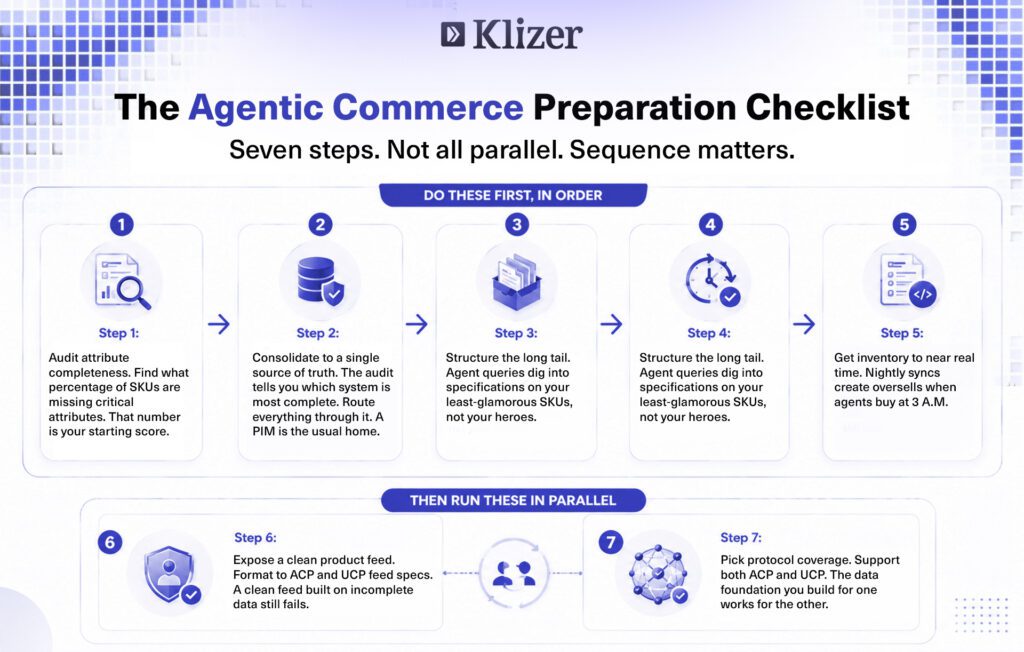
A concrete checklist:
- Audit attribute completeness. Find out, today, what percentage of your SKUs are missing critical structured attributes: size, color, material, dimensions, compatibility. That number is your starting score.
- Consolidate to a single source of truth. If product data lives in three systems, pick the one that becomes canonical and route everything through it. A PIM is the usual home for this.
- Structure the long tail, not just the heroes. Agent queries dig into specifications, and specifications live in your less-glamorous SKUs.
- Get inventory to near real time. Nightly cache syncs create oversells when an agent buys at 3 a.m.
- Expose a clean product feed. Format your catalog to the feed specs the major protocols (ACP, UCP) expect.
- Revisit fraud rules. Make sure your fraud model won’t auto-reject legitimate agent traffic that lacks human browser signals.
- Pick your protocol coverage. Most product businesses will support both ACP and UCP rather than betting on one ecosystem.
What are the risks of agentic commerce?
Letting software spend money introduces real exposure, and it’s worth being clear-eyed about it. Authorization is the central question. Scoped, delegated payment tokens exist specifically so an agent can complete one transaction without holding standing access to a buyer’s funds. Merchant-of-record status staying with the business (not the agent) keeps liability and tax handling where they belong.
The newer risk is data integrity as an attack surface. When an agent makes decisions purely from your structured data, poisoned or manipulated product feeds become a way to game which products get surfaced. And there’s a consumer-protection layer regulators haven’t fully addressed yet: who’s accountable when an agent buys the wrong thing? In May 2026, nobody has a complete answer. Anyone claiming a finished compliance playbook is selling something.
Signing off
Agentic commerce won’t replace traditional ecommerce on a deadline. It’ll run alongside it as a new channel. Plenty of people will keep browsing and buying by hand, especially for discovery-driven or emotional purchases. Others will hand off the repetitive, spec-driven buying (reorders, replacements, “find me the cheapest in-stock one that ships by Thursday”) to an agent and never look back.
Product-centric businesses have to be ready for both at once. The teams that get there won’t be the ones who chased the demo. They’ll be the ones who did the unglamorous catalog work while everyone else was tweeting about the future.
FAQ
What is agentic commerce in simple terms?
It’s online shopping done by an AI agent on your behalf. You state what you want; the agent researches, compares, and completes the purchase, with your approval.
What is the Agentic Commerce Protocol (ACP)?
An open standard released by OpenAI and Stripe on September 29, 2025, that defines how AI agents, buyers, businesses, and payment providers interact to complete a purchase. It’s free to implement and works across different AI agents.
Is agentic commerce the same as conversational commerce?
No. Conversational commerce is chatting with a bot that helps you find something. Agentic commerce goes further: the agent can autonomously complete the transaction, not just answer questions.
What’s the difference between ACP and UCP?
ACP is the OpenAI/Stripe open standard powering ChatGPT’s checkout. UCP (Universal Commerce Protocol) is Google’s standard, co-developed with Shopify, powering agentic commerce in Google’s AI Mode and Gemini. Many merchants will support both.
Do I need ChatGPT or Google to do agentic commerce?
You need to make your catalog and checkout agent-ready by adopting a protocol. That lets various agents (ChatGPT, Gemini, and others) transact with you. You’re integrating with the standard, not a single company.
What is agentic checkout?
The step where an AI agent completes payment for the buyer, typically by passing a scoped payment token to the merchant rather than the buyer filling in a form. The merchant stays the merchant of record and never exposes raw card data to the agent.
Why does product data matter so much for agentic commerce?
Agents make decisions from structured data, not page design. If an attribute is missing or inconsistent, the agent can’t recommend your product. Clean, complete, well-governed product data is what gets you surfaced.
What is a PIM and how does it relate to agentic commerce?
A Product Information Management platform (like Akeneo) is a single source of truth for product data. It enforces the completeness, consistency, and governance that agents require to trust and transact against your catalog.
Which companies are leading agentic commerce in 2026?
OpenAI and Stripe (ACP), Google and Shopify (UCP), plus PayPal, Visa, Mastercard, commercetools, and PIM platforms like Akeneo. Early retail adopters include Ulta Beauty, Etsy, Coach, and URBN’s brands.
How do I start preparing without disrupting current operations?
Start with a product-data audit, measure attribute completeness, and consolidate to a single source of truth. That work improves your existing storefront too, so it’s not throwaway effort even if agent volume builds slowly.