

Managing product data across multiple sales channels becomes increasingly difficult as your ecommerce business grows.
A product update that takes minutes on one platform often requires manual changes across marketplaces, mobile apps, social commerce stores, and your website. This is where customers lose confidence, return products, and choose competitors instead.
PIM for ecommerce becomes essential in such scenarios as it centralizes product data, automates updates, and distributes accurate information across every sales channel. It creates a single source of truth for product information, helping businesses maintain data consistency, improve operational efficiency, and deliver a better customer experience.
ON THIS PAGE
What Is PIM for eCommerce?
PIM for ecommerce is a centralized system that helps businesses collect, organize, enrich, and distribute product information from a single source. Instead of updating product details separately across ecommerce websites, marketplaces, mobile apps, and social commerce platforms, teams manage the data once and publish consistent, accurate information everywhere.
A Product Information Management platform supports the entire product content lifecycle through the following capabilities:
- Technical Product Data: Manage SKUs, specifications, dimensions, material details, inventory attributes, and other technical information.
- Digital Assets: Store and organize product images, videos, 3D models, user manuals, and datasheets.
- Marketing Content: Create SEO-friendly product descriptions, feature highlights, keywords, and promotional copy.
- Localization and Compliance: Maintain multilingual content, region-specific product information, and regulatory requirements for different markets.
How a Headless PIM Supports Modern eCommerce Architecture
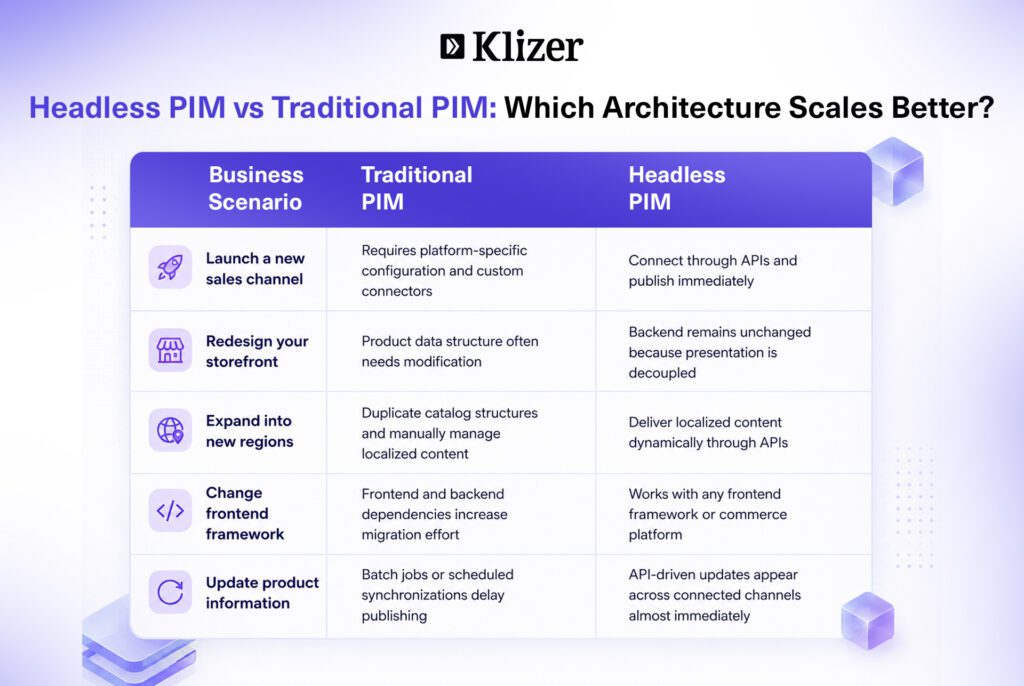
A headless PIM separates product information management from the presentation layer and delivers product data through APIs to every customer touchpoint. Here is how a headless PIM strengthens modern ecommerce architecture.
- Centralized Omnichannel Distribution: Maintain one product catalog and publish consistent product information across websites, marketplaces, mobile apps, POS systems, and other digital channels.
- Frontend Flexibility: Build high-performance storefronts with React, Vue.js, Flutter, or any modern frontend framework without modifying backend product data.
- Faster Time-to-Market: Launch new storefronts, regions, or sales channels quickly by connecting them to existing product data through APIs.
- System Integrations: Synchronize product information with ERP, CMS, CRM, OMS, DAM, and ecommerce platforms to eliminate data silos.
- Scalable Catalog Management: Manage multilingual content, localized attributes, regulatory information, and large product catalogs from a centralized platform.
What Are the Key Features to Look for in Product Information Management Solutions?
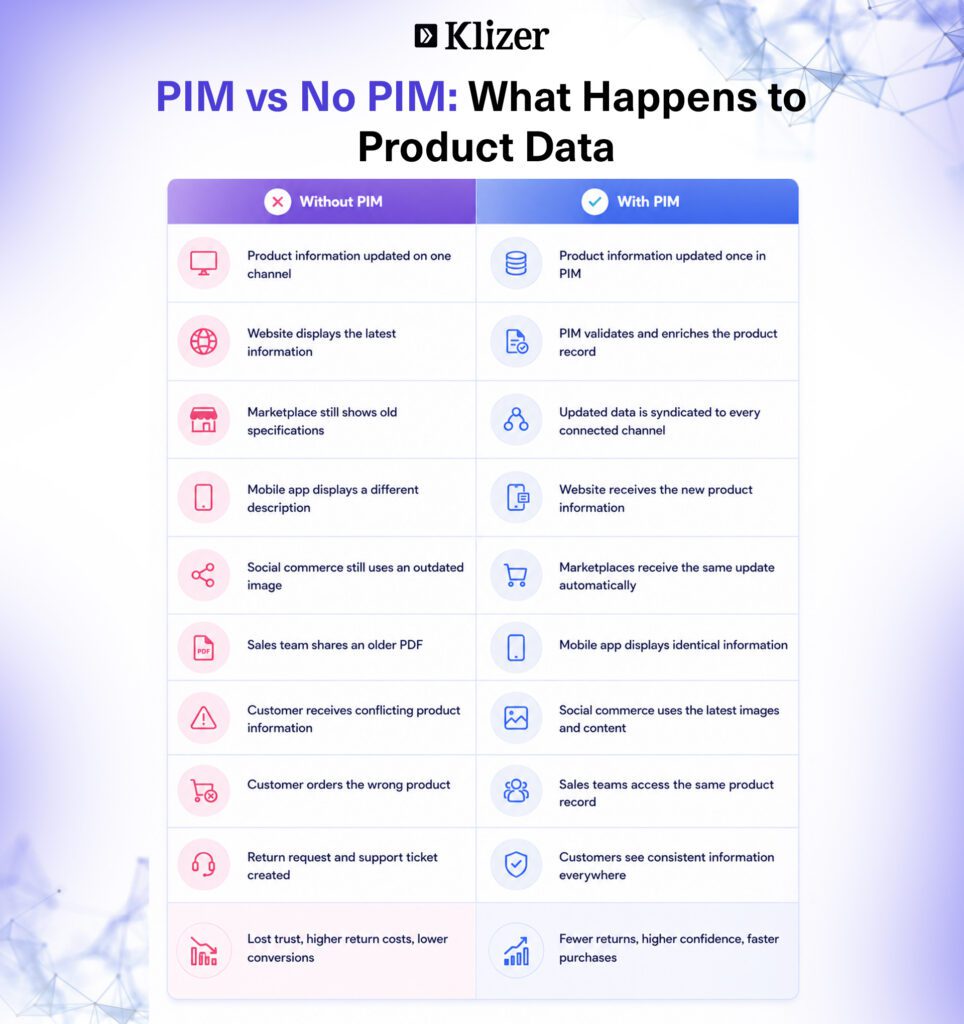
When evaluating product information management solutions, focus on capabilities that improve catalog accuracy, simplify product operations, and support long-term business growth.
- Centralized Product Repository: Manage all product information, including SKUs, specifications, attributes, pricing, and digital assets, from a single source.
- Advanced Product Data Modeling: Support product variants, configurable products, bundles, product families, and complex catalog structures.
- Omnichannel Syndication: Automatically publish optimized product data to ecommerce platforms, marketplaces, mobile apps, and other sales channels.
- Digital Asset Management (DAM): Associate images, videos, 360° views, user manuals, and other rich media with the correct products.
- Workflow Automation: Streamline product enrichment, approvals, and publishing with configurable workflows.
- Data Governance: Validate product information, prevent duplicate records, enforce data standards, and maintain version history.
- Localization Support: Manage multilingual content, regional attributes, currencies, compliance requirements, and market-specific product information.
- API-First Connectivity: Integrate with ERP, CMS, CRM, OMS, ecommerce platforms, and third-party applications through APIs.
- AI-Powered Enrichment: Generate product descriptions, recommend attributes, classify products, and identify missing data automatically.
- Analytics and Catalog Insights: Monitor product completeness, content quality, workflow efficiency, and catalog performance through reporting dashboards.
What Are the Benefits of Using Product Information Management for eCommerce Businesses?
The primary benefit of Product Information Management for ecommerce businesses is centralized, accurate, and consistent product data across all sales channels.
- Facilitates Omnichannel Consistency: A PIM for ecommerce synchronizes product data across websites, marketplaces, mobile apps, and social commerce channels.
- Accelerates Product Launches: Automates product enrichment and publishing, enabling teams to launch products and update catalogs faster.
- Improves Operational Efficiency: Product information management reduces manual tasks, streamlines workflows, and improves team collaboration.
- Simplifies Global Expansion: Manages multilingual content, localized attributes, and regional compliance from a single platform.
- Enhances Customer Experience: Delivers accurate product information that builds trust, improves buying decisions, and reduces product returns.
Best PIM Solutions for Headless Commerce in 2026
The best PIM solution for headless commerce depends on your business size, product catalog complexity, integration requirements, and scalability goals. All platforms offer different strengths, from open-source flexibility to enterprise-grade product data management. Below is a comparison of the leading PIM platforms based on features, pros, cons, and ideal use cases.
1. Akeneo PIM
Akeneo PIM is an API-first Product Information Management platform designed for businesses that need centralized product data, flexible integrations, and scalable catalog management.
Features
- API-first architecture
- Open-source Community Edition
- Product data enrichment
- Bulk editing
- Data quality insights
- Multi-language support
- Workflow automation
- Marketplace and ERP integrations
| Pros | Cons |
| Open-source flexibility | Enterprise features require a paid license |
| Easy API integrations | Advanced customization needs technical expertise |
| Scalable for growing catalogs | Initial setup can be time-consuming |
Ideal Use Case: Best for businesses building scalable headless commerce solutions with complex product catalogs.
2. Akeneo PIM Magento 2 Integration
The Akeneo PIM Magento 2 integration synchronizes product information between Akeneo and Adobe Commerce (Magento 2), enabling centralized product management while Magento handles the storefront experience.
Features
- API-based synchronization
- Product and category mapping
- Attribute synchronization
- Media asset synchronization
- Automated product updates
- Multi-store support
| Pros | Cons |
| Eliminates manual product updates | Requires connector configuration |
| Improves catalog consistency | Custom mappings may require development |
| Supports large Magento catalogs | Enterprise projects may increase implementation time |
Ideal Use Case: Best for Magento 2 stores managing large catalogs across multiple websites or regions.
3. Pimcore
Pimcore combines PIM, Master Data Management (MDM), and Digital Asset Management (DAM) into a single platform, making it suitable for organizations with complex product ecosystems.
Features
- Product Information Management
- Master Data Management
- Digital Asset Management
- API-first architecture
- Workflow automation
- Product variants management
- Multi-channel publishing
| Pros | Cons |
| Combines PIM, DAM, and MDM | Steeper learning curve |
| Highly customizable | Longer implementation time |
| Strong enterprise capabilities | Requires technical expertise |
Ideal Use Case: Best for enterprises managing complex product data and multiple digital assets.
4. Salsify
Salsify focuses on Product Experience Management (PXM), helping brands create, enrich, and distribute product content across ecommerce channels and retail marketplaces.
Features
- Product Experience Management
- Marketplace syndication
- Digital asset management
- Product analytics
- Collaboration tools
- API integrations
| Pros | Cons |
| Excellent marketplace connectivity | Premium pricing |
| User-friendly interface | Better suited for larger businesses |
| Strong content syndication | Limited customization compared to open-source platforms |
Ideal Use Case: Best for brands selling across multiple marketplaces and retail channels.
5. inriver
inriver is an enterprise-grade PIM platform designed to manage product information throughout the product lifecycle while supporting omnichannel commerce.
Features
- Centralized product data
- AI-powered enrichment
- Workflow automation
- Omnichannel publishing
- Product lifecycle management
- API integrations
| Pros | Cons |
| Strong enterprise capabilities | Higher implementation cost |
| AI-driven content management | Requires dedicated onboarding |
| Scalable architecture | Premium licensing |
Ideal Use Case: Best for manufacturers, distributors, and enterprise B2B organizations.
6. Plytix
Plytix is a cloud-based PIM that simplifies product catalog management for small and mid-sized ecommerce businesses.
Features
- Cloud-based PIM
- Product catalog management
- Digital asset management
- Team collaboration
- API integrations
- Product feeds
| Pros | Cons |
| Affordable pricing | Limited enterprise features |
| Easy to implement | Basic workflow capabilities |
| Intuitive interface | Fewer advanced integrations |
Ideal Use Case: Best for growing ecommerce businesses seeking an affordable and easy-to-use PIM.
7. Syndigo
Syndigo helps businesses manage and syndicate product information across retailers, distributors, and ecommerce marketplaces.
Features
- Product content syndication
- Master data management
- Rich media management
- Data validation
- Retailer integrations
- Workflow automation
| Pros | Cons |
| Extensive retailer network | Enterprise-focused pricing |
| Strong data governance | Complex implementation |
| Reliable content syndication | May exceed SMB requirements |
Ideal Use Case: Best for enterprise brands distributing product data across multiple retailers and marketplaces.
8. Contentserv
Contentserv combines Product Information Management with Product Experience Management to help brands deliver consistent product content across global markets.
Features
- Product Information Management
- Product Experience Management
- Digital Asset Management
- AI-powered enrichment
- Workflow automation
- Multi-brand support
- Omnichannel publishing
| Pros | Cons |
| Strong multilingual capabilities | Higher implementation cost |
| Flexible workflows | Requires implementation planning |
| Excellent multi-brand management | Best suited for mid-sized and enterprise businesses |
Ideal Use Case: Best for global brands managing multilingual catalogs and multiple business units.
How to Choose the Right Product Information Management Solution
Choose a Product Information Management solution that matches your business requirements, technology ecosystem, and long-term growth strategy. Compare platforms based on implementation fit, flexibility, scalability, and total ownership cost instead of features alone.
- Define your business needs by evaluating product catalog size, sales channels, product complexity, and future expansion plans
- Verify that the platform integrates smoothly with your existing ecommerce platform and business applications to avoid costly custom development
- Select a deployment model, cloud or on-premises, that aligns with your IT resources, security policies, and operational requirements
- Assess the vendor’s implementation expertise, technical support, training resources, and partner ecosystem before making a decision
- Compare the total cost of ownership, including licensing, implementation, integrations, customization, upgrades, and ongoing maintenance
- Request a demo or proof of concept to validate usability, performance, and compatibility with your business workflows before investing
If you plan to adopt headless commerce, choose a PIM that supports API-first architecture and offers proven implementation expertise to reduce deployment risks and support long-term scalability.
How Klizer Implements Headless PIM Solutions
At Klizer, a headless PIM implementation begins with analyzing product data quality, defining product taxonomy, and designing a scalable data model that supports future business growth. Using an API-first integration approach, Klizer connects Akeneo PIM with Magento, ERP, CMS, DAM, CRM, and other business applications to build a connected commerce architecture that keeps product information synchronized across every touchpoint. Once the data flows are established, Klizer configures enrichment workflows, validation rules, and automated publishing to ensure every channel receives accurate, up-to-date product information from a single source.
Partner with Klizer to implement a future-ready PIM solution that delivers accurate product data, faster go-to-market, and exceptional customer experiences across every digital channel.
Connect with Klizer to discuss your PIM implementation goals today.
FAQs
1. What is the difference between PIM and DAM?
PIM manages product information, while DAM manages digital assets such as images, videos, and documents. A Product Information Management system stores structured product data like titles, descriptions, specifications, and attributes, whereas a Digital Asset Management system organizes rich media files.
2. Can a PIM system integrate with ERP and CRM software?
Yes, most modern PIM systems integrate with ERP, CRM, CMS, ecommerce platforms, and other business applications. If you need custom integrations, Klizer can help connect your PIM with your existing technology ecosystem.
3. How long does it take to implement a PIM solution?
Most PIM implementations take anywhere from a few weeks to several months, depending on project complexity. Factors such as product catalog size, data quality, integrations, and customization affect the timeline.
4. Does a PIM improve SEO for eCommerce websites?
Yes, a PIM improves SEO by helping businesses publish complete, consistent, and optimized product information. Rich product descriptions, accurate metadata, and structured product data enhance search visibility, improve user experience, and support higher organic rankings.
5. Which PIM solution is best for headless commerce?
Akeneo PIM is one of the best PIM solutions for headless commerce because of its API-first architecture and flexible integration capabilities. However, the right choice depends on your business requirements, product complexity, and scalability goals.