
A stockout rarely starts when the inventory counter hits zero. The warning signs usually appear much earlier: sales velocity starts increasing, a supplier takes longer to deliver, open orders pile up, or demand for a particular SKU suddenly changes.
The problem is that these signals often sit across different systems.
For manufacturers and distributors, that can make it difficult to see the full picture until the shortage is already affecting customers.
And the cost can be high. A 2025 survey of manufacturers and distributors found that 32% of companies reported losing sales because of stockouts, while 37% reported struggling with backorders.
This is where stockout prediction can change the way businesses approach inventory planning.
Instead of asking, “Which products are out of stock?”
AI can help teams ask: “Which products are likely to run out next, and what is causing the risk?”
By analyzing inventory, demand, sales, supplier, and order data, AI can identify patterns that may indicate a future shortage while there is still time to respond.
ON THIS PAGE
Understanding Stockout Prediction
Stockout prediction uses AI and machine learning to identify products that are likely to run out of inventory within a specific period.
Traditional inventory monitoring often focuses on what is happening now.
Stockout prediction looks at what could happen next.
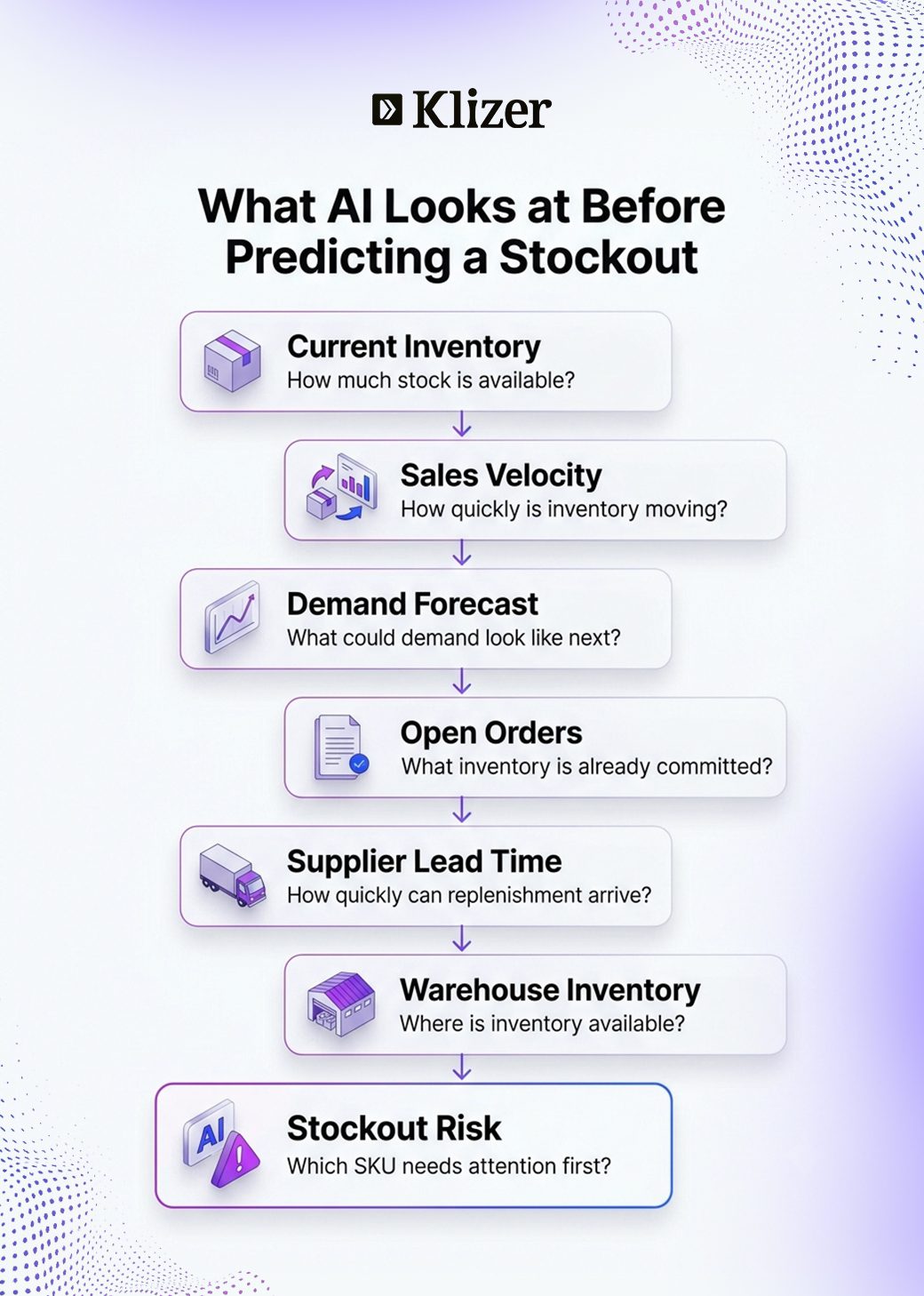
An AI model can evaluate signals such as:
- Current inventory levels
- Historical sales
- Recent sales velocity
- Demand forecasts
- Open customer orders
- Purchase orders
- Supplier lead times
- Seasonal demand
- Product trends
- Warehouse inventory
- Returns
- Pricing and promotions
A 2025 machine learning study using data from more than 1.6 million SKUs found that current inventory levels, recent sales, and near-term demand forecasts were among the most influential factors in predicting stockouts.
For businesses managing thousands of SKUs, analyzing these signals continuously can be difficult to do manually.
AI can help turn that data into an earlier warning.
Why Stockouts Are Difficult to Predict
Inventory teams already have reports, reorder points, safety stock calculations, and demand forecasts.
So why do stockouts still happen?
Because inventory risk is rarely caused by one variable.
Consider a distributor with 800 units of a product available.
On its own, that number may not look concerning.
But now consider that:
- Sales have increased by 35% over the past month.
- A large customer order is scheduled for delivery.
- The supplier’s lead time has increased from 10 to 18 days.
- Inventory at another warehouse is already low.
- Demand is expected to increase over the next two weeks.
The 800 units may not be enough.
The challenge is connecting all of these signals quickly enough to identify the risk.
This is where AI-based stockout prediction can add value.
How AI Predicts Stockouts
AI does not simply look at how much inventory is available.
It evaluates the relationship between inventory, demand, replenishment, and other operational signals.
Here is how the process typically works.
1. AI Brings Inventory Data Together
The first step is connecting the data required to understand inventory movement.
For a manufacturer or distributor, that may include information from:
- ERP
- eCommerce
- WMS
- PIM
- CRM
- Order management systems
- Supplier systems
- Sales platforms
This creates a broader view of what is happening across products, locations, orders, and suppliers.
Without reliable data, even the most sophisticated AI model will struggle to produce useful predictions.
2. It Tracks Sales Velocity
Current inventory does not tell you how quickly a product is being consumed.
A SKU with 1,000 units available could be perfectly healthy if demand is 50 units per week.
The same SKU could be at risk if demand has suddenly increased to 300 units per week.
AI can monitor changes in sales velocity and identify when demand is moving away from historical patterns.
For example:
Stable demand → Demand increases → Sales accelerate → Inventory depletes faster → Stockout risk rises
This gives inventory teams an opportunity to investigate the change before the product becomes unavailable.
3. It Compares Demand With Inventory
AI can estimate how long current inventory may last based on recent and expected demand.
For example:
Current inventory: 1,000 units
Expected daily demand: 90 units
Estimated inventory coverage: 11 days
Supplier lead time: 15 days
The business could face an inventory gap before replenishment arrives.
A stockout prediction system can flag that SKU for review instead of waiting until inventory falls below zero.
4. It Factors in Supplier Lead Times
Demand is only one side of the equation.
Replenishment time matters just as much.
If a supplier normally delivers within seven days but recent deliveries are taking 14 days, the inventory plan needs to account for that change.
Recent research on causal AI and out-of-stock events found that supplier on-time and in-full performance and lead-time settings can be important drivers of stockout risk.
AI can evaluate supplier performance alongside inventory and demand data to identify products where replenishment may not arrive in time.
5. It Detects Demand Changes
Historical averages are useful, but they do not always reflect what is happening right now.
Demand can change because of:
- Seasonal buying
- Large customer projects
- Promotions
- Market changes
- New product applications
- Customer purchasing patterns
- Regional demand
- Competitor availability
AI can compare current behavior with historical patterns and identify unusual changes.
This is especially useful for distributors with large product catalogs where demand patterns can vary significantly between SKUs.
6. It Combines the Signals
This is where stockout prediction becomes more useful than a simple inventory report.
Consider a product with:
Low inventory
- Increasing sales velocity
- Longer supplier lead time
- Large open orders
- Expected demand increase
Each signal matters.
Together, they create a much stronger indication of potential stockout risk.
AI can bring these signals together and help prioritize the products that require attention.
What Does Stockout Prediction Look Like in Practice?
Instead of asking inventory teams to review thousands of SKUs manually, an AI-powered system can surface products based on their predicted risk.
For example:
| SKU | Inventory | Demand Trend | Supplier Lead Time | Predicted Risk |
| SKU-1024 | 450 | Increasing | 10 days | High |
| SKU-2087 | 1,200 | Stable | 7 days | Low |
| SKU-3142 | 620 | Increasing | 14 days | High |
| SKU-4518 | 2,100 | Stable | 5 days | Low |
The important information is not just the inventory number.
Teams can investigate why a SKU is at risk and determine what action makes sense.
That could mean expediting a purchase order, moving inventory between warehouses, contacting a supplier, or reviewing an upcoming customer order.
How Businesses Can Act on Stockout Predictions
Prediction is only the first step.
The real value comes from connecting the prediction to an operational response.
Adjust Replenishment
If demand is increasing faster than expected, purchasing teams can review upcoming orders and replenishment quantities.
Prioritize High-Risk SKUs
Instead of spending hours reviewing every product, teams can focus on products showing the strongest stockout signals.
Reallocate Inventory
If one warehouse is approaching a stockout while another has sufficient inventory, teams can evaluate whether inventory should be moved between locations.
Review Supplier Performance
If supplier delays are contributing to stockout risk, teams can investigate the cause and consider alternative replenishment options.
Alert Sales Teams
Sales teams can be informed when a product is approaching an availability risk, particularly when customer commitments are involved.
Recommend Substitute Products
For suitable products, ecommerce and sales systems can surface alternative SKUs when the preferred product is likely to become unavailable.
Stockout Prediction for Manufacturers and Distributors
Stockout prediction becomes particularly valuable when businesses have complex product catalogs and interconnected operations.
A distributor could have:
- Thousands or hundreds of thousands of SKUs
- Multiple warehouses
- Different supplier lead times
- Customer-specific pricing
- Large recurring orders
- Seasonal demand
- Long-tail products
- Multiple sales channels
Monitoring every SKU manually is difficult.
AI can continuously analyze these products and bring the highest-risk situations to the attention of inventory and purchasing teams.
This changes the workflow from: “What is out of stock?” to: “What is at risk of becoming out of stock?”
That difference gives teams more time to respond.
AI Is Already Moving Into Inventory Management
Stockout prediction is part of a broader shift toward AI-powered supply chain planning.
85% of supply chain leaders surveyed planned to use AI or generative AI for inventory management over the following two years, while 91% planned to use it for demand forecasting.
McKinsey’s 2025 distributor research also found that distributors viewed logistics optimization and inventory management among the areas where AI and analytics could have the greatest impact.
The opportunity is not simply to add an AI model to an existing inventory report.
It is to connect AI with the systems and workflows that already drive the business.
How Stockout Prediction Fits Into Connected Commerce
Stockout prediction becomes more useful when it is connected to the rest of the commerce operation.
For example:
ERP
Inventory, purchasing, supplier, and order data
↓
AI
Demand analysis and stockout prediction
↓
Inventory Workflow
Risk alerts and replenishment recommendations
↓
eCommerce
Updated product availability
↓
Sales
Visibility into potential inventory constraints
↓
Operations
Action on purchasing, allocation, and fulfillment
This creates a connected flow between the systems that manage inventory and the channels that sell it.
For manufacturers and distributors, this is important because inventory availability does not exist in isolation.
It affects ecommerce, sales, customer service, purchasing, fulfillment, and ultimately the customer experience.
What Data Does AI Need for Stockout Prediction?
The quality of a stockout prediction depends on the quality of the data behind it.
Common data sources include:
- SKU and product data
- Current inventory
- Historical sales
- Open orders
- Purchase orders
- Supplier lead times
- Warehouse inventory
- Demand forecasts
- Returns
- Pricing changes
- Promotions
- Customer demand patterns
Businesses do not necessarily need to connect everything at once.
A practical starting point is to identify the systems that contain reliable inventory, sales, order, and supplier data.
From there, additional data sources can be introduced as the use case develops.
Challenges to Consider
AI can help identify stockout risks, but it is not a replacement for sound inventory data and business processes.
Data Quality
Incorrect inventory quantities, duplicate SKUs, missing order data, or inconsistent product information can affect predictions.
System Integration
AI needs access to the information that influences inventory decisions. ERP, ecommerce, WMS, PIM, and other systems may need to exchange data.
Changing Conditions
Demand patterns can change. Supplier conditions can change. Business rules can change.
AI models need to be monitored and updated as the business evolves.
Human Oversight
A prediction is a signal, not automatically the right business action.
Inventory and purchasing teams still need to consider supplier agreements, minimum order quantities, customer commitments, budgets, and operational constraints.
Explainability
Teams need to understand why a product has been flagged.
A useful stockout prediction should provide more than a risk label. It should help teams understand the signals contributing to that risk.
From Reactive Inventory Management to Predictive Planning
A stockout is easy to identify after it happens.
The harder question is whether the business could have seen it coming.
For manufacturers and distributors, the answer may be hidden across sales data, inventory levels, open orders, supplier performance, warehouse locations, and demand patterns.
AI can bring those signals together.
With stockout prediction, businesses can move from monitoring inventory after problems occur to identifying potential shortages earlier.
That does not mean every prediction will be perfect. It means inventory teams can have more information available when deciding where to focus their attention.
The goal is simple: Know what is at risk before customers experience the shortage.
Final Thoughts
Stockouts are not always caused by a lack of inventory planning.
Sometimes the issue is that the warning signs are spread across too many systems to identify quickly.
AI can analyze those signals at scale, identify changing demand patterns, account for replenishment constraints, and flag products that may be heading toward a shortage.
For manufacturers and distributors, stockout prediction can become part of a broader connected commerce strategy that brings ERP, ecommerce, inventory, and AI closer together.
The next step is not simply adding AI.
It is identifying where better data, connected systems, and predictive intelligence can help your teams act earlier.
Explore Klizer’s Advanced AI for eCommerce to see how AI can support inventory, forecasting, and ecommerce operations. Get in touch with us.
FAQs
What is stockout prediction?
Stockout prediction uses AI and data analysis to identify products that are likely to run out of inventory within a specific period.
How does AI predict stockouts?
AI can analyze inventory levels, sales velocity, demand forecasts, open orders, supplier lead times, and other signals to identify potential stockout risks.
What data is required for stockout prediction?
Common data sources include inventory, sales, orders, purchase orders, supplier lead times, warehouse data, product information, and demand forecasts.
Can AI predict stockouts across multiple warehouses?
Yes. When warehouse and inventory data are connected, AI can evaluate inventory and demand across locations and identify where shortages may occur.
How can stockout prediction help distributors?
It can help distributors identify high-risk SKUs earlier, prioritize replenishment, monitor demand changes, and respond to supplier or warehouse constraints.
Does AI replace inventory planners?
No. AI supports inventory planners by identifying patterns and potential risks. Teams can use those insights alongside business rules and operational knowledge to make decisions.