
Most headless security effort goes into the wrong place. Teams audit the storefront, harden the CDN, and pass the pen test, and the breach still arrives through an API quietly connecting the frontend to the ERP. Decoupling the storefront from the backend does not remove risk; it relocates it. In a headless setup, headless commerce security is decided at the integration layer, where the storefront talks to the systems that hold your pricing, accounts, and orders.
For B2B manufacturers and distributors, that shift raises the stakes. The data crossing those connections is contract pricing, credit terms, and account history, the kind of information a competitor or a compromised account should never reach.
ON THIS PAGE
Why Is Headless Commerce Security Different?
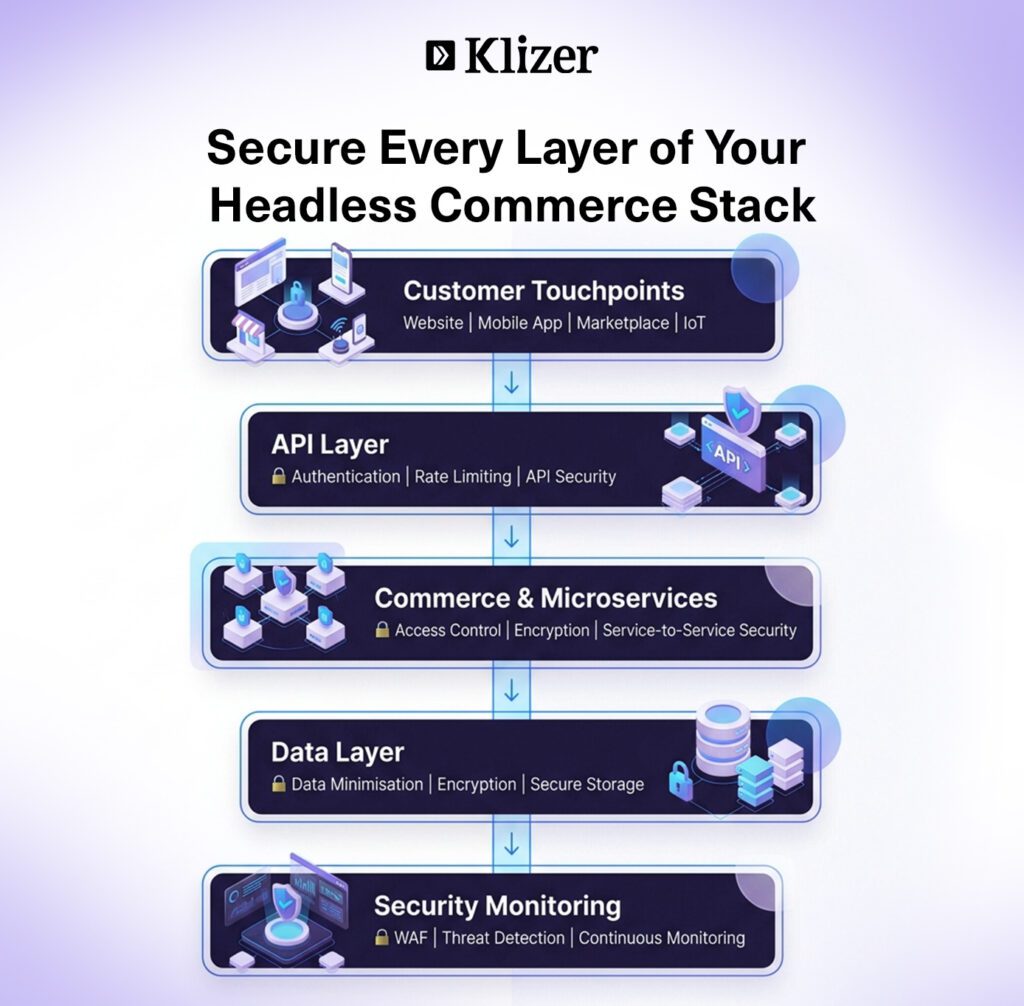
In a traditional monolith, the storefront and backend share one codebase and communicate internally. When you go headless, that conversation moves onto APIs, and every API becomes a documented, reachable entry point. The attack surface expands with each service you connect: the commerce engine, the ERP, the OMS, the PIM, the search provider, and the payment gateway.
That pressure is now measurable: in its 2026 SOTI Security report, Akamai found API attacks rose 113% year over year, with 87% of organizations hitting an API security incident during the year.
Securing a headless build is not a frontend problem; it is an authorization and integration problem. The storefront renders data, but the sensitive logic lives behind the APIs.
For a distributor, the stakes are specific. A single exposed endpoint can leak:
- Customer-specific and contract pricing
- Credit limits and net-terms status
- Full order and quote history
- Account hierarchies and buyer roles
Sound ecommerce security best practices for headless start by treating those integration points as the primary thing to defend.
Securing the APIs Between Your Storefront and Systems of Record
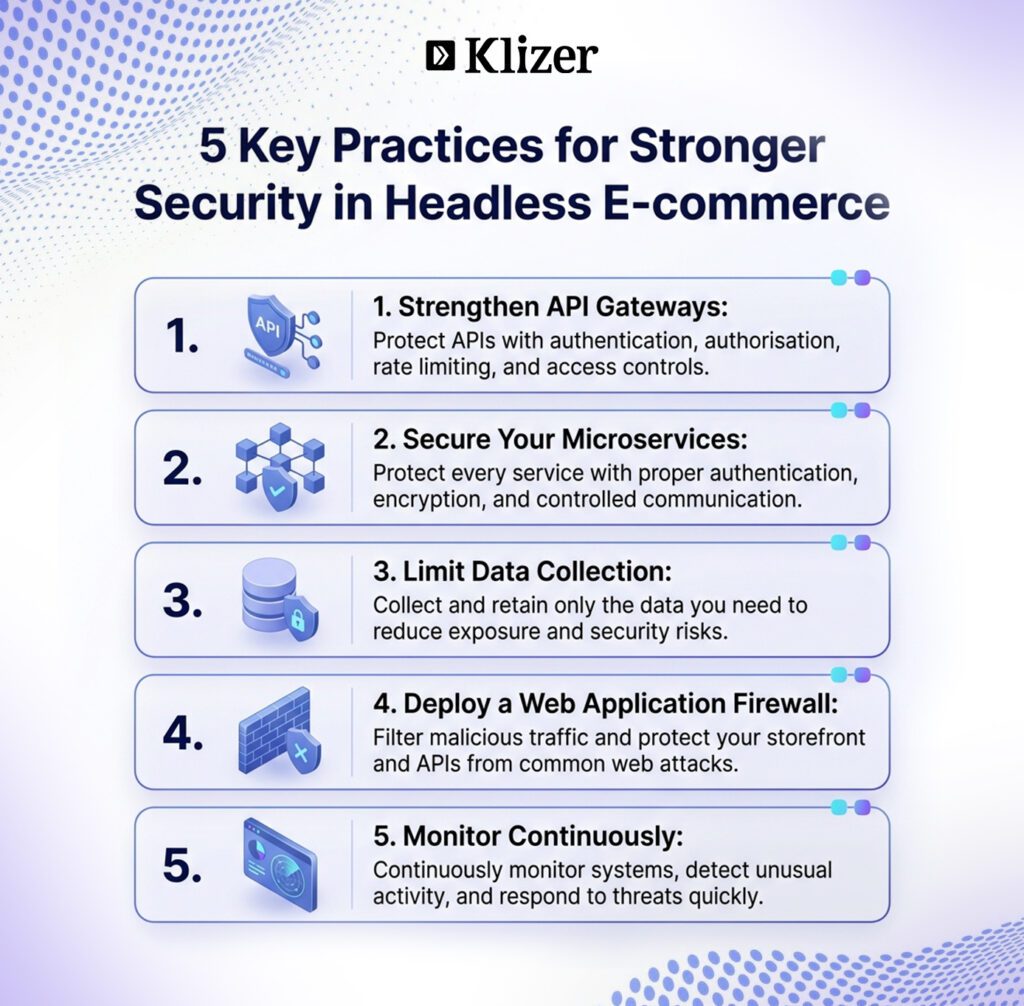
The APIs connecting your headless storefront to your systems of record carry the most sensitive traffic in the architecture, so ecommerce API security is where hardening should begin. The goal is straightforward: prove who is calling, allow only what they need, and encrypt everything in transit.
A few controls do most of the work when you secure ecommerce APIs:
- Strong authentication: Use OAuth 2.0 or signed JWTs to validate every request. Tokens should be short-lived and scoped to a single service.
- Least privilege: Grant each service and user the minimum access required. A search integration has no reason to read credit terms. This is the core principle of Zero Trust architecture: never trust, always verify, and enforce least privilege at every layer regardless of where the request originates.
- TLS everywhere: Encrypt all traffic between frontend, backend, and third-party services so data cannot be intercepted or altered in transit.
- Rate limiting: Cap request volume per client to blunt credential-stuffing and denial-of-service attempts.
- Keep secrets out of the code: Store API keys and credentials in a secrets manager or environment variables, never in the frontend bundle or a repository.
These measures do not slow the architecture down. They set the terms on which the integration layer is allowed to operate.
What Does the OWASP API Security Top 10 Cover?
When teams work to secure ecommerce APIs without a reference model, they tend to over-index on injection and forget authorization. The OWASP API Security Top 10 corrects that. It is the industry-standard list of the most common API vulnerabilities, and it consistently ranks broken object-level authorization (BOLA), one account accessing another account’s data through a manipulated request, as the number one risk.
BOLA has held that top spot since 2019, and Salt Security’s research attributes roughly 40% of API attacks to it.
For B2B, that ranking is exactly right. Effective ecommerce API security means enforcing not just whether a request is authenticated, but whether that specific buyer is authorized to see that specific record. The classic web threats still apply and still belong in your controls:
- Injection (SQL and similar): validate and sanitize every input, including API parameters and URL fields
- Cross-site scripting (XSS): enforce a Content Security Policy to restrict which sources can load and execute
- Cross-site request forgery (CSRF): use anti-forgery tokens on state-changing requests
Working through that list during design, rather than after a pen test, is one of the highest-return habits a headless team can build.
How Do You Enforce Account-Level Access Control in B2B Headless?
Unlike B2C, where every shopper sees the same catalog at the same price, B2B has to return different pricing, terms, and history to different buyers on the same endpoint.
That makes authorization the center of headless commerce security for distributors. Access control has to be tied to the account hierarchy in your ERP integration, so entitlements are resolved server-side on every call, not assumed from a session or trusted from the client.
Two risks deserve direct attention:
- Account takeover on net-terms accounts: A compromised B2B login can place large orders on credit, so protect these accounts with MFA and monitor for unusual ordering behavior.
- Authorization drift across roles: Buyer, approver, and admin roles carry different permissions, and object-level authorization checks apply to each one separately.
Monitoring, Compliance, and Continuous Testing
Security is not a launch task you complete once. The last layer of ecommerce security best practices is the discipline that runs after go-live, when new integrations and patches keep changing the surface you are defending.
Build in the following as standing practice:
- Continuous monitoring and logging. Use intrusion detection and centralized logs across APIs to catch suspicious behavior in real time.
- PCI DSS compliance. Keep payment data handling aligned with the standard, and reduce scope by keeping cardholder data off systems that do not need it.
- Regular penetration testing. Test the integration layer on a schedule and after major changes, not only before launch.
- Disciplined patching. Track and apply security updates across the platform, APIs, and every third-party service in the stack.
- Supply chain security. Audit third-party APIs and dependencies regularly. Compromised npm packages and vendor API changes are an increasingly common entry point in headless architectures where the dependency count is high.
Documented, repeatable, and owned by a named team, these practices are what separate a headless build that holds up from one that quietly accumulates risk.
Final Thoughts
The ecommerce security best practices that matter for a B2B build come down to securing the APIs to your systems of record, enforcing authorization down to the individual account, and treating monitoring and testing as ongoing work rather than a checklist. Get those right and headless gives you flexibility without handing attackers a wider way in.
Klizer builds the storefront, the ERP integration, and the intelligence layer together rather than stitching them after the fact, so the link between your systems of record and your storefront is designed to be secure, not patched into security later.
Book a free consultation with the Klizer team to review where your headless architecture is exposed and how to secure the integration layer end to end.
FAQs
What makes headless commerce security different from traditional ecommerce security?
In a traditional monolith, the storefront and backend share one codebase and communicate internally. In a headless build, every service connection becomes an external API endpoint. The attack surface expands with each integration, and the sensitive logic that was previously locked inside the platform is now reachable through documented API calls. Security shifts from hardening the storefront to securing the integration layer.
What is BOLA and why does it matter for B2B headless?
BOLA stands for broken object-level authorization, and it has ranked as the number one API vulnerability in the OWASP API Security Top 10 since 2019. In a B2B context, it means one buyer account accessing another account’s pricing, order history, or credit terms through a manipulated API request. Preventing it requires server-side authorization checks on every call, not just session-level authentication.
What is the Zero Trust model and how does it apply to headless commerce?
Zero Trust means never trusting a request by default, regardless of where it originates, and always verifying identity and enforcing least-privilege access at every layer. In headless commerce, this means every API call must authenticate, every service must only access what it needs, and no internal traffic is assumed to be safe. It is the recommended security model for architectures where multiple services communicate across integration boundaries.
How often should a headless commerce build be penetration tested?
At a minimum, penetration testing should run before launch and after every major integration change or platform upgrade. For B2B builds handling contract pricing, credit terms, and order history, a scheduled test every six to twelve months is standard practice. The integration layer, not just the storefront, should be in scope for every test.