
Your ecommerce website may have great products, competitive pricing, and a strong brand. But if the website feels slow, customers may never get far enough to see any of them.
A product page that takes too long to load, a filter that takes seconds to respond, or a layout that keeps shifting can turn a potential buyer into a lost sale.
This is why website performance has become a business priority, not just a developer concern.
Headless commerce performance gives ecommerce businesses more control over how their storefront loads, responds, and delivers content. By separating the frontend from the commerce backend, businesses can use modern development approaches to create faster and more flexible digital experiences.
But does headless automatically make an ecommerce website faster? No. The real advantage comes from how the headless architecture is designed and optimized.
Let’s explore how headless commerce can support better Core Web Vitals and what businesses should consider before making the move.
ON THIS PAGE
What Are Core Web Vitals and Why Do They Matter for eCommerce?
Core Web Vitals are Google’s key metrics for measuring how users experience a website. For ecommerce businesses, they are especially important because customers constantly interact with product pages, search, filters, carts, menus, and checkout.
A slow website creates friction at every stage of the buying journey.
Think about a customer landing on a product page. They expect the main product image to appear quickly. When they click “Add to Cart,” they expect an immediate response. If the page moves unexpectedly while they are trying to click a button, the experience becomes frustrating.
That is why Core Web Vitals ecommerce performance should be treated as part of the overall customer experience, not just a technical SEO task.
The Three Core Web Vitals Metrics
There are three key Core Web Vitals metrics ecommerce businesses should monitor.
1. Largest Contentful Paint (LCP)
LCP measures loading performance. It tracks how long it takes for the main content element on a page to become visible. On an ecommerce website, this could be a product image, hero banner, or large product section.
A good LCP score is 2.5 seconds or less.
For example, when a customer clicks a product from a search result, they expect to see the product image and important product information quickly. If the main content takes too long to appear, the website can feel slow even if other elements have already loaded.
This is why techniques such as image optimization, caching, efficient code, and faster content delivery are important when businesses want to improve LCP.
2. Interaction to Next Paint (INP)
INP measures overall responsiveness. It looks at how quickly a page responds to user actions such as clicking “Add to Cart,” opening a menu, applying a filter, or selecting a product option.
A good INP score is 200 milliseconds or less.
INP replaced First Input Delay (FID) and provides a broader view of how responsive a website is throughout a customer’s visit.
For ecommerce, this is especially important. A customer may interact with dozens of elements before completing a purchase. If buttons, filters, search, or product options respond slowly, the buying journey becomes frustrating.
3. Cumulative Layout Shift (CLS)
CLS measures visual stability. It tracks unexpected movement of content while a page loads.
Imagine a customer is about to click the “Buy Now” button. An image or promotional banner loads above it and pushes the button down. The customer may accidentally click something else.
A good CLS score is 0.1 or less.
Developers can reduce layout shifts by reserving space for images and dynamic content, defining image dimensions, and carefully managing fonts and other page elements.
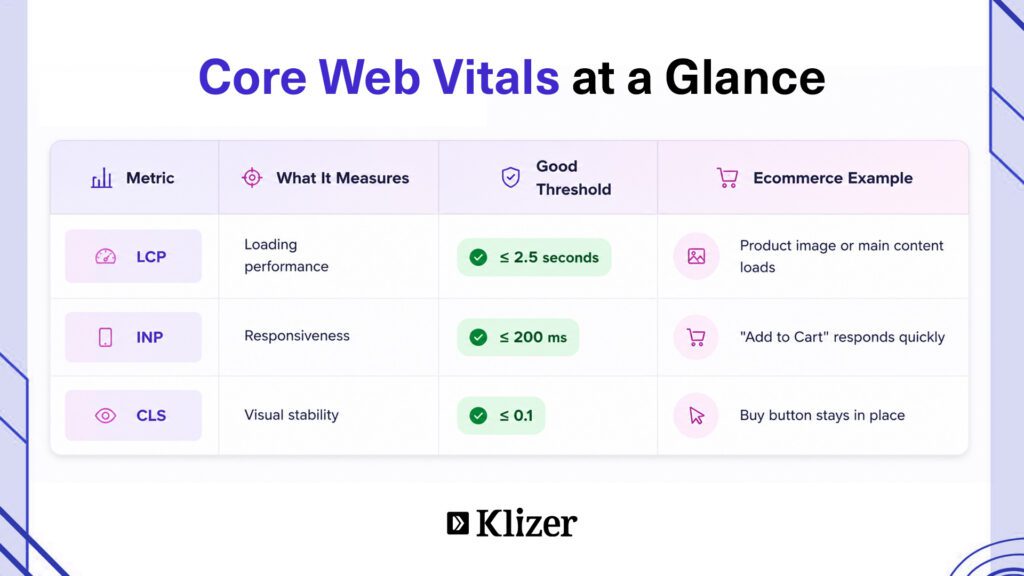
These three metrics give ecommerce teams a practical way to understand the quality of their storefront experience.
How Headless Commerce Supports Better Core Web Vitals
In a traditional ecommerce setup, the frontend and backend are closely connected. The commerce platform often controls the structure and delivery of the storefront.
Headless commerce takes a different approach.
The backend continues to manage products, pricing, inventory, customers, orders, and other commerce operations. A separate frontend handles what customers see and interact with.
This separation gives businesses more control over the customer-facing experience.
Developers can decide how content is rendered, which assets load first, how JavaScript is used, how images are delivered, and which parts of the page need to be dynamic.
This flexibility can support better ecommerce performance optimization.
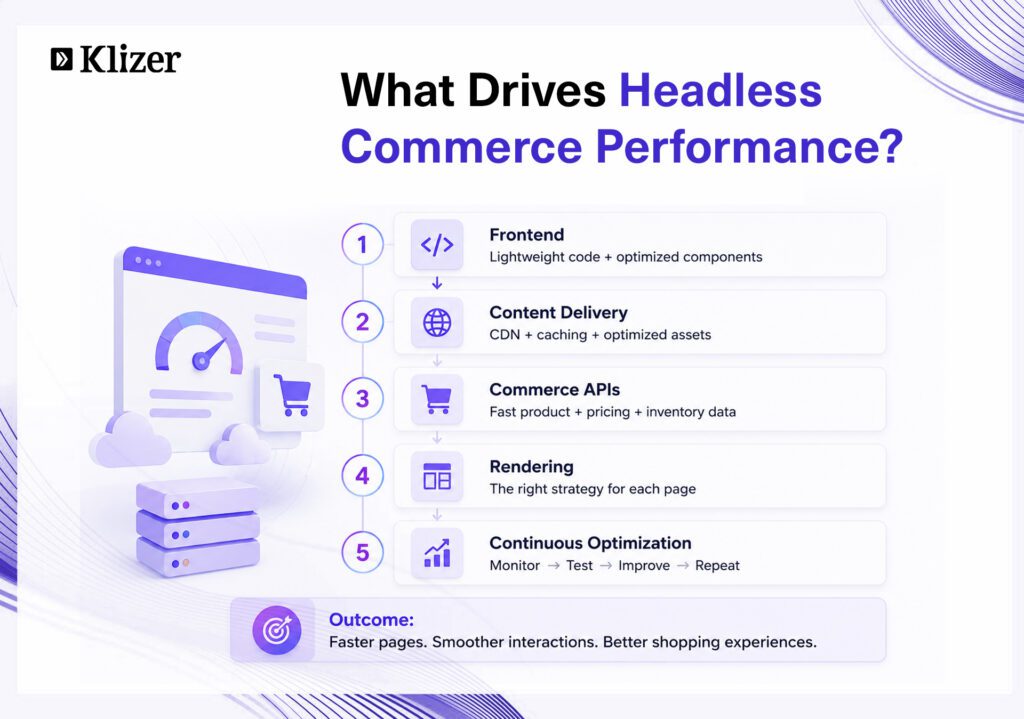
1. A Faster Frontend Can Help Improve LCP
LCP is particularly important for ecommerce because customers want to see the main content of a page quickly.
Imagine a customer searching for a product and clicking through to your website. They expect to see the product image, name, price, and key information almost immediately.
Instead, they see a blank screen or a loading indicator.
That creates friction before the shopping journey has even started.
A well-designed headless storefront can prioritize the content customers need first.
Developers can:
- Optimize product images
- Use modern image formats
- Reduce unnecessary JavaScript
- Preload critical resources
- Load important content first
- Apply caching strategies
- Use a CDN to deliver content efficiently
These techniques can help businesses improve LCP and create a faster first impression.
However, headless architecture by itself does not guarantee a better LCP score. Large images, excessive JavaScript, slow APIs, and unnecessary third-party scripts can still make a headless storefront slow.
The architecture creates the opportunity. The implementation determines the result.
2. More Frontend Control Can Reduce Performance Bottlenecks
One of the biggest advantages of headless commerce is frontend control.
Traditional ecommerce stores often collect themes, plugins, extensions, tracking scripts, widgets, and other features over time.
Each addition may serve a purpose, but too many can increase page weight and the amount of work a browser has to perform.
With headless commerce, development teams have greater control over what reaches the customer’s browser.
They can decide:
- What needs to load immediately
- What can load later
- Which components actually need JavaScript
- Which third-party scripts are necessary
- Which content can be cached
For example, product recommendations do not necessarily need to block the main product information from appearing.
Loading less critical content after the primary content can help create a faster initial experience.
4. Better Layout Control Can Reduce CLS
Have you ever tried clicking a button on a website only for the page to move at the last second?
That is a layout shift.
For ecommerce websites, layout shifts can happen when:
- Product images load without defined dimensions
- Promotional banners appear late
- Fonts change after the page loads
- Reviews or recommendations are inserted dynamically
- Pop-ups push existing content down
A headless storefront gives developers greater control over how these elements are rendered.
For example, reserving the correct space for a product image before it loads can prevent surrounding content from jumping.
Defining dimensions for banners and managing fonts carefully can also help keep the page stable.
These details may seem small, but they contribute to a smoother headless commerce user experience.
5. Flexible Rendering Can Support Better Performance
Not every ecommerce page needs to load in exactly the same way.
A product listing page may benefit from one rendering approach, while a personalized customer account page may require another.
Headless commerce gives development teams more flexibility to choose a rendering strategy based on the requirements of each page.
Depending on the project, teams can use approaches such as:
- Server-side rendering
- Static generation
- Incremental static regeneration
- Streaming
- Client-side rendering where appropriate
The goal is not to use a particular technology simply because it is popular.
The goal is to choose the approach that provides the right balance of speed, functionality, personalization, and scalability.
This flexibility is one of the reasons headless architecture can support strong ecommerce performance optimization.
6. Headless Makes Ongoing Performance Optimization More Flexible
Performance is not a one-time project.
Your ecommerce website will continue to change. New products will be added, campaigns will launch, integrations will be introduced, and third-party tools may be added.
Over time, these changes can affect website performance.
A headless architecture gives teams more flexibility to monitor and optimize the frontend independently from the commerce backend.
Businesses should regularly review:
- Core Web Vitals
- JavaScript bundle size
- Product image sizes
- API response times
- CDN performance
- Third-party scripts
- Caching
- Mobile performance
- Overall page weight
This makes ecommerce page speed optimization an ongoing process rather than something addressed only after the website becomes slow.
Does Headless Commerce Always Mean Better Core Web Vitals?
No. This is an important distinction.
A poorly built headless website can still have slow page loads, excessive JavaScript, large images, slow API calls, and too many third-party scripts.
The value of headless commerce is that it provides more control over the frontend architecture.
That control can be used to build a faster experience, but businesses need the right strategy and development expertise to take advantage of it.
Before moving to headless, businesses should understand where their current performance problems come from.
Start by measuring Core Web Vitals. Review page weight, JavaScript, images, API performance, third-party integrations, and mobile experience.
Then determine whether a headless architecture can address those challenges.
When Should Your Business Consider Headless Commerce?
Headless commerce may be worth considering if your ecommerce business is dealing with:
- Slow storefront performance
- Poor mobile experiences
- Limited frontend flexibility
- Growing personalization requirements
- Complex ERP and third-party integrations
- High traffic volumes
- Multiple customer journeys
- A need for greater control over the digital experience
For example, a B2B distributor may need account-specific pricing, complex product catalogs, real-time inventory, ERP integrations, and personalized buying experiences.
A headless architecture can provide the frontend flexibility needed to create these experiences while allowing the commerce backend to continue managing core business operations.
Conclusion
Headless commerce is not a shortcut to a faster website. It is an architecture that gives businesses more control over how their digital storefront is built and optimized.
The right strategy can help businesses improve LCP, create faster interactions, reduce layout shifts, and deliver a better overall headless commerce user experience.
Choosing the right Headless Commerce development partner like Klizer can make that process easier.
Klizer provides Headless Commerce development solutions designed around performance, scalability, integrations, and customer experience. From headless architecture and frontend development to performance optimization and commerce integrations, Klizer can help businesses build a storefront that is ready for modern ecommerce demands.
Talk to Klizer about your headless commerce requirements and build an ecommerce experience designed for speed, flexibility, and growth.