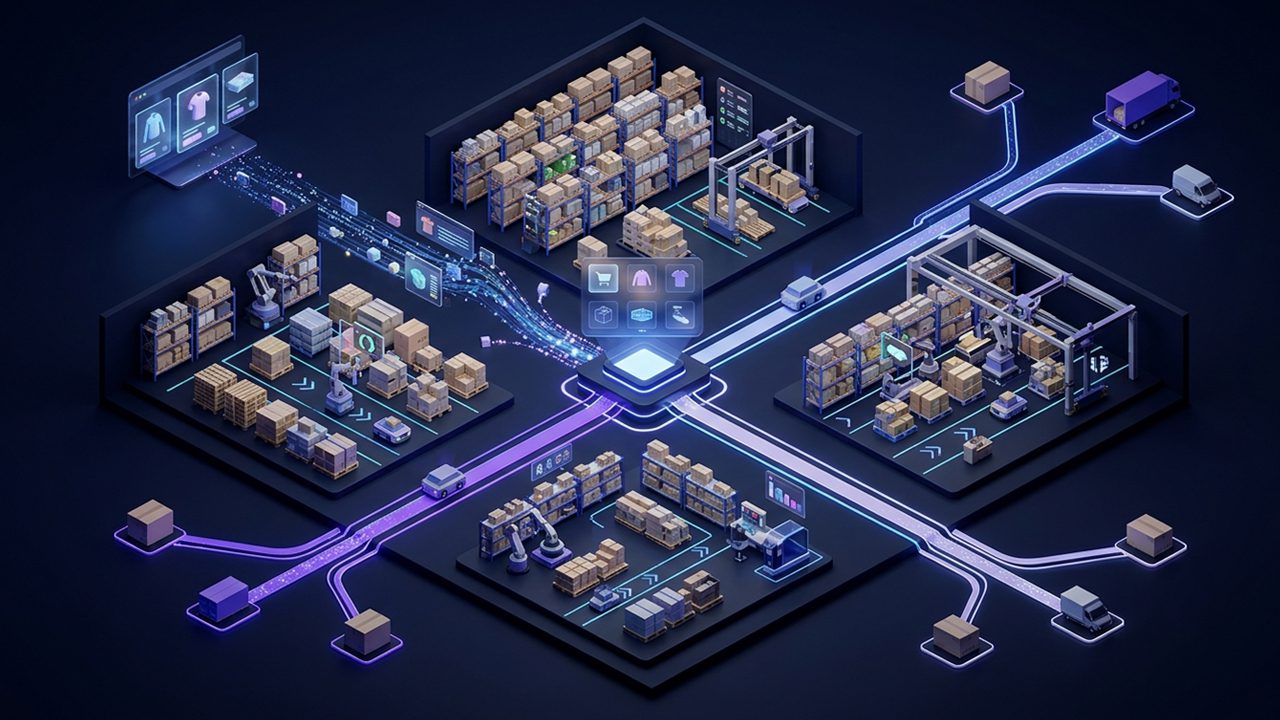

B2B distributors face growing pressure to meet rising buyer expectations because many still rely on manual workflows and email-based order management, leading to delays, pricing errors, and inefficient operations.
A distributor processing hundreds of bulk orders each day can lose hours manually verifying customer-specific pricing, checking inventory, and routing approvals. These factors lead to delayed shipments and increased operational costs.
A robust B2B ecommerce platform enables distributors to automate repetitive tasks, unify business systems, and deliver faster, more accurate buying experiences. The platform must support complex B2B workflows, integrate with existing business systems, and scale with evolving customer demands.
Shopware for B2B distributors combines API-first architecture, ERP integrations, customer-specific pricing, and workflow automation to help businesses scale without adding operational complexity.
ON THIS PAGE
Why Traditional Distribution Models Are Failing Modern B2B Businesses
Traditional B2B distribution models struggle to support today’s business requirements because they depend on manual workflows and disconnected processes that reduce efficiency, increase operational costs, and slow order fulfillment.
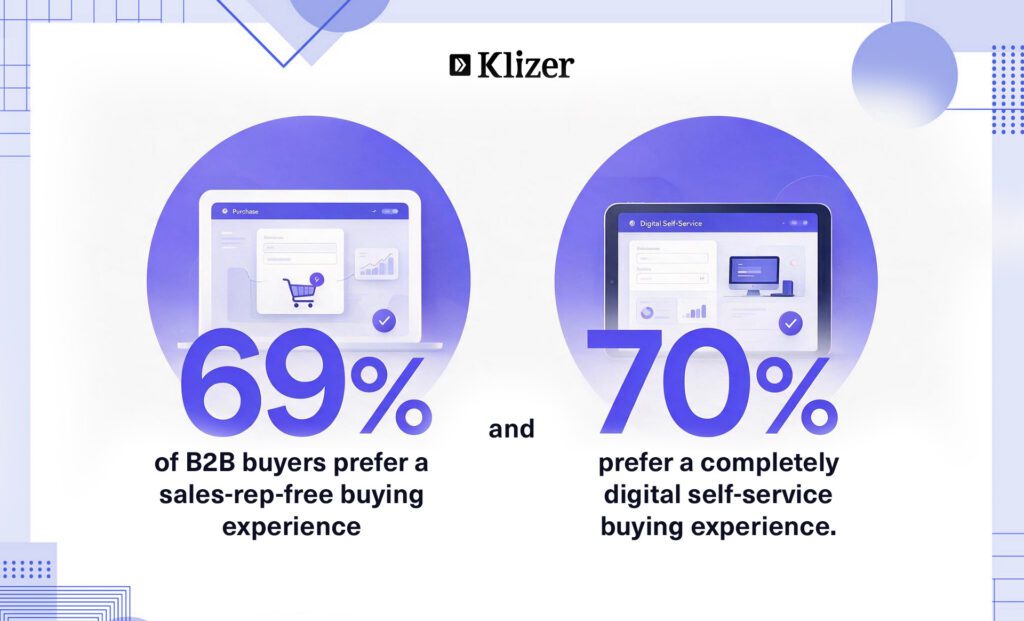
- Digital-First Buyers Demand Self-Service: According to Gartner, 69% of B2B buyers prefer a sales-rep-free buying experience, and 70% prefer a completely digital self-service buying experience. Distributors that rely on manual sales channels struggle to meet these expectations, giving digitally enabled competitors a clear advantage.
- Complex Buying Journeys Need Smarter Commerce: B2B purchasing involves multiple stakeholders, from procurement and finance to technical teams. Traditional approval processes slow decision-making, extend sales cycles, and make it harder to close deals efficiently.
- Manual Processes Reduce Efficiency: Many distributors still depend on spreadsheets, paperwork, and manual order entry. These repetitive tasks increase errors, delay order fulfillment, and reduce productivity, making it difficult to improve B2B ecommerce ROI.
- Legacy Systems Create Operational Silos: Disconnected ERP, CRM, inventory, and ecommerce systems prevent teams from accessing real-time data, causing inefficient workflows, inconsistent information, and slower business decisions.
- Limited Scalability Restricts Growth: Traditional distribution models often require hiring more staff as order volumes grow. A modern B2B ecommerce platform automates workflows, optimizes resources, and supports long-term business growth without significantly increasing operational costs.
What Makes Shopware an Ideal B2B eCommerce Platform?
Shopware Commerce combines enterprise-grade B2B capabilities, API-first architecture, and low-code automation to help wholesale businesses simplify complex operations, improve customer experiences, and maximize B2B ecommerce ROI. B2B Components — including company accounts, approval workflows, and customer-specific pricing — are available from the Evolve plan (from approximately €2,400 per month) and above.
- Dedicated B2B Suite: Manage company accounts, buyer roles, approval hierarchies, and organizational structures from a single platform.
- Customer-Specific Pricing: Configure contract pricing, tiered pricing, negotiated rates, and volume discounts with built-in pricing rules.
- Quick Ordering and RFQs: Speed up bulk purchasing through SKU search, CSV uploads, and integrated Request for Quote management.
- Flow Builder: Automate approvals, notifications, and repetitive workflows to improve operational efficiency and B2B ecommerce ROI.
- API-First Architecture: Integrate ERP, CRM, PIM, WMS, and third-party applications for connected digital commerce for distributors.
- Headless Commerce: Deliver personalized shopping experiences across web, mobile, marketplaces, and customer portals from one backend.
Learn more about B2B ecommerce personalization. - Multi-Store Management: Manage multiple brands, storefronts, languages, and currencies through a centralized platform.
- Flexible Deployment: Deploy Shopware as SaaS, PaaS, or self-hosted based on your business and compliance requirements.
- Cost-Effective Scalability: Scale your business without paying revenue-based platform fees, making Shopware a future-ready B2B ecommerce platform.
- Agentic Commerce Readiness: Shopware 6.7 introduced MCP server support, enabling AI procurement agents to query your catalog, verify pricing, and prepare orders without human intervention. For distributors building toward agent-ready commerce, this is a meaningful advantage at the enterprise layer.
How Shopware Helps B2B Distributors Increase Sales
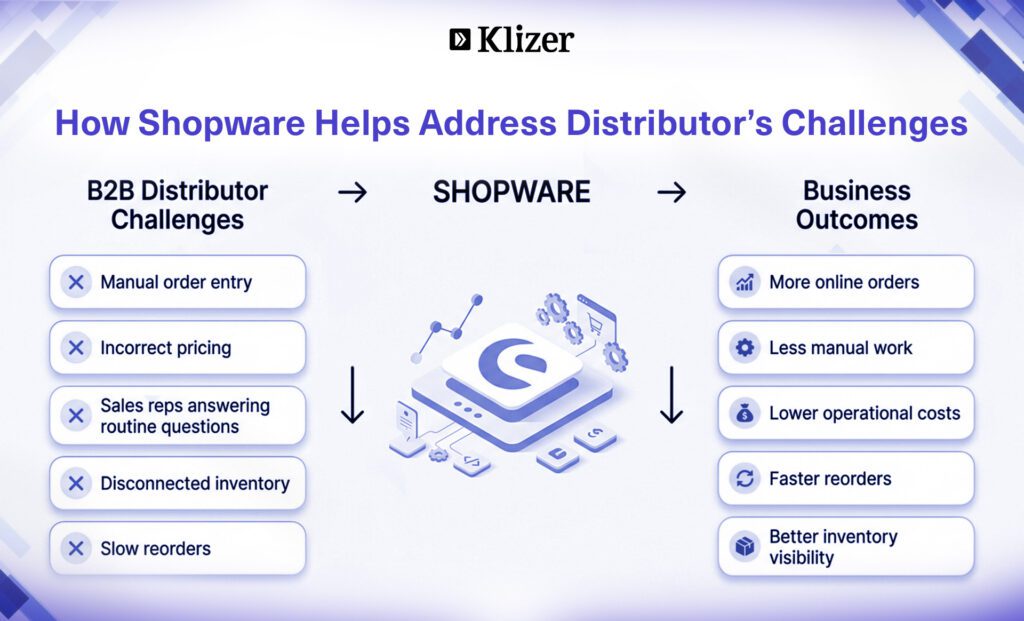
Shopware helps B2B distributors increase sales by automating complex purchasing processes, delivering personalized buying experiences, and enabling faster, more efficient digital commerce.
- Customer-Specific Pricing: Negotiated pricing, contract rates, and volume discounts increase customer loyalty and repeat purchases.
- Personalized Product Catalogs: Customer-specific catalogs and product assortments tailored to each buyer’s requirements reduce search friction and increase order completion.
- Self-Service Purchasing: According to McKinsey, 73% of B2B buyers want to manage their purchases independently using digital channels. Self-service portals let customers place orders, reorder products, and track shipments without involving a sales rep.
- Bulk Ordering: SKU search, saved order lists, and CSV-based bulk ordering simplify high-volume purchases and reduce ordering time for repeat buyers.
- Company Accounts and Buyer Roles: Multiple buyers, spending limits, and approval hierarchies within a single business account mirror real procurement structures and reduce unauthorized purchasing.
- Automated Approval Workflows: Purchase requests routed automatically accelerate procurement and free sales teams from manual follow-up.
- Integrated Quote Management: RFQ creation, negotiations, and approvals managed in one system shorten the sales cycle and reduce back-and-forth between buyers and sales teams.
- ERP and PIM Integration: Real-time synchronization of inventory, pricing, and product data eliminates the manual updates that create pricing errors and stockout surprises.
- AI-Powered Product Discovery: Intelligent search and personalized recommendations help buyers find relevant products quickly, reducing zero-result searches and abandoned sessions.
- Cross-Selling and Upselling: Complementary product recommendations increase average order value and surface relevant products buyers might otherwise miss.
- Performance Analytics: Customer behavior and sales trend monitoring supports data-driven decisions and continuous improvement of B2B ecommerce ROI.
- Digital Sales Rooms: Interactive product demonstrations and real-time quote discussions improve buyer engagement for complex or high-value sales.
How Shopware Reduces Operational Costs for Wholesale Distributors
Shopware helps wholesale distributors reduce operational costs by eliminating repetitive tasks, minimizing manual errors, and optimizing resource utilization across the entire commerce operation.
- Reduce Customer Support Costs: Self-service ordering, invoice downloads, and order tracking decrease inbound support requests without adding headcount.
- Eliminate Manual Pricing Errors: Automated contract pricing and discount rules prevent costly pricing mistakes and protect profit margins.
- Lower Administrative Workloads: Automated workflows replace manual order processing and approvals, saving time and reducing labor costs.
- Support Business Growth Without Additional Overhead: A single B2B ecommerce platform scales operations without proportional increases in staff or infrastructure costs.
- Simplify Product Data Management: Centralized product information updates across multiple channels reduce maintenance effort and eliminate channel-level inconsistencies.
- Reduce Integration Costs: Shopware’s API-first architecture connects enterprise applications with minimal custom development compared to platforms that require bespoke connectors for every integration.
- Minimize Inventory Carrying Costs: Synchronized inventory reduces overstocking, stockouts, and unnecessary warehousing expenses by giving buyers and operations teams the same real-time stock picture.
Read more about inventory forecasting.
Best Practices for Implementing Shopware Successfully
- Define clear business objectives aligned with B2B ecommerce ROI: Set measurable goals before platform configuration begins. For distributors, this typically means targets for self-service order rate, manual entry reduction, and support ticket volume.
- Start with your highest-volume accounts and core catalog: Roll out critical features to your top 20% of accounts first. Validate pricing accuracy, ERP sync, and self-service flows before expanding to the full account base.
- Prepare high-quality data before migration: Validate product, customer, pricing, and order data before importing. Migrating dirty data into Shopware creates the same problems you had in the legacy system, faster.
- Map B2B workflows before configuring the platform: Document approval chains, pricing tiers, and account hierarchies before touching the Shopware admin. Configuration built on undocumented assumptions requires expensive rework.
- Run end-to-end testing against real B2B scenarios: Test bulk ordering, approval workflows, ERP pricing sync, and multi-warehouse inventory before go-live. Edge cases that fail in staging are far cheaper to fix than ones that fail when a buyer is placing a $50,000 order.
- Monitor performance and adoption post-launch: Track self-service order rate, cart abandonment, API error rates, and ERP sync health weekly in the first 90 days. Problems that go unmonitored.
Partner with Klizer to Build a Future-Ready Shopware Solution
According to Salesforce, 77% of B2B commerce executives consider digital transformation essential for business success. Choosing the right ecommerce platform is only the beginning. To achieve real business growth, B2B distributors need a partner who can translate Shopware’s capabilities into efficient workflows, connected integrations, and measurable results.
Klizer helps businesses build scalable B2B ecommerce platforms with expert Shopware implementation, customization, migration, and integration services. Our team helps distributors streamline complex processes, enhance customer experiences, and improve digital commerce for distributors with solutions designed for long-term growth.
Schedule a call with Klizer to build your Shopware-powered B2B commerce solution.
FAQs
1. Is Shopware suitable for large B2B businesses with complex sales processes?
Yes, Shopware supports large B2B businesses with complex sales processes through flexible workflows, scalable architecture, and enterprise-level customization options.
2. How is Shopware headless different from traditional ecommerce platforms?
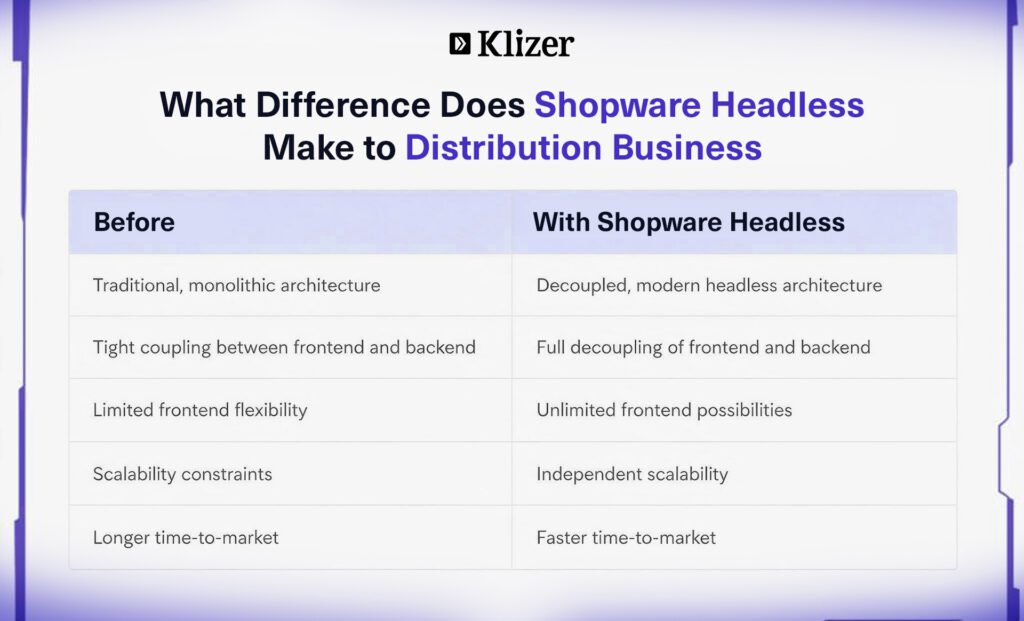
Shopware differs from traditional ecommerce platforms by offering a flexible, API-first architecture that supports complex B2B requirements, omnichannel commerce, and custom integrations without revenue-based platform fees.
3. Can Shopware integrate with SAP and other enterprise systems?
Yes, Shopware integrates with SAP, ERP, CRM, PIM, and other enterprise systems to maintain connected business operations.