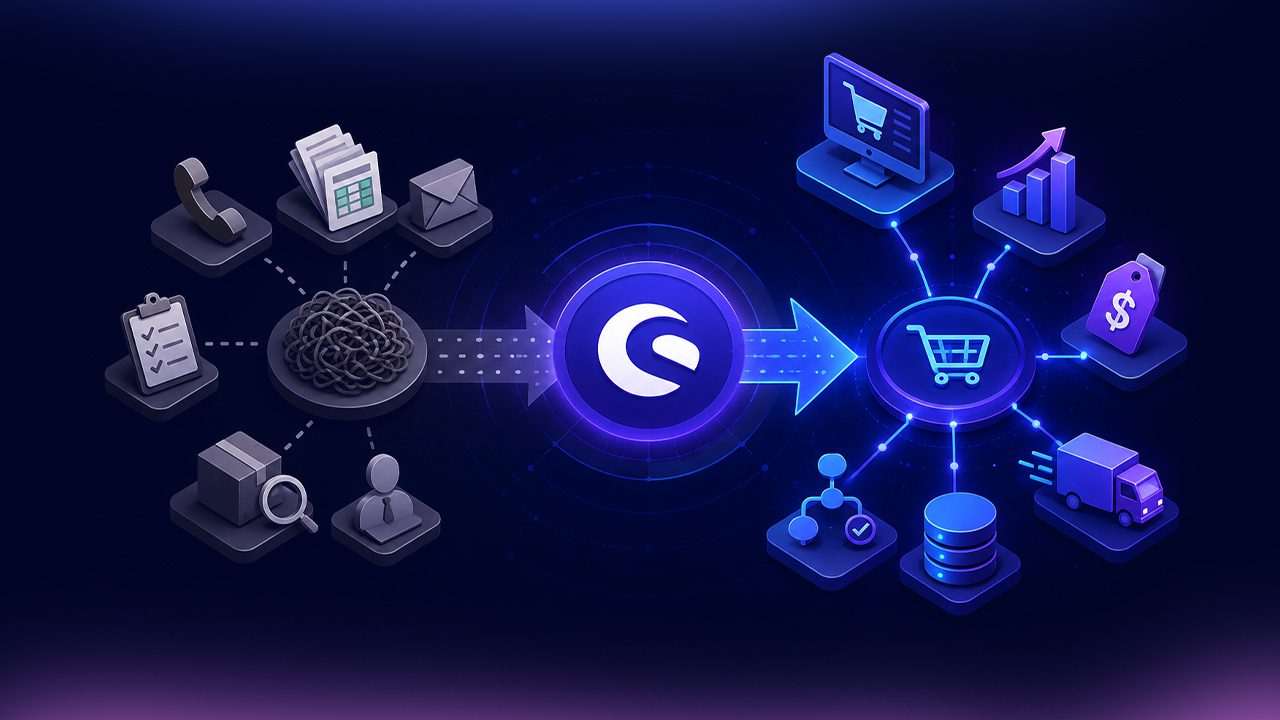

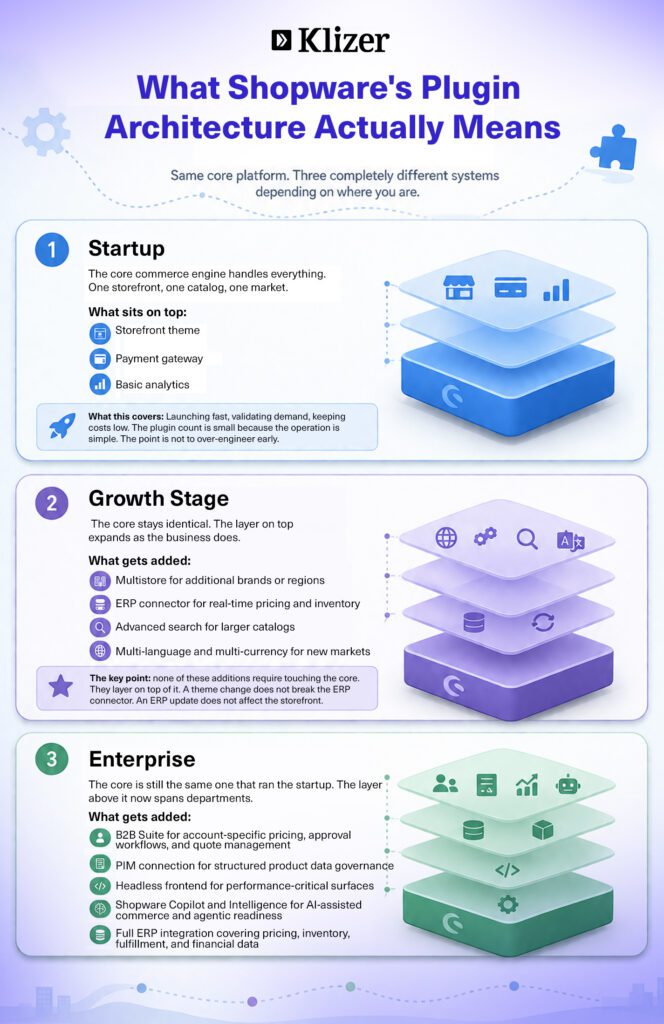
There is a version of your business two years from now that is stuck on the wrong platform.
The trap is easy to walk into. You launch on something simple, you outgrow it fast, and then you rip the whole thing out and rebuild somewhere that fits.
That rebuild is one of the most expensive mistakes a growing merchant makes, and most of the time it was avoidable.
Shopware Enterprise was built to break that cycle. The same core that runs a small catalog is designed to run a multi-brand, multi-region operation, so you scale the system instead of replacing it. Shopware 6 rebuilt the platform around that one idea: your commerce engine should grow with you, not force you to start over.
Here is how that works in practice, from your first storefront to a full enterprise operation.
ON THIS PAGE
What is Shopware and Who Uses It?
Shopware is an open-source enterprise ecommerce platform founded in Germany in 2000, and its history explains how it behaves. The company stayed bootstrapped and profitable for more than two decades before taking outside investment, which means its features grew out of real merchant feedback rather than investor growth targets. That long, deliberate development is why the platform handles complex commerce so comfortably.
More than 100,000 merchants worldwide now run on the platform across B2C, D2C, and B2B, with the strongest concentration in Germany, Austria, and Switzerland. Shopware has led Germany’s top 1,000 B2C online shops for four consecutive years, and the buyer profile skews toward businesses that need operational depth rather than a quick storefront.
- Roughly 80% of Shopware customers are based in Germany, and most are small to mid-sized companies
- Retail is the largest vertical, followed by manufacturing and distribution
What Makes Shopware Built to Scale?
Scalability is not a feature you switch on; it comes from architecture, and Shopware is API-first from the ground up. The backend runs on Symfony while the administration panel is built on Vue.js, and that clean separation means your storefront, your integrations, and your backend can each evolve without breaking the others. When you grow, you extend the system rather than fight it.
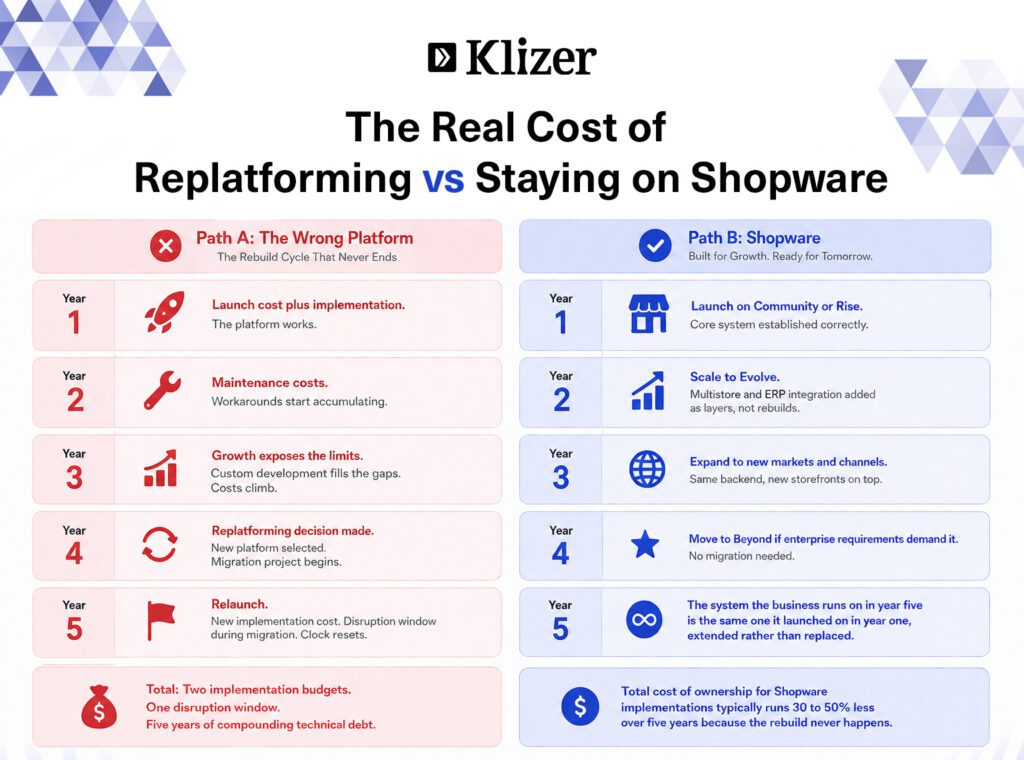
This matters because scaling rarely means more traffic alone. It usually means more catalogs, sales channels, languages, and internal systems that all need to talk to each other, and an enterprise ecommerce platform has to absorb that complexity without forcing a rebuild every time you expand. Shopware’s plugin architecture makes that possible, since functionality layers on top of the core through modules you add or swap as requirements change.
Deployment flexibility reinforces the point. Shopware runs as fully hosted SaaS, managed PaaS, or self-hosted on your own infrastructure, and you can move between those models as your needs shift, so a business can start hosted to avoid overhead and later self-host when compliance or performance demands more control.
How Does Shopware Grow From Startup to Enterprise?
The real value of Shopware shows up when you map it to business stages, because the platform is designed so each stage builds on the last without a disruptive migration in between. You are not buying a startup tool you will replace later; you are buying the early configuration of a system you will still run at enterprise scale.
What Do You Need at the Startup Stage?
Early on, the priorities are launching fast and keeping costs low, and the free Community edition together with the entry Rise plan covers that well. You get a working storefront, a product catalog, and the core commerce engine, enough to validate demand and start selling without a heavy upfront commitment.
One important detail: the Community edition is free but capped at €1M GMV. Once you cross that threshold, you move to a paid plan. For most startups, that cap is generous, but it is worth factoring into your growth planning before you launch.
The one thing worth doing carefully is structuring your product data cleanly, because the categories and attributes you set up now will either help or haunt you when you scale.
What Changes at the Shopware Multistore Growth Stage?
As sales climb, expansion becomes the priority, and this is where Shopware multistore capabilities start to earn their keep. You can run several storefronts from a single backend, each with its own branding, catalog, and pricing, while managing everything from one administration, which keeps operations coherent even as brands and channels multiply.
Beijer Ref, a global B2B distributor operating across 45 countries and 500+ branches, consolidated its digital commerce on Shopware 6 precisely for this reason. Core processes, plugins, and self-service capabilities are now governed centrally and deployed across regions, enabling faster rollout of new features while preserving local market flexibility. Digital self-service absorbed routine orders and service requests, reducing manual ERP work and freeing local teams to focus on complex cases.
International demand usually arrives around the same time, and Shopware multi-language support lets you serve customers in their own language and currency without standing up separate systems per market. Running one backend behind many fronts is what keeps a growing operation manageable instead of fragmented.
- Multiple storefronts managed from one administration
- Per-channel catalogs, pricing, and design
- Native language and currency handling for new regions
- Product data synchronized across every channel
What Does the Enterprise Stage Demand?
At enterprise scale, the questions change entirely, because now you are dealing with complex B2B buying, deep ERP integration, and workflows that span departments. This is where Shopware enterprise features become the deciding factor, since the storefront is only the visible part of a larger system.
The real work happens in the flow of data between commerce, ERP, and fulfillment. Shopware 6 also introduced native agentic commerce readiness through Shopware Intelligence and Copilot, which means AI agents can query your catalog, verify pricing, and execute transactions directly against the platform as long as your product data is structured and your APIs are clean. For manufacturers and distributors building toward agent-ready commerce, this is a meaningful advantage at the enterprise layer.
Know more about our Shopware Development Services.
What Do You Get With Shopware Enterprise Edition?
For B2B operators, the Shopware enterprise edition centers on the B2B Suite, the component that most clearly separates Shopware from platforms built primarily for retail. It handles the buying patterns industrial commerce actually runs on, from negotiated pricing to layered account permissions, rather than bolting wholesale features onto a consumer checkout.
- Account-specific pricing and negotiated rates
- Employee account hierarchies with role-based permissions and approval chains
- Quote management, budget controls, and customer-specific catalogs
- Quick order and reorder by SKU or CSV upload
- Digital Sales Rooms for guided, remote selling
Beyond the B2B Suite, the Shopware enterprise edition includes automation that reduces manual work as volume grows. The Rule Builder defines pricing, promotion, and catalog logic through conditions rather than custom code, while the Flow Builder automates order routing, notifications, and status updates so your team is not touching every step by hand.
The built-in Shopping Experiences CMS gives merchandising teams a drag-and-drop way to build content-rich pages without pulling in developers.
How Much Does Shopware Cost?
Shopware pricing follows the growth path rather than charging one flat rate, so you move up the ladder as your requirements deepen instead of paying enterprise prices from day one.
| Plan | Monthly Cost | Best For |
| Community | Free (self-hosted, up to €1M GMV) | Developers, startups, and validation |
| Rise | From €600/month | Growing businesses, AI, page builder, automation |
| Evolve | From €2,400/month | B2B commerce, advanced search, workflows |
| Beyond | From €6,500/month | Enterprise businesses, dedicated account manager, advanced enterprise capabilities |
Actual spend depends on deployment model, hosting, and extensions, so a mid-sized business typically lands between €3,000 and €5,000 per month all in. Total cost of ownership for Shopware implementations typically runs 30 to 50% less than comparable Adobe Commerce builds, which matters when evaluating long-term platform investment.
What matters is that moving up these tiers never means changing platforms, so your investment compounds instead of resetting.
Shopware or Shopify: Which Should You Choose?
Shopware and Shopify solve different problems, and the honest framing is that they compete in different segments rather than head to head. Shopware optimizes for control, customization, and complex B2B requirements, while Shopify optimizes for speed and simplicity in retail.
| Consideration | Shopware | Shopify |
| Core model | Open-source, full code access | Managed SaaS, hosted |
| Customization | Deep, unrestricted frontend and backend customization | Limited by platform structure |
| B2B features | Native B2B Suite from Evolve plan and above | Add-ons available; full B2B suite on Shopify Plus (starts at $2,300/month on a 3-year contract or $2,500/month on a 1-year contract) |
| Multistore | Native multistore from a single backend | Supported, plan-dependent |
| Localization | Strong multi-language and multi-currency support | Solid, via Shopify Markets |
| Extensions | 2,900+ enterprise and ERP-focused extensions | 8,000+ retail-focused apps |
| Payment gateways | 70+ payment gateways with no platform transaction fees | 100+ payment gateways; additional platform transaction fees apply (0.2% to 2.0%) when not using Shopify Payments |
| Hosting | SaaS, PaaS, or self-hosted | SaaS only |
| Setup speed | 1 to 2 weeks, more configuration | Same-day launch possible |
| Best fit | Complex, scaling B2B and distribution businesses | Fast retail and D2C launches |
If your growth path runs toward custom workflows, ERP-driven data, and industrial buying, Shopware enterprise capabilities give you room the SaaS-only model does not, along with data ownership and no percentage-based platform fees on volume.
If you need a simple store live this week and run a straightforward D2C model, Shopify will likely serve you better. The answer depends less on which platform is stronger and more on which description fits your business.
How Do You Scale Successfully on Shopware?
A platform gives you the ceiling, but how you build underneath it decides whether you reach it. The merchants who scale well on Shopware tend to get a few things right early, before growth forces the issue.
- Structure product data early, because clean, consistent data is what makes multi-channel and multi-language expansion painless later
- Plan integrations before you need them, mapping how your ERP, PIM, and fulfillment systems will connect rather than retrofitting under pressure
- Automate with the Rule and Flow Builders from the start, so manual work does not scale in lockstep with order volume
- Choose plugins deliberately, since every extension is code you now maintain and vet against long-term fit, not just the immediate need
- Budget for the talent gap, because the Shopware ecosystem is smaller than Shopify’s, particularly in the US market where fewer agencies have deep Shopware expertise, so lining up a capable partner early matters more than it does elsewhere
The platform is only ever as strong as the system built around it, and that system is where most scaling efforts either succeed or quietly stall. Klizer has delivered B2B ecommerce implementations for manufacturers and distributors where the integration layer between ERP and storefront determined whether the platform investment paid off, not the platform itself.
Final Thoughts
Shopware gives you a storefront that can grow from startup to enterprise without a replatform, which is a real advantage. But the storefront is only one layer, and what determines whether you scale is how it connects to your ERP, your integrations, and the intelligence that runs your operation day to day.
That is the problem Klizer is built to solve. Klizer delivers Connected Commerce for industrial B2B manufacturers and distributors, bringing ERP, B2B ecommerce, integrations, and Operational AI into one connected system, under one roof.
If you are mapping a Shopware build to a real growth path, that is the architecture worth planning around from the start.
Book a consultation with the Klizer team today.