
It’s no secret that traditional monolithic platforms cannot meet the challenges of current digital commerce. They are less customizable, slower to innovate, and have limited integration capabilities.
Headless and composable commerce provide modern architectural methods that enable quicker innovation, scalability, and higher personalization for customers.
Headless commerce allows you to switch out the front end without impacting the back end, while composable commerce is the construction of a full-fledged system based on independent tools.
In this headless commerce vs composable commerce guide, you will learn about the architecture, benefits, drawbacks, and differences to decide which approach to take.
ON THIS PAGE
What is Headless Commerce?
Headless commerce is an ecommerce architecture where the front-end of your website (the “head”) is completely decoupled, or separated, from the back-end business logic (the “body”).
Think about the last time you bought something online. Did you order it through a desktop browser, click a link on Instagram, or use a mobile app? If you noticed a seamless, lightning-fast experience across all three, you likely interacted with headless commerce.
Headless commerce turns your store into a modular system. The back-end handles the heavy lifting like checkout, inventory management, security, and data storage, while the front-end can be anything you want: a standard website, a mobile app, a smartwatch interface, or even a voice assistant. They talk to each other seamlessly using APIs (Application Programming Interfaces), which act as a translator, bridging the two sides.
Core Components of Headless Commerce
- Frontend Layer: It is the layer that the customer will face when communicating with the brand. This includes websites, mobile apps, and other digital interfaces.
- APIs: APIs are interconnections between the front and back end of the systems. They allow the exchange of information in real-time and promote integration.
- Content Management System (CMS): A content management system facilitates teams in managing content and publishing it through various channels.
- Commerce Engine: It handles the core business functions such as products, pricing, stock, orders, payments, etc.
How Does Headless Commerce Work?
In a traditional setup, changing your storefront design means rewiring the entire system. Headless commerce cuts that cord by splitting the store into two independent layers.
- The Front-End (The Head): Everything your customer touches — websites, mobile apps, smart screens. Loads instantly because it carries no backend weight.
- The Back-End (The Body): Your operational engine. Handles payments, inventory, security, and logistics — none of which the customer sees.
- The API (The Messenger): The high-speed translator between the two layers. When a customer hits “Buy Now,” the frontend passes the data to the API, the backend processes it, and the API returns the confirmation.
Pros of Headless Commerce
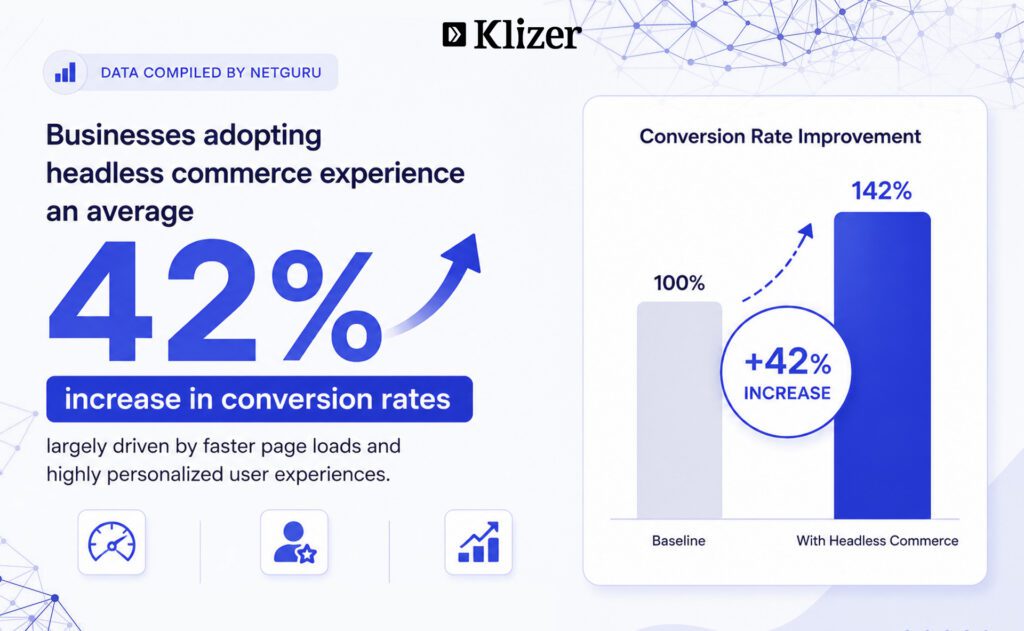
- Blazing-Fast Loading Speeds: Lightweight front-end layouts separate from heavy databases to load your pages instantly.
- Complete Design Freedom: Front-end developers build completely custom shopping experiences without any platform template restrictions.
- Effortless Omnichannel Selling: One back-end database seamlessly pushes products to websites, mobile apps, and smart devices.
- Rapid Marketing Agility: Teams launch fresh promotions and layout changes instantly without risking a backend site crash.
- Easy Tool Integration: You connect the absolute best checkout, search, and marketing tools directly via APIs.
Cons of Headless Commerce
- Higher Initial Cost: Building two separate digital systems requires a larger upfront financial investment than traditional platforms.
- Increased Management Complexity: Your team must monitor, maintain, and secure multiple separate software pieces instead of just one.
- Heavy Developer Dependence: Non-technical marketing teams cannot easily change site layouts without relying on front-end developers.
- No Native Preview Tools: Marketers often lose the ability to see live page previews before hitting the publish button.
- Delayed Time-to-Market: Designing and connecting a custom headless store takes significantly longer than launching a pre-built template.
Read More: What is Headless Commerce? Complete Guide for Businesses
What is Composable Commerce?
Composable commerce is an ecommerce design approach where you build your online store using interchangeable, plug-and-play software components. Instead of buying one massive, rigid software package from a single vendor that handles your entire store, you select individual, specialized apps for different tasks like one for your search bar, one for your checkout, and another for your product reviews and stitch them together into a custom system.
The key distinction in composable commerce vs headless commerce is that composable commerce not only decouples the front end but also emphasizes integrating the whole commerce stack from independent best-of-breed solutions.
Core Components of Composable Commerce
- PBCs (Packaged Business Capabilities): These are modular, business-oriented components, such as checkout, search, or promotions. Each PBC has its own function and is independent.
- APIs: APIs connect all components and help communication across systems. In composable commerce, they are useful in connecting services beyond just the frontend and backend.
- Microservices: Each function of the composable architecture runs as a separate microservice. This provides for better scalability, flexibility, and deployment speed.
- Cloud Infrastructure: Cloud-native workloads use aspects of the cloud such as scalability, resilience, and global performance. There are no infrastructure constraints, and businesses can scale their services on demand.
How Does Composable Commerce Work?
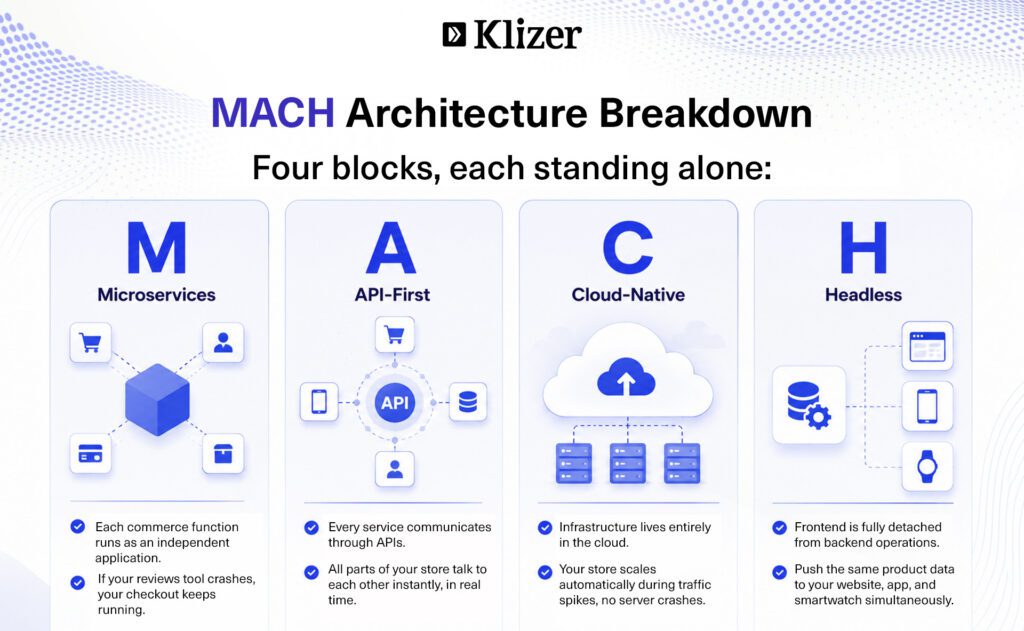
Composable commerce brings plug-and-play freedom to your website using a framework called MACH architecture:
- M- Microservices: It breaks your store down into independent applications (like separate tools for checkout, search, and reviews). If your reviews tool crashes, your checkout still runs perfectly because they do not share structural code.
- A- API-First: These individual applications communicate instantly through APIs, which act as high-speed digital translators passing data back and forth in milliseconds.
- C- Cloud-Native: The entire system lives in the cloud, which automatically scales up to handle massive holiday traffic spikes without risking server crashes.
- H- Headless: The front-end design layer stays completely detached from back-end operations, letting you push identical product data to websites, mobile apps, or smartwatches simultaneously.
Pros of Composable Commerce
- Full-stack flexibility: Every commerce layer, like checkout, search, CMS, and pricing, is independently selectable. IKEA runs separate best-of-breed tools for each function across its global retail ecosystem without being locked into a single platform’s roadmap.
- Faster feature deployment: Teams update individual components without touching the rest of the system. Businesses adopting modular setups report an average 27% faster time-to-market for new features, according to the Alokai Composable Commerce Trends Report.
- No vendor lock-in: Underperforming tools get swapped without rebuilding the entire stack. Each service is independently replaceable, which gives procurement teams real negotiating leverage.
- Enterprise-grade scalability: Cloud-native infrastructure scales individual services on demand. During peak traffic, only the components under load need to scale, not the entire platform.
Cons of Composable Commerce
- High governance overhead: Managing multiple vendor contracts, SLAs, and integration dependencies simultaneously adds operational complexity that a single-platform setup does not.
- API sprawl is a real risk: As the number of connected services grows, maintaining clean API contracts and preventing integration failures requires dedicated engineering attention. This is one of the most common post-launch pain points.
- Specialist team dependency: Composable architecture requires engineers with API, DevOps, and microservices expertise. Most in-house ecommerce teams are not staffed for this at the outset.
- High upfront investment: Design, testing, and assembly of a composable stack demands significantly more time and budget than a SaaS platform launch, with costs that are often underestimated in the planning phase.
Headless Commerce vs Composable Commerce: Quick Comparison
| Feature | Headless Commerce | Composable Commerce |
| Architecture | Decoupled frontend and backend | Fully modular, microservices-based architecture |
| Frontend Flexibility | High frontend flexibility | Extremely high flexibility across entire stack |
| Backend Structure | Centralized commerce backend | Distributed, independent services (PBCs) |
| Customization Level | Limited to frontend and APIs | End-to-end customization across all components |
| Scalability | Scales frontend easily | Scales entire ecosystem independently |
| Time to Market | Faster for frontend updates | Faster for continuous innovation and upgrades |
| Cost | Moderate initial cost | Higher initial investment |
| Best For | Mid-market and D2C brands | Large enterprises and complex ecosystems |
| Technology Stack | Fixed backend, flexible frontend | Fully flexible, best-of-breed stack |
| APIs Usage | Connect frontend and backend | Connect multiple services and systems |
| Business Agility | Moderate agility | High business agility |
| Vendor Lock-in | Partial dependency on backend vendor | Minimal to no vendor lock-in |
| Implementation Complexity | Moderate complexity | High complexity and requires expertise |
Real-World Examples of Headless Commerce
- Google: Google Cloud partners with Commercetools to deliver a powerful headless commerce solution. Their API-first platform enables omnichannel commerce, a microservices architecture, and easy integrations. This partnership offers SDK tools that support PHP, JavaScript, and Java, while enabling scalable shopping experiences through APIs.
- Amazon: Amazon implements a headless architecture supported by AWS to operate on eCommerce on a large scale and flexibly. Its API-first structure allows it to quickly adapt, offer features like fraud detection and easily integrate with other services.
- Microsoft: Microsoft Dynamics 365 Commerce offers a headless solution through its Commerce Scale Unit. This architecture supports omnichannel experiences, flexible hosting options, and easy integration with third-party services.
Real-World Examples of Composable Commerce
- Miko: Miko applies composable commerce through AI functionality to provide deeply personalized shopping experiences. Its platform utilizes real-time analytics and machine learning to provide personalized recommendations and dynamic content tuned to the customer, improving customer engagement.
- Jollyes: Jollyes has adopted composable commerce to integrate its digital and physical operations. Its modular ecosystem includes inventory management, CRM, and omnichannel functionalities, allowing merchants to provide consistent and efficient experiences at all customer touchpoints.
- IKEA: IKEA leverages composable commerce as part of its multi-channel, international retail ecosystem. With best-of-breed solutions, IKEA enables a unified shopping experience across web, mobile, and in-store while retaining the ability to easily scale and innovate across geographies.
Read More: Headless Commerce for Scalable B2B with Shopware
Common Mistakes Businesses Make During Migration
- Mistake #1: Going composable too early
Many mid-market companies adopt composable commerce because it sounds future-proof, only to discover they lack the internal API and DevOps resources required to maintain it. The architecture is enterprise-grade by design. Without the team to match, it becomes a liability. - Mistake #2: Treating headless as a performance fix
Headless improves frontend flexibility but does not automatically solve backend bottlenecks, poor catalog structure, or ERP integration issues. Merchants who migrate expecting speed gains without addressing the underlying data layer are often disappointed post-launch. - Mistake #3: Underestimating legacy system compatibility
Most B2B and mid-market merchants run ERPs, PIMs, or OMS tools that were never built with API-first architecture in mind. Forcing a legacy system into a headless or composable stack without a proper integration layer creates data sync failures, performance issues, and ongoing maintenance overhead. - Mistake #4: Skipping data migration planning
Merchants focus on the storefront and treat data migration as an afterthought. In practice, migrating product data, customer records, and order history securely and without loss is one of the highest-risk phases of any replatforming project. - Mistake #5: Assuming one team can own everything
Headless and composable architectures split responsibilities across frontend, backend, API, DevOps, and vendor management. Companies that assign the entire migration to a single development team without clear ownership boundaries consistently run into coordination failures and delayed launches.
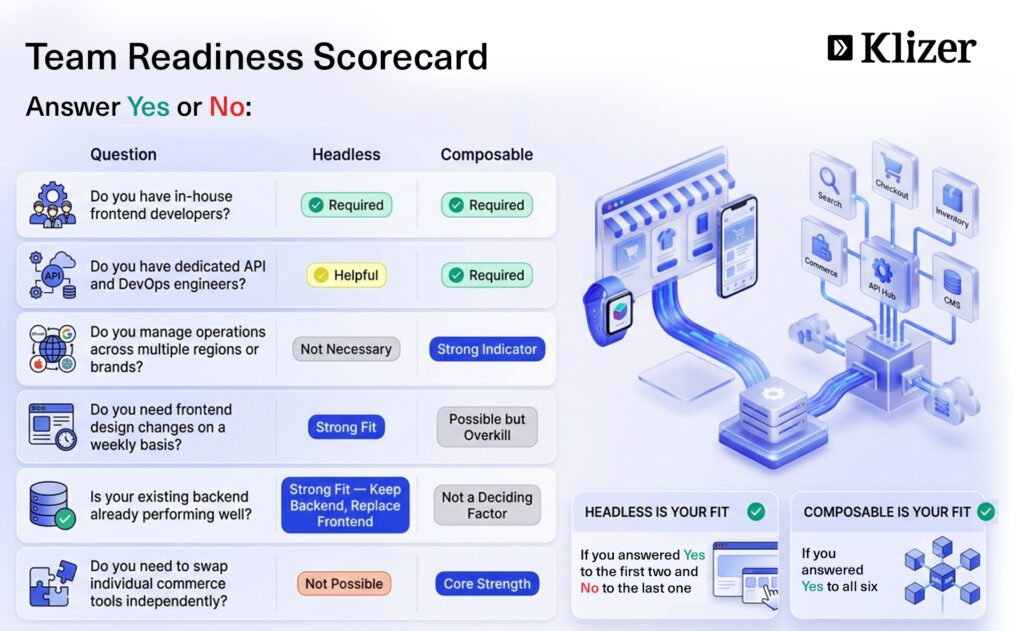
Composable vs Headless Commerce: Which One Should You Choose?
Choose Headless Commerce If:
- You have limited architecture transformation goals
- You need strong frontend flexibility
- Your existing backend systems already perform well
- You want faster UI/UX updates without backend changes
- You aim to improve omnichannel experiences quickly
- You are a mid-market brand or run a D2C (direct-to-consumer) business
- You focus on content-heavy commerce experiences
- You want to modernize the frontend without rebuilding the backend
Choose Composable Commerce If:
- You operate at an enterprise scale
- You manage multiple business models or brands
- You need rapid innovation and continuous upgrades
- You prioritize long-term scalability and flexibility
- You want full control over your commerce ecosystem
- You manage multi-brand or multi-region operations
- You operate as a global retailer
- You require high business agility and modular architecture
Decision Matrix
| Business Requirement | Recommended Approach |
| Faster website redesigns | Headless commerce |
| Omnichannel selling | Headless commerce |
| Enterprise customization | Composable commerce |
| Lower implementation complexity | Headless commerce |
| Future-proof architecture | Composable commerce |
Not sure which architecture fits your business?
Most businesses choose wrong because they optimize for technology, not operations. Get a free audit from Klizer’s commerce experts, and walk away with a clear answer backed by your actual stack, team size, and growth goals.
The Key Takeaway
When it comes to composable commerce vs headless commerce, both architectures address modern digital commerce needs but serve different priorities.
For most manufacturers and distributors, headless commerce development is often the right first modernization step. It preserves existing ERP and commerce investments while improving the customer-facing experience without a full infrastructure rebuild. Composable becomes relevant when multiple business units, brands, or channels require independent technology stacks that cannot share a single backend.
The decision is less about which architecture is better and more about where your business is in its digital maturity. Headless is a focused upgrade. Composable is a platform strategy.
At Klizer, we specialize in helping enterprise brands break free from legacy limitations. Whether you want to launch a headless storefront using Shopify Plus, BigCommerce, or Adobe Commerce, or construct a fully composable MACH ecosystem from scratch, our expert development teams build stable, future-proof frameworks that drive conversion rates and scale with your business.
Ready to build your headless or composable storefront? Talk to a Headless Commerce Expert at Klizer today.
Frequently Asked Questions
Q1. How does testing differ in headless and composable architectures?
Headless testing is focused on frontend/backend testing, whereas composable commerce necessitates tests across multiple services and integrations.
Q2. Which model offers better disaster recovery capabilities?
Composable systems allow for improved resiliency by breaking down failures into independent services.
Q3. How do these architectures impact DevOps practices?
Composable architecture demands sophisticated DevOps, while headless requires basic DevOps.
Q4. Can composable commerce reduce technical debt over time?
Yes, modular parts enable businesses to substitute antiquated parts without having to rebuild the entire system.
Q5. What role does cloud strategy play in these architectures?
Cloud facilitates scalability and flexibility, especially for modular and distributed systems.